
May 7, 2026
When a Single Bridge Becomes the Weakest Link in Global Uranium Supply
Remote mining operations have always carried a logistical paradox at their core. The very geological conditions that concentrate high-value mineral deposits, deep within ancient shield terrains and subarctic basins, are the same conditions that make those deposits extraordinarily difficult and expensive to service. Northern Saskatchewan's Athabasca Basin is perhaps the clearest expression of this paradox anywhere in the world. It hosts uranium ore of unmatched grade, yet it sits at the end of infrastructure networks so thin that a single failure point can cascade rapidly into a global supply story.
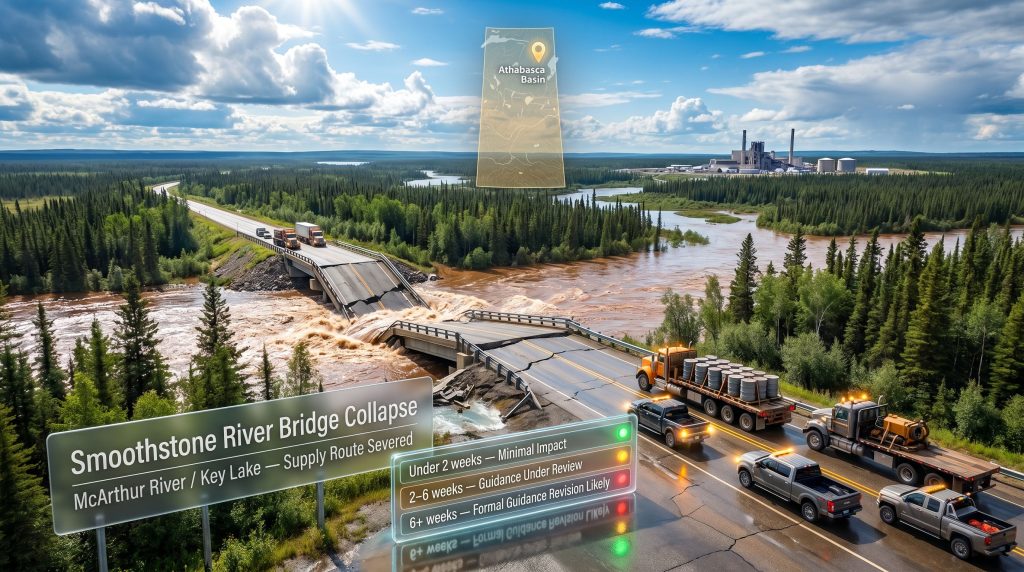
That is precisely what has unfolded in May 2026, when the Cameco northern Saskatchewan flooding production halt became the dominant operational story across the uranium sector, triggered by seasonal flooding that caused the collapse of the Smoothstone River bridge, cutting off the primary supply artery to two of Cameco's most strategically significant operations.
When big ASX news breaks, our subscribers know first
The Infrastructure Failure Driving the Cameco Northern Saskatchewan Flooding Production Halt
Why One Bridge Controls Two World-Class Operations
The Smoothstone River bridge is not a minor access track. It is the primary road corridor used to deliver critical operating materials to both the McArthur River mine and the Key Lake mill. When flooding caused the structure to fail, it did not merely complicate logistics. It severed the supply chain entirely for two operations that function as a single integrated production unit.
What makes this particularly significant is the distinction between the type of disruption and what most observers initially assume when they hear the phrase "flooding at a mine." The physical mine and mill infrastructure at both McArthur River and Key Lake have not been inundated by floodwaters. The sites themselves remain structurally intact. The vulnerability is not geological. It is logistical.
"The disruption is entirely infrastructure-driven. Flood waters have not reached Cameco's mine or mill sites. The damage is to the road network that connects those sites to the outside world, a distinction with significant implications for how quickly operations could resume once the bridge is repaired or replaced."
An alternative roadway does exist, but restrictions are currently in place that prevent it from serving as a full substitute for the collapsed primary route. Cameco has confirmed it is in ongoing communication with the Saskatchewan Ministry of Highways and is working with on-site teams to reduce the impact of delivery interruptions as much as possible.
Key Lake Mill: The Processing Bottleneck at the Centre of the Problem
Understanding why a road collapse can halt uranium production requires understanding how the McArthur River and Key Lake operations work together.
McArthur River is widely recognised as the highest-grade uranium mine on Earth. The ore extracted there cannot simply be stockpiled indefinitely awaiting alternative logistics. It must be processed, and that processing happens exclusively at the Key Lake mill, located separately but operationally connected via the same supply corridor.
The relationship between these two sites means that when Key Lake cannot receive critical operating materials — including reagents, fuel, maintenance supplies, and personnel rotation capacity — the entire production chain stalls. Key Lake has been placed in a full production halt. McArthur River has reduced its activity levels accordingly.
This is not a partial inconvenience. For the duration of the road restriction, the integrated McArthur River/Key Lake operation is effectively suspended.
Cigar Lake: The Operational Counterweight Holding Cameco's Plan Together
One critical stabilising factor in this disruption is that Cameco's third major Saskatchewan operation, the Cigar Lake mine, is continuing normal operations. Cigar Lake relies on a separate supply route that has not been affected by the Smoothstone River bridge collapse, meaning its production contribution remains intact.
This matters substantially for how the market should interpret Cameco's 2026 production position. The company has stated that its consolidated annual production plan remains unchanged at this stage, a position that is only credible because Cigar Lake is still running. Cigar Lake is itself one of the world's most significant uranium producers, and its uninterrupted output provides a meaningful buffer against the McArthur River/Key Lake suspension.
However, there is a ceiling on how much Cigar Lake can compensate. McArthur River/Key Lake is responsible for a substantial portion of Cameco's total annual output. If the road restriction persists beyond a certain threshold, the arithmetic becomes increasingly difficult to manage within existing guidance.
Historical Context: Water-Related Disruptions in the Athabasca Basin Are Not New
The 2006 Cigar Lake Underground Flooding Event
The Athabasca Basin has a documented history of water-related production disruptions, and the 2006 underground flooding at Cigar Lake remains the most consequential example in modern uranium mining history. A rockfall triggered an uncontrolled inflow of water into the mine workings, ultimately flooding the entire underground operation and forcing a full shutdown.
What followed was one of the most complex dewatering and remediation projects ever undertaken in Canadian hard rock mining. The restoration process took the better part of five years before Cigar Lake returned to meaningful production capacity. During that period, global uranium supply was materially tightened, and spot prices responded dramatically, reaching historic highs in 2007 before correcting.
The 2006 event revealed two things of lasting importance. First, the Athabasca Basin's geological water environment is deeply challenging, with ore bodies sitting below and adjacent to significant water-bearing formations. Second, when major Canadian uranium production is disrupted, spot markets react sharply — a dynamic that remains highly relevant to understanding current uranium supply-demand volatility.
Prior Flooding-Related Road Disruption at McArthur River
Less widely discussed but relevant to assessing the current situation is the fact that McArthur River has previously experienced a flooding-related access restriction that delayed production for at least two months. This is not a once-in-a-generation event. It is a recurring vulnerability built into the geography of northern Saskatchewan mining.
The absence of redundant supply infrastructure connecting these sites is a structural gap that has persisted for decades. Building alternative all-season road corridors, expanding airstrip capacity, or developing rail feasibility studies in subarctic terrain carries extraordinary cost. However, as climate-related hydrological events become more frequent and severe across northern Canada, the calculus is shifting considerably.
| Event | Site Affected | Year | Root Cause | Approximate Duration |
|---|---|---|---|---|
| Underground rockfall flood | Cigar Lake | 2006 | Geological water inflow | Approx. 5 years to full restoration |
| Road access restriction | McArthur River | Prior to 2026 | Flooding-related road damage | At least 2 months |
| Bridge collapse / supply route failure | McArthur River / Key Lake | 2026 | Smoothstone River flooding | Timeline currently unknown |
What Cameco's Response Reveals About Operational Risk Management
Inventory Buffers and the Critical Materials Question
One of the least-discussed but most important variables in assessing how long operations can sustain reduced activity is the on-site inventory of critical materials. Mining operations in remote locations typically carry buffer stocks of essential consumables precisely because supply chain disruptions are a foreseeable risk in these environments.
The question of how deep those stockpiles are at McArthur River and Key Lake as of the disruption date is not publicly disclosed. Furthermore, it is the single most important operational variable that will determine whether this is a two-week inconvenience or a multi-month production event — one that could meaningfully influence broader uranium market dynamics for the remainder of 2026.
Air Freight as a Contingency: Feasible but Costly
Northern Saskatchewan's mining corridor does have airstrip infrastructure servicing remote operations, and Cameco has the operational scale to activate air freight logistics for critical supplies if road access remains compromised for an extended period. This is not a theoretical option. It is a real contingency used by remote mining operators across Canada's north.
The practical constraint is cost. Air freight in subarctic regions carries a significant premium over road transport, and the volume of materials required to keep a major uranium processing mill operational is substantial. Activating air logistics as a primary supply channel would compress margins materially and may not be economically sustainable beyond a limited timeframe.
Scenario Analysis: How Duration Determines Market Impact
The central variable driving all downstream analysis — whether operational, financial, or market-related — is timeline. Cameco has been explicit that no resumption date is currently known, and that the path forward depends on the Saskatchewan Ministry of Highways' ability to repair or replace the Smoothstone River bridge and lift restrictions on the alternative route.
| Disruption Scenario | Approximate Duration | Likely Impact on 2026 Guidance | Market Sensitivity |
|---|---|---|---|
| Short-term resolution | Under 2 weeks | Minimal, recoverable within annual plan | Low |
| Medium-term disruption | 2 to 6 weeks | Partial reduction, guidance under review | Moderate |
| Extended disruption | 6 weeks or more | Formal guidance revision likely | High, potential spot price reaction |
Canada is one of the world's top two uranium-producing nations alongside Kazakhstan uranium dominance, and Cameco is the single largest Western uranium producer by volume. When Canadian supply is disrupted, spot markets have historically demonstrated sensitivity, particularly in an environment where long-term contracting activity has tightened the available pool of uncommitted production.
The current uranium market context amplifies this sensitivity. Utility buyers have been progressively rebuilding long-term contract coverage following a decade of under-contracting after Fukushima. Supply tightness in the primary market means that unexpected production shortfalls from a tier-one producer like Cameco carry more weight than they would in a well-supplied market. Consequently, uranium market trends heading into the second half of 2026 will be closely shaped by how this situation resolves.
The Broader Infrastructure Risk Picture for Northern Canadian Mining
Single-Route Supply Chains as a Systemic Vulnerability
The Smoothstone River bridge collapse is a specific event, but it reflects a systemic vulnerability that extends across the northern Canadian mining sector. Many operations in Saskatchewan, Manitoba, and the Northwest Territories rely on one or two road corridors for virtually all material deliveries. The economics of building redundant infrastructure in remote subarctic environments have historically been prohibitive.
What is changing is the risk profile of those single routes. Climate scientists have documented increasing precipitation variability and intensifying spring flood events across northern Saskatchewan and the broader boreal zone. Freeze-thaw cycles are shifting, reducing the seasonal stability that historically made winter roads viable. Infrastructure that was engineered to historical weather parameters is increasingly being tested by conditions outside its design envelope.
What the 2026 Event Should Prompt for Long-Term Planning
For Cameco and the broader Athabasca Basin mining community, the Smoothstone River bridge collapse serves as a concrete argument for reassessing infrastructure investment priorities. In addition, understanding global uranium reserves and their geographic concentration makes clear just how costly unplanned halts at tier-one operations can be for global supply. The options on the table are not simple or cheap, but they are quantifiable against the cost of unplanned production halts at operations of this scale and grade.
Potential areas for investigation include:
- All-season road redundancy: A secondary permanent route that does not share hydrological exposure with the primary corridor
- Expanded airstrip capacity: Upgrading facilities to handle heavier freight loads as a credible logistics backup
- Strategic material pre-positioning: Increasing on-site buffer stocks of critical consumables before peak flood season each year
- Bridge engineering standards review: Assessing whether existing watercourse crossings in the region are engineered to accommodate increased flood frequency and peak flow events
The next major ASX story will hit our subscribers first
Key Monitoring Points for Investors and Industry Observers
As this situation evolves, the following variables will determine whether the Cameco northern Saskatchewan flooding production halt remains a minor operational footnote or escalates into a material guidance event. Analysts covering the sector are closely tracking each of these indicators:
- Bridge repair or replacement timeline: The primary determinant of everything downstream
- Cigar Lake output continuity: Any disruption to Cigar Lake would fundamentally change the production arithmetic
- Saskatchewan Ministry of Highways updates: Provincial infrastructure communications will likely precede any formal Cameco operational statement
- Alternative logistics activation: If Cameco confirms air freight or other contingency supply arrangements, it signals a longer disruption horizon
- On-site inventory disclosures: Any guidance from Cameco on how long existing stockpiles can sustain reduced operations
- Formal guidance revision: A revision to McArthur River/Key Lake 2026 production targets would be the clearest indication that the disruption has crossed a material threshold
Disclaimer: This article contains forward-looking scenario analysis and market commentary based on publicly available information. It does not constitute financial advice. Investors should conduct their own due diligence and consult qualified financial advisers before making investment decisions. Production timelines, guidance positions, and market dynamics referenced are subject to change.
Frequently Asked Questions: Cameco Northern Saskatchewan Flooding and Production Halt
Are Cameco's mine and mill sites physically flooded?
No. The McArthur River mine and Key Lake mill have not been reached by floodwaters. The disruption is caused entirely by the collapse of the Smoothstone River bridge, which serves as the primary road for delivering critical operating supplies to both sites.
Which Cameco operations are still running normally?
Cigar Lake mine is continuing normal operations. Its supply route is independent of the Smoothstone River bridge and has not been affected by the flooding event.
Has Cameco changed its 2026 production guidance?
As of the May 2026 announcement, Cameco's consolidated annual production plan remains unchanged. However, the company has flagged that a prolonged road restriction carries a risk of impacting McArthur River/Key Lake output targets for the year.
Why does the Key Lake mill matter so much to the McArthur River mine?
McArthur River ore is processed exclusively at the Key Lake mill. The two sites operate as a single integrated production unit. A halt at Key Lake effectively suspends the entire McArthur River production chain regardless of conditions at the mine itself.
Has this type of disruption happened before at these operations?
Yes. A prior flooding-related access restriction previously affected McArthur River operations for at least two months. The 2006 Cigar Lake underground flooding event, while structurally different in cause, remains the most significant historical precedent for water-related production disruption in the Athabasca Basin.
When will normal deliveries resume?
No timeline has been provided. Resumption depends on the repair or replacement of the Smoothstone River bridge and the lifting of restrictions on the alternative roadway, both subject to the Saskatchewan Ministry of Highways' assessment and repair schedule.
Want to Know When Major Uranium Discoveries Hit the ASX First?
Discovery Alert's proprietary Discovery IQ model delivers real-time alerts the moment significant mineral discoveries — including uranium — are announced on the ASX, giving subscribers an immediate edge in identifying actionable opportunities before the broader market reacts. Explore historic discovery returns on Discovery Alert's dedicated discoveries page and begin a 14-day free trial to position yourself ahead of the next major market-moving announcement.