
August 25, 2026
The Hidden Complexity Inside a US$2 Billion Mine Finance Stack
Large-scale mine development rarely fails on geology. It fails on sequencing. The gap between a technically viable resource and a shovel in the ground is filled with interdependent financing instruments, procurement timelines, regulatory milestones, and calendar constraints that each carry their own logic, their own deadlines, and their own failure modes. Understanding any one of these layers in isolation produces an incomplete picture. Understanding how they interact is what separates informed capital allocation from headline-driven speculation.
The Canada Nickel Crawford project financing story is, at its core, a sequencing problem wrapped inside a capital architecture problem. The project requires approximately US$2 billion in total funding. That number is large but manageable. What is considerably more complex is the order of operations required to close each layer, the interdependencies between them, and the hard external deadlines that no amount of financing sophistication can override.
When big ASX news breaks, our subscribers know first
Why Conventional Mine Finance Cannot Scale to Crawford
The Structural Limits of Traditional Project Finance
The standard mine development financing model works adequately for projects in the US$200 million to US$500 million range. A company raises equity, secures a senior debt facility from a commercial bank syndicate, and proceeds to construction. The equity dilution is painful but manageable. The bank syndicate's risk appetite covers the debt quantum. Offtake agreements provide revenue visibility.
Crawford does not fit this model. At roughly US$2 billion, the capital requirement exceeds what any single commercial bank facility or equity raise can practically cover without catastrophic dilution to existing shareholders. A project of this scale demands a multi-instrument architecture, and that architecture introduces its own complexity: each layer has different risk criteria, different tenor requirements, different counterparty relationships, and different timing constraints that must be coordinated simultaneously.
What Non-Dilutive Architecture Actually Means in Practice
The term non-dilutive is frequently used loosely in mining finance. At Crawford, it refers to a deliberate strategy of maximising capital sources that do not require issuing new common equity at the project company level. The practical tools available are:
- Export credit agency debt at sovereign-backed terms, which carries no equity dilution
- Refundable investment tax credit monetization, which converts a deferred government incentive into front-loaded construction capital without share issuance
- Strategic partner equity, which brings in capital at the project level rather than the corporate level, limiting dilution to the corporate shareholder base
- Structured offtake financing, which monetizes future revenue streams rather than present equity value
Each of these instruments serves a different function in the capital stack, and none of them is interchangeable with the others. Furthermore, understanding how each layer interacts with the others is essential to reading Crawford's financing timeline correctly.
Crawford's Full Capital Stack: What Each Layer Does
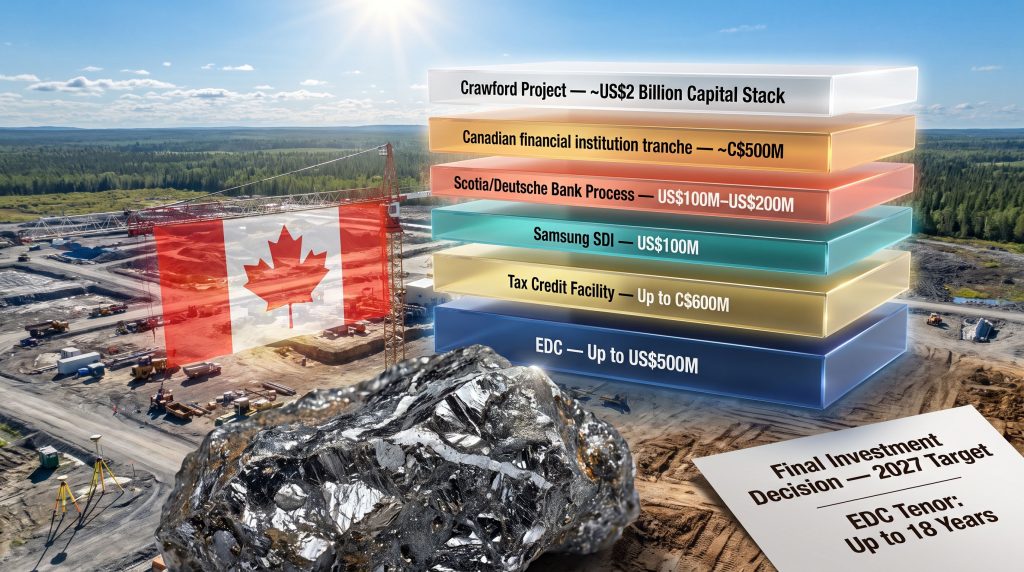
The table below maps every financing layer currently in play for the Crawford project, alongside its current status as of August 2026:
| Financing Layer | Instrument Type | Quantum | Status |
|---|---|---|---|
| Export Development Canada (EDC) | Long-term project debt | Up to US$500M | Letter of Interest secured; term sheet pending |
| Refundable Investment Tax Credits | Tax-credit monetization facility | Up to C$600M | SB1 Markets mandated; facility targeted by end-2026 |
| Samsung SDI | Strategic equity / offtake-linked capital | US$100M | Committed |
| Canadian Financial Institution | Structured equity or debt | ~C$500M | Terms evolving |
| Scotia / Deutsche Bank Process | Project equity or structured offtake | US$100M–US$200M | Active process underway |
| Critical Minerals Infrastructure Fund | Public-sector grant support | Up to C$6.8M | Announced for electrification studies |
| August 2026 Private Placement | Working capital / bridge equity | Up to C$21M | Closed on or around August 28, 2026 |
This is not a single transaction. It is a deliberately layered capital structure in which each instrument anchors the next. Export credit agency participation reduces perceived risk for commercial co-lenders. Tax credit monetization reduces the equity quantum required. Strategic partner capital validates project economics for institutional debt providers. The sequencing is intentional and consequential.
Export Development Canada: What a US$500 Million Sovereign Mandate Signals
From Letter of Interest to Term Sheet
EDC's letter of interest for up to US$500 million with a tenor of up to 18 years represents one of the largest export credit commitments publicly associated with a Canadian critical minerals demand project. It is important to distinguish what a letter of interest is and what it is not: it is an expression of intent to lend subject to due diligence and final terms, not a binding commitment. The binding step is a term sheet, and that is the next concrete milestone on the debt side of Crawford's financing sequence.
The significance of EDC's involvement extends beyond the quantum. Export credit agency participation fundamentally reshapes the risk profile presented to commercial co-lenders. When a sovereign-backed institution with EDC's mandate and balance sheet is in the capital stack, it signals to other debt providers that the project has passed a meaningful level of institutional scrutiny. That validation effect is worth as much to the financing process as the capital itself.
The Co-Lender Effect
Canada Nickel has also described approximately four years of parallel dialogue with other global export credit agencies, which are expected to layer into the debt stack behind EDC's involvement once the term sheet is executed. This creates a potential cascade effect: EDC's binding commitment de-risks the position for peer agencies, which in turn de-risks the position for commercial banks. Understanding this cascade is critical to reading the financing timeline correctly. The EDC term sheet is not just one milestone among many. It is the keystone that unlocks downstream institutional capital.
Tax Credit Monetization: The Least Understood Lever in Crawford's Stack
How Refundable Tax Credits Normally Work, and Why That Creates a Problem
In conventional project finance, refundable investment tax credits are claimed after construction expenditure has already occurred. A company spends capital, files its claim, and receives the credit back on a lag that can extend many months or longer. This creates a fundamental cash flow sequencing problem: you need the capital to do the spending before you can claim the credit for doing the spending.
Canada Nickel's approach, through its mandate with SB1 Markets, is designed to break this circularity. The facility would allow the company to draw against up to C$600 million in refundable credits upfront, effectively converting what is normally a deferred benefit into a front-loaded capital source available during the construction window itself.
Comparing Capital Approaches: Dilution vs. Monetization
| Approach | Dilution Risk | Capital Availability | Timing Dependency |
|---|---|---|---|
| Traditional equity raise | High | Immediate | Market-dependent |
| Tax credit monetization (upfront) | Minimal | Large quantum | Policy / facility-dependent |
| Strategic partner capital | Low | Targeted | Negotiation-dependent |
| Export credit agency debt | None | Long-tenor | Due diligence-dependent |
The SB1 Markets mandate was signed approximately two months before August 2026, with the facility arrangement targeted for completion by end-2026. That timing is not arbitrary. The facility needs to be structured and agreed before the Final Investment Decision, which is currently targeted for 2027, so that the tax credit draw can be incorporated into the construction funding model from the outset.
Strategic Partner Capital: Samsung, Scotia, Deutsche Bank, and What Each Represents
Samsung SDI's US$100 Million Commitment
Samsung SDI's US$100 million commitment is the first major strategic partner capital secured for Crawford. Structured as a combination of project interest and offtake-linked financing, it carries significance beyond the dollar quantum. Battery manufacturers committing equity-linked capital to upstream supply projects represents a structural shift in how battery metals investment supply chains are being financed globally. When a major cell manufacturer places capital upstream, it is not simply investing. It is securing future supply certainty, which is a fundamentally different risk appetite than a financial investor's return-driven mandate.
The Scotia and Deutsche Bank Process
An active process with Scotia and Deutsche Bank is targeting a further US$100 million to US$200 million, structured as either a sale of an additional 10% to 20% project interest or as a structured offtake financing arrangement. The distinction between these two structures matters considerably for Canada Nickel's long-term economics.
- A project equity sale at 10% to 20% permanently dilutes Canada Nickel's share of future Crawford cash flows, but delivers capital without revenue strings attached
- A structured offtake financing preserves ownership but commits future production at potentially predetermined pricing terms, which can constrain upside capture if nickel markets strengthen materially during Crawford's operating life
The choice between these two structures is not merely a financing preference. It is a fundamental decision about where Canada Nickel captures long-term value, and investors should track the outcome of this process closely.
Why Generalist Investor Engagement Is an Independent Signal
Canada Nickel CEO Mark Selby has noted publicly that the volume of meetings with generalist institutional investors in the nine months prior to August 2026 exceeded the total accumulated across the six preceding years combined. This data point is analytically significant for reasons that go beyond simple demand validation.
Generalist investors — meaning those not specialised in resources or critical minerals — typically engage with a project only when it has crossed a threshold of perceived de-risking. Their arrival signals that Crawford is being evaluated as a mainstream infrastructure-scale investment rather than a speculative mining play. Historically, the migration of generalist capital into large mining projects precedes major financing closes, because generalists tend to engage precisely when the probability of project execution has risen to a level their mandates can accommodate.
The next major ASX story will hit our subscribers first
The Operational Constraints That Financing Cannot Override
Long-Lead Equipment: Why Orders Cannot Wait for Financial Close
Large-scale mining projects require specialised equipment with manufacturing and delivery lead times that routinely extend 18 to 36 months. Crushers, mills, hoisting systems, and processing plant components are not shelf items. They are manufactured to specification, and the queue for that manufacturing capacity is competitive.
Canada Nickel has begun placing long-lead equipment orders now, funded from the C$21 million placement, specifically to decouple delivery risk from the formal Final Investment Decision timeline. If equipment orders wait until financing closes, delivery windows push out by the length of that wait, which could delay construction start regardless of how efficiently the financing process concludes.
The Engineering Ramp: Why Hundreds of Thousands of Hours Cannot Be Compressed
Detailed engineering for a project of Crawford's scale involves accumulating hundreds of thousands of work hours across disciplines ranging from geotechnical to process design to infrastructure. This workload cannot be compressed into a short pre-construction sprint for a straightforward reason: early-stage rework is catastrophic to construction schedules.
Engineering disciplines are interdependent. Process design outputs feed into structural design. Structural design feeds into procurement specifications. Procurement specifications feed into supplier selection. Compressing this sequence forces downstream decisions before upstream inputs are finalised, generating the rework that blows out both timelines and budgets. The multi-year engineering ramp is therefore not a preference. It is a technical necessity.
Abitibi's Seasonal Window: The Binary Calendar Risk
The Abitibi region of Ontario operates within a defined construction season. Missing a fourth-quarter construction start in any given year effectively pushes the groundbreaking date to the same quarter of the following year. This is not a soft deadline. It is a binary calendar constraint with a 12-month penalty for a miss.
This constraint makes the convergence of financing, procurement, and engineering readiness a time-critical problem. All three workstreams must reach sufficient completion before that seasonal window opens. A delay in any one of them that pushes preparation past the Q4 threshold does not result in a Q1 start. It results in a Q4 start one year later.
The C$21 Million Private Placement: Bridge Capital With Precision Allocation
Structure and Terms
The August 2026 private placement, upsized from C$15 million to C$21 million following strong investor demand, carries the following terms:
- Unit price: C$1.50 per unit
- Unit composition: One common share plus one-half of one common share purchase warrant
- Warrant exercise price: C$2.25 per whole warrant
- Warrant term: 36 months from closing
- Offering size: Up to 14,000,000 units
- Close date: On or around August 28, 2026, subject to TSXV approval
The placement pricing above prevailing market levels at announcement is analytically notable. Placements priced at discounts to market are common in junior mining. Placements priced above market reflect genuine investor conviction that the current share price undervalues near-term catalysts, which in Crawford's case are the financing milestones described throughout this article.
Precise Use of Proceeds
- Permitting and engineering activities sustaining the detailed engineering ramp and regulatory workstreams running parallel to the financing sequence
- Repayment of outstanding indebtedness cleaning up the balance sheet ahead of the formal debt stack
- Working capital and general corporate purposes maintaining operational continuity through the financing close
This raise is explicitly a bridge instrument. It funds the critical path between now and the closing of the larger capital stack, not a substitute for it.
Milestone Sequencing: What Investors Should Be Tracking Through 2026 and 2027
| Milestone | Category | Significance | Timing |
|---|---|---|---|
| EDC term sheet execution | Debt | Converts LOI to binding commitment; unlocks co-lender cascade | Next concrete debt checkpoint |
| SB1 Markets tax credit facility close | Equity-equivalent | Enables upfront C$600M credit draw | Targeted end-2026 |
| Scotia / Deutsche Bank process outcome | Strategic equity | Adds US$100M–US$200M; determines ownership structure | Active |
| Private placement formal close | Bridge capital | Funds procurement and engineering ramp | ~August 28, 2026 |
| Long-lead equipment order confirmation | Procurement | Decouples delivery risk from FID | Underway |
| Fourth-quarter Abitibi construction window | Construction | Binary seasonal deadline | Q4 target year |
| Final Investment Decision | Project | Formal commitment to full construction | 2027 target |
What Crawford's Capital Architecture Reveals About Critical Minerals Finance
A Template for Tier-1 Project Finance in the Current Cycle
Crawford's financing architecture is notable not just for its scale but for the instruments it combines. Tax credit monetization at this quantum, export credit agency debt at 18-year tenor, and strategic battery manufacturer equity in the same capital stack represents a configuration that has not commonly appeared in Canadian mining finance before.
The broader significance is that this multi-instrument approach may represent an emerging template for how large, capital-intensive critical minerals projects in stable jurisdictions get financed in the current cycle. The combination of policy-created incentive structures, energy transition demand signals, and sovereign lender appetite has created an environment where these instruments are simultaneously available at meaningful scale for the first time. The Canada Nickel Crawford project financing model, consequently, could define how comparable projects are structured for years to come.
The Role of Export Credit Agencies in Anchoring Mine Finance
Export credit agency involvement in mine finance is not new, but the scale and terms being discussed for Crawford reflect a meaningful shift in how these institutions are approaching critical minerals. Traditionally, ECAs focused on equipment export facilitation or sovereign risk mitigation for projects in developing markets. The 18-year tenor being discussed for Crawford's EDC facility is oriented around domestic infrastructure development, which signals an evolution in ECA mandate interpretation that has implications for how future Canadian critical minerals projects approach their debt structures.
Broader Implications for Canadian Nickel Supply
Crawford's development trajectory matters to Canada's position in global nickel supply. The deposit's scale, combined with its location in established Ontario mining infrastructure and its carbon capture credentials through the hosting ultramafic rock's natural carbonation properties, positions it differently from conventional sulphide or laterite nickel projects.
Furthermore, the project has already secured federal approval, a significant regulatory de-risking milestone that strengthens the case for institutional lenders. The adoption of new extraction technologies across the critical minerals sector also provides a broader context in which Crawford's own processing innovations sit. If the financing architecture closes as structured and the 2027 FID is executed, Crawford would represent a meaningful addition to Western-aligned nickel production capacity at a point when supply from major producing regions remains structurally constrained.
The project's progress through a definitive feasibility study process has also been central to attracting institutional capital at this scale. For a deeper look at Canada Nickel's technical reporting and project documentation, Canada Nickel's investor resources provide comprehensive detail on the underlying resource and engineering parameters.
Disclaimer: This article is for informational purposes only and does not constitute financial advice or a recommendation to buy or sell any security. All figures, timelines, and financing terms referenced are based on publicly available information as of August 2026 and are subject to change. Forward-looking statements involve risks and uncertainties. Readers should conduct their own due diligence before making any investment decisions.
Further Exploration: Readers seeking deeper analysis of critical minerals project finance and Canadian nickel development can explore additional coverage through Crux Investor's ongoing series on the Crawford project and battery metals at cruxinvestor.com.
Want to Be First When the Next Major Mineral Discovery Hits the ASX?
Discovery Alert's proprietary Discovery IQ model scans ASX announcements in real time, instantly identifying significant mineral discoveries across more than 30 commodities and turning complex data into actionable investment insights — explore historic discoveries and their returns, then start your 14-day free trial at Discovery Alert to position yourself ahead of the broader market.