July 20, 2026
The Industrial Logic Behind Canada's Nuclear Ambitions
Few energy transitions unfold in a straight line. History shows that the nations best positioned to benefit from a structural shift in global energy markets are rarely those that move first out of desperation, but rather those that enter at the moment of maximum leverage, armed with pre-existing capabilities that others cannot replicate quickly. That moment has arrived for Canada in the nuclear sector, and the country's first-ever comprehensive Canada nuclear energy strategy, released in June 2026, represents a deliberate attempt to convert decades of accumulated industrial advantage into sovereign economic power.
Understanding why this strategy matters requires looking beyond the policy document itself. The real story is about supply chain bifurcation, geopolitical realignment, and a global nuclear market that is growing faster than most Western governments had anticipated just five years ago.
When big ASX news breaks, our subscribers know first
Why the Global Nuclear Market Has Reached a Structural Inflection Point
The convergence of three independent forces has created conditions that are historically rare in energy markets. Geopolitical instability, particularly the reconfiguration of nuclear fuel supply chains away from Russian-origin uranium and enrichment services, has exposed deep vulnerabilities in Western energy infrastructure. Simultaneously, decarbonisation commitments have caused governments across Europe, Asia, and North America to reassess their earlier assumptions about nuclear energy's role in the clean grid.
A third factor, perhaps the most underappreciated, is the raw growth of electricity demand driven by artificial intelligence infrastructure, electric vehicle adoption, and industrial electrification. Furthermore, the uranium market dynamics at play have accelerated this shift considerably.
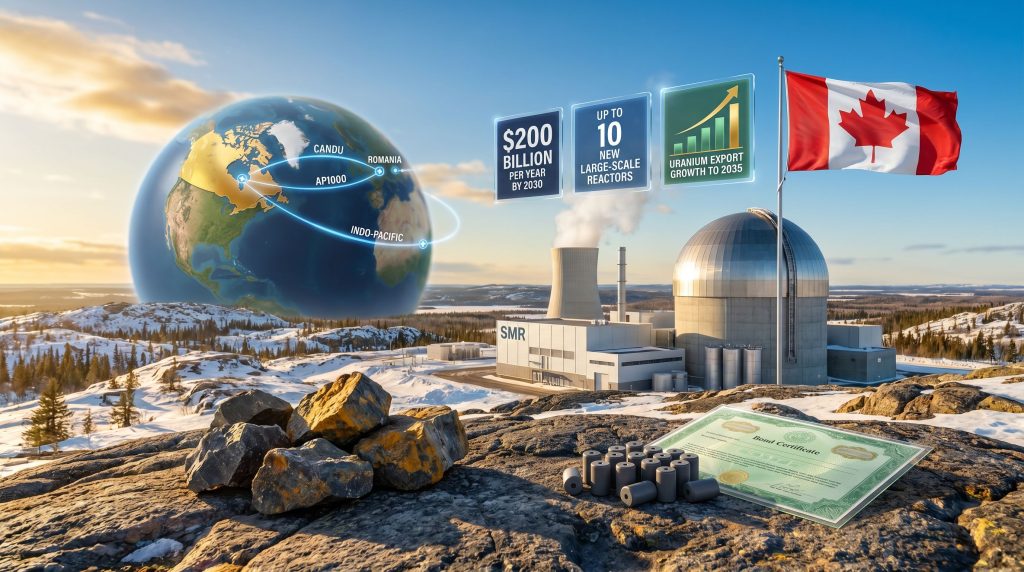
Together, these forces have produced a policy environment in which 38 nations have formally endorsed the Declaration to Triple Nuclear Energy by 2050, and the global nuclear market is projected to reach $200 billion per year by 2030. For a country that has been a tier-one nuclear nation for seven decades, this is not an abstract opportunity. It is a time-sensitive competitive window that closes as other nations build their own capabilities.
The Athabasca Basin Advantage: Understanding Canada's Uranium Geology
One detail that receives insufficient attention in broader nuclear policy discussions is the geological distinction that gives Canada its most durable competitive advantage. The Athabasca Basin in Saskatchewan hosts uranium deposits of exceptional grade, with ore grades that are frequently 10 to 100 times higher than the global average for uranium mines. High-grade deposits require less ore to be processed per pound of uranium produced, which translates directly into lower operating costs, smaller environmental footprints, and stronger margins across commodity price cycles.
This geological reality underpins Canada's status as the world's second-largest uranium producer and gives its expansion targets credibility that lower-grade producers cannot match. When the strategy targets a doubling of Canadian uranium exports within the 10-year period to 2035, this is not aspirational arithmetic. It reflects a production base anchored in some of the most economically defensible global uranium reserves on the planet.
The bifurcation of Western nuclear fuel supply chains away from Russian-origin materials is not a temporary disruption. It represents a permanent structural realignment, and Canada's Athabasca Basin is the most geologically qualified alternative source at scale.
The Four Strategic Pillars of Canada's Nuclear Energy Strategy
Pillar One: Enabling Domestic New Builds at Scale
Canada's domestic build targets are ambitious by any historical benchmark. The strategy targets enabling up to 10 new large-scale reactors within Canada, with 2 under construction by 2035 and a further 5 planned or under development by 2040. Alongside this, at least one SMR or equivalent deployment outside Ontario is targeted by 2035, with a Canadian-designed microreactor demonstrated before 2035 and deployed to remote communities in the late 2030s.
The microreactor programme addresses a structural problem that large-grid nuclear cannot solve. Many of Canada's northern and remote communities currently rely on diesel generation that is both expensive and environmentally damaging. A Generation IV microreactor capable of operating in these environments would simultaneously reduce energy costs, cut emissions, and extend energy sovereignty to communities that have historically been underserved by centralised grid infrastructure.
The regulatory architecture supporting these targets is being restructured in parallel. Key reforms include:
- Federal regulatory review processes targeted for completion within a two-year window
- A fleet-based approval approach to reduce per-project burden, construction risk, and supply chain costs
- A Draft Policy on Federal Financing of New Nuclear Power Projects to be released by April 2027, covering green bonds, Canada Infrastructure Bank participation, and loan guarantees
- Centralised federal support for nuclear buildout coordination and intellectual property management
The fleet-based regulatory approach deserves particular attention. South Korea's nuclear programme has consistently delivered reactors on time and within cost estimates, a performance record that is exceptional by Western standards. The key differentiator is that South Korea treats each reactor not as a unique engineering project but as a standardised unit within a fleet programme. Canada's strategy explicitly adopts this model.
Pillar Two: Becoming the World's Preferred Nuclear Exporter
Canada's export ambition extends well beyond selling uranium. The strategy establishes a formal Nuclear Export Strategy providing end-to-end lifecycle support for international clients, from initial reactor design through fuel supply, operations support, and waste management. This cradle-to-grave service model is a significant differentiator in markets where new nuclear entrant countries lack the domestic expertise to manage these functions independently.
| Export Target | Metric | Timeline |
|---|---|---|
| New CANDU international markets | At least 4 | By 2040 |
| New nuclear entrant country engagements | 6 to 10 countries | 15-year horizon |
| Non-CANDU international project participation | At least 5 | By 2040 |
| Romania new build and refurbishment | Flagship priority | Near-term |
The CANDU technology platform, with 26 reactors operating globally including 17 domestically, forms the foundation of the export programme. Its defining technical characteristic, the ability to use natural, unenriched uranium as fuel, provides a meaningful cost and supply chain advantage for operating countries. No enrichment services are required, which eliminates one of the most geopolitically sensitive dependencies in the nuclear fuel cycle.
Crucially, the strategy also positions Canada's supply chain capabilities beyond CANDU. Cameco's co-ownership of Westinghouse alongside Brookfield gives Canada a direct commercial stake in the AP1000 reactor platform, one of the most widely deployed large light-water reactor designs globally. The strategy explicitly acknowledges this multi-technology export capability, positioning Canada as a supplier across CANDU, SMR, and LWR project types simultaneously.
Pillar Three: Uranium Dominance and Full Fuel Chain Development
The uranium expansion pillar is where Canada's geological advantages translate most directly into geopolitical leverage. The strategy frames Western fuel chain bifurcation not as a risk but as a structural demand catalyst for Canadian production, noting that markets in the United States and Europe are actively seeking alternatives following the ban on Russian uranium in favour of reliable allied suppliers.
| Metric | Current Position | 2035 Target |
|---|---|---|
| Global uranium production rank | Number 2 globally | Maintained or strengthened |
| Export volume growth | Baseline | Doubled within 10 years |
| New mine production | Existing operations | New capacity entering service by 2035 |
| Mining investment policy | Under review | Updated framework by 2027 |
One of the more nuanced elements of this pillar is the enrichment question. CANDU reactors use unenriched natural uranium, meaning Canada has historically had no domestic enrichment requirements. However, the deployment of SMRs and potentially light-water reactors will create a modest future need for enriched uranium. The strategy's position is to meet near-term requirements through allied partnerships and long-term contracts, whilst keeping the door open to domestic enrichment capability development if the non-CANDU fleet expands substantially through the 2030s.
If Canada's SMR programme scales aggressively through the 2030s and 2040s, the domestic enrichment calculus shifts materially. Canada could transition from being primarily a uranium raw material supplier to operating as a full-spectrum nuclear fuel provider, which would represent a significant step up the nuclear value chain.
The pillar also advances the deep geological repository project for used nuclear fuel, a long-duration infrastructure commitment that is essential to maintaining the social licence for new nuclear builds. A Nuclear Fuels Table comprising industry, provincial and territorial governments, and Indigenous groups will serve as the primary governance forum for supply chain analysis and fuel cycle tracking. Increased Indigenous equity participation in nuclear energy generation projects is mandated as a structural requirement, with particular relevance to uranium mining communities in Saskatchewan.
Pillar Four: Innovation, Fusion, and Medical Isotopes
The fourth pillar sets out Canada's ambition to remain at the frontier of nuclear technology well beyond the current generation of reactor designs. Key targets include:
- More than doubling annual private-sector nuclear R&D investment by 2032
- Establishing Canada as a global leader in the fusion fuel cycle market
- Development and demonstration of a Canadian-controlled Generation IV microreactor before 2035
- Expansion of research reactor capacity by the early 2030s, alongside formal assessment of the case for a large-scale research reactor replacement
- A dedicated Radioisotope Strategy targeting a minimum 10% increase in Canada's share of the global medical isotope market
The closure of the National Research Universal (NRU) reactor in 2018 removed a foundational research capability that had supported Canadian nuclear science for decades. The strategy frames replacement of the NRU not as a scientific exercise but as a strategic national infrastructure priority, leveraging the Pan-Canadian Multipurpose Research Reactor Alliance to evaluate the case for a large-scale successor.
Canada's inclusion of fusion energy within the strategy is a longer-horizon bet, but a strategically coherent one. Nations that establish positions in the fusion fuel cycle now, particularly in tritium handling, lithium-6 enrichment, and related technologies, are building capabilities that will carry significant value if commercial fusion becomes viable in the 2040s or 2050s.
How Canada Compares to Global Nuclear Peers
| Dimension | Canada | United States | France | South Korea | United Kingdom |
|---|---|---|---|---|---|
| Domestic reactor target to 2040 | Up to 10 new large-scale | Multiple SMR programmes | Fleet extension plus EPR | 3 or more new APR-1400 units | Up to 8 new large-scale |
| SMR programme maturity | Commercial deployment by 2035 | Multiple developer licences | Early-stage | SMART reactor export focus | BWRX-300 partnership |
| Uranium production | World number 2 producer | Minimal domestic production | Minimal | None | None |
| Export technology platform | CANDU plus AP1000 stake | AP1000 and SMR designs | EPR | APR-1400 | BWRX-300 |
| Enrichment capability | Under evaluation | Domestic and expanding | Domestic via Orano | Limited | Urenco partnership |
The table above illustrates a competitive distinction that is easy to overlook. Canada is the only nation in this peer group that simultaneously holds a top-tier uranium production position, an established reactor export technology, and a commercial stake in a second reactor platform through Cameco's Westinghouse ownership. This multi-asset positioning means Canada can participate in nuclear value creation at more stages of the cycle than any other single nation.
The Financial Architecture: What Is Committed and What Remains to Be Built
The strategy's financing framework operates at two levels. The most concrete commitment is $2.2 billion over ten years allocated for capital investments at Chalk River Laboratories, Canada's national nuclear research hub. This funding covers advanced materials research and critical infrastructure upgrades at a facility that underpins much of Canada's nuclear innovation ecosystem.
Beyond Chalk River, the strategy establishes a framework rather than pre-allocating designated project funding. The financing instruments under active consideration include:
- Green bonds
- Canada Infrastructure Bank participation
- Loan guarantees
- Growth Fund mechanisms
The inclusion of green bonds as a financing instrument reflects a broader global reclassification of nuclear energy as a sustainable investment category. The European Union's taxonomy already classifies nuclear as a transitional green energy source, and Canada's financing architecture appears to be mirroring this approach. For institutional investors with sustainability mandates, this reclassification materially expands the pool of capital that can legitimately flow into nuclear infrastructure.
Total capital investment requirements for the full programme could exceed $100 billion, meaning the federal financing framework is designed primarily to derisk and catalyse private and institutional capital rather than to fund projects directly through government appropriations. Furthermore, current uranium investment trends suggest that institutional appetite for nuclear-linked assets is growing considerably.
Provincial Positioning Within the National Framework
Canada's federal structure means that nuclear strategy implementation will vary significantly across provinces, each of which brings different energy needs and industrial contexts to the programme.
Ontario is the commercial anchor of the strategy. The province is advancing the G7's first commercial SMR deployment at the Darlington Nuclear Generating Station, and its existing fleet of large CANDU reactors provides the engineering workforce, regulatory experience, and supply chain infrastructure that underpins the national programme.
Alberta is at an earlier stage but represents one of the most significant long-term demand opportunities. The province has committed to developing a provincial nuclear generation strategy by 2027, aligned with the federal financing policy timeline. Alberta's energy-intensive industrial base, including oil sands operations requiring substantial process heat and electricity, creates a natural demand case for SMR deployment that differs from the grid-balancing use case that dominates Ontario's planning.
Saskatchewan's role is foundational but less visible than Ontario's. The province's Athabasca Basin deposits are the backbone of Canada's uranium expansion targets, and the Indigenous communities of northern Saskatchewan will be directly engaged through the mandated equity participation requirements embedded in the strategy's third pillar.
The next major ASX story will hit our subscribers first
The Geopolitical Dimension: Nuclear as an Instrument of Foreign Policy
Canada's Energy Minister Tim Hodgson framed the Canada nuclear energy strategy at its launch as something more expansive than an energy plan, describing it as an industrial strategy, a pillar of energy security, and an instrument of foreign policy simultaneously. This framing is significant because it signals that Canada intends to use nuclear technology exports as a tool for building strategic partnerships with allied and emerging nations, not merely as a commercial opportunity.
The Team Canada export doctrine consolidates government agencies, Crown corporations, and private sector technology providers under a unified international sales mandate. This model reduces the fragmentation that has historically limited Canada's ability to compete against state-backed nuclear exporters from Russia and China, both of which offer integrated packages of reactor technology, financing, fuel supply, and operational support.
Romania's selection as the flagship near-term export priority is geopolitically telling. Located at the intersection of NATO's eastern flank and Europe's energy security anxieties, Romania represents both a commercially significant project and a demonstration case for Canada's ability to displace Russian nuclear influence in Central and Eastern Europe. Success there would substantially strengthen Canada's credibility with the six to ten new nuclear entrant countries the strategy targets over its 15-year horizon. According to BNN Bloomberg, Canada's broader ambition is to become an energy superpower underpinned by this comprehensive nuclear framework.
Frequently Asked Questions: Canada Nuclear Energy Strategy
What is Canada's Nuclear Energy Strategy?
Canada's Nuclear Energy Strategy is the country's first comprehensive federal nuclear policy framework, released in June 2026. Structured around four pillars, it covers enabling new domestic nuclear builds, becoming a preferred global nuclear exporter, expanding uranium production and fuel chain capabilities, and advancing nuclear innovation including fusion and Generation IV technologies.
How many new nuclear reactors is Canada planning to build?
The strategy targets enabling up to 10 new large-scale reactors within Canada, with 2 under construction by 2035 and 5 more planned or under development by 2040. At least one SMR or equivalent deployment outside Ontario is targeted by 2035, alongside a microreactor demonstration before 2035.
How much is Canada investing in nuclear energy?
The federal government has committed $2.2 billion over ten years for Chalk River Laboratories infrastructure. The broader financing framework, designed to mobilise private and institutional capital for projects whose total investment requirements could exceed $100 billion, will be detailed in a Draft Policy on Federal Financing of New Nuclear Power Projects to be released by April 2027.
What is CANDU reactor technology?
CANDU, which stands for Canada Deuterium Uranium, is a Canadian-designed reactor technology that uses natural, unenriched uranium as fuel. With 26 CANDU reactors operating globally, it forms the backbone of Canada's international reactor export programme, with Romania identified as the near-term flagship project.
Will Canada develop domestic uranium enrichment capability?
The strategy does not commit to domestic enrichment but explicitly does not rule it out. Near-term enrichment needs from SMR deployment will be met through allied partnerships and contracts. The case for domestic enrichment capability strengthens if Canada's non-CANDU reactor fleet expands substantially through the 2030s.
How does Canada's nuclear strategy address Indigenous communities?
The strategy mandates increased Indigenous equity participation in nuclear energy generation projects and commits to expanding economic and leadership opportunities for Indigenous communities, particularly in uranium mining regions of Saskatchewan. The Nuclear Fuels Table governance forum includes Indigenous groups as formal participants in supply chain analysis and fuel cycle tracking.
This article contains forward-looking statements, targets, and projections drawn from publicly available government policy documents. All forecasts and timelines reflect government targets and are subject to change based on regulatory, financial, and geopolitical developments. Nothing in this article constitutes financial or investment advice. Readers should conduct their own due diligence before making investment decisions related to any companies or sectors mentioned.
Want to Capitalise on the Uranium Boom Driving Canada's Nuclear Ambitions?
Discovery Alert's proprietary Discovery IQ model delivers real-time alerts on significant ASX mineral discoveries — including uranium — instantly empowering subscribers to identify actionable opportunities ahead of the broader market. Explore historic examples of exceptional discovery returns and begin your 14-day free trial today to position yourself ahead of the next major move.