Critical Resources Ltd
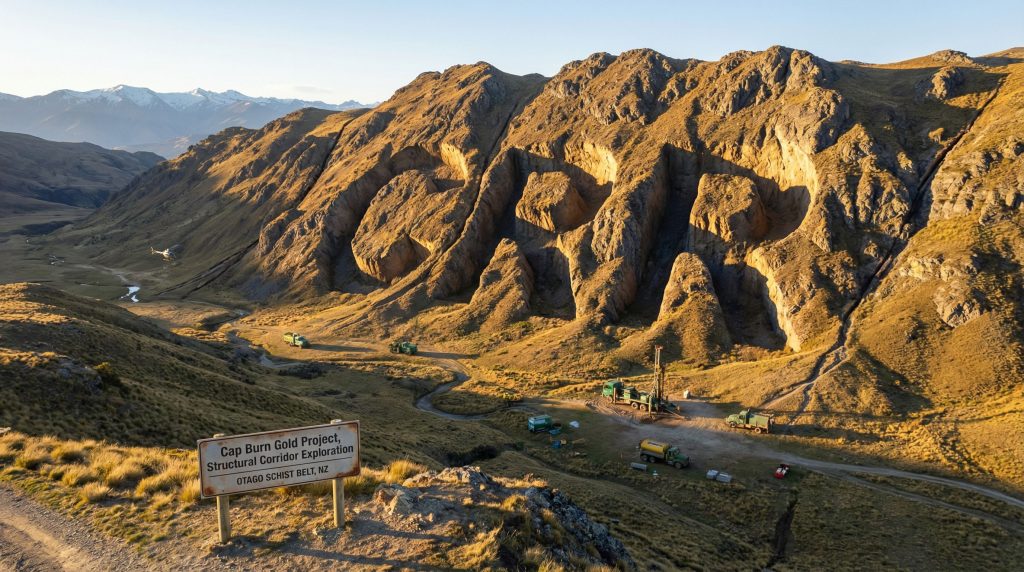
Critical Resources Limited (ASX:CRR) has delivered compelling first-pass drilling results from its Cap Burn Gold Project in New Zealand's proven Otago Schist Belt. The shallow RC drilling programme has confirmed a broad, structurally controlled orogenic gold system associated with the Cap Burn Fault, located just 11 km along strike from OceanaGold's massive 10 million ounce gold camp at Macraes.
The results validate Critical Resources' exploration model, with key intersections including 7m @ 0.37 g/t Au (including 1m @ 1.29 g/t Au) in hole CBRC017 and 16m @ 0.22 g/t Au in hole CBRC021. Perhaps most significantly, the drilling has defined a coherent >1 km² arsenic-in-soil anomaly that provides compelling surface expression of the mineralised system—with several holes terminated in mineralisation due to groundwater constraints, confirming the system remains open at depth.
Breaking Down the Discovery: What Makes Cap Burn Special
The first-pass drilling across 12 holes has intersected gold mineralisation within the TZ4 schist unit—the same geological package that controls gold at Santana Minerals' (ASX:SMI) Rise and Shine discovery. This positioning is critical, as it suggests Cap Burn may be at an analogous structural position to Rise and Shine at a comparable stage of exploration.
Key Drilling Highlights:
- CBRC017: 7m @ 0.37 g/t Au from 65m (including 1m @ 1.29 g/t Au)
- CBRC021: 16m @ 0.22 g/t Au from 46m
- CBRC024: 11m @ 0.16 g/t Au from 2m
- CBRC016: 6m @ 0.10 g/t Au from 41m
The gold-arsenic association is particularly compelling, with the strongest intersection of 1m @ 1.29 g/t Au coinciding with highly elevated arsenic levels >1,600 ppm As. This geochemical signature is consistent with orogenic hydrothermal systems and provides clear vectoring for future drilling campaigns.
| Drill Hole | From (m) | To (m) | Interval (m) | Au (g/t) |
|---|---|---|---|---|
| CBRC017 | 65 | 72 | 7 | 0.37 |
| including | 65 | 66 | 1 | 1.29 |
| CBRC021 | 46 | 62 | 16 | 0.22 |
| CBRC024 | 2 | 13 | 11 | 0.16 |
When big ASX news breaks, our subscribers know first
Understanding Orogenic Gold Systems: The Rise and Shine Analogy
Orogenic gold systems represent one of the world's most significant sources of gold, typically forming in structurally controlled environments where hydrothermal fluids concentrate gold along fault zones and shear structures. These systems are characterised by their association with specific geological units and distinctive geochemical signatures—particularly the gold-arsenic correlation observed at Cap Burn discovery.
The comparison to Santana Minerals' Rise and Shine deposit is particularly instructive. Rise and Shine initially showed similar patterns: broad, disseminated gold within the TZ4 unit beneath arsenic soil anomalies, before higher-grade mineralisation was subsequently discovered by stepping down-plunge along the controlling fault structure. This progression from broad, low-grade intersections to focused, higher-grade zones is typical of orogenic systems as exploration advances from surface expressions to deeper structural targets.
For investors, this means Cap Burn's current results represent the early-stage signature of a potentially significant system, with the critical down-plunge targets—where higher-grade mineralisation typically occurs—remaining entirely untested.
District-Scale Opportunity: The 10km Cap Burn Fault Corridor
One of the most compelling aspects of the Critical Resources Cap Burn discovery is its scale potential. The Cap Burn Fault extends over approximately 10 km across Critical Resources' tenure, defining a district-scale structural corridor of the type known to host significant orogenic gold systems in the Otago Schist Belt.
Current drilling has tested only a small portion of this corridor, with the broader fault system remaining largely unexplored. Multiple prospective positions exist along strike, and the down-plunge extension beneath the fault represents an entirely untested target that will be the focus of the next drilling phase.
Strategic Location Advantages:
- 11 km along strike from OceanaGold's 10Moz Macraes gold camp
- Positioned within New Zealand's most active and proven gold province
- Located on the same structural trend hosting Macraes, Bendigo-Ophir and numerous historic alluvial gold workings
- >1 km² geochemical footprint confirming system-scale mineralisation
Managing Director Commentary
"These are encouraging first-pass results that validate our Cap Burn exploration model. Broad gold mineralisation with strong arsenic-gold association beneath the fault is exactly the geochemical signature we were targeting — and several holes were still in mineralisation when we had to stop drilling."
— Tim Wither, Managing Director, Critical Resources
Next Steps: Targeting the Down-Plunge Zone
Critical Resources has outlined a clear follow-up programme targeting the untested down-plunge zone beneath the Cap Burn Fault, expected to commence in Q2-2026. The company's approach will focus on several key areas:
Priority Drilling Targets:
- Step-out drilling around CBRC017 and CBRC021 where broad mineralisation and higher-grade intervals were intersected
- Deeper extensions testing below current intersections—several holes were terminated in mineralisation due to groundwater
- Structurally favourable positions including interpreted fault intersections and zones of dilation
- Down-plunge targets analogous to the Rise and Shine exploration model
Technical Programme:
- Systematic along-strike soil geochemistry to extend the existing arsenic anomaly
- Detailed structural mapping to refine understanding of mineralisation controls
- Integration of datasets to prioritise drilling beneath the >1 km² arsenic anomaly
The drilling depth constraint of ~60m maximum due to RC rig capacity and groundwater inflow means the true potential of the system remains untested. This technical limitation, while frustrating for immediate results, actually represents significant upside—with mineralisation intersected at the end of several holes confirming the system extends well beyond current drill depths.
Investment Thesis: Early-Stage Discovery with Clear Catalysts
Critical Resources' Cap Burn discovery represents a compelling early-stage gold opportunity in one of the world's most proven gold provinces. The combination of confirmed orogenic gold system, district-scale structural corridor, and systematic exploration approach positions the company for potential value creation through 2026.
Key Investment Drivers:
- Confirmed gold system with strong structural and geochemical controls
- Analogous positioning to successful discoveries in the region
- Large exploration footprint with >90% of the fault corridor untested
- Clear exploration pathway with down-plunge targets defined
- Proven geological province with multiple operating mines nearby
Upcoming Catalysts:
- Q2-2026: Commencement of follow-up drilling programme
- Step-out drilling results targeting higher-grade zones
- Expanded geochemical surveys along the 10km fault corridor
- Deeper drilling testing the critical down-plunge targets
The current market positioning appears to reflect early-stage exploration risk rather than the systematic approach and geological validation achieved through this first-pass programme. With multiple untested targets across a 10km structural corridor and clear technical pathways to potential discovery, the Critical Resources Cap Burn opportunity represents significant exploration leverage for investors willing to follow a methodical discovery process.
The next major ASX story will hit our subscribers first
Why Investors Should Follow Critical Resources
Critical Resources has demonstrated the ability to systematically validate geological models through targeted exploration, with the Cap Burn results confirming both the structural interpretation and exploration approach. The company's positioning in New Zealand's premier gold province, combined with a clear technical pathway and upcoming catalysts, makes it a compelling story for investors focused on early-stage discovery potential.
The Rise and Shine analogy is particularly relevant—Santana Minerals' systematic approach from early-stage intersections to resource definition demonstrates the value creation potential available to companies that can successfully advance orogenic gold discoveries in proven geological terranes.
With upcoming drilling programmes targeting the untested down-plunge zone and multiple structural targets along the 10km Cap Burn Fault corridor, investors should expect regular newsflow and systematic exploration progress throughout 2026.
Key Takeaway
Critical Resources has positioned itself as a systematic explorer in New Zealand's premier gold province, with the Cap Burn discovery confirming significant exploration upside across a 10km structural corridor. With upcoming down-plunge drilling targeting the critical depth extensions where higher-grade mineralisation typically occurs in orogenic systems, investors should monitor Critical Resources as a potential discovery story with clear technical catalysts ahead.
Ready to Explore Critical Resources' Cap Burn Discovery Potential?
Critical Resources has delivered compelling first-pass results that validate a significant orogenic gold system across a 10km structural corridor in New Zealand's premier gold province. With the critical down-plunge targets—where higher-grade mineralisation typically occurs—remaining entirely untested and systematic drilling programmes commencing in Q2-2026, this early-stage discovery offers substantial exploration leverage. Discover how Critical Resources is positioning itself for potential value creation through methodical exploration of multiple structural targets along the Cap Burn Fault corridor by visiting criticalresources.com.au.