August 21, 2026
The Strategic Imperative for Carbon Capture Implementation
Industrial decarbonisation strategies face unprecedented complexity as global carbon constraints reshape manufacturing economics. Traditional emission reduction approaches through efficiency gains and fuel switching have reached practical limitations across energy-intensive sectors. Meanwhile, the emergence of carbon capture utilization and storage technologies presents a fundamentally different pathway, one that addresses emissions at their source while potentially creating new revenue streams through carbon utilisation products.
The technological convergence of capture methodologies, transportation infrastructure, and permanent storage solutions represents more than an environmental imperative. For heavy industries including cement, steel, chemicals, and power generation, carbon capture utilization and storage implementation may determine long-term competitive positioning in carbon-constrained markets. Furthermore, understanding this technology's strategic implications requires examining its technical architecture, economic drivers, and deployment challenges across different industrial contexts, particularly as decarbonisation benefits become increasingly quantifiable.
When big ASX news breaks, our subscribers know first
What Is Carbon Capture Utilization and Storage Technology?
Carbon capture utilization and storage encompasses an integrated technological system designed to intercept carbon dioxide emissions from industrial processes, transport the captured CO₂ to utilisation or storage facilities, and either convert it into valuable products or permanently sequester it in geological formations. Unlike traditional pollution control technologies that filter contaminants, CCUS fundamentally alters the carbon cycle by preventing CO₂ from entering the atmosphere while potentially creating commercial value from what was previously considered waste.
Core Technology Components and Industrial Applications
The technological foundation of carbon capture utilization and storage rests on three interconnected pillars: capture, transportation, and utilisation or storage. Capture technologies extract CO₂ from various emission sources, ranging from concentrated flue gases in power plants to process emissions in cement manufacturing. Transportation systems move captured CO₂ through pipeline networks or maritime vessels to end-use facilities. The final component either permanently stores CO₂ in geological formations or converts it into commercial products such as synthetic fuels, chemicals, or building materials.
Industrial applications vary significantly based on emission source characteristics and operational requirements. Power generation facilities typically implement post-combustion capture systems that treat flue gases after fuel burning. Chemical manufacturers may utilise pre-combustion capture integrated with hydrogen production processes. Cement plants face unique challenges capturing both combustion emissions and process CO₂ released during limestone calcination, requiring specialised approaches that maintain production efficiency while achieving substantial emission reductions.
Distinguishing CCUS from Traditional Carbon Management Approaches
Traditional carbon management strategies focus primarily on emission avoidance through energy efficiency improvements, fuel switching, or process optimisation. Carbon capture utilization and storage represents a fundamentally different approach by directly addressing unavoidable emissions from industrial processes. This distinction proves critical for industries where deep decarbonisation cannot be achieved through conventional methods alone.
The technology's dual potential for emission reduction and revenue generation distinguishes it from purely mitigation-focused approaches. While energy efficiency improvements reduce operational costs but provide diminishing returns, CCUS implementation can create new revenue streams through carbon credit sales, utilisation product markets, or enhanced oil recovery applications. This economic dimension transforms carbon management from a cost centre into a potential profit driver for participating industries.
Integration with Existing Industrial Infrastructure
Successful carbon capture utilization and storage deployment requires careful integration with existing industrial infrastructure to minimise operational disruptions and capital expenditure requirements. Retrofit applications must consider space constraints, utility requirements, and process integration challenges while maintaining production capacity and product quality standards.
Key integration considerations include:
- Energy supply requirements: CCUS systems typically require 10-40% additional energy compared to baseline operations
- Space allocation: Capture equipment, compression facilities, and temporary storage require significant industrial footprint
- Process compatibility: Integration points must maintain product specifications and operational reliability
- Maintenance scheduling: CCUS maintenance cycles must align with existing plant turnaround schedules
- Safety systems: CO₂ handling requires specialised safety protocols and emergency response procedures
How Do the Three Pillars of CCUS Technology Function?
Understanding carbon capture utilization and storage requires examining how capture, transportation, and utilisation/storage components interact as an integrated system. Each pillar presents distinct technological challenges, economic considerations, and operational requirements that must be optimised collectively to achieve commercial viability.
Advanced Capture Methodologies Beyond Amine Scrubbing
While chemical absorption using amine solvents represents the most commercially mature capture technology, advanced methodologies offer improved efficiency, reduced energy requirements, and enhanced operational flexibility. Membrane separation technologies utilise selective permeability to separate CO₂ from gas streams, potentially reducing energy consumption by 20-35% compared to conventional amine systems.
| Capture Technology | Efficiency Rate | Cost per Tonne CO₂ | Primary Applications |
|---|---|---|---|
| Amine Scrubbing | 85-95% | $50-100 | Coal/gas power plants, refineries |
| Membrane Separation | 80-90% | $40-80 | Natural gas processing, chemicals |
| Solid Sorbents | 90-99% | $60-120 | Steel manufacturing, cement |
| Cryogenic Separation | 95-99% | $80-150 | High-purity CO₂ requirements |
Breakthrough Technologies:
Emerging nanotechnology approaches including metal-organic frameworks (MOFs) and carbon nanotube membranes demonstrate potential for significant efficiency improvements. These materials offer enhanced selectivity, reduced regeneration energy requirements, and improved durability under industrial operating conditions. Early pilot projects suggest these technologies could reduce capture costs by 30-50% while improving overall system reliability.
Transportation Infrastructure and Logistics Networks
CO₂ transportation represents a critical link between capture facilities and utilisation or storage sites, with infrastructure selection significantly impacting overall project economics. Pipeline networks provide the most cost-effective solution for large-scale, consistent CO₂ transport over moderate distances, typically requiring compression to 8-15 MPa to maintain dense phase flow.
Pipeline Economics:
- Construction costs: $1-3 million per kilometre depending on diameter and terrain
- Operating pressures: 8-15 MPa for dense phase transport
- Capacity factors: Large pipelines (24-inch diameter) can transport 10-20 million tonnes CO₂ annually
- Distance economics: Pipeline transport becomes cost-competitive for distances exceeding 100-150 kilometres
Maritime Transport Alternative:
Ship-based CO₂ transport offers flexibility for smaller volumes and longer distances, particularly for offshore storage applications. Specialised CO₂ carriers maintain cargo at -50°C and 0.7 MPa, enabling transport of 10,000-50,000 tonne quantities per voyage. While per-tonne transport costs remain higher than pipeline alternatives, shipping provides access to remote storage sites and enables hub-and-spoke distribution networks.
Storage Versus Utilisation: Strategic Decision Framework
The choice between permanent storage and commercial utilisation fundamentally impacts project economics, technical requirements, and long-term sustainability. Geological storage offers permanent sequestration with minimal ongoing operational requirements, while utilisation pathways create revenue opportunities but may provide temporary carbon management depending on product lifecycles.
| Storage Option | Capacity (Gt CO₂) | Permanence | Development Timeline |
|---|---|---|---|
| Saline Aquifers | 1,000-10,000 | >1,000 years | 5-10 years |
| Depleted Oil/Gas Fields | 675-900 | >1,000 years | 3-7 years |
| Enhanced Oil Recovery | 60-85 | >1,000 years | 2-5 years |
| Unmineable Coal Seams | 3-15 | 500-1,000 years | 5-8 years |
Commercial Utilisation Pathways:
- Synthetic Fuel Production: Converting CO₂ with hydrogen to produce methanol, diesel, or jet fuel
- Chemical Manufacturing: Utilising CO₂ as feedstock for polymers, urea, and specialty chemicals
- Construction Materials: Incorporating CO₂ into concrete, aggregates, and carbon fibre products
- Enhanced Mineral Weathering: Accelerating natural carbonation processes in industrial minerals
- Algae Cultivation: Supplying concentrated CO₂ for enhanced biomass production
Which Industries Benefit Most from CCUS Implementation?
Carbon capture utilization and storage deployment varies significantly across industrial sectors based on emission characteristics, technical feasibility, and economic viability. Industries with concentrated, high-purity CO₂ streams typically achieve lower capture costs and faster implementation timelines, while sectors with distributed or dilute emissions face greater technical challenges and capital requirements. Additionally, industry innovation trends demonstrate increasing focus on CCUS integration across multiple sectors.
Power Generation and Heavy Industry Applications
Coal and natural gas power plants represent prime candidates for CCUS implementation due to their large, concentrated emission streams and existing environmental control infrastructure. Modern combined cycle gas turbines produce flue gases containing 3-4% CO₂, while coal plants generate 12-15% concentrations, significantly impacting capture system design and efficiency.
Power sector CCUS deployment faces unique operational challenges including variable electricity demand, cycling operations, and grid reliability requirements. Capture systems must respond to rapid load changes while maintaining emission reduction performance, often requiring flexible operation modes that balance capture efficiency with grid stability obligations.
Technical Considerations for Power Plants:
- Energy penalty: CCUS systems reduce net electrical output by 6-12% for coal plants, 4-8% for gas plants
- Capital cost integration: Retrofit applications cost $1,500-3,000 per kW of capacity
- Operational flexibility: Load-following capability requires sophisticated control systems
- Grid services: CCUS-equipped plants can provide enhanced frequency regulation through variable capture rates
Cement, Steel, and Chemical Manufacturing Integration
Cement manufacturing presents particularly compelling opportunities for carbon capture utilization and storage due to unavoidable process emissions from limestone calcination. Approximately 60% of cement plant CO₂ originates from raw material decomposition rather than fuel combustion, making CCUS one of the few viable deep decarbonisation strategies for this sector. In addition, green iron project developments showcase how metallurgical industries are adopting similar low-carbon approaches.
Steel production through traditional blast furnace routes generates substantial CO₂ emissions from both coking coal combustion and iron ore reduction processes. Integrated steelworks produce 1.8-2.2 tonnes CO₂ per tonne of crude steel, with process emissions accounting for 70-75% of total plant emissions. CCUS integration requires careful consideration of blast furnace gas composition, thermal integration opportunities, and impacts on downstream steel quality.
Chemical manufacturing offers diverse CCUS applications ranging from ammonia production facility integration to petrochemical complex optimisation. Many chemical processes already handle CO₂ as an intermediate compound, providing technical familiarity with gas handling systems and potential process integration opportunities.
Oil Refining and Petrochemical Sector Opportunities
Oil refineries generate CO₂ from multiple sources including hydrogen production units, fluid catalytic crackers, and process heaters, creating opportunities for integrated capture systems serving multiple emission points. Refinery CCUS implementation can leverage existing hydrogen infrastructure, steam systems, and environmental controls to reduce incremental capital requirements.
Petrochemical complexes benefit from potential CO₂ utilisation applications including enhanced ethylene production, methanol synthesis, and specialty chemical manufacturing. The sector's technical expertise in high-pressure gas handling, process optimisation, and product purification translates directly to CCUS operational requirements, potentially accelerating deployment timelines compared to other industries.
What Are the Economic Drivers Behind CCUS Investment?
Economic viability of carbon capture utilization and storage depends on multiple revenue streams, cost reduction trajectories, and risk mitigation strategies that extend beyond traditional industrial investment frameworks. Understanding these financial drivers requires analysing government incentive structures, carbon market dynamics, and technological learning curves that influence project development decisions. Furthermore, renewable energy integration provides additional economic synergies for CCUS deployment.
Government Incentive Structures and Policy Frameworks
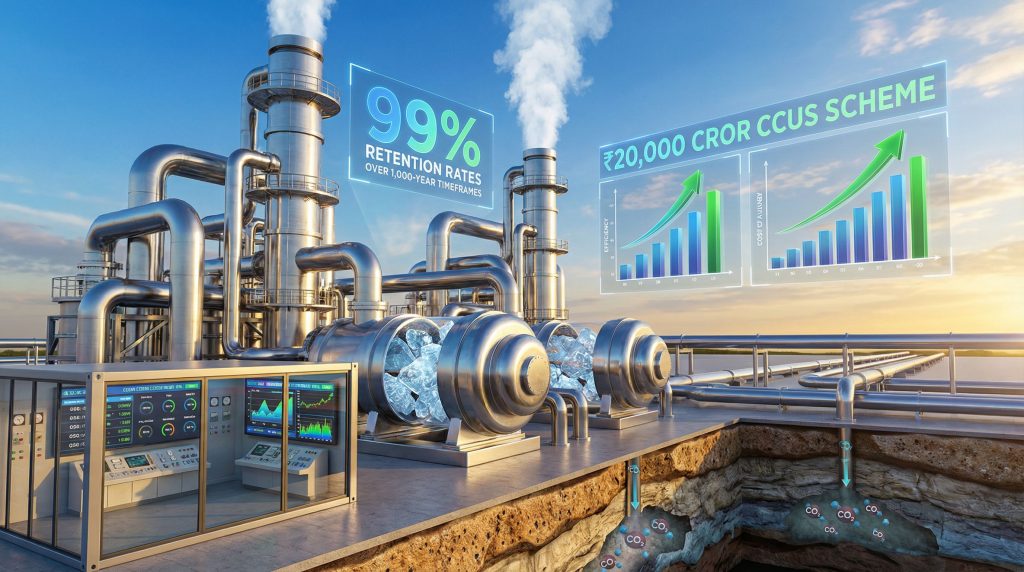
India's recent commitment of ₹20,000 crore (approximately $2.4 billion) for carbon capture utilization and storage development represents one of the largest national CCUS funding announcements globally. This substantial government investment, announced as part of the Union Budget 2026-27, signals strategic recognition that CCUS deployment requires coordinated policy support spanning multiple industrial sectors and infrastructure requirements.
| Country/Region | CCUS Funding Commitment | Policy Mechanism | Target Sector Focus |
|---|---|---|---|
| India | $2.4 billion (₹20,000 crore) | Direct budget allocation | Multi-sector deployment |
| United States | $12 billion (IRA 2022) | Tax credits (45Q) | Industrial and DAC |
| European Union | €3.2 billion (Innovation Fund) | Grant funding | Heavy industry |
| United Kingdom | £1 billion | Industrial clusters | Regional hubs |
| Canada | CAD $9.1 billion | Tax incentives | Oil & gas, industry |
The Indian government's concurrent extension of Basic Customs Duty exemptions on lithium-ion cell manufacturing components demonstrates integrated policy thinking that recognises CCUS deployment within broader energy infrastructure development. This approach acknowledges that successful carbon capture utilization and storage requires complementary investments in energy storage, grid modernisation, and renewable energy capacity to optimise system-wide efficiency and economics.
Carbon Credit Markets and Revenue Generation Models
Carbon credit market dynamics increasingly influence CCUS project economics as voluntary and compliance markets assign premium valuations to permanent sequestration compared to nature-based solutions or temporary storage approaches. Current voluntary carbon market prices for engineered removal methods including CCUS range from $100-600 per tonne CO₂, substantially higher than traditional offset project categories.
Revenue Stream Diversification:
Successful CCUS projects typically incorporate multiple revenue sources to improve financial resilience and reduce market risk exposure. Primary revenue streams include:
- Carbon credit sales: $100-600 per tonne for permanent removal credits
- Government incentives: Tax credits, grants, or production incentives varying by jurisdiction
- Enhanced oil recovery: $10-25 per tonne CO₂ for suitable geological formations
- Utilisation product sales: Variable pricing based on market dynamics for synthetic fuels, chemicals, or materials
- Avoided emissions penalties: Regulatory compliance value in carbon pricing jurisdictions
Cost-Benefit Analysis for Industrial Adoption
Industrial CCUS adoption requires comprehensive cost-benefit analysis incorporating capital expenditure, operational cost increases, revenue opportunities, and risk mitigation value. Total capital requirements typically range from $600-1,500 per tonne annual CO₂ capacity depending on capture technology, scale, and integration complexity.
Cost Structure Breakdown:
- Capture systems: 60-70% of total project capital expenditure
- Transportation infrastructure: 15-25% of total costs
- Storage development: 10-20% of total investment
- Integration and commissioning: 5-10% of capital requirements
Operational cost impacts vary significantly by industry and implementation approach. Energy-intensive industries may experience 5-15% increases in operating costs per unit production, offset partially by carbon credit revenues and potential utilisation product sales. Learning curve effects suggest 15-25% cost reductions achievable through technology improvements and scale economies over 5-10 year deployment periods.
How Does CCUS Enable Negative Emissions Scenarios?
Carbon capture utilization and storage technologies enable negative emissions through integration with biomass energy systems and direct air capture applications that remove more CO₂ from the atmosphere than they release. This capability proves essential for climate scenarios requiring net-negative emissions to limit global temperature increases and compensate for difficult-to-abate emission sources across the global economy.
Biomass Energy with Carbon Capture (BECCS) Applications
Biomass Energy with Carbon Capture and Storage represents one of the most scalable approaches to achieving negative emissions at industrial scale. BECCS systems combust or gasify biomass feedstocks to generate electricity or produce fuels while capturing the resulting CO₂ emissions for permanent storage. Since biomass absorbs atmospheric CO₂ during growth, capturing and storing these emissions creates net atmospheric removal.
Technical Implementation Pathways:
- Dedicated biomass power plants with post-combustion capture systems
- Co-firing biomass in existing coal plants with selective CO₂ capture
- Biomass gasification integrated with hydrogen production and CO₂ storage
- Biofuel production with fermentation CO₂ capture and utilisation
- Waste biomass utilisation converting agricultural residues and forestry waste
BECCS deployment faces constraints including sustainable biomass availability, land use competition with food production, and transportation costs for distributed feedstock collection. Current assessments suggest global BECCS potential of 5-15 gigatonnes CO₂ removal annually by 2050, though sustainable implementation requires careful lifecycle assessment to ensure genuine negative emissions accounting for indirect land use changes and transportation emissions.
Direct Air Capture Integration Strategies
Direct Air Capture technologies extract CO₂ directly from ambient atmosphere, typically achieving concentrations of 10-20% CO₂ in processed air streams suitable for compression and storage. While energy requirements remain substantial (1,500-2,000 kWh per tonne CO₂), DAC integration with renewable energy systems and waste heat sources can improve overall efficiency and reduce operational costs.
Integration Opportunities:
- Industrial waste heat utilisation: Cement plants, steel mills, and refineries providing thermal energy for DAC regeneration
- Renewable energy pairing: Wind and solar installations with excess capacity during high generation periods
- Geothermal integration: Direct utilisation of geothermal heat for DAC thermal requirements
- Nuclear power coupling: Utilising nuclear plants' steady thermal output for continuous DAC operation
Long-term Climate Impact Modelling
Climate modelling scenarios increasingly rely on carbon capture utilization and storage deployment to achieve temperature stabilisation targets. Integrated Assessment Models project requirements for 10-20 gigatonnes annual CO₂ removal by 2050 to limit warming to 1.5°C, with CCUS technologies providing 40-60% of total negative emissions requirements.
Permanence Considerations:
Geological storage provides CO₂ retention exceeding 1,000 years in properly selected and monitored formations, meeting permanence requirements for climate impact accounting. Utilisation pathways offer varying permanence depending on product lifecycles, with construction materials providing decades to centuries of storage while synthetic fuels release CO₂ during combustion, requiring careful accounting of utilisation pathway climate benefits.
The next major ASX story will hit our subscribers first
What Are the Technical Challenges and Solutions?
Technical implementation of carbon capture utilization and storage faces substantial engineering challenges spanning materials science, process integration, and long-term monitoring requirements. Successful deployment requires addressing these challenges through innovative solutions that maintain operational reliability while achieving cost-competitive performance compared to alternative emission reduction strategies.
Storage Security and Monitoring Technologies
Geological CO₂ storage security depends on comprehensive site characterisation, advanced monitoring systems, and predictive modelling that ensures long-term containment performance. Storage formations must demonstrate appropriate porosity, permeability, and caprock integrity to prevent CO₂ migration while accommodating injection volumes and pressure increases over project lifecycles.
Storage Site Selection Criteria:
- Geological stability: Minimal seismic activity and structural integrity over extended timeframes
- Caprock characteristics: Low permeability formations (typically <1 millidarcy) providing effective seals
- Formation depth: Typically 800-3,000 metres depth ensuring supercritical CO₂ phase stability
- Storage capacity: Adequate pore volume for planned injection quantities with pressure management
- Proximity to sources: Reasonable transportation distances to minimise infrastructure costs
"Advanced monitoring systems achieve 99% CO₂ retention verification over 1,000-year timeframes through continuous subsurface pressure monitoring, periodic seismic surveys, and atmospheric leak detection networks positioned around injection sites."
Monitoring technologies integrate multiple measurement approaches including downhole pressure and temperature sensors, distributed acoustic sensing along injection wells, time-lapse seismic imaging, and satellite-based atmospheric CO₂ detection. These systems provide real-time operational data and long-term verification of storage performance while enabling rapid response to any detected anomalies.
Energy Requirements and Efficiency Optimisation
Carbon capture systems impose substantial energy penalties on industrial processes, typically increasing facility energy consumption by 15-35% depending on capture technology and integration approach. Minimising these energy requirements through process optimisation, heat integration, and advanced materials represents a critical challenge for commercial viability.
Energy Optimisation Strategies:
- Heat integration: Utilising waste heat from industrial processes for capture system regeneration
- Process intensification: Advanced reactor designs reducing separation energy requirements
- Hybrid technologies: Combining multiple capture approaches to optimise overall efficiency
- Energy storage integration: Using variable renewable electricity during peak generation periods
- Cogeneration opportunities: Producing steam and electricity while maintaining capture performance
Advanced capture technologies demonstrate potential for significant energy reduction compared to conventional amine scrubbing systems. Membrane-based approaches can reduce energy consumption by 20-35%, while solid sorbent systems offer improved regeneration efficiency through advanced thermal management and process intensification strategies.
Scale-Up Challenges from Pilot to Commercial Operations
Transitioning carbon capture utilization and storage from pilot demonstrations to commercial-scale deployment faces significant engineering and economic challenges related to equipment scaling, system integration, and operational reliability. Most current CCUS projects operate at pilot or demonstration scale (0.1-1 million tonnes CO₂ annually), while commercial deployment requires 5-10 million tonne annual capacity to achieve economic viability.
Scaling Considerations:
- Equipment manufacturing: Limited supplier base for large-scale CCUS equipment components
- Construction expertise: Specialised installation and commissioning capabilities for complex integrated systems
- Operational experience: Limited operational data for large-scale system optimisation and maintenance
- Financial risk: Higher capital requirements and longer payback periods for first commercial deployments
- Regulatory frameworks: Evolving permitting and oversight requirements for large-scale CO₂ handling
Technology developers address scaling challenges through modular system designs, standardised equipment packages, and progressive capacity expansion strategies that enable incremental deployment while building operational experience and reducing technical risks.
Which Countries Lead Global CCUS Development?
Global carbon capture utilization and storage development demonstrates significant regional variation in policy approaches, technology focus areas, and deployment strategies. Leading countries coordinate government support, private sector investment, and international collaboration to establish competitive advantages in emerging CCUS markets while addressing domestic decarbonisation requirements.
United States and European Union Strategic Initiatives
The United States has established comprehensive CCUS support through the Inflation Reduction Act's enhanced 45Q tax credits, providing $85 per tonne CO₂ for direct air capture and $60 per tonne for industrial applications. This policy framework, combined with $12 billion in federal funding commitments, positions the US as a leading market for CCUS deployment across multiple sectors including power generation, industrial manufacturing, and direct air capture.
US CCUS development concentrates on regional hub approaches that integrate multiple emission sources with shared transportation and storage infrastructure. Major projects include the Texas Gulf Coast hub connecting petrochemical facilities, the Midwest hub serving agricultural processing and ethanol production, and the Wyoming integrated test centre focusing on coal-fired power generation applications.
European Union CCUS strategy emphasises industrial cluster development through the Innovation Fund and REPowerEU initiatives, allocating €3.2 billion for CCUS deployment across member states. EU policy prioritises hard-to-abate industries including cement, steel, and chemicals while developing cross-border CO₂ transportation networks connecting industrial regions with North Sea storage formations.
Asia-Pacific Market Development and Investment Flows
Asia-Pacific CCUS development reflects diverse national priorities ranging from energy security in import-dependent economies to industrial competitiveness in export-oriented manufacturing sectors. Japan leads regional technology development through industrial partnerships focusing on shipping-based CO₂ transport and utilisation applications including synthetic fuel production and chemical manufacturing. Similarly, the region's energy transition strategy increasingly incorporates CCUS as a critical component.
Regional Investment Distribution:
- Japan: $4.7 billion committed through Green Transformation (GX) program
- South Korea: $2.1 billion K-New Deal green technology investment
- Australia: $1.6 billion Carbon Capture Use and Storage Development Fund
- China: $850 million provincial and national demonstration programs
- India: $2.4 billion Union Budget 2026-27 allocation
India's substantial ₹20,000 crore commitment represents the largest single national CCUS funding announcement in the Asia-Pacific region, signalling strategic intent to establish domestic technology capabilities while addressing emissions from energy-intensive industries central to economic development objectives.
Middle East and Gulf State Implementation Programs
Middle East CCUS development leverages existing oil and gas infrastructure, technical expertise, and geological storage resources to establish cost-competitive deployment advantages. Gulf states particularly focus on enhanced oil recovery applications that generate immediate revenue while building CCUS operational experience and infrastructure capacity.
Regional initiatives include Saudi Arabia's Circular Carbon Economy program targeting 44 million tonnes annual CO₂ capture by 2030, UAE's national CCUS strategy emphasising industrial hub development, and Qatar's North Field expansion integrated with CO₂ capture and storage systems. These programs demonstrate how resource-rich economies can utilise CCUS to maintain hydrocarbon sector competitiveness while achieving emission reduction commitments.
How Do CCUS Projects Impact Energy Security?
Carbon capture utilization and storage deployment creates multifaceted energy security benefits through domestic manufacturing development, reduced dependence on international carbon markets, and enhanced industrial competitiveness in carbon-constrained global trade environments. These strategic considerations increasingly influence national CCUS policy development and investment priorities beyond direct environmental objectives.
Domestic Manufacturing and Supply Chain Benefits
CCUS project development stimulates domestic manufacturing capacity across specialised equipment categories including capture systems, compression equipment, pipeline infrastructure, and monitoring technologies. This industrial development creates high-value employment opportunities while building technical capabilities that support export market opportunities as global CCUS deployment accelerates.
Manufacturing Value Chain Development:
- Capture equipment: Specialised heat exchangers, absorption columns, and regeneration systems
- Compression systems: High-pressure CO₂ compression and dehydration equipment
- Pipeline infrastructure: Specialised materials and construction capabilities for CO₂ transport
- Monitoring technologies: Advanced sensing and data systems for storage verification
- Utilisation equipment: Process technologies for CO₂ conversion to valuable products
India's CCUS scheme design emphasises domestic manufacturing development through coordinated policy support including customs duty exemptions on critical components and procurement preferences for locally manufactured equipment. This approach aims to establish India as a regional CCUS technology hub while capturing economic value from domestic deployment programs.
Reduced Dependence on Carbon Offset Imports
Domestic CCUS capacity development reduces reliance on international carbon offset markets while providing greater control over carbon accounting quality and permanence verification. This independence proves particularly valuable as voluntary carbon markets face increasing scrutiny regarding additionality, permanence, and measurement accuracy of offset projects, especially nature-based solutions with variable long-term performance.
Strategic Independence Benefits:
- Price stability: Reduced exposure to volatile international carbon market pricing
- Quality assurance: Direct oversight of carbon removal verification and monitoring
- Regulatory alignment: Domestic projects designed to meet national accounting standards
- Economic value retention: Keeping carbon market value creation within domestic economy
- Policy coordination: Integrated CCUS deployment with broader industrial and energy policies
Industrial Competitiveness in Carbon-Constrained Markets
As carbon border adjustment mechanisms and climate-related trade measures expand globally, CCUS deployment provides strategic advantages for export-oriented industries facing international carbon pricing. Industries implementing effective carbon management maintain market access and competitive positioning while competitors without carbon management face increasing cost disadvantages.
Carbon capture utilization and storage enables continued operation of carbon-intensive industries that provide essential materials and employment while meeting increasingly stringent climate commitments. This capability proves particularly important for emerging economies where industrial development remains central to economic advancement and poverty reduction objectives.
What Investment Opportunities Exist in the CCUS Value Chain?
The carbon capture utilization and storage value chain presents diverse investment opportunities spanning technology development, infrastructure deployment, and product market creation. Understanding these opportunities requires analysing market dynamics, risk profiles, and return characteristics across different value chain segments while considering technology maturity and regulatory environment evolution.
Equipment Manufacturing and Technology Development
CCUS equipment manufacturing represents a substantial market opportunity as global deployment accelerates from current demonstration scale to commercial implementation. Equipment categories include capture systems, compression and transportation infrastructure, storage development technologies, and utilisation processing equipment, each with distinct market characteristics and competitive dynamics.
Technology Investment Categories:
- Advanced capture materials: Novel solvents, solid sorbents, and membrane technologies
- Process optimisation: Heat integration, energy efficiency, and system reliability improvements
- Monitoring and verification: Advanced sensor networks, satellite monitoring, and data analytics
- Utilisation technologies: CO₂ conversion processes for fuels, chemicals, and materials
- Integration systems: Retrofit solutions and turnkey project development capabilities
Early-stage technology companies demonstrate strong venture capital interest, particularly for breakthrough materials and process innovations that offer substantial cost reduction potential. Established industrial equipment manufacturers increasingly acquire or partner with technology developers to build comprehensive CCUS solution portfolios serving diverse industrial applications.
Infrastructure Development and Pipeline Networks
CO₂ transportation infrastructure development requires substantial capital investment while offering stable, long-term revenue characteristics similar to traditional pipeline and utility businesses. Pipeline networks benefit from natural monopoly characteristics and regulated rate structures that provide predictable returns on invested capital over extended operating periods.
Infrastructure Investment Characteristics:
- Capital intensity: $1-3 million per kilometre pipeline construction costs
- Operating leverage: High fixed costs with variable throughput pricing
- Regulatory framework: Utility-style regulation providing stable return structures
- Network effects: Connected infrastructure increases overall system value
- Long asset life: 40-60 year operating periods with periodic maintenance requirements
Hub-and-spoke infrastructure development models enable shared transportation costs across multiple emission sources while providing economies of scale for storage development. These regional approaches attract infrastructure investment funds and pension funds seeking stable, long-duration cash flow streams with inflation protection characteristics.
Carbon Utilisation Product Markets
Carbon utilisation creates new product markets spanning synthetic fuels, chemicals, construction materials, and specialty applications that convert captured CO₂ into valuable commercial products. Market opportunities vary significantly by application, with some utilisation pathways achieving commercial viability at current carbon prices while others require substantial technology advancement and cost reduction.
Commercial Utilisation Markets:
- Synthetic fuels: Aviation fuel, marine fuel, and transportation applications requiring carbon-neutral alternatives
- Chemical feedstocks: Methanol, carbon monoxide, and specialty chemicals replacing fossil-based inputs
- Construction materials: Concrete additives, aggregates, and carbon fibre products incorporating captured CO₂
- Enhanced oil recovery: Utilising CO₂ for additional petroleum production while achieving permanent storage
- Food and agriculture: Controlled environment agriculture and food processing applications
Investment opportunities range from technology development companies creating novel conversion processes to project development entities building integrated utilisation facilities. Market success depends on achieving cost competitiveness with conventional products while providing carbon footprint advantages that justify premium pricing or regulatory preferences.
Frequently Asked Questions About CCUS Implementation
What is the typical timeline for CCUS project development?
Carbon capture utilization and storage project development timelines vary significantly based on scale, technology selection, and regulatory complexity. Typical commercial-scale projects require 5-8 years from initial feasibility studies through operational startup, including approximately 2-3 years for engineering and permitting, 2-3 years for construction and commissioning, and 1-2 years for operational optimisation and performance verification.
Development phases include front-end engineering design (12-18 months), environmental impact assessment and permitting (18-24 months), detailed engineering and procurement (12-18 months), construction and installation (24-36 months), and commissioning and startup (6-12 months). Storage development may require additional time for geological characterisation and injection well completion.
How do CCUS costs compare to other decarbonisation technologies?
CCUS costs vary significantly by application but generally range from $50-150 per tonne CO₂ for industrial applications and $150-600 per tonne for direct air capture. These costs compare with carbon pricing levels of $25-80 per tonne in existing compliance markets and $5-50 per tonne for nature-based offset projects in voluntary markets.
Alternative decarbonisation approaches show varied cost competitiveness depending on specific applications. Renewable energy integration with storage costs approximately $30-100 per tonne CO₂ avoided in power generation, while industrial electrification and hydrogen substitution range from $100-400 per tonne CO₂ across different processes. CCUS often provides the only technical pathway for deep decarbonisation in process-emission-intensive industries including cement and steel production.
What regulatory approvals are required for CCUS projects?
CCUS projects require comprehensive regulatory approvals spanning environmental impact assessment, CO₂ handling and storage permits, transportation infrastructure licensing, and operational safety oversight. Specific requirements vary by jurisdiction but typically include pre-injection site characterisation, injection permit approval, monitoring and verification protocols, and long-term stewardship arrangements for storage sites.
Key regulatory frameworks include underground injection control permits for CO₂ storage, pipeline safety regulations for transportation systems, air quality permits for capture system operations, and environmental impact assessments covering potential ecological and groundwater impacts. International projects may require additional approvals for cross-border CO₂ transport and coordination between national regulatory systems.
How does CCUS integration affect existing industrial operations?
CCUS integration impacts existing industrial operations through increased energy consumption, additional operational complexity, and space requirements while potentially affecting product quality specifications and maintenance scheduling. Energy penalties typically range from 6-12% for power plants and 8-20% for industrial processes, requiring careful consideration of utility capacity and operating cost implications.
Operational integration requires specialised training for plant personnel, modified safety procedures for CO₂ handling, and coordinated maintenance between CCUS systems and existing process equipment. Production flexibility may be reduced during CCUS startup periods, and emergency response procedures require updates to address CO₂-specific safety considerations including leak detection and personnel protection protocols.
Future Outlook: CCUS Market Projections Through 2030
The carbon capture utilisation and storage market demonstrates accelerating momentum through unprecedented government funding commitments, technology advancement, and industrial adoption across multiple sectors. Market projections suggest global CCUS capacity could reach 200-400 million tonnes CO₂ annually by 2030, representing approximately 100-fold increase from current operational capacity of approximately 4 million tonnes annually.
Technology cost reductions driven by learning curve effects, economies of scale, and breakthrough materials development project
Ready to Capitalise on CCUS Industry Growth?
Discovery Alert's proprietary Discovery IQ model delivers real-time alerts on significant mineral discoveries across the Australian mining sector, identifying emerging opportunities in critical materials essential for industrial decarbonisation technologies. Understand how major mineral discoveries have historically generated exceptional returns by exploring Discovery Alert's discoveries page, and begin your 14-day free trial today to position yourself ahead of the market as CCUS deployment accelerates globally.