June 3, 2026
When Rocks Refuse to Flow: Understanding Brittle Crustal Behaviour
The Earth's crust is not a static, passive shell. It is a dynamic system under constant mechanical stress, and the manner in which rocks respond to that stress depends on a precise set of physical conditions. Not all deformation looks the same. Some rocks bend and flow, their mineral grains recrystallising into foliated ribbons over millions of years. Others shatter catastrophically, reduced to angular rubble by forces they cannot absorb through any other mechanism. This second behaviour, brittle failure under tectonic stress, is what produces cataclastic texture in rocks, one of geology's most informative structural signatures and one of its most underappreciated.
Understanding why some rocks fracture while others flow requires a framework built on depth, temperature, and composition. The crust does not behave uniformly from surface to base. Near the surface, where confining pressure and temperature are relatively low, rocks respond to stress in a brittle fashion. They accumulate elastic strain until they exceed their mechanical strength, then fail abruptly. At greater depths, rising temperature facilitates dislocation creep and mineral recrystallisation, allowing rocks to deform plastically without breaking. The transition between these two regimes, referred to as the brittle-ductile transition zone, occurs at roughly 10 to 15 kilometres depth depending on crustal composition, geothermal gradient, and fluid availability.
Felsic rocks such as granite and rhyolite are particularly prone to brittle failure because their dominant minerals, quartz and feldspar, resist dislocation creep at low temperatures and instead fracture along cleavage planes and grain boundaries. Mafic rocks, by contrast, contain minerals like olivine and pyroxene that can accommodate strain through recrystallisation at lower temperature thresholds, making them more resilient to brittle failure under the same conditions.
When big ASX news breaks, our subscribers know first
What Cataclasis Actually Means: A Mechanical Definition
The term cataclasis derives from the Greek concept of breaking apart into pieces, and it describes with precision the dominant deformation mechanism operating in fault zones within the upper crust. Rather than involving the transformation of minerals through heat-driven chemical reactions, cataclasis is a purely mechanical process. Rock is dismantled grain by grain through a combination of microfracturing, frictional sliding, grain rotation, and progressive pulverisation, all occurring without the elevated temperatures required to drive metamorphic recrystallisation.
This is what makes cataclastic texture geologically distinctive. The chemistry of the original rock, its mineralogy, its elemental composition, remains largely intact. What changes entirely is the physical architecture of the rock fabric. Coherent crystals are shattered. Grain boundaries are obliterated and replaced by irregular fracture surfaces. The original rock structure, the protolith, is systematically destroyed at the microscale while its chemical identity persists.
Cataclasis is not a metamorphic process. It requires neither heat nor mineral transformation. It is geology's most efficient form of mechanical self-destruction, driven by stress alone.
Cataclastic Texture Defined: The Anatomy of a Fractured Rock Fabric
Cataclastic texture refers to a rock fabric characterised by angular, randomly oriented fragments of varying sizes embedded in a fine-grained crushed matrix, produced by brittle deformation within fault zones and shear environments. The primary driver is differential stress, the condition where tectonic forces acting on a rock body are unequal in different directions, causing grain-scale failure when rock strength is exceeded.
The resulting fabric is diagnostic and unmistakable to a trained geologist. Unlike igneous textures, which preserve interlocking crystals grown from cooling magma, or metamorphic textures, which show foliation and aligned mineral growth, cataclastic texture is defined by chaos, angularity, and mechanical destruction rather than growth or order.
Core Diagnostic Features of Cataclastic Rock Fabric
| Diagnostic Feature | Description |
|---|---|
| Angular clast morphology | Fragments retain sharp, unrounded edges indicating in-place fracturing with minimal transport |
| Chaotic grain orientation | No preferred alignment of fragments; random fabric throughout |
| Bimodal grain size distribution | Coarse clasts suspended within a fine-grained crushed matrix |
| Absence of recrystallisation | No new mineral growth; original mineralogy preserved in broken form |
| Frictional sliding surfaces | Slickensides and micro-shear planes visible at grain contacts |
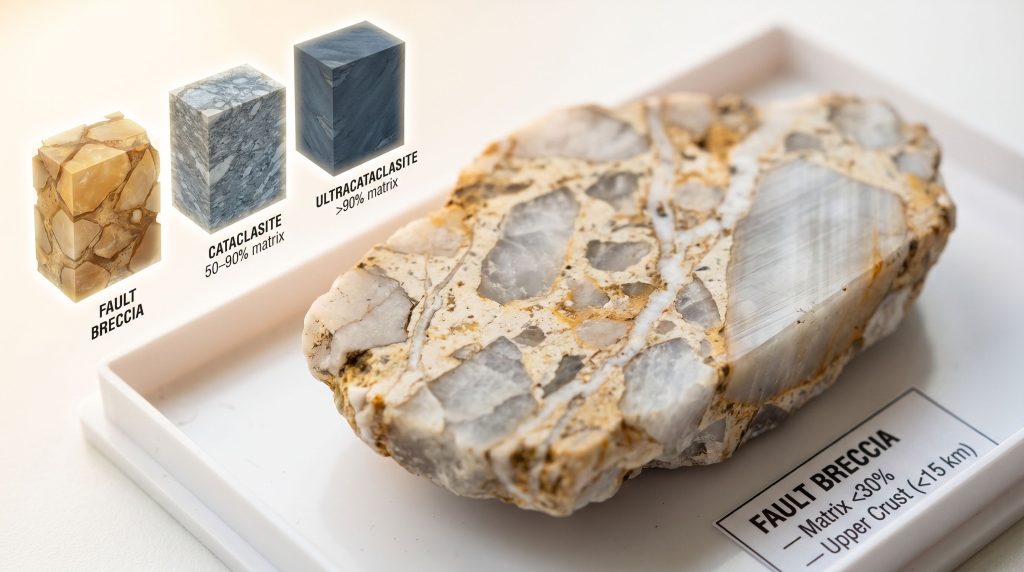
| Matrix percentage variation | Ranges from less than 30% in breccias to over 90% in ultracataclasites |
It is equally important to clarify what cataclastic texture is not. It is not a metamorphic texture because there is no foliation, no crystal alignment, and no mineral phase change. It is not a sedimentary texture because the angular fragments have not been rounded by transport through water or wind. Angularity is not an accident in cataclastic rocks; it is the direct product of in-place fracturing without subsequent reworking. Furthermore, it is not volcanic fragmentation, which involves heat-driven vesiculation, pyroclastic transport, and in many cases, welding of fragments.
How Cataclastic Texture Forms: A Stage-by-Stage Breakdown
Stage 1: Stress Accumulation Along Fault Structures
Plate boundary interactions generate differential stress fields that concentrate along pre-existing weaknesses in the crustal architecture. These zones of weakness, inherited fractures, lithological contacts, ancient sutures, become the loci where stress preferentially accumulates. The build-up is progressive and can span thousands to millions of years before failure occurs. When accumulated stress exceeds the yield strength of the host rock, failure is inevitable.
Stage 2: Fracture Propagation and Initial Fragment Generation
Brittle failure begins at the microscale. Individual mineral grains develop hairline microfractures that propagate through the crystal lattice and coalesce across grain boundaries into macroscopic fractures. The original protolith is broken into angular fragments, typically coarser than 2 millimetres at this stage, representing the early development of what geologists classify as fault breccia. At this point, the rock has fractured but not yet been extensively ground down.
Stage 3: Progressive Grinding, Rotation, and Grain Reduction
Continued fault movement drives grain-on-grain attrition. Fragments rotate against each other, slide along newly created surfaces, and collide repeatedly, progressively reducing particle size from coarse breccia through cataclasite to ultra-fine fault gouge. An important and counterintuitive phenomenon emerges at this stage: cataclastic flow. Under certain conditions, the collective movement of thousands of small brittle fragments produces macroscopic deformation that superficially resembles ductile flow, even though no individual grain is deforming plastically.
Stage 4: Fluid Infiltration, Pressure Solution, and Cementation
The fracture network created by cataclasis dramatically increases the permeability of the fault zone, drawing in hydrothermal fluids and groundwater. These fluids interact with the crushed material in two key ways. First, pressure solution dissolves mineral material at highly stressed grain contacts and redistributes it as silica or carbonate in lower-stress pore spaces. Second, precipitation of quartz, calcite, and other minerals from these migrating fluids cements the fragmented mass, temporarily restoring cohesion.
Consequently, subsequent fault movement refractures this cemented material, initiating a new cycle. This repeated sequence of fracturing, cementation, and refracturing is a defining characteristic of long-lived fault zones and produces layered complexity that geologists can use to reconstruct slip histories.
The fracture-cementation-refracture cycle found in active fault zones creates geological records of extraordinary complexity, with each generation of cementation and breakage representing a distinct episode of tectonic activity preserved in the rock fabric.
The Cataclastic Rock Family: Classification by Deformation Intensity
Cataclastic rocks are not a single product. They represent a spectrum of deformation intensity, classified primarily by the proportion of fine-grained matrix relative to coarse clasts, the degree of cohesion the rock retains, and the cumulative strain experienced within the fault zone. Understanding this spectrum is essential for interpreting fault zone structure and history.
Fault Breccia: Coarse-Grained Brittle Failure
Fault breccia is the coarsest expression of cataclastic deformation. It consists of angular fragments exceeding 2 millimetres embedded in a subordinate fine-grained matrix that accounts for less than 30% of the rock volume. Fault breccia represents relatively early-stage or lower-intensity brittle deformation where fracturing dominates over subsequent grinding. The angular clast morphology is a diagnostic indicator of minimal post-fracture transport.
Fault breccia can be either cohesive, where mineral cement such as quartz or calcite fills void spaces between fragments, or non-cohesive, where the rock mass remains loose and unconsolidated. The distinction between cohesive and non-cohesive breccia has significant implications for fault zone mechanics and fluid flow behaviour. You can explore further parallels in IOCG deposit formation, where hydrothermal fluid pathways through fractured rock play a similarly critical role.
Cataclasite: The Intermediate Fault Rock
Cataclasite occupies the middle ground of the cataclastic spectrum. It is defined by a cohesive fine-to-medium-grained matrix containing angular to sub-angular clasts, with matrix content exceeding 10% of total rock volume. Three progressive subtypes reflect increasing deformation intensity:
| Cataclasite Subtype | Matrix Content | Deformation Intensity |
|---|---|---|
| Protocataclasite | 10 to 50% matrix | Low to moderate |
| Cataclasite (sensu stricto) | 50 to 90% matrix | Moderate to high |
| Ultracataclasite | Greater than 90% matrix | Extreme, approaching gouge |
A critical distinction separates cataclasite from mylonite: cataclasite lacks foliation and crystal alignment entirely. Mylonites, which form at deeper crustal levels under ductile conditions, are defined by their aligned mineral fabric, a product of dislocation creep and recrystallisation. The absence of such fabric in cataclasite is a definitive indicator of brittle mechanical origin. According to research on cataclastic rock classification, this fabric distinction is among the most reliable criteria used in thin section analysis.
Fault Gouge: Maximum Pulverisation in the Fault Core
Fault gouge is produced by extreme mechanical grinding in the highest-strain core of actively slipping fault zones. It is very fine-grained, with dominant particle sizes below 1 millimetre, clay-rich, and typically incohesive and mechanically weak. The clay mineral content, particularly smectite and illite, profoundly influences how the fault behaves during seismic loading.
This makes fault gouge critically important in seismic hazard assessment. Depending on fluid pressure, temperature, and clay mineralogy, gouge zones can either lubricate fault slip, promoting dynamic rupture and earthquakes, or inhibit it, causing the fault to creep aseismically. Distinguishing between these two behaviours is one of the central challenges in modern earthquake science.
Transitional and Extreme End-Members
| Rock Type | Formation Mechanism | Key Distinguishing Feature |
|---|---|---|
| Mylonite | Ductile shearing at deeper crustal levels | Foliated fabric with recrystallised mineral grains |
| Pseudotachylyte | Frictional melting during seismic slip | Glassy, dark, vein-like; records instantaneous thermal events |
Pseudotachylyte represents a particularly significant end-member. It forms not through mechanical grinding but through frictional melting, where the heat generated during rapid seismic slip is sufficient to momentarily melt rock along the fault surface. The resulting glassy material, when preserved, serves as direct evidence of past earthquake rupture at depth. Its presence in exhumed fault rocks is one of the clearest indicators that ancient seismic events can be identified in the geological record.
Global Occurrences: Where Cataclastic Texture in Rocks Is Found
Cataclastic fabrics develop wherever the upper crust is subjected to sufficient differential stress along a localised fault or shear structure. Several tectonic environments are particularly productive:
- Strike-slip fault systems generate extensive cataclasite and gouge corridors through continuous lateral displacement. The San Andreas Fault system in California is among the most intensively studied examples globally, offering accessible surface exposures of fault gouge, breccia zones, and multi-generation cataclastic sequences.
- Thrust fault zones in compressional settings, such as mountain-building environments, produce breccia-dominated fault cores where rocks are stacked and crushed under convergent stress.
- Transform plate boundaries accumulate high cumulative displacement over geological timescales, developing multi-generation cataclastic sequences that record millions of years of fault activity.
- Impact structures generate impact breccias that share diagnostic features with tectonic cataclasites but form through shock wave propagation from meteorite impacts rather than fault slip.
- Exhumed continental fault zones such as those in Arizona provide accessible surface exposures of deep crustal fault rocks, including well-characterised cataclastic sequences brought to the surface by erosion.
Depth control is fundamental. Cataclastic deformation is largely restricted to the upper 10 to 15 kilometres of the crust. Below this threshold, temperature increases sufficiently to activate dislocation creep and recrystallisation, transitioning deformation into the ductile regime. Furthermore, fluid availability at shallow crustal depths amplifies cataclasis by reducing effective confining stress through elevated pore pressure, allowing rocks to fail at lower applied differential stresses than they otherwise would.
The next major ASX story will hit our subscribers first
Cataclastic vs. Metamorphic Texture: A Definitive Comparison
The distinction between cataclastic and metamorphic rock fabrics is one of the most practically important in structural geology. Both can involve intense deformation of pre-existing rocks, however the mechanisms, products, and geological implications differ fundamentally.
| Property | Cataclastic Texture | Metamorphic Texture |
|---|---|---|
| Primary mechanism | Mechanical fracturing and grain grinding | Recrystallisation driven by heat and pressure |
| Crustal depth | Upper crust, typically shallower than 15 km | Mid to lower crust, generally deeper than 15 km |
| Temperature regime | Low temperature conditions | Moderate to high temperature conditions |
| Grain fabric | Chaotic, angular, randomly oriented | Foliated, aligned, systematically ordered |
| Mineralogical change | Minimal to none | Significant new mineral growth common |
| Rock examples | Fault breccia, cataclasite, fault gouge | Schist, gneiss, mylonite |
| Deformation style | Brittle | Ductile to semi-ductile |
| Fluid role | Cementation and pressure solution | Metasomatism and metamorphic reactions |
The single most reliable field indicator of cataclastic origin is the combination of angular fragments, random orientation, and complete absence of recrystallised minerals. Any foliation or aligned mineral growth points immediately toward ductile metamorphic processes rather than brittle cataclasis.
Why Cataclastic Rocks Matter: Scientific and Economic Significance
Reconstructing Fault Activity and Tectonic History
Cataclastic rock sequences function as stratigraphic archives of fault behaviour. Multiple generations of breccia, cataclasite, and gouge layers within a single fault zone preserve a record of episodic slip events, each episode leaving behind textural evidence that can be identified, mapped, and dated. Clast size distributions and matrix volume ratios allow geologists to estimate cumulative displacement and strain rates in ancient fault systems that are no longer active.
Earthquake Mechanics and Seismic Hazard
Fault gouge mineralogy and thickness are directly relevant to seismic hazard modelling. The progressive transition from coarse fault breccia through cataclasite to ultra-fine gouge tracks the mechanical weakening of fault zones over geological time. Understanding this trajectory is central to predicting how faults will behave during future seismic events, including how ruptures nucleate, propagate, and arrest. Gouge rheology models are integral components of modern earthquake hazard assessments in active tectonic regions.
Fluid Migration and Subsurface Flow Systems
Fault breccia zones function as high-permeability conduits for groundwater and hydrothermal fluids, while fault gouge can act as low-permeability barriers that compartmentalise fluid flow within the crust. This permeability architecture is directly relevant to geothermal energy development, subsurface water management, and the long-term containment performance of geological storage sites. The spatial relationship between permeable breccia corridors and impermeable gouge seals governs where fluids move and accumulate within fault-hosted systems.
Mineral Exploration and Economic Geology
Many epithermal gold, silver, and base metal deposits are spatially associated with fault breccia zones where hydrothermal fluids have migrated, reacted, and precipitated economic minerals. Cataclastic textures serve as pathfinder indicators during exploration targeting precisely because the same fracture networks that enable brittle deformation also channel mineralising fluids. Understanding the mineral exploration importance of structural controls helps explain why fault-hosted breccia systems are among the highest-priority targets for discovery.
Orogenic gold deposit models, which account for a substantial proportion of the world's gold endowment, are built around the relationship between fault zone cataclasis, fluid flow, and metal precipitation. In addition, VMS ore deposits also frequently occur in tectonically active zones where structural permeability has been enhanced by brittle deformation. Recognising cataclastic fabrics in drill core and surface outcrop is therefore a practical economic skill, not merely an academic one. When interpreting drill results, understanding whether mineralisation is hosted in cataclastic breccia zones can significantly alter the economic assessment of a project. Furthermore, accounting for true vs apparent widths is especially important when drilling through steeply dipping fault breccia corridors.
Frequently Asked Questions About Cataclastic Texture in Rocks
What is the simplest definition of cataclastic texture?
Cataclastic texture is a rock fabric produced by mechanical crushing, fracturing, and grain-size reduction within fault zones, without significant chemical or mineralogical transformation. It is defined by angular fragments of varying sizes embedded in a fine-grained crushed matrix, with no preferred crystal orientation and no evidence of recrystallisation.
How does a fault breccia differ from a sedimentary breccia?
While both rock types contain angular fragments, the distinction lies in how and where those fragments formed. Sedimentary breccias are produced by the deposition of broken rock material that has been transported, typically by gravity, from a source area. Fault breccias, however, form entirely in place through tectonic fracturing, meaning the fragments never experience significant transport. This in-place origin preserves extreme angularity, which would be progressively reduced by abrasion during sedimentary transport.
Can cataclastic rocks be observed at the Earth's surface?
Yes. Ancient fault zones that formed at depth and were subsequently uplifted and eroded can expose cataclastic rock sequences at the surface. These outcrops provide direct access to the physical record of past fault mechanics and crustal stress conditions. The San Andreas Fault system offers accessible surface exposures, as do numerous exhumed continental fault zones on multiple continents.
Which minerals are most susceptible to cataclasis?
Quartz and feldspar, the dominant minerals in felsic crustal rocks, are particularly susceptible due to their brittle behaviour at low temperatures. Phyllosilicates such as micas and clay minerals accommodate strain more plastically and tend to be concentrated in fault gouge zones, which is why clay content is such an important factor in gouge rheology and fault slip behaviour.
Is pseudotachylyte classified as a cataclastic rock?
Pseudotachylyte occupies a related but distinct category. While it forms within fault zones, its origin is thermal rather than purely mechanical. Frictional melting during rapid seismic slip generates instantaneous heat sufficient to melt rock, producing a glassy vein-like material upon cooling. This thermal origin separates pseudotachylyte from true cataclastic rocks, though it is often found in close spatial association with cataclasites and fault breccias in exhumed seismogenic fault cores.
What field features allow geologists to identify cataclastic texture?
Key field indicators include:
- Angular fragments with no preferred orientation within the rock mass
- A fine-grained crushed matrix surrounding larger clasts
- Slickensided surfaces at grain boundaries or on fault planes
- Complete absence of foliation or recrystallised mineral grains
- Spatial association with mapped fault zones or shear structures
- Variable matrix-to-clast ratios reflecting different deformation intensities along the fault
The Geological Legacy of Rocks That Break Rather Than Flow
Key Takeaways for Understanding Cataclastic Deformation
- Cataclastic texture is the definitive signature of brittle fault zone deformation in the Earth's upper crust
- The progressive spectrum from fault breccia through cataclasite to fault gouge reflects systematically increasing deformation intensity and grain size reduction
- These rocks preserve irreplaceable scientific records of fault mechanics, earthquake behaviour, and crustal fluid flow
- From an economic standpoint, cataclastic fault zones are prospective targets for hydrothermal mineral deposits and geothermal resources
- The brittle-ductile transition zone marks the fundamental boundary between cataclastic and metamorphic deformation regimes in the crust
Every angular fragment, every crushed grain, every chaotic fabric preserved in a fault zone outcrop represents a physical record of tectonic stress. These rocks do not merely record where a fault once moved. They document how it moved, at what rate, under what fluid conditions, and over how many episodes. As analytical techniques in fault rock petrology continue to advance, including microstructural imaging, thermochronology, and gouge rheology experiments, the information extractable from cataclastic texture in rocks grows ever more detailed. What once appeared as chaotic rubble is increasingly understood as one of the most information-rich materials the planet produces.
Readers seeking deeper engagement with fault rock classification and formation mechanics can consult the USGS Professional Paper 687 on cataclastic rocks as a foundational technical reference. Peer-reviewed journals including Tectonophysics and the Journal of Structural Geology publish ongoing research on brittle deformation, fault zone mechanics, and the geological significance of cataclastic textures.
Want to Know Which ASX Explorers Are Drilling Into Fault-Hosted Mineralisation Right Now?
Fault breccia zones and cataclastic textures are among the most reliable structural pathfinders for hydrothermal gold and base metal deposits — and when a significant discovery is made within these prospective systems, timing is everything. Discovery Alert's proprietary Discovery IQ model delivers real-time ASX discovery alerts the moment high-potential announcements hit the market, turning complex geological data into actionable investment insights for both short-term traders and long-term investors — start your 14-day free trial today, or explore historic discovery returns to understand just how transformative early positioning in a major mineral discovery can be.