
August 20, 2026
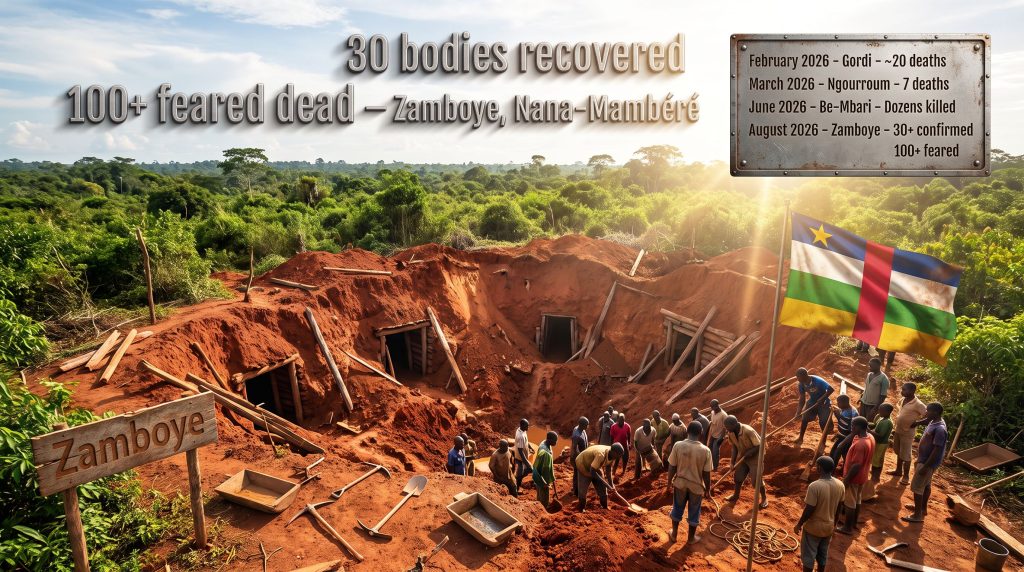
When the Ground Gives Way: The Hidden Catastrophe of Artisanal Gold Mining in Central Africa
Across sub-Saharan Africa, millions of people descend into hand-dug tunnels each day with no safety harnesses, no ventilation systems, and no legal protection. For many, artisanal gold mining is not a career choice but a survival strategy, one practiced at the very edge of physical safety. The Central African Republic gold mine collapse at Zamboye in August 2026 did not emerge from a vacuum. It was the foreseeable consequence of systemic neglect, compounded by poverty, conflict, and the near-total absence of regulatory enforcement in one of the world's most fragile states.
When big ASX news breaks, our subscribers know first
The Physical Reality of Artisanal Mining: Why Are These Sites So Prone to Failure?
To understand why collapses like the one at Zamboye occur with such regularity, it helps to understand how artisanal and small-scale mining (ASM) actually operates on the ground in the Central African Republic.
Unlike industrial mining operations, which deploy engineered tunnel systems, hydraulic shoring, and real-time structural monitoring, ASM sites in CAR are typically excavated by hand. Workers use basic tools to dig narrow shafts and horizontal tunnels that can extend many metres below the surface. There is no standardised shoring, no formal ventilation, and no geotechnical assessment of the surrounding soil or rock.
The result is a network of underground voids held in place by nothing more than the natural cohesion of the surrounding earth. Furthermore, mining waste management at these informal sites is entirely unregulated, adding additional instability to already fragile excavation zones.
Key structural vulnerabilities at informal ASM sites include:
- Unshored tunnel walls that depend entirely on soil stability, which can shift rapidly with changes in moisture, temperature, or adjacent excavation activity
- Multiple tunnels dug in close proximity, creating interconnected weak points where a single failure cascades across several chambers simultaneously
- No engineering oversight to assess safe excavation depth or lateral tunnel spacing
- No evacuation protocols, alarm systems, or emergency egress routes
- No worker logs that would allow rescuers to determine how many people were underground at the time of a collapse
The Baboua public prosecutor attributed the Zamboye disaster specifically to the failure of multiple underground tunnels in which miners were actively working, a description that aligns precisely with the structural failure mode seen at unshored artisanal excavations. When one tunnel section gives way, the load redistribution to adjacent walls can trigger a chain reaction that collapses a much wider underground network within seconds.
Zamboye: Geography, Context, and What Made This Site Particularly Vulnerable
The village of Zamboye sits roughly 50 kilometres from the town of Baboua in CAR's Nana-Mambéré prefecture, positioned within a few kilometres of Garoua-Boulai in eastern Cameroon. This border-region geography creates a specific set of complications that extend beyond the physical risks of the mine itself.
Cross-border ASM zones present compounded challenges:
- Jurisdictional ambiguity: Both CAR and Cameroonian authorities nominally hold oversight responsibilities in border regions, but in practice neither maintains consistent enforcement presence at informal mining sites
- Population fluidity: Miners regularly move between both countries in search of productive sites, making headcount at any single location structurally impossible to maintain
- Fragmented response capacity: When an incident occurs, responsibility for emergency response falls into a gap between two national systems, each with limited reach in remote border areas
- Limited road access: Infrastructure in western CAR's border regions is severely underdeveloped, slowing the arrival of any outside assistance in a time-critical rescue window
The collapse occurred on a Tuesday in August 2026. By the following day, authorities were already acknowledging that a definitive casualty figure would be difficult, if not impossible, to establish. According to reporting from ABC News, at least 30 bodies had been recovered from the site as rescue efforts continued.
The Death Toll Debate: Why Numbers at ASM Disasters Are Never Simple
One of the most striking features of the Zamboye tragedy is the significant gap between confirmed and feared deaths, a gap that itself tells an important story about how informal mining operates.
| Source | Reported Figure | Status at Time of Statement |
|---|---|---|
| Deputy Mayor Souleymane Bi | 30 bodies recovered | Confirmed |
| Local mining association official (Reuters) | More than 100 deaths | Unconfirmed, feared total |
| Multiple local sources (AFP) | At least 100 deaths | Unconfirmed, feared total |
| Local official Laurent Ngon Baba | Formal toll not yet established | Ongoing assessment |
The disparity between 30 confirmed recoveries and a feared toll exceeding 100 is not simply a product of slow reporting. It reflects a structural data failure baked into how informal mining sites operate. Without entry and exit logs, there is no baseline figure against which to measure who is missing.
Rescue operations at Zamboye were conducted primarily by local residents and fellow miners rather than trained emergency services, further limiting systematic documentation of casualties.
Miner Cedric Mbango, speaking from the site in the immediate aftermath, described the scale of devastation on the ground and confirmed that people remained buried underground as rescue attempts continued. Deputy Mayor Souleymane Bi described conditions at the site as horrible and issued a public appeal for assistance from humanitarian organisations and individuals.
The gap between confirmed recoveries and feared deaths at artisanal mine disasters is rarely closed. In the absence of formal worker registries, definitive casualty accounting is structurally impossible, meaning the true human cost of events like Zamboye often remains unknown indefinitely.
A Pattern, Not an Anomaly: CAR's Escalating Mine Collapse Crisis in 2026
The Central African Republic gold mine collapse at Zamboye cannot be evaluated in isolation. It is part of a documented and accelerating pattern of fatal collapses across CAR's artisanal mining sector.
| Month | Location | Reported Deaths | Incident Type |
|---|---|---|---|
| February 2026 | Gordi, northeast CAR | Approximately 20 | Mine collapse |
| Mid-March 2026 | Ngourroum, western CAR | 7 | Landslide at mine |
| June 2026 | Be-Mbari, Cameroon border | Dozens | Gold mine collapse |
| August 2026 | Zamboye, Nana-Mambéré | 30+ confirmed / 100+ feared | Multi-tunnel collapse |
Within a single calendar year, hundreds of lives have been lost across CAR's artisanal mining sector. The problem extends beyond CAR's borders. In February 2026, at least 37 miners died from carbon monoxide poisoning at a Nigerian mine. In November 2025, dozens were killed in the DRC mineral resources sector after a bridge collapsed at a copper and cobalt extraction site. In August 2026, 14 suspected illegal miners were killed in a South African mine collapse.
These incidents collectively illustrate a continent-wide governance failure. Formal safety protections that are considered standard in industrial mining environments have not been meaningfully extended to the informal and artisanal mining populations who represent a significant share of Africa's total mining workforce.
The Economics of Desperation: Who Works in CAR's Informal Gold Sector?
Gold is one of CAR's most significant mineral resources. Yet the economic value generated at the artisanal level rarely filters back into community infrastructure or worker safety investment. Several thousand workers across CAR depend on artisanal gold extraction as their primary source of income, operating outside formal employment structures with no injury compensation, no occupational health access, and no legal recourse if conditions deteriorate.
What drives workers to these sites despite the known dangers:
- Extreme poverty and a near-total absence of alternative formal employment in rural regions
- The relatively low capital requirement to begin artisanal mining compared to other income-generating activities
- The potential for daily income that, while modest and unpredictable, exceeds what most alternative rural activities can generate
- Established social networks around mining communities that create both economic and cultural ties to the activity
The World Gold Council and various academic researchers have noted that ASM globally employs an estimated 40 to 45 million people, making it the largest employment sector in artisanal and small-scale mining worldwide. In fragile states like CAR, where conflict has dismantled formal economic infrastructure, that number represents not just a workforce but a population with no viable alternative.
The next major ASX story will hit our subscribers first
What Effective Reform Would Actually Require
Preventing future Zamboyes is not simply a matter of improving emergency response. The structural conditions that produce these disasters require structural solutions. In addition, understanding mine reclamation importance is increasingly relevant, as long-term site rehabilitation must be built into any credible regulatory framework from the outset.
A credible reform framework for CAR's artisanal mining sector would need to address six interconnected layers:
- Formalisation pathways: Low-cost, accessible licensing systems that bring ASM operators into regulatory frameworks without effectively criminalising subsistence mining through prohibitive barriers
- Minimum engineering standards: Mandated tunnel shoring specifications, maximum excavation depth guidelines, and basic ventilation requirements at all registered sites
- Worker registration and headcount systems: Simple entry and exit logging requirements that create a baseline population count, enabling accurate casualty assessment when incidents occur
- Pre-positioned emergency response capacity: Mine rescue equipment and trained local responders deployed to high-density ASM areas before disasters occur, not mobilised in their aftermath
- Cross-border coordination agreements: Formal CAR-Cameroon joint response protocols for mining incidents in shared border zones, with clear authority and resource-sharing arrangements
- Downstream accountability mechanisms: Strengthened due diligence requirements for international buyers of CAR gold, creating market-based incentives for sourcing from operators who meet defined safety benchmarks
International bodies with existing frameworks relevant to this challenge include the World Bank's Extractive Industries Technical Advisory Facility, which has supported ASM formalisation programmes across sub-Saharan Africa, and the African Development Bank, which has identified artisanal mining governance as a priority area for fragile and conflict-affected states. However, the mining geopolitical risks inherent to regions like CAR continue to complicate sustained international engagement. UN agencies operating in CAR, including MINUSCA, could also incorporate mining safety into broader civilian protection mandates without requiring new institutional architecture.
The Response on the Ground and Its Limits
In the immediate aftermath of the Zamboye collapse, CAR government spokesman Evariste Ngamana confirmed that authorities were working to deliver relief and assistance to affected families. The governor of Cameroon's eastern region, Gregoire Mvongo, confirmed via public radio that Cameroonian and Central African authorities were collaborating on the response.
These statements reflect genuine cross-border coordination effort. However, they also highlight the limits of what governmental response can achieve when emergency infrastructure is fundamentally absent. There are no known dedicated mine rescue teams operating in the Nana-Mambéré region. Medical facilities in the Baboua area have limited mass casualty capacity.
Road access to remote border mining sites is poor, and international media access to the immediate aftermath was constrained. Consequently, as SBS News reported, the primary rescue effort at Zamboye was conducted by local miners and residents using their hands, with no specialised equipment and no systematic approach to documenting who they found or where.
Frequently Asked Questions
Where exactly is Zamboye, and why does the location matter?
Zamboye is a village located approximately 50 kilometres from Baboua in CAR's Nana-Mambéré prefecture, positioned a few kilometres from Garoua-Boulai in eastern Cameroon. The border-region location creates jurisdictional ambiguity that complicates both regulatory oversight and emergency response.
Why is there such a large gap between confirmed and feared deaths?
Informal ASM sites do not maintain worker registries. Without a baseline headcount, there is no way to determine how many people were underground at the time of collapse. The 30 confirmed recoveries represent bodies physically retrieved by rescuers, while the 100-plus feared figure reflects community-level knowledge of how many people were working in the mine that day.
Is the Central African Republic the only country facing this problem?
No. Deadly artisanal mine collapses have occurred across Nigeria, the Democratic Republic of Congo, South Africa, and numerous other African countries within recent months alone. The problem reflects a continent-wide governance gap rather than a CAR-specific failure. Furthermore, understanding natural capital in mining illustrates why environmental and social governance must be addressed together, not in isolation.
What role do international gold buyers play in this crisis?
Under frameworks such as the OECD Due Diligence Guidance for Responsible Supply Chains of Minerals from Conflict-Affected and High-Risk Areas, downstream buyers of gold sourced from conflict-affected regions bear responsibility for assessing and mitigating supply chain risks. Strengthening and enforcing these requirements could create meaningful economic pressure on the sector to improve site-level safety standards.
Disclaimer: Casualty figures cited in this article reflect information available at the time of initial reporting and may be subject to revision as official assessments are completed. The situation at Zamboye remained active and evolving at the time of writing.
Want to Invest in Significant ASX Mineral Discoveries the Moment They're Announced?
Discovery Alert's proprietary Discovery IQ model delivers real-time alerts on major ASX mineral discoveries, transforming complex geological data into clear, actionable insights for investors at every experience level — explore the historic returns major discoveries have generated and begin a 14-day free trial to position yourself ahead of the broader market.