June 3, 2026
When Geology and Geopolitics Converge: The Case for Multi-Element Skarn Exploration in 2026
There is a particular moment in any commodity cycle when the geological and macroeconomic arguments for a specific deposit type align so precisely that the exploration community begins paying serious attention to systems it previously overlooked. That moment, for iron-copper-rare earth element (Fe-Cu-REE) skarn deposits, appears to have arrived. Two of the most structurally important materials in the global energy transition — copper and rare earth elements — are simultaneously facing supply shortfalls that no single producing nation can resolve quickly. Against this backdrop, the Chalice Mining Deep Blue copper rare earth target in Western Australia's Wheatbelt has emerged as one of the more technically compelling greenfield exploration stories on the ASX in 2026.
When big ASX news breaks, our subscribers know first
Why Copper and Rare Earths Are Facing Simultaneous Supply Crises
The critical minerals demand driving the energy transition is often discussed as a single macro trend, but it is better understood as a convergence of several parallel material demands. Copper underpins virtually every electrification pathway — from grid infrastructure and EV charging networks to offshore wind cabling and grid-scale battery systems. Rare earth elements, by contrast, are critical for the permanent magnets that drive electric motors in vehicles, wind turbines, robotics, and defence systems. Both commodities are facing structural supply gaps that are projected to intensify through the late 2020s.
Global copper mine supply has consistently failed to keep pace with demand growth, with average ore grades at producing mines declining from roughly 1.2% in the early 2000s to below 0.6% at many major operations today. New mine development timelines typically span 15 to 20 years from discovery to production, meaning the pipeline of future copper supply is already largely visible — and insufficient relative to projected demand.
On the REE side, geographic concentration remains the dominant strategic concern. China accounts for approximately 60% of global rare earth mine production and an even larger share of downstream processing and separation capacity. This concentration creates supply chain vulnerability for manufacturers of permanent magnets in allied nations, spurring government and investor interest in new rare earth supply chains in geopolitically stable jurisdictions.
"The intersection of copper and REE supply constraints in a single exploration target is not merely convenient — it is strategically significant. Projects that can credibly address both deficits simultaneously occupy a differentiated position in the critical minerals landscape."
Skarn-style mineralisation systems are uniquely positioned to deliver this dual outcome. Forming at the contact zones between igneous intrusive bodies and carbonate-bearing host rocks through a process called metasomatism, skarns can host iron, copper, molybdenum, silver, gold, and in certain geological configurations, substantial concentrations of rare earth elements — all within a single coherent mineralised envelope.
The Deep Blue Target: A Technical Breakdown of an Unusual Discovery
How Fe-Cu-REE Skarn Systems Form and Why They Matter
Understanding what makes the Chalice Mining Deep Blue copper rare earth target technically distinctive requires a brief examination of skarn deposit geology. When magma intrudes into carbonate-bearing rocks such as limestone or dolostone, the heat and chemically reactive fluids emanating from the intrusion drive a process of mineral replacement in the host rock. This metasomatic alteration can introduce large quantities of iron, copper, and other metals, while REE enrichment is often associated with the later-stage, lower-temperature fluid pulses that follow the main mineralising event.
Critically, the mineral assemblages produced by this process generate strong physical contrasts with surrounding unmineralised rock. Dense iron-oxide and sulphide minerals produce elevated density anomalies detectable by gravity surveys, while magnetite-rich alteration zones respond prominently in airborne magnetic surveys. This dual geophysical signature is precisely what has been documented at Deep Blue, providing independent corroboration of the surface geochemical evidence.
The Anomaly in Numbers: What the Data Actually Shows
The statistical profile of the Deep Blue anomaly is what separates it from routine exploration targets. The key measurements are worth examining in detail:
| Parameter | Measured Value |
|---|---|
| Soil anomaly strike length | 2.5 kilometres |
| Soil anomaly width | 500 metres |
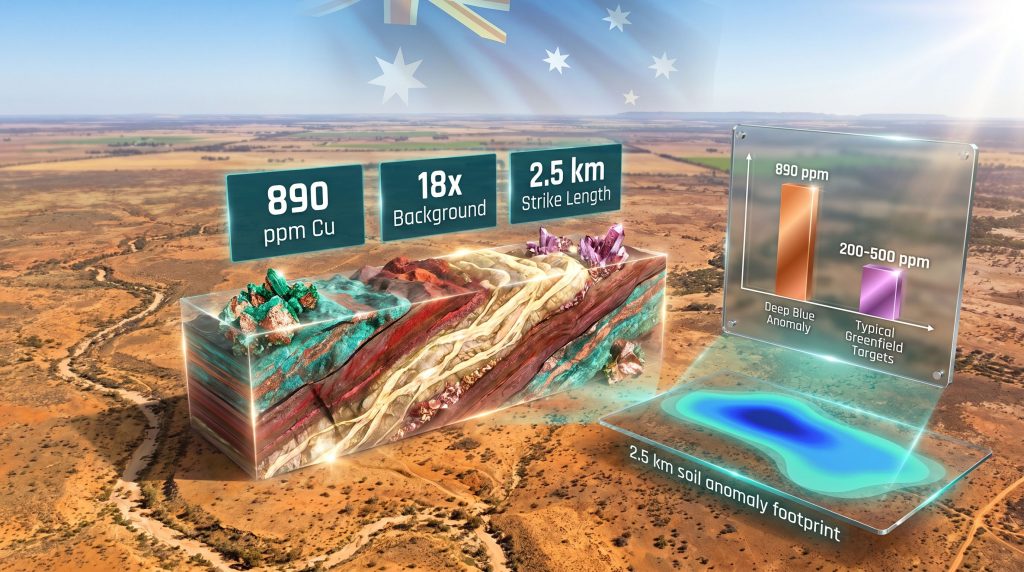
| Peak copper-in-soil | 890 parts per million (ppm) |
| Local background copper level | ~50 ppm |
| Anomaly contrast ratio | ~18x background |
| Magnetic inversion structural extent | 2 to 3 kilometres along strike |
| Rock chip REE grades | Up to 15.5% and potentially exceeding 19% |
An 18-fold contrast between the peak copper anomaly and local background concentrations is a figure that warrants emphasis. In soil geochemistry, anomaly contrast ratios above 10x background are generally considered highly significant; an 18x contrast over a 2.5-kilometre footprint is the kind of signal that exploration geologists spend careers waiting to find.
The multi-element association across this footprint is equally instructive. The consistent presence of silver, molybdenum, and gold alongside copper across the full strike length of the anomaly indicates a coherent magmatic-hydrothermal event rather than surficial contamination or isolated mineralisation pods. Molybdenum is particularly significant in this context: it is a well-established pathfinder mineral in porphyry-skarn transition environments, frequently indicating proximity to a causative intrusive centre. Furthermore, when molybdenum appears alongside copper at surface over a multi-kilometre strike, it suggests the system has a heat source capable of generating a substantial mineralised footprint.
What the Geophysics Reveal About Depth and Geometry
Airborne magnetic surveys at Deep Blue have resolved a series of discrete, steeply northeast-dipping bodies that spatially coincide with the soil geochemical anomaly. Magnetic inversion modelling — a computational technique that uses measured magnetic field variations to estimate the geometry, depth, and volume of subsurface sources — indicates these bodies collectively extend two to three kilometres along strike. A confirmatory ground gravity response adds an independent physical measurement to this picture, reducing the probability that the magnetic anomalies reflect non-mineralised magnetite bodies alone.
"The convergence of soil geochemistry, rock chip assays, airborne magnetics, and ground gravity into a single, spatially coherent target envelope is the hallmark of a well-constrained drill-ready system. Each dataset independently supports the same conclusion: there is something significant beneath the surface at Deep Blue."
Chalice Mining's Track Record and Financial Position
The Julimar Blueprint: Why Exploration Methodology Matters
The Chalice Mining Deep Blue copper rare earth target does not exist in a vacuum. It has been identified and advanced using an exploration methodology refined through one of the most celebrated greenfield discoveries in recent Australian mining history. Chalice's 2020 discovery of the Julimar palladium-nickel-copper-gold deposit in Western Australia demonstrated the company's capacity to identify world-class mineralised systems in underexplored terranes through systematic geophysical and geochemical work.
The sequential framework applied at Deep Blue follows the same logic:
- Regional geophysics to identify buried anomalous features beneath cover
- Soil and rock chip sampling across target areas to establish surface geochemical expression
- Ground geophysics (gravity and magnetics) to constrain the three-dimensional geometry of the target
- Drill targeting based on the convergence of multiple independent datasets
This methodology is designed to maximise the probability of intersecting meaningful mineralisation when drilling commences, rather than speculating on poorly constrained targets. Each step reduces uncertainty before capital is committed to the drill bit.
Financial Strength in a Capital-Constrained Exploration Environment
One of the less-discussed but critically important aspects of Chalice's position is its financial standing relative to exploration-stage peers. The company holds approximately $63 million in cash and listed investments, providing a substantial runway to advance Deep Blue through drilling without near-term equity dilution pressure. This is a material differentiator in an environment where many junior explorers face funding constraints that delay or abort promising drill programmes.
At the time of the announcement, Chalice Mining carried a market capitalisation of approximately $588.1 million — a scale that reflects both investor confidence in the company's exploration capability and the broader market recognition of the Northam JV project's potential.
Regional Context: The Caravel Copper Analogue
Deep Blue is situated approximately 15 kilometres southeast of the Caravel copper project, operated by a separate ASX-listed entity and currently at pre-feasibility stage with a 3.0 million tonne (Mt) contained copper resource. The proximity of an advanced copper project of this scale provides meaningful geological context. Consequently, it validates the broader mineral endowment of the Wheatbelt district and strengthens the case for deep-seated copper supply crunch systems in the area. For explorers, analogue proximity matters — it reduces the geological uncertainty associated with new targets in the same terrane.
Interpreting the Rock Chip REE Results: What Grades Above 15% Actually Mean
The Limitations and Significance of Surface Sampling
Rock chip sampling involves the collection of individual rock specimens from surface or near-surface exposures. The resulting assay values reflect the composition of the sampled material, not a continuous interval of mineralisation. This distinction is fundamental to interpreting the reported REE grades of up to 15.5% and potentially exceeding 19% at Deep Blue.
Investor Caveat: Exploration-stage rock chip results, regardless of their apparent grade, do not constitute a mineral resource under the JORC Code. These figures represent maximum grade occurrences within the sampled material and cannot be extrapolated to represent bulk-mineable estimates without drill confirmation.
That said, REE grades exceeding 10% in rock chip datasets are genuinely uncommon. Most commercial REE projects operate at bulk grades measured in fractions of a percent — operations like Mount Weld in Western Australia, considered one of the world's highest-grade REE mines, carry resource grades in the range of 8 to 9% total rare earth oxides (TREO). Rock chip results in the 15 to 19% TREO range, if confirmed as representative of a broader mineralised system through drilling, would place Deep Blue in a category of REE occurrences that would attract significant commercial and technical scrutiny.
Mineralogy: The Hidden Variable in REE Projects
One aspect of REE exploration that is poorly understood outside specialist circles is the critical importance of the specific REE-bearing mineral phases present in the system. Common REE minerals in skarn environments include allanite, bastnäsite, and monazite, each with materially different processing characteristics. Allanite, for example, is notoriously resistant to conventional metallurgical recovery methods, while bastnäsite and monazite are more amenable to established separation circuits.
Identifying the REE mineralogy through techniques such as X-ray diffraction (XRD) or quantitative evaluation of minerals by scanning electron microscopy (QEMSCAN) is therefore a critical early step in assessing whether high-grade rock chip results translate to economically recoverable mineralisation.
Benchmarking Deep Blue Against Australian and Global Critical Minerals Targets
| Attribute | Deep Blue (CHN) | Typical Greenfield Copper Target | Advanced Copper-REE System |
|---|---|---|---|
| Anomaly strike length | 2.5 km (soil) / 2-3 km (magnetic) | 0.5 to 1.5 km | 2 to 5 km |
| Peak Cu-in-soil | 890 ppm | 200 to 500 ppm | 500 to 2,000 ppm |
| Multi-element association | Cu, Mo, Ag, Au, REE | Cu ± Mo | Cu + REE ± Au |
| Geophysical confirmation | Magnetics + gravity | Magnetics only | Magnetics + gravity |
| Deposit classification | Fe-Cu-REE skarn | Porphyry or IOCG | Skarn or IOCG |
| Drill-ready status | Confirmed | Variable | Variable |
The co-product dimension of copper-REE systems deserves particular attention from an investment perspective. Single-commodity copper projects face increasing pressure from declining head grades and processing complexity. A credible REE co-product stream has the potential to materially improve project economics through revenue diversification, particularly given the structural demand underpinning REE from permanent magnet applications in electric vehicles, defence systems, and renewable energy infrastructure. In addition, the proximity to iron ore deposit types and analogous Fe-skarn systems in the Wheatbelt further contextualises the geological setting at Deep Blue.
The next major ASX story will hit our subscribers first
Risk Framework: Key Technical Uncertainties Before Drilling
Experienced investors in the exploration sector will recognise that even the most compelling pre-drill datasets carry material uncertainties. The key technical risks at Deep Blue include:
- Depth to mineralisation: Magnetic inversion modelling indicates steeply dipping bodies, but the vertical distance to the top of mineralisation remains unconfirmed. Deeper targets carry higher development cost implications and require longer drill holes, increasing per-metre costs.
- Grade continuity at scale: High-grade rock chip results may reflect narrow, structurally controlled veins rather than bulk-mineable widths. Skarn systems are frequently geometrically complex, requiring dense drilling to resolve their three-dimensional architecture.
- REE metallurgical amenability: As noted above, the specific mineral phases hosting REE at Deep Blue remain to be characterised. Processing complexity is one of the most common reasons that high-grade REE surface results do not translate to commercially viable projects.
- Structural complexity: Steeply dipping, multi-body skarn systems can be challenging to drill efficiently, potentially increasing the cost and duration of the resource definition phase.
Catalysts That Will Define the Deep Blue Investment Narrative
- Initial reverse-circulation (RC) drilling results confirming depth extent and continuity of Cu-REE mineralisation
- REE mineralogy identification through XRD or QEMSCAN analysis, confirming processing amenability
- Infill and step-out soil sampling to test the lateral extent of the geochemical anomaly
- Potential joint venture or strategic partnership developments related to the REE component
- Broader updates to the Northam JV exploration programme
Frequently Asked Questions: Chalice Mining Deep Blue Target
What is the Deep Blue target?
Deep Blue is a multi-element copper-molybdenum-silver-rare earth exploration target within Chalice Mining's Northam JV project in Western Australia's Wheatbelt, characterised by a 2.5-kilometre soil anomaly, high-grade rock chip REE results, and coincident magnetic and gravity geophysical responses consistent with an Fe-Cu-REE skarn system. The full project details are available via Chalice Mining's official exploration pages.
What makes the rock chip REE grades at Deep Blue significant?
REE grades of 15.5% to potentially exceeding 19% in rock chips are well above what is typically encountered in exploration datasets. While these figures reflect localised surface enrichment rather than bulk resource grades, they indicate the presence of REE-bearing mineral phases capable of producing high-grade zones within the broader system.
What is the next step for the Deep Blue project?
The primary next step is reverse-circulation drilling to test whether the surface geochemical and geophysical signatures extend at depth with sufficient grade and continuity to support resource estimation. Mineralogical characterisation of REE phases will also be critical in the near term.
How does Deep Blue compare to the Caravel copper project nearby?
Caravel, located approximately 15 kilometres northwest of Deep Blue, hosts a 3.0 Mt contained copper resource at pre-feasibility stage. It serves as a geological analogue demonstrating the district's copper endowment, though Deep Blue's potential REE co-product makes it a fundamentally different and potentially more complex system.
Is Chalice Mining well-funded to advance Deep Blue?
With approximately $63 million in cash and listed investments, Chalice Mining has a substantial exploration runway. This financial position reduces the near-term risk of equity dilution associated with advancing a greenfield target through drilling and follow-up work.
This article is intended for informational purposes only and does not constitute financial or investment advice. Exploration-stage results, including rock chip assays and geochemical anomalies, do not represent JORC-compliant mineral resources. Investors should conduct their own due diligence and seek independent financial advice before making investment decisions. Forward-looking statements involve inherent uncertainty and actual outcomes may differ materially from those discussed.
Want To Be First When The Next Major ASX Mineral Discovery Is Announced?
Discovery Alert's proprietary Discovery IQ model delivers real-time alerts the moment significant mineral discoveries — including critical minerals like copper and rare earth elements — are announced on the ASX, turning complex geological data into clear, actionable insights for investors at every level. Explore how historic discoveries have generated substantial returns on the Discovery Alert discoveries page, and begin your 14-day free trial today to position yourself ahead of the broader market.