
May 21, 2026
When Regulatory Approval Is Not the Final Word: Chile's Environmental Permit Challenge
Across Latin America's critical mineral belt, a quiet but consequential assumption has long underpinned project finance, capital allocation, and operational planning: that a formally issued environmental authorisation, once confirmed through multiple layers of regulatory review, represents a stable and durable basis for construction and operation. The Collahuasi environmental assessment in Chile is now testing that assumption in ways that will reverberate far beyond a single copper mine in the Tarapacá region.
The case is not simply a story about one project encountering legal turbulence. It is a stress test of Chile's entire environmental permitting architecture, and its outcome will shape how operators, investors, lenders, and communities engage with the Sistema de Evaluación de Impacto Ambiental (SEIA) for years to come. Furthermore, the copper supply crunch implications of prolonged permitting uncertainty add a further dimension to an already complex situation.
When big ASX news breaks, our subscribers know first
How Chile's Environmental Authorisation System Operates
Chile's environmental assessment framework is administered by the Environmental Assessment Service, known as the SEA, which sits at the centre of a multi-agency review process designed to evaluate the potential impacts of major infrastructure and resource projects before construction begins. The primary output of this process is the Resolución de Calificación Ambiental, or RCA, which functions as the project's core environmental operating licence.
For a large-scale mining project, reaching an RCA requires the coordinated input of numerous technical bodies, including sector regulators covering water, biodiversity, coastal management, and Indigenous affairs. The process is documentation-intensive and typically spans several years from submission to approval. What many outside observers underestimate is that an RCA is not simply a tick-box approval — it is a conditional instrument, embedding specific mitigation commitments, monitoring requirements, and operational constraints that bind the project throughout its life.
The Ministers Committee and the Tribunal Layer
Once an RCA is granted, Chilean law provides for a secondary review mechanism through the Ministers Committee, a body with the power to confirm, modify, or reject the SEA's determination. This layer exists to provide political and technical oversight of decisions with significant socioeconomic or environmental consequences.
Beyond that, Chile's environmental tribunal system, comprising dedicated courts with jurisdiction over environmental law disputes, provides a further avenue for challenge. Crucially, tribunals can assess whether an RCA was granted in accordance with legal and procedural requirements, and their rulings carry the power to set aside authorisations where they find deficiencies. The distinction between a ruling that partially constrains an RCA and one that nullifies it entirely is not always codified with statutory clarity, which is precisely where the Collahuasi case has exposed a structural gap in the legal framework.
The Collahuasi Project at the Centre of the Dispute
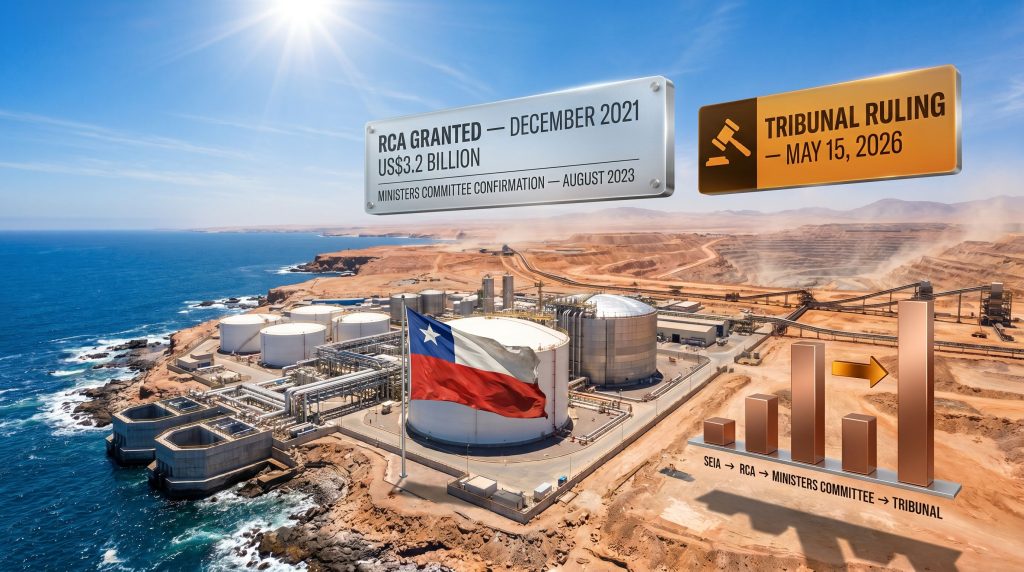
The infrastructure and production capacity expansion project at Collahuasi represents one of the largest private mining investments currently active in Chile. The project received its RCA in December 2021 following a full SEA assessment, and that authorisation was subsequently confirmed by the Ministers Committee in August 2023, establishing two distinct layers of regulatory validation. Despite this, Chile's Second Environmental Tribunal issued a ruling on May 15, 2026, targeting the 2021 RCA on two specific grounds. Anglo American's press release confirms that both co-owners are actively seeking clarification on the ruling's precise scope and enforceability.
| Project Component | Detail |
|---|---|
| Project Name | Infrastructure Development and Production Capacity Improvement |
| Total Estimated Investment | US$3.2 billion |
| Key Infrastructure Element | Desalination plant (reported as nearly complete) |
| RCA Granted | December 2021 |
| Ministers Committee Confirmation | August 2023 |
| Tribunal Ruling Date | May 15, 2026 |
| Immediate Production Impact | None reported, alternative water sources in use |
The tribunal identified concerns relating to impacts on a local community and effects on the marine environment. Notably, the ruling does not appear to constitute a wholesale invalidation of the project, but its precise scope and enforceability remain subjects of active legal interpretation, which is itself a revealing symptom of the framework's ambiguities.
The Desalination Plant Paradox
The near-complete desalination plant at the heart of this dispute occupies an unusual position in the regulatory debate. Desalination technology was adopted specifically to reduce the mine's dependence on continental freshwater extraction in one of the driest environments on Earth — the Tarapacá region of northern Chile. From an environmental policy perspective, moving away from freshwater abstraction in such a water-stressed area would ordinarily be viewed as a significant step in the right direction.
Yet it is this very infrastructure that now faces legal uncertainty on marine environment grounds. The irony is considerable: a facility designed to reduce one category of environmental harm is being challenged for potentially introducing another. This tension reflects a broader challenge in environmental assessment methodology — specifically, the difficulty of evaluating trade-offs between competing ecological priorities when large coastal industrial infrastructure is involved.
Community Rights and the Indigenous Consultation Fault Line
The community impact dimension of the tribunal's ruling connects to one of the most persistent fault lines in Chilean mining regulation. Indigenous communities in the Tarapacá region filed legal challenges between 2023 and 2024, arguing that the approval process failed to adequately assess consequences for livelihoods and territorial rights. These challenges invoked both Chile's domestic consultation obligations and the international standards embedded in ILO Convention 169 on Indigenous and Tribal Peoples, a framework that requires free, prior, and informed consultation with communities that may be affected by development projects.
The Business and Human Rights Resource Centre's coverage of the Ministers Committee proceedings underscores the extent to which community rights groups have been engaged throughout the process. This is consistent with a broader pattern across the mining geopolitical landscape, where social licence and legal challenge are increasingly intertwined.
A recurring pattern: The adequacy of prior consultation has emerged as a flashpoint not just at Collahuasi but across multiple major Chilean mining approvals in recent years, suggesting a systemic rather than project-specific challenge within the SEIA process.
Chile's consultation mechanism is formally embedded within the SEA process, but the legal community has long debated whether its procedural design genuinely satisfies the substantive intent of ILO 169. Critics argue that consultation as practised tends toward notification rather than genuine negotiation, creating a gap between formal compliance and meaningful community participation that tribunals are now stepping in to address.
Comparing Chile's Framework to Regional Peers
Chile's SEIA is generally regarded as one of the more structured environmental assessment systems in Latin America, however regional comparisons reveal both strengths and notable gaps.
| Dimension | Chile (SEIA) | Peru | Argentina |
|---|---|---|---|
| Primary Permitting Body | SEA | SENACE | Provincial authorities |
| Indigenous Consultation Mechanism | Formal SEA process + separate consultation | EIA-embedded | Provincial variation |
| Tribunal Review Mechanism | Environmental Tribunals | Administrative courts | Administrative review |
| Marine Impact Assessment | Integrated into EIA | Sector-specific | Limited framework |
| Appeals to Ministerial Level | Yes (Ministers Committee) | Limited | No equivalent |
Chile's layered system, with both ministerial and tribunal review, provides more formal oversight than most regional peers. However, the absence of clearly defined statutory categories for partial versus full RCA invalidation is a gap that Peru and Argentina also share, suggesting this is a region-wide weakness rather than a uniquely Chilean problem.
Operational Outlook: Why Copper Production Continues
Collahuasi is co-owned by Anglo American and Glencore, two of the world's largest diversified mining companies, and ranks among the highest-grade and highest-volume copper operations globally. Both companies have indicated publicly that the tribunal's ruling appears confined to two specific issues — a stance that signals a coordinated legal strategy oriented toward clarification and targeted remediation rather than wholesale project redesign.
Critically, Collahuasi has access to alternative water sources that allow current mining operations to continue without interruption. The desalination plant's primary function relates to long-term production capacity growth rather than sustaining present output levels, which provides a meaningful operational buffer while legal resolution is pursued.
The pathways available to Collahuasi under Chilean law include:
- Seeking formal clarification from the tribunal on the ruling's scope and enforceability.
- Engaging the SEA to determine whether supplementary environmental assessment is required on the two contested impact areas.
- Pursuing a formal legal appeal through Chile's higher courts.
- Conducting targeted re-assessment of community impact and marine environment methodology to directly address the tribunal's stated concerns.
Each pathway carries different timelines and commercial implications, and the dual-ownership structure introduces an additional layer of coordination complexity into decision-making.
The next major ASX story will hit our subscribers first
Project Finance Risk: A New Category Emerges
From an investment and lender perspective, the Collahuasi environmental assessment situation introduces a risk category that standard project finance models handle poorly.
Construction-complete, operationally-suspended risk occurs when capital has been fully or substantially deployed into a physical asset, yet that asset cannot be commissioned due to legal uncertainty over its underlying regulatory authorisation. This is distinct from construction risk, regulatory risk during development, or operational risk post-commissioning, and most project finance documentation does not contain explicit provisions for it.
For lenders and insurers active in Latin American mining, this case creates a precedent that may prompt significant revisions to environmental permit risk clauses in facility agreements. The growing integration of ESG risk frameworks into due diligence processes means that permit stability is no longer evaluated simply as a binary approved or not approved condition, but as a spectrum of durability influenced by consultation quality, cumulative impact methodology, and community relations history.
The demand for political risk and regulatory insurance products in Chilean mining project finance may accelerate meaningfully as a result of this ruling, particularly for assets with coastal infrastructure components where marine environment challenges are more likely. In addition, those reviewing copper investment strategies for the year ahead should weigh permit durability as a core variable in asset selection.
Structural Weaknesses and the Case for Reform
The Collahuasi case has crystallised several structural deficiencies in Chile's environmental assessment architecture that the policy and legal community has been debating for some time.
| Reform Area | Current State | Proposed Enhancement |
|---|---|---|
| Marine Environment Assessment | General EIA coverage | Dedicated cumulative impact protocol |
| Indigenous Consultation | Formal but contested | Integrated, independently verified track |
| RCA Partial Invalidation | Legally ambiguous | Defined statutory categories |
| Post-Approval Monitoring | Limited | Mandatory milestone reporting |
| Pre-Tribunal Mediation | Absent | Structured early resolution mechanism |
Proposals circulating within Chile's policy community include the introduction of a dedicated marine cumulative impact protocol within the SEIA framework, a parallel and independently verified Indigenous consultation track formally integrated into the RCA process, and a structured pre-tribunal mediation mechanism. These could resolve emerging community and environmental concerns before they escalate into costly and time-consuming legal proceedings.
The absence of mandatory post-approval monitoring milestones is a particularly underappreciated weakness. In jurisdictions with robust post-approval monitoring, compliance drift and emerging community concerns can be identified and addressed administratively before they crystallise into formal legal challenges. Chile's current system relies heavily on front-loaded assessment and provides limited structured mechanisms for ongoing engagement once an RCA is issued.
The Global Copper Supply Chain Dimension
No analysis of the Collahuasi environmental assessment in Chile is complete without acknowledging what this mine represents in the global copper supply landscape. Collahuasi consistently ranks among the top copper-producing operations worldwide, and copper's indispensable role in electrification infrastructure — from grid cables to electric vehicle motors — means that any material disruption to a flagship asset of this scale carries implications that extend well beyond Chile's borders. The Chile copper price outlook for the coming years will be shaped, in part, by how swiftly this permitting uncertainty is resolved.
The broader pattern is instructive: multiple major copper, lithium, and iron ore projects across Latin America have encountered similar regulatory and community-based legal challenges in recent years, suggesting that the region's environmental assessment frameworks are under sustained pressure from increasingly sophisticated legal strategies. For investors assessing critical minerals demand and supply chain risk, the durability of environmental permits has consequently become as important a variable as grade, tonnage, or infrastructure proximity.
The Collahuasi case does not represent a failure of any single regulatory decision. It reflects the growing tension between the pace at which the global economy demands expanded critical mineral supply and the speed at which environmental assessment frameworks are evolving to address cumulative ecological impacts and community rights. Chile, as the world's largest copper producer, sits at the epicentre of that tension, and how it resolves this case will signal to the entire mining investment community what regulatory stability in a world-class copper jurisdiction actually means in practice.
This article contains analysis of regulatory developments, legal proceedings, and investment risk frameworks. It does not constitute legal or financial advice. Outcomes of legal proceedings described are subject to change, and forward-looking assessments involve inherent uncertainty. Readers are encouraged to consult qualified legal and financial advisors before making investment or operational decisions based on the information presented.
Want to Stay Ahead of Major ASX Mineral Discoveries Before the Broader Market Reacts?
As regulatory complexity reshapes the global critical minerals landscape, Discovery Alert's proprietary Discovery IQ model cuts through the noise — delivering real-time alerts on significant ASX mineral discoveries and transforming complex data into actionable investment insights for both short-term traders and long-term investors. Explore how historic discoveries have generated substantial returns on Discovery Alert's discoveries page, and begin your 14-day free trial today to secure a market-leading edge.