August 6, 2026
The Quiet Crisis in Industrial Gas: Why Helium Supply Security Has Become a Geopolitical Priority
Most discussions of critical resource scarcity focus on rare earth elements, lithium, or cobalt. Yet one of the most consequential supply constraints unfolding in 2026 involves a gas most people associate with birthday parties. Helium has quietly become one of the most strategically sensitive industrial inputs in the global economy, and the structural forces now converging around its supply tell a story far more complex than any single policy announcement can capture.
Understanding why China helium export controls have triggered concern across semiconductor fabs, hospital procurement desks, and aerospace supply chains requires first understanding what makes helium uniquely irreplaceable, and why its supply architecture is so fragile. The broader helium supply crisis unfolding globally adds considerable urgency to this analysis.
When big ASX news breaks, our subscribers know first
Why Helium Cannot Be Substituted or Synthesised
Unlike most industrial gases, helium is a finite, non-renewable resource. It forms through the radioactive decay of uranium and thorium deep within the Earth's crust over billions of years, accumulates in natural gas reservoirs, and once released into the atmosphere, it escapes Earth's gravitational field permanently. There is no industrial process capable of producing helium synthetically. Every cubic metre consumed is gone.
This physical reality sits at the foundation of every supply chain vulnerability discussed in this article.
Helium's Role Across Critical Industrial Sectors
The breadth of helium's industrial applications is frequently underestimated outside specialist circles. Its unique physical properties, including the lowest boiling point of any element at -269 degrees Celsius, extreme chemical inertness, and exceptionally low density, make it non-substitutable across four sectors that sit at the core of modern technological infrastructure.
| Sector | Primary Application | Why Helium Is Irreplaceable |
|---|---|---|
| Semiconductor Manufacturing | Wafer fabrication, chip cooling, atmospheric control | Inert properties prevent oxidation at cryogenic temperatures |
| Medical Equipment | MRI superconducting magnet cooling | Only element capable of maintaining required cryogenic field stability |
| Aerospace and Defence | Pressurisation systems, leak detection, rocket fuel purging | Non-flammable, ultra-light, chemically stable under extreme conditions |
| Quantum Computing | Qubit cooling infrastructure | Near-absolute-zero operating temperatures require liquid helium |
Demand pressure from these sectors has been intensifying structurally. The global buildout of AI chip manufacturing facilities requires helium at every stage of wafer production. Quantum computing infrastructure, still in early-stage commercial deployment, is expected to drive significant incremental helium demand through the late 2020s. Furthermore, these are not cyclical demand spikes; they represent permanent baseline increases, reflective of the broader critical minerals demand surge reshaping global industrial supply chains.
How Helium Enters the Supply Chain
Helium does not exist as a standalone mineable resource in most commercially viable concentrations. Globally, the vast majority of commercial helium is extracted as a by-product of liquefied natural gas processing, captured from natural gas streams before LNG is produced for energy markets.
This structural dependency on LNG production creates a fundamental geographic concentration risk. Commercial-scale helium supply is tied directly to a small number of LNG-producing nations. The three dominant global sources are Qatar's Ras Laffan industrial complex, which is the world's largest single helium production hub, Russian export infrastructure centred on the Amur Gas Processing Plant in Eastern Siberia, and the United States federal helium reserve system combined with private production in the U.S. mid-continent.
A critical and frequently overlooked characteristic of this market is the near-total absence of large-scale storage buffers. Unlike oil or many industrial chemicals, liquid helium cannot be economically stockpiled at scale by most end-users. Consequently, supply disruptions transmit to end markets with unusual speed, and price spikes can be severe and rapid.
What China's Helium Export Controls Actually Prohibit
The Legal Architecture of the 2026 Measure
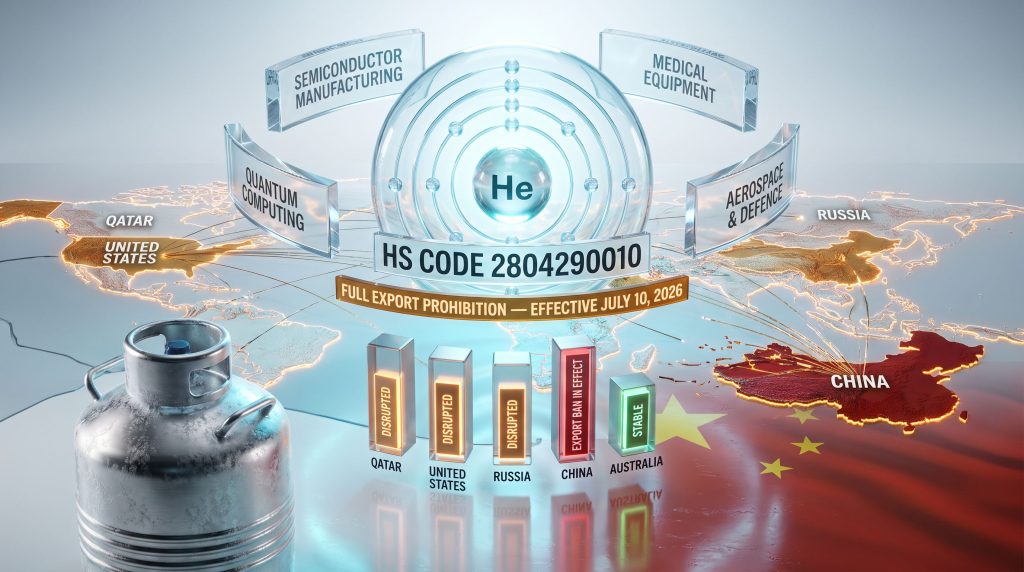
China helium export controls were introduced through Announcement No. 29 of 2026, issued jointly by the Ministry of Commerce and the General Administration of Customs. The legal basis cited is China's Foreign Trade Law, and the controlled commodity is identified under customs classification HS Code 2804290010, covering helium gas.
The Ministry of Commerce confirmed the measure was aligned with both domestic foreign trade legislation and World Trade Organization rules, citing domestic supply security as the primary rationale. The ministry also signalled that export management policies would be adjusted over time in response to shifts in both domestic and international supply and demand conditions.
A structural distinction that matters significantly for importers and trade lawyers is the difference between an outright export prohibition and a licensing restriction. China's export controls applied to gallium and germanium in 2023 introduced licensing requirements that allowed exports to continue subject to approval processes. The helium measure, by contrast, is structured as a complete prohibition, with no publicly listed exemption categories for medical, scientific, semiconductor, or humanitarian end-uses at the time of introduction.
Regulatory Note: The absence of exemption categories in the initial measure represents a more absolute policy instrument than China's prior critical material controls. Whether sector-specific exemptions are introduced through subsequent regulatory adjustments remains an open question with significant implications for healthcare and research procurement globally.
Confirmed Scope and Policy Ambiguities
What the ban definitively covers:
- Full prohibition on overseas helium shipments effective from July 10, 2026
- No stated expiration date, making this an open-ended policy instrument
- No published exemption categories for medical, scientific, or strategic industrial applications
- No public guidance issued on the treatment of pre-existing long-term supply contracts
Key policy ambiguities that remain unresolved:
- How long-term supply agreements signed before July 10 will be treated at customs
- What specific conditions would trigger the "subsequent adjustments" mechanism referenced by the Ministry of Commerce
- Whether re-export prevention is explicitly codified in customs instructions or implied through the prohibition language
- Whether goods already in transit or customs clearance at the effective date are subject to the measure
WTO Compliance Considerations
The Ministry of Commerce's affirmation of WTO alignment reflects a legally defensible position. Under WTO Article XI, export restrictions imposed for the purpose of domestic supply security are permissible under defined circumstances. China has successfully defended similar positions in relation to earlier export controls on industrial inputs.
However, the complete absence of exemptions for essential medical goods may attract scrutiny. WTO dispute settlement history involving export restrictions on raw materials has generally required states to demonstrate that restrictions are necessary, non-discriminatory, and proportionate. The open-ended duration and absence of humanitarian exemptions could form the basis of a future challenge, though dispute resolution timelines typically operate on multi-year horizons.
The Strategic Paradox at the Heart of China's Decision
A Net Importer Imposing Export Controls
The most analytically striking feature of China helium export controls is the fundamental paradox they represent. According to data cited by Trivium China, Reuters has confirmed that more than 85 percent of China's domestic helium supply is sourced from overseas, primarily from Qatar and Russia. China holds no meaningful domestic helium reserves.
This makes China simultaneously a net importer of helium and, through re-export flows, a participant in the international helium trade. The export ban is therefore not an act of resource nationalism in the conventional sense. It does not reflect control over a domestic resource; it reflects control over imported supply that would otherwise flow back out through Chinese distribution networks.
Key Insight: When international spot prices for helium spike above the price levels at which helium is sold domestically within China, domestic distributors face strong financial incentives to divert imported helium for export rather than supplying Chinese industrial consumers. The ban closes this arbitrage channel, ensuring imported helium reaches domestic semiconductor fabs, hospitals, and aerospace programmes rather than exiting through commercial re-export activity.
Three Structural Drivers Behind the Policy
-
Domestic industrial security: China's semiconductor fabrication sector, medical imaging infrastructure, and aerospace programmes all depend on stable helium supply. Protecting these sectors from global spot market volatility is a direct industrial policy objective.
-
Re-export arbitrage prevention: Global supply tightening in 2025 and 2026 has driven international helium prices significantly higher. Price differentials between controlled domestic Chinese prices and international spot rates create profit incentives that could drain domestically available supply. The export prohibition eliminates this dynamic.
-
Strategic sector prioritisation: China's AI chip manufacturing buildout and quantum computing investment programmes have elevated helium to a critical input for state-prioritised industrial sectors, reinforcing the political logic of domestic supply protection.
The Upstream Shock Context
China's export controls did not emerge in isolation. They represent, in supply chain terms, a third-order response to a sequence of upstream disruptions that have progressively tightened global helium availability:
- Conflict-related disruption to energy infrastructure in the Middle East affecting LNG-adjacent production
- Russia's tightening of its own helium export controls, removing a major global supply source from open markets
- Operational disruptions at Qatar's Ras Laffan complex, the world's largest individual helium production facility
Each of these events removed supply from a market that already operates with minimal storage buffers. China's ban arrives as an additional constraint on an already stressed global system, compounding geopolitical resource risks that have been building across multiple commodity categories.
Global Supply Architecture and Sector Exposure
Calibrating the Market Impact
| Supplier | Role in Global Market | Current Status |
|---|---|---|
| Qatar (Ras Laffan) | Largest single production source globally | Disrupted |
| United States | Second-largest, combination of strategic reserves and private production | Stable but declining structural output |
| Russia (Amur GPP) | Major global exporter | Export controls tightened |
| China | Net importer, minor re-export participant | Export prohibition in effect |
| Australia | Emerging production capacity | Limited current commercial scale |
China's direct contribution to global helium export volumes is relatively modest given its net importer status. The immediate volumetric impact of the ban on global supply is therefore limited compared to, for example, a disruption at Ras Laffan. However, the significance of the measure is amplified by its timing and its signalling function: it adds a fourth concurrent supply-side constraint to a market already under pressure from three separate upstream disruptions.
Which Sectors Face the Highest Exposure
Semiconductor manufacturing faces production-level consequences rather than cost increases alone. Helium shortages cannot be resolved through substitution in wafer fabrication environments; they translate directly into reduced production throughput.
Medical imaging carries some buffer through strategic reserves maintained by major MRI manufacturers, but extended procurement cycle disruptions compress hospital capital equipment programmes and create downstream patient access concerns.
Aerospace and defence programmes with government procurement relationships typically have priority access mechanisms, though commercial aerospace operators face open-market exposure at elevated prices.
Quantum computing and research institutions represent the most vulnerable category. These buyers have the smallest purchasing power relative to industrial consumers, no strategic reserve access, and procurement processes poorly adapted to spot market dynamics.
Comparing This to the Gallium and Germanium Controls
China's 2023 export licensing regime for gallium and germanium established the template for applying export control frameworks to critical industrial inputs beyond rare earth supply chains. That measure was widely interpreted as carrying geopolitical leverage intent, given gallium and germanium's specific roles in defence electronics and compound semiconductors used extensively by Western military programmes.
The helium measure is structurally different in its apparent rationale. The defensive supply security logic, grounded in China's own import dependency rather than resource leverage, positions this as a domestic protection measure rather than an externally directed pressure instrument. However, the cumulative pattern is unmistakable: China has now extended export control frameworks across rare earths, critical minerals, and industrial gases. Helium is the first industrial gas to enter this framework from a major economy.
Scenarios for Resolution and Supply Chain Adaptation
Three Regulatory Pathways Forward
Scenario A: Short-Term Lifting Within Three to Six Months
Triggered by stabilisation of Qatar's Ras Laffan operations and Russian supply conditions, combined with replenishment of Chinese domestic helium inventories. The most likely resolution in this scenario would involve transitioning from an outright prohibition to a licensing-based framework, consistent with the pattern established for gallium and germanium.
Scenario B: Extended Prohibition with Selective Exemptions Over Six to Eighteen Months
Continued upstream supply disruption combined with sustained domestic demand growth drives an extended restriction. In this scenario, sector-specific exemptions covering medical and scientific research applications are introduced through subsequent regulatory adjustments, while semiconductor and commercial re-export uses remain restricted.
Scenario C: Permanent Structural Reform Beyond Eighteen Months
China develops long-term bilateral supply agreements with emerging helium producers, or makes meaningful progress in domestic helium capture capacity. In this scenario, the outright prohibition is replaced by a managed allocation system with formal licensing requirements, effectively institutionalising state oversight of helium flows permanently.
How Global Buyers Are Responding
- Inventory acceleration: Industrial gas companies and semiconductor manufacturers are accelerating procurement from non-Chinese sources, particularly U.S. private reserves and Algerian production
- Supplier diversification: Buyers are increasing engagement with emerging producers in Tanzania, Algeria, and developing U.S. private reserve projects
- Substitution research: Investment in helium-reduction technologies in MRI manufacturing and semiconductor thermal management systems is accelerating, though meaningful substitution remains years away for most applications
- Contract restructuring: Procurement legal teams are urgently reviewing long-term supply agreements for export control force majeure provisions and updating standard terms for future contracts
The next major ASX story will hit our subscribers first
Frequently Asked Questions on China's Helium Export Controls
Why does China ban helium exports if it imports the vast majority of its supply?
The ban targets re-export arbitrage. When international spot prices exceed Chinese domestic distribution prices, commercial incentives drive helium imported for domestic use back into export channels. The prohibition ensures imported supply reaches Chinese industrial consumers rather than exiting through trader activity.
Which industries face the most significant disruption?
In order of operational severity: semiconductor manufacturing, medical imaging, aerospace supply chains, and quantum computing research institutions.
Is the ban permanent?
The measure has no stated expiration date. The Ministry of Commerce has indicated adjustments will be made based on domestic and international supply conditions, but no timeline or trigger criteria have been published. ABC News reporting on the ban's implications for chipmaking highlights the open-ended nature of the restriction.
How does this differ from the 2023 gallium and germanium controls?
The gallium and germanium regime introduced licensing requirements rather than outright prohibition, and was widely read as carrying geopolitical leverage intent. The helium measure is structured as defensive supply security given China's import dependency, though both are part of an expanding Chinese export control framework.
What is the current global helium supply situation?
Four concurrent supply-side constraints are operating simultaneously: disruption at Qatar's Ras Laffan complex, tightened Russian export controls, conflict-related energy infrastructure disruption in the Middle East, and China's export prohibition.
What This Signals for Critical Resource Governance
Industrial Gas as a New Frontier of Strategic Resource Policy
The extension of export control frameworks from minerals to industrial gases represents a meaningful evolution in how governments conceptualise critical resource security. Helium is now the first industrial gas to enter a major-economy export control regime. The policy logic that justified controls on rare earths, then gallium and germanium, has now been applied to a gaseous by-product of LNG processing with no viable substitute and no synthetic production pathway.
This creates a precedent that procurement strategists and supply chain risk managers across the semiconductor, medical technology, and aerospace sectors need to integrate into long-term planning frameworks. The assumption that industrial gases exist outside the geopolitical resource competition framework is no longer sustainable.
Operational Checklist for Procurement and Supply Chain Teams
- Monitor Ministry of Commerce announcements specifically for language around "subsequent adjustments" to the China helium export controls prohibition
- Review existing long-term helium supply contracts for export control force majeure provisions and legal interpretation of material adverse change clauses
- Assess current inventory buffer adequacy against a six to eighteen month extended restriction scenario, not a short-term disruption model
- Identify and develop alternative supplier relationships across Qatar post-disruption recovery scenarios, U.S. private production, and emerging producers in Algeria and Tanzania
- Engage government procurement channels for priority allocation access if operating in strategic sectors including medical imaging and defence aerospace
- Commission internal substitution feasibility assessments for helium-intensive production processes, even where near-term substitution is not viable
Readers seeking additional context on China's evolving export control frameworks and global helium supply dynamics may find the South China Morning Post's ongoing global economy coverage a useful supplementary reference for tracking regulatory developments.
Want to Know When the Next Major Resource Discovery Hits the ASX?
Discovery Alert's proprietary Discovery IQ model scans ASX announcements in real time, instantly identifying high-potential mineral and resource opportunities across more than 30 commodities — so investors can act before the broader market catches on. Explore Discovery Alert's discoveries page to see how historic finds have delivered substantial returns, and begin your 14-day free trial today to secure a genuine market-leading edge.