August 20, 2026
Africa's Industrial Chessboard Is Being Redrawn One Billion Dollars at a Time
Across the African continent, a quiet but consequential transformation is underway. Special economic zones and beneficiation that once served primarily as low-cost assembly points are evolving into sophisticated industrial corridors capable of reshaping global supply chains. At the centre of this shift sits a zone straddling two of the world's most critical maritime passages, attracting capital at a scale that few African investment destinations have ever seen. The China $2 billion investment in Egypt's Suez Canal Economic Zone is not a single transaction. It is a signal that Beijing's industrial strategy in Africa has entered a new, more ambitious phase.
When big ASX news breaks, our subscribers know first
The Suez Canal Economic Zone: Africa's Most Geographically Privileged Industrial Platform
Understanding why Egypt's Suez Canal Economic Zone commands this level of attention requires stepping back from the headlines and examining what makes SCZONE structurally distinct from every other African special economic zone in operation today.
Covering approximately 461 square kilometres, SCZONE occupies a geographic position that no other African zone can replicate. It simultaneously connects to both the Red Sea and the Mediterranean, meaning goods manufactured within its borders can reach European, Gulf, South Asian, and East African markets without transiting a secondary port. This dual-sea access compresses logistics costs and delivery timelines in ways that single-corridor African zones simply cannot match.
The zone's infrastructure reflects decades of deliberate investment. Key assets include:
- Deepwater port facilities at East Port Said, one of the Mediterranean's most capable transshipment hubs
- The Ain Sokhna port complex on the Red Sea coast, which handles bulk industrial cargo
- Dedicated industrial parks with pre-built utilities and logistics corridors
- Customs exemption frameworks and free zone licensing structures designed to reduce regulatory friction for foreign investors
Egypt's status as Africa's third-most industrialised nation adds another layer of attractiveness. Unlike many African investment destinations where Chinese projects must build foundational infrastructure from scratch, SCZONE offers a pre-existing industrial baseline, including a skilled technical workforce, established supply chains, and functioning utilities networks.
How SCZONE Compares to Other Major African Special Economic Zones
| Feature | SCZONE (Egypt) | Lekki FTZ (Nigeria) | Dube TradePort (South Africa) |
|---|---|---|---|
| Total Area | ~461 km² | ~165 km² | ~29 km² |
| Primary Focus | Industry, logistics, manufacturing | Light manufacturing, trade | Logistics, agri-processing |
| China Investment Presence | High — multiple $2B+ projects | Moderate | Low |
| Port Access | Red Sea + Mediterranean | Atlantic coast | Indian Ocean adjacent |
| Job Creation Targets | 150,000+ (projected) | ~170,000 (long-term) | ~15,000 |
Egypt's dual-sea access makes SCZONE structurally superior for export-oriented manufacturing relative to most African SEZs, which typically serve single-corridor trade routes. No other zone on the continent offers simultaneous gateway access to Europe, the Gulf, and Sub-Saharan Africa from a single industrial footprint.
Three Separate $2 Billion Chinese Projects: Unpacking What Is Actually Being Built
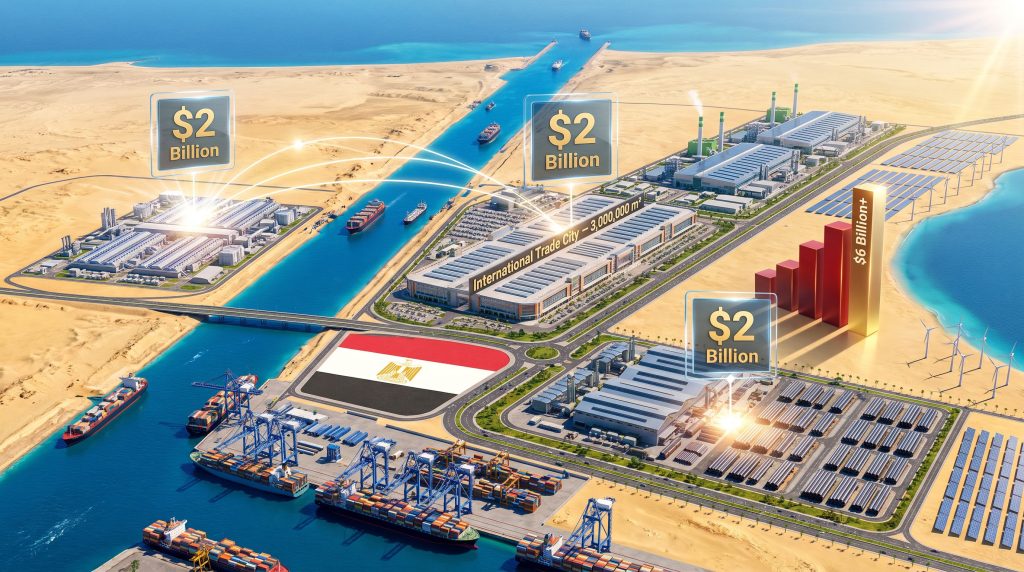
One of the most widely misunderstood dimensions of the China $2 billion investment in Egypt's Suez Canal Economic Zone is the assumption that a single project accounts for the figure. In reality, multiple distinct Chinese-led initiatives, each carrying its own approximately $2 billion valuation, are either proposed or in advanced negotiation within SCZONE. When aggregated, announced Chinese investment commitments in the zone substantially exceed the headline number.
Project One: The Integrated Aluminum Industrial Complex
In August 2026, Egypt's Deputy Prime Minister for Economic Affairs, Hussein Issa, met with a senior delegation from a leading Chinese aluminum group in New Alamein city. The discussions centred on a proposed $2 billion integrated aluminum industrial complex to be developed within or adjacent to SCZONE's industrial framework.
Key parameters of this project include:
- A projected workforce of more than 3,000 direct local jobs
- A mandatory requirement that the facility operate using clean and renewable energy sources
- Explicit conditions around the transfer of advanced manufacturing technologies to Egyptian counterparts
- Integration with Egypt's broader industrial development priorities under its FDI attraction framework
The clean energy requirement is particularly significant. Aluminum smelting ranks among the most electricity-intensive industrial processes in existence, typically consuming between 13,000 and 17,000 kilowatt-hours per tonne of aluminum produced. A smelter powered by renewable energy in Egypt would produce a product that qualifies as low-carbon aluminum, a category commanding a growing price premium in European markets as the EU's Carbon Border Adjustment Mechanism begins to penalise carbon-intensive imports. Furthermore, the decarbonisation benefits of such an approach extend well beyond compliance, offering long-term competitive advantages in premium export markets.
Project Two: The International Trade and Logistics City
A separate and considerably larger Chinese proposal envisions a trade and logistics city modelled on China's renowned Yiwu International Trade City, one of the world's largest wholesale commodity markets covering more than 5.5 million square metres across multiple districts. The SCZONE version is proposed at a footprint of approximately 3 million square metres.
This project's scope extends well beyond warehousing. Planned facilities include:
- Commercial showrooms across multiple product categories
- Integrated hotel, school, and hospital facilities creating a self-contained commercial ecosystem
- Dedicated logistics and freight handling infrastructure linked to SCZONE's port assets
- An employment projection of up to 150,000 workers, making it the single largest employment-generating Chinese project proposed in SCZONE
The Yiwu model is worth understanding in depth. Yiwu's trade city functions as a permanent wholesale exhibition and transaction hub, where manufacturers and traders from across China display and sell goods to international buyers in a physical marketplace. Replicating this structure in SCZONE would effectively create a permanent gateway market for Chinese goods entering African, European, and Gulf markets, while also allowing Egyptian and other African producers to access the distribution network.
Project Three: The Iron and Steel Manufacturing Plant at Ain Sokhna
Xinxing Ductile Iron Pipes, a major Chinese industrial manufacturer with global operations in pipe and steel production, has proposed a $2 billion iron and steel manufacturing facility at the Ain Sokhna industrial area within the broader SCZONE framework.
The product focus is ductile iron pipes and steel goods, targeting both Egyptian domestic infrastructure demand and export markets across the region. Africa's infrastructure deficit, estimated in the hundreds of billions of dollars across road, water, and energy networks, represents a substantial addressable market for exactly this type of output. Consequently, the green steel pricing dynamics emerging globally could further enhance the competitiveness of low-carbon steel production from this facility.
Chinese Investment in SCZONE: Consolidated Overview
| Project Type | Chinese Sector | Investment | Jobs Created | Export Focus |
|---|---|---|---|---|
| Aluminum Industrial Complex | Aluminum manufacturing | $2 billion | 3,000+ | Yes — regional export hub |
| International Trade City | Logistics and wholesale trade | $2 billion | 150,000 | Yes — multi-market |
| Iron and Steel Plant (Ain Sokhna) | Heavy industry | $2 billion | TBC | Yes — pipe and steel exports |
| Total Announced (Approximate) | Multi-sector | $6 billion+ | 150,000+ | High |
When these projects are viewed collectively rather than individually, Chinese announced investment in SCZONE represents one of the largest concentrated foreign direct investment commitments in any African special economic zone in modern history. The scale signals a systematic industrial strategy, not opportunistic deal-making.
The Economic Logic Driving China's SCZONE Push
Three structural forces are converging to make SCZONE the focal point of Chinese outbound industrial investment at this particular moment.
Overcapacity and the need for offshore production platforms. China's domestic aluminum and steel sectors have accumulated significant surplus production capacity following years of state-directed industrial expansion. Rather than continuing to flood global markets with directly exported goods that attract anti-dumping tariffs, relocating production to a jurisdiction like SCZONE allows Chinese manufacturers to service the same global demand from a neutral, trade-agreement-connected base.
Tariff arbitrage through Egypt's trade architecture. Products manufactured within SCZONE benefit from Egypt's membership in the African Continental Free Trade Area (AfCFTA), a preferential trade framework encompassing 54 African countries. They also benefit from Egypt's association agreement with the European Union and proximity to Gulf Cooperation Council markets. However, the impact of tariffs and supply chains globally means that Chinese-manufactured goods face escalating trade barriers in Western markets, whereas SCZONE-manufactured goods do not carry the same tariff exposure.
Belt and Road Initiative operationalisation. Egypt formally joined China's Belt and Road Initiative in 2016, and SCZONE was identified early as a strategic industrial cooperation zone within that framework. The current wave of investment proposals represents the translation of a decade-old diplomatic alignment into concrete industrial commitments. This is not opportunism; it reflects the maturation of a pre-planned strategic trajectory.
Currency and cost advantages. Egypt's pound has undergone significant devaluation cycles in recent years, materially reducing production costs for dollar-denominated exporters operating in Egypt. For Chinese manufacturers pricing in US dollars or euros, Egyptian operating costs have become increasingly competitive relative to domestic Chinese production.
Egypt's Negotiating Position: Technology Transfer and Green Energy as Non-Negotiable Conditions
What distinguishes Egypt's approach to this investment wave from passive resource extraction deals is the conditions Cairo has embedded in its negotiations. Egypt's government has made clear that Chinese investment in SCZONE must deliver two outputs beyond capital and employment: advanced technology transfer and clean energy adoption.
The technology transfer requirement is strategically important. Rather than simply hosting foreign factories that employ local labour in low-skill roles, Egypt is seeking to transfer industrial knowledge and process expertise into its domestic economy. If enforced effectively, this approach mirrors South Korea and Taiwan's historical use of foreign industrial investment as a vehicle for technological upgrading, a pathway that transformed both economies from low-cost manufacturers to high-value industrial producers within two generations.
The clean energy mandate carries its own strategic rationale beyond environmental alignment. The EU's Carbon Border Adjustment Mechanism is already pricing carbon intensity into imports. Egyptian-manufactured aluminum or steel produced using renewable energy will carry a lower CBAM liability than the same products manufactured using conventional electricity grids, creating a lasting cost advantage in European export markets.
Egypt's Gulf of Suez corridor, directly adjacent to SCZONE, is one of the Middle East and North Africa region's most productive wind energy zones. The Sinai Peninsula and Western Desert offer significant solar irradiance. This renewable energy potential is not theoretical; Egypt has been building large-scale renewable capacity for years, and SCZONE industrial projects represent high-certainty anchor demand for that generation capacity.
The Geopolitical Dimension: Washington's Strategic Response Problem
The SCZONE investments are unfolding within a broader contest for economic influence across Africa, one in which the United States is increasingly engaged but structurally disadvantaged in terms of speed and scale.
Washington has committed approximately $62.8 million across four African nations to support rare-earth mineral projects, part of a wider effort to reduce global dependence on Chinese-controlled critical minerals demand supply chains. This represents a meaningful signal of intent, but the capital differential when set against China's multi-billion-dollar SCZONE commitments is stark.
Comparing US and Chinese Engagement Models in Africa
| Dimension | China's Approach | US Approach |
|---|---|---|
| Primary instrument | Industrial FDI, SEZ development, BRI infrastructure | Development finance, security partnerships, rare-earth funding |
| Scale of commitment | $6 billion+ in SCZONE alone | $62.8 million (rare-earth focus, four countries) |
| Speed of deployment | Fast — bilateral state-to-state structures | Slower — multilateral, compliance-heavy frameworks |
| Technology transfer | Embedded in deal conditions | Limited in current Africa engagement model |
| Employment generation | High — labour-intensive manufacturing | Moderate — project-specific |
The asymmetry in capital deployment scale suggests that, in the near term, China's industrial footprint in SCZONE will continue expanding faster than Western alternatives can be mobilised, unless the US substantially recalibrates both the scale and structure of its Africa economic engagement architecture.
The Suez Canal's strategic importance amplifies the geopolitical stakes. The canal handles approximately 12 to 15 percent of global trade by volume in normal operating years, making the surrounding industrial and logistics infrastructure genuinely consequential for global shipping economics, not merely a bilateral trade matter.
The next major ASX story will hit our subscribers first
Employment, Technology, and Exports: Quantifying the Impact on Egypt
If even a fraction of the announced Chinese projects in SCZONE reach operational scale, the macroeconomic effects on Egypt could be substantial across three dimensions.
Direct employment generation from the trade city alone projects 150,000 roles, a figure that exceeds the total workforce of many African special economic zones combined. The aluminum complex adds a further 3,000 direct manufacturing positions in higher-skill industrial roles. Indirect employment multipliers in construction, logistics, services, and supply chain management could amplify total economic impact by a factor of three to five times the direct figures.
Technology transfer outcomes will depend heavily on Egypt's regulatory capacity to enforce the conditions embedded in investment agreements. Emerging market history is littered with technology transfer commitments that remained aspirational. Egypt's ability to operationalise these conditions — through localisation requirements, joint venture structures, or mandatory training provisions — will determine whether SCZONE becomes a genuine industrial upgrading vehicle or simply a foreign-operated export platform.
Export hub positioning represents the most strategically significant long-term outcome. With access to AfCFTA's continental market, EU association agreement benefits, and Gulf proximity, SCZONE-manufactured goods can reach a combined consumer base numbering in the billions without facing the tariff exposure that confronts goods shipped directly from Chinese ports.
Scenario projection: If all three major Chinese SCZONE projects reach operational capacity within a seven to ten year horizon, Egypt could plausibly add $4 to $6 billion in annual export revenues from SCZONE alone, reduce its aluminum and steel import dependency, and establish itself as the dominant industrial processing corridor between Sub-Saharan Africa and European markets. Realisation depends on political continuity, energy infrastructure delivery, enforcement of negotiated conditions, and global commodity demand cycles. This is a scenario projection, not a confirmed forecast, and investors should apply appropriate caution to long-range industrial development timelines in emerging markets.
Frequently Asked Questions: China's Investment in Egypt's Suez Canal Economic Zone
What exactly is the $2 billion China investment in Egypt's Suez Canal Economic Zone?
The figure refers to multiple separate Chinese investment proposals within SCZONE, each carrying an approximate $2 billion valuation. These include an integrated aluminum industrial complex, a large-scale international trade and logistics city modelled on China's Yiwu market, and an iron and steel manufacturing plant in the Ain Sokhna area. When combined, total announced Chinese commitments in SCZONE substantially exceed the widely cited $2 billion headline figure.
How many jobs will these projects create in Egypt?
Combined projections range from 3,000 direct manufacturing positions in the aluminum complex to 150,000 roles in the international trade city. Indirect employment effects across supply chains, logistics, and services could multiply these figures significantly over the project development timeline.
Is this connected to China's Belt and Road Initiative?
Yes. Egypt joined the Belt and Road Initiative in 2016, and SCZONE was identified as a strategic BRI industrial cooperation zone within that framework. The current investment proposals represent the deepening of that diplomatic alignment into concrete industrial and infrastructure commitments.
What conditions has Egypt attached to Chinese investment in SCZONE?
Egypt's government has embedded requirements for clean energy sourcing, technology transfer, and meaningful local employment creation into its investment negotiations. Egypt has also committed to streamlining its regulatory environment and reducing bureaucratic barriers to project development, as communicated by Deputy Prime Minister Hussein Issa during negotiations with Chinese delegations.
Why does this investment matter beyond Egypt's borders?
SCZONE's geographic position on both the Red Sea and Mediterranean means that large-scale industrial capacity established there effectively serves as a production hub for European, Gulf, and African markets simultaneously. If SCZONE develops into a major aluminum and steel export platform, the pricing and supply dynamics in those sectors across the broader region could shift materially over the medium term.
The Strategic Outlook: Catalysts, Risks, and What Comes Next
Near-term catalysts for acceleration include:
- Egypt's continued FDI liberalisation and investment climate reform agenda
- Growing EU demand for green-certified industrial metals under CBAM compliance pressure
- AfCFTA's progressive implementation deepening market access for SCZONE-manufactured goods
- China's persistent overcapacity pressure sustaining outbound industrial investment momentum
Risk factors that investors and analysts should monitor:
- Egypt's macroeconomic stability, particularly currency volatility, inflation, and fiscal pressures that could complicate project financing structures
- The enforceability of technology transfer conditions, which historically represent the most frequently under-delivered element of emerging market FDI agreements
- Geopolitical friction, including potential US pressure on Egyptian partners regarding Chinese industrial presence in strategically sensitive maritime corridors
- Energy infrastructure delivery timelines, given that power-intensive aluminum and steel manufacturing at SCZONE scale would represent a substantial incremental demand load on Egypt's grid
The longer-term strategic significance of what is unfolding in SCZONE extends beyond Egypt's borders. If the zone's Chinese industrial projects reach operational scale, Egypt could emerge as Africa's dominant heavy manufacturing export platform — a structural shift with continent-wide implications for where industrial production and value-added processing occur across the developing world. For global commodity markets, new aluminum and steel capacity originating from SCZONE would introduce meaningful additional supply with regional pricing implications for construction and infrastructure sectors across Sub-Saharan Africa and the Gulf.
The chessboard is being rearranged. The pieces being moved are measured in billions of dollars and hundreds of thousands of jobs. And the board itself is the 461 square kilometres sitting between two seas at the hinge point of three continents.
Want to Stay Ahead of the Next Major Mineral Discovery Driving These Industrial Shifts?
As billions of dollars reshape Africa's industrial corridors and critical mineral supply chains, Discovery Alert's proprietary Discovery IQ model delivers real-time alerts on significant ASX mineral discoveries, transforming complex data into actionable investment insights — explore historic discoveries and their remarkable returns, then begin your 14-day free trial to position yourself ahead of the market.