
August 5, 2026
The Hidden Architecture of Mineral Dependency: Why Rare Earth Controls Are Rewriting Global Trade Rules
The global economy has quietly constructed itself around a geological reality that very few policymakers fully appreciated until recently. China rare earth export controls have emerged as one of the defining trade policy developments of 2025, reshaping how governments and manufacturers think about supply chain security. Rare earth elements and critical minerals like indium are not simply raw materials traded on open markets. They are foundational inputs embedded so deeply within modern industrial systems that their absence can halt aircraft engine production, derail semiconductor fabrication lines, and delay the construction of next-generation AI data centres.
China's dominance over rare earth processing did not emerge overnight. It was built over three decades of deliberate industrial policy, subsidised refinery development, and tolerance for environmental costs that Western nations were unwilling to accept. By the time global manufacturers recognised the extent of their exposure, Chinese firms controlled an estimated 85-90% of global rare earth refining capacity, creating a structural dependency that no amount of diplomatic goodwill could quickly resolve.
When big ASX news breaks, our subscribers know first
Why China's Rare Earth Export Controls Are Reshaping Global Industry
The Strategic Logic Behind Beijing's Mineral Restrictions
When China introduced its first wave of controls in April 2025, the immediate framing was retaliatory. The controls followed U.S. President Donald Trump's "Liberation Day" tariff announcements and were widely interpreted as a tit-for-tat measure. That framing was accurate as far as it went, but it obscured a more sophisticated strategic calculation playing out beneath the surface.
Beijing recognised that tariffs are reversible. A future administration could lower them with a signature. Export control regimes, particularly those embedded in national security licensing frameworks with end-use verification requirements, are fundamentally different instruments. They create institutional dependencies, bureaucratic processes, and enforcement architectures that outlast any single diplomatic cycle.
By routing critical mineral access through a licensing system rather than simply adjusting quotas or prices, China transformed a trade dispute instrument into a permanent regulatory feature of global commerce. Furthermore, China's rare earth restrictions have proven far more durable than conventional tariff measures, precisely because they are embedded within national security frameworks.
From Raw Materials to Geopolitical Instruments
The conceptual shift that occurred in 2025 was from treating rare earths as export commodities subject to market forces, to treating them as strategic assets subject to national security oversight. This shift carries profound implications for every industry that relies on these materials, because it means that access is no longer primarily a commercial question. It is a political one.
Consider the difference in practical terms:
- Under a commodity market model, a manufacturer can hedge supply risk through contracts, inventory management, and supplier diversification.
- Under a licensing regime, a manufacturer must seek approval from a foreign government whose criteria for granting or denying approval can shift based on geopolitical conditions entirely outside the manufacturer's control.
- The approval process introduces timeline uncertainty, end-use scrutiny, and the implicit risk that legitimate commercial applications could be reclassified as strategically sensitive at any point.
This is the environment that manufacturers across aerospace, semiconductors, clean energy, and defence now operate within. The controls are not simply a supply constraint. They are a permanent conditionality woven into global industrial planning.
A Timeline of Escalation
The progression of China rare earth export controls reveals a carefully sequenced strategy rather than reactive policymaking:
| Date | Control Action | Scope |
|---|---|---|
| February 2025 | Indium added to export control list | Full licensing requirements for all exports |
| April 2025 | Wave 1 implemented | Seven heavy rare earth elements targeted |
| October 2025 | Wave 2 expansion announced | Five additional elements plus processing technology and technical know-how |
| Post-October 2025 | Wave 2 partially suspended | Suspension window running until November 2026 |
| May 2026 | Summit acknowledgment | White House tacitly accepts permanent regime |
The trajectory reveals an important pattern. Each escalation step covered not just additional minerals but additional layers of the supply chain, eventually incorporating the processing expertise and equipment knowledge that China has spent decades accumulating.
What Minerals Are Actually Controlled and Why Each One Matters
The First Wave: Heavy Rare Earths Targeted in April 2025
The seven heavy rare earth elements targeted in the initial April 2025 controls were not chosen arbitrarily. Heavy rare earths possess unique magnetic and luminescent properties that make them particularly valuable in high-performance applications. Their relative scarcity within known ore deposits and the complexity of their separation chemistry means that alternative sourcing cannot be rapidly established even with substantial capital investment.
Yttrium serves a critical function in the thermal barrier coatings applied to turbine blades in commercial and military jet engines. These coatings must withstand temperatures exceeding 1,000 degrees Celsius while maintaining structural integrity, and yttrium-stabilised zirconia remains the industry standard material. Ongoing yttrium shortages have severely impacted U.S. aerospace manufacturing, with companies lobbying Washington to intervene with Beijing over access constraints disrupting both commercial aviation maintenance schedules and defence procurement timelines.
Scandium, another element in the initial control wave, has become increasingly important in semiconductor fabrication, particularly in certain deposition processes used during chip manufacturing. Scandium shortages have created measurable impacts on chip manufacturing yield and capacity planning for producers operating at the leading edge of process technology.
The Second Wave: Technology and Know-How as Controlled Items
The October 2025 expansion marked a qualitative shift in the scope of the control regime. By extending restrictions to cover processing equipment, technical documentation, and the accumulated operational knowledge required to refine rare earth elements into usable compounds, Beijing effectively weaponised its decades of processing expertise as a strategic asset.
This is a particularly sophisticated form of export control because it targets capabilities rather than just commodities. The processing challenges involved in converting raw ore into usable compounds represent one of the most significant structural vulnerabilities facing Western supply chains today. A Western nation could theoretically mine rare earth ore domestically and still find itself unable to process those ores into battery-grade or magnet-grade materials without access to the technology and knowledge China now controls.
Indium: The Mineral That Connects Semiconductors to AI Infrastructure
Of all the minerals addressed in China's export control framework, indium arguably represents the most consequential near-term vulnerability for emerging technology sectors. Its inclusion on the Chinese export control list in February 2025 predated the main rare earth control waves, suggesting Beijing had specifically identified its strategic significance in advance of broader escalation.
Indium's criticality stems from two distinct compound applications that are both expanding rapidly:
- Indium phosphide serves as the foundational substrate material for next-generation photonic chips, which process data using light rather than electricity. These chips are being rapidly integrated into AI data centre infrastructure as hyperscale operators seek to overcome the energy efficiency limitations of conventional silicon-based processing.
- Indium tin oxide functions as a transparent conducting material essential for LED displays, touchscreens, and certain solar cell configurations. Its optical transparency combined with electrical conductivity makes it extremely difficult to substitute in display manufacturing.
The convergence of AI infrastructure buildout with indium supply disruption creates a structural tension that is only beginning to manifest in commercial planning cycles.
Table 1: Key Controlled Minerals, Their Industrial Applications, and Affected Sectors
| Mineral | Primary Industrial Use | Sectors Most Affected |
|---|---|---|
| Yttrium | Thermal barrier coatings in jet engines | Aerospace, defence |
| Scandium | Semiconductor fabrication processes | Chipmaking, advanced electronics |
| Indium | Photonic chips, LED screens, optical lasers | AI infrastructure, 6G, consumer electronics |
| Heavy rare earths (7) | Advanced magnets, EV motors, wind turbines | Clean energy, defence, automotive |
| Additional 5 rare earths | Covered alongside processing equipment and technical know-how | Industrial manufacturing, refining |
How Severe Is the Supply Disruption? Quantifying the Impact
Indium Export Collapse: Numbers That Demand Attention
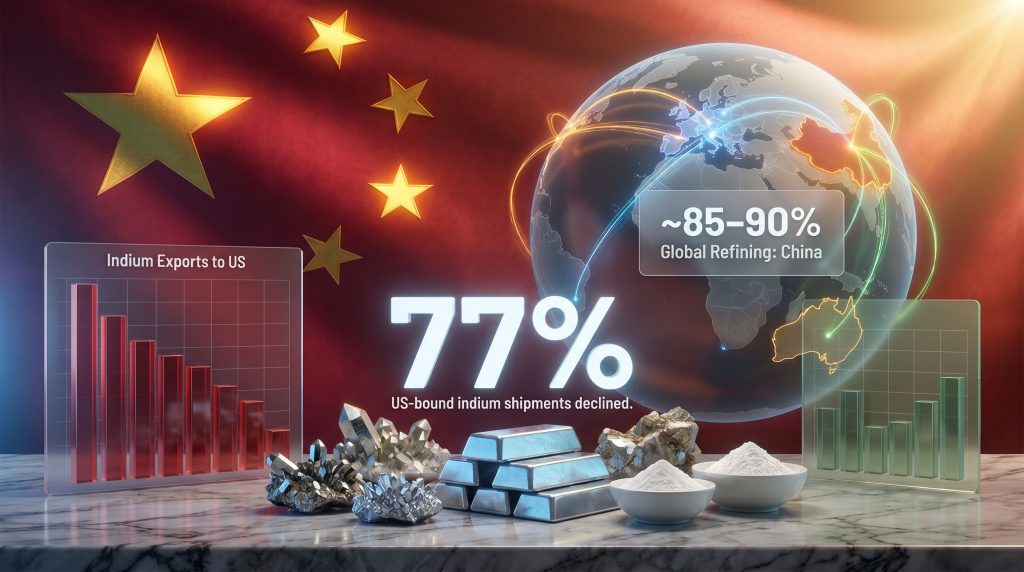
The quantitative evidence of supply disruption following China's export controls is stark. According to customs data, Chinese indium exports fell by approximately two-thirds globally in the 14 months following the February 2025 control implementation. For U.S.-bound shipments specifically, the decline was even more pronounced, with volumes dropping by approximately 77% over the same timeframe.
These are not marginal supply adjustments. A 77% reduction in U.S.-bound indium shipments represents a near-complete supply severance from what had been the dominant global source. For manufacturers whose production planning assumed continued access to Chinese-sourced indium at historical volumes and prices, the practical consequences include:
- Immediate production shortfalls where inventory buffers have been exhausted.
- Forced entry into spot markets where alternative supply commands significant price premiums.
- Allocation constraints that require manufacturers to prioritise end uses, potentially abandoning lower-margin product lines.
- Multi-year capacity planning disruption as expansion decisions are deferred pending supply certainty.
Licensing Asymmetry: Who Gets Approved and Who Waits
One of the most revealing features of China's export control implementation is the asymmetric pattern of licensing approvals. Export licences are flowing with relative normalcy to automotive manufacturers and consumer electronics producers, while companies in sectors with potential military applications continue to experience systematic delays.
This selective licensing approach is not simply bureaucratic friction. It represents a deliberate calibration designed to impose maximum strategic leverage on Western defence and technology sectors while limiting the economic blowback that would accompany broader commercial disruption.
The IEA has noted that supply concentration risks have now become a commercial reality, with implications that extend well beyond any single diplomatic cycle. Manufacturers serving both commercial and defence markets face the added complexity of demonstrating end-use segregation to Chinese licensing authorities, a process that introduces timeline uncertainty into procurement planning across entire product portfolios.
What Did the US-China Summit Actually Achieve on Rare Earths?
Reading the White House Fact Sheet Carefully
The May 2026 summit between U.S. and Chinese leadership generated considerable diplomatic activity, but the specific language used in the White House's post-summit fact sheet reveals more through its careful word choices than through any explicit commitments. The statement indicated that China would "address US concerns about shortages of critical minerals and rare earths including yttrium, scandium and indium," and that China would also address concerns about export restrictions on rare earth processing technology.
Notice what that language does not say. It does not commit China to removing specific controls by a specified date. It does not establish a verification mechanism. It does not define what "address" means in operational terms. The diplomatic framing is notably less ambitious than the October 2025 Busan summit language, where the White House had claimed China committed to "effectively eliminating" all current and proposed critical mineral export controls. Six months later, that commitment had not been realised.
China's Ministry of Commerce: A Telling Omission
While the White House dedicated specific language to rare earths and critical minerals in its summit summary, China's Ministry of Commerce published its own account of the summit outcomes without mentioning rare earths at all. This asymmetry in official communications is diplomatically significant.
When two parties emerge from a negotiation and describe its outcomes differently in official statements, the divergence typically reflects a genuine gap in what each side believes was actually agreed. In this case, the pattern aligns with an interpretation where China made general assurances about addressing concerns without committing to specific regulatory changes, while the U.S. framed those assurances as more concrete commitments.
Cory Combs, Associate Director at macro research firm Trivium China, noted that while the gap between the two official accounts was not ideal, what mattered most was that both governments had communicated a credible interest in stability to their respective domestic audiences.
The November 2026 Deadline: The Next Critical Inflection Point
The White House's post-summit statement notably failed to address whether the one-year suspension on Wave 2 rare earth controls, due to expire in November 2026, would be extended. This omission is potentially the most consequential aspect of the summit for global supply chain planners.
If the Wave 2 suspension expires without renewal, five additional rare earth elements would return to full export control coverage simultaneously, creating a compounding supply shock for industries that have not yet established alternative sources. The absence of any clarity on this question means that manufacturers face a planning horizon of less than six months with fundamental uncertainty about their input supply environment.
Who Bears the Greatest Economic Risk? A Sector-by-Sector Breakdown
The Photonic Chip Bottleneck and AI Infrastructure
The intersection of indium supply constraints with the accelerating demand for AI processing infrastructure represents one of the most concentrated risk scenarios emerging from China's export control regime. Photonic chips rely on indium phosphide as a substrate material with no currently scalable commercial substitute.
One manufacturer holds approximately 40% of the global market share in indium phosphide optical components. Paul Triolo, Partner and China Technology Policy Lead at DGA-Albright Stonebridge Group, has noted that if Chinese licensing approvals remain slow or politically contingent, manufacturers in this space face the prospect of higher input costs, allocation shortfalls, and difficulty meeting demand from major cloud operators whose infrastructure buildout timelines are already under pressure.
Defence and Aerospace: The Yttrium Vulnerability
The aerospace and defence sectors face a qualitatively different type of risk compared to commercial industries. While a consumer electronics manufacturer can delay a product launch or absorb higher material costs, a defence contractor building aircraft engines or missile guidance systems operates under procurement contracts with fixed delivery schedules and cost structures that cannot easily absorb sudden input supply disruptions.
Furthermore, the CSIS has highlighted that China's rare earth and magnet restrictions represent a direct and measurable threat to U.S. defence supply chains, with yttrium shortages creating measurable disruption to heat-protective coating supply chains for jet engines.
Clean Energy and EV Manufacturing
The electric vehicle and wind energy sectors face structural exposure to heavy rare earth controls through their dependence on high-performance permanent magnets. Neodymium-iron-boron magnets, which require dysprosium and terbium additions to maintain performance at elevated temperatures, are essential components of EV traction motors and direct-drive wind turbine generators.
As global EV production continues to scale and wind energy deployment accelerates, demand for these materials is growing precisely as supply security is deteriorating. In addition, the rare earth supply chain disruptions of 2025 have fundamentally altered how clean energy manufacturers assess long-term procurement risk.
The next major ASX story will hit our subscribers first
Is China's Export Control Regime a Permanent Feature of Global Trade?
Why Structural Considerations Point to Permanence
The weight of evidence suggests that China rare earth export controls should now be understood as a permanent structural feature of global trade rather than a temporary negotiating instrument. Several factors support this conclusion:
First, the May 2026 summit outcome represents the second consecutive diplomatic cycle in which commitments to eliminate or significantly reduce controls were not translated into regulatory action. The pattern of making broad commitments that are not operationalised suggests that China is using diplomatic language to manage Western concerns without making actual regulatory concessions.
Second, the expansion of controls to cover processing technology and technical know-how in October 2025 demonstrates that the regime is evolving to protect Chinese industrial capabilities rather than simply responding to trade provocation. Third, the licensing architecture itself creates institutional momentum. Bureaucratic systems with national security mandates tend to expand rather than contract once established.
Table 2: Comparison of Export Control Waves
| Control Wave | Timing | Minerals Covered | Additional Scope | Strategic Character |
|---|---|---|---|---|
| Indium controls | February 2025 | Indium | Full export licensing | Technology targeting |
| Wave 1 | April 2025 | 7 heavy rare earths | Compounds, metals, magnets | Trade retaliation |
| Wave 2 | October 2025 | 5 additional rare earths | Equipment, technology, know-how | National security expansion |
| Wave 2 Suspension | Post-October 2025 | Wave 2 elements | Suspended to November 2026 | Trade diplomacy |
How Are Western Nations and Industry Responding?
Australia's Divestment Order: Protecting Upstream Assets
Australia's response to China's export control escalation took a direct form in May 2026, when the government ordered Chinese investors to divest their stakes in domestic rare earth mining operations. According to reporting from Mining.com, six shareholders in Northern Minerals Ltd. were required to sell their stakes within two weeks, reflecting a broader strategic decision to limit Chinese influence over upstream mineral assets within allied nations' borders.
This move represents an explicit acknowledgment by an allied government that upstream ownership stakes in critical mineral assets constitute a national security concern, not merely a commercial investment question. The policy logic suggests that Chinese ownership of mining assets could provide Beijing with additional leverage over supply availability even for minerals extracted outside China's borders.
The Processing Capacity Problem
Western responses to China rare earth export controls have increasingly focused on expanding mining output and upstream production capacity. However, this addresses only part of the structural problem. Mining rare earth ores is considerably less technically demanding than refining those ores into the high-purity compounds that manufacturers actually require.
China's near-total dominance of global rare earth refining capacity, estimated at 85-90% of worldwide production capability, means that a Western nation could establish significant mining operations and still find itself unable to convert that ore into usable materials. Consequently, America's rare earth supply chain faces a particularly acute version of this challenge, given the scale of downstream industrial demand across defence, semiconductor, and clean energy sectors.
Table 3: Global Rare Earth Processing Capacity
| Region | Share of Global Refining Capacity | Key Constraints |
|---|---|---|
| China | ~85-90% | Dominant; tightly controlled |
| United States | ~5% | Limited downstream processing capability |
| Australia | ~3-5% | Strong in upstream; refining remains nascent |
| European Union | Less than 2% | Heavily dependent on imports |
| Rest of World | Less than 5% | Fragmented; predominantly early-stage |
EU Policy Frameworks and the Critical Raw Materials Act
European industrial exposure to Chinese rare earth controls spans multiple strategic sectors simultaneously. The EU's digital sector depends on indium and scandium for semiconductor and display manufacturing. The clean energy transition relies on heavy rare earth magnets for wind turbines and EV motors. European critical raw materials policy frameworks establish diversification targets and strategic stockpile objectives, but translating policy ambition into functional alternative supply chains requires investment timelines measured in years to decades rather than months.
What Would a Genuine Diversification Strategy Require?
Capital, Time, and Technical Expertise at Scale
Building a functional alternative to Chinese rare earth supply is not a problem that can be solved by policy declarations or short-term investment commitments alone. The refining bottleneck represents the most technically challenging and capital-intensive dimension of the diversification challenge, requiring not just financial investment but the development of processing expertise that Western industries largely allowed to atrophy during the decades when Chinese supply was cheap and reliable.
A realistic diversification pathway would require:
- Upstream investment in mining projects across geologically prospective regions in North America, Australia, and Africa, with permitting and development timelines typically spanning five to ten years from initial resource definition.
- Processing infrastructure built to commercial scale, requiring multi-billion dollar capital commitments, specialised technical knowledge, and operational experience that takes years to accumulate under production conditions.
- Technology acquisition or development for the separation and refining processes that China currently controls, either through domestic research programmes, allied technology sharing arrangements, or acquisition of rare earth processing expertise from the limited number of non-Chinese entities that possess it.
- Downstream qualification of materials produced from new sources, as manufacturers using rare earth compounds in critical applications typically require extensive testing and qualification processes before accepting alternative supply sources.
Strategic Stockpiling as a Bridge Mechanism
Given the multi-year timeframe required to build genuine supply chain alternatives, strategic stockpiling represents the most immediately deployable risk management tool available to Western governments and manufacturers. Physical inventories of critical rare earth compounds provide a buffer against supply disruption during the period when alternative processing capacity is being developed.
However, stockpiling carries its own limitations. Many rare earth compounds have finite shelf lives or require specialised storage conditions. The capital cost of maintaining substantial physical inventories is significant. And stockpiles address availability constraints without resolving the underlying structural dependency that creates vulnerability in the first place.
The Long-Term Structural Outlook: Critical Minerals as a Permanent Geopolitical Fault Line
Three Scenarios for 2026 and Beyond
The trajectory of China's export controls and Western responses creates three plausible scenarios for the global critical minerals landscape over the coming years:
Scenario One: Managed Coexistence. Both governments maintain surface-level diplomatic stability while China preserves its licensing architecture intact. Sectors with commercial applications receive selective approvals with manageable delays. Defence and advanced semiconductor applications continue to face systematic friction. The control regime becomes normalised as a permanent background feature of global supply chain planning.
Scenario Two: Escalation. The November 2026 suspension of Wave 2 controls expires without renewal. Five additional rare earth elements return to full export control simultaneously. Global manufacturers accelerate diversification spending, but face a multi-year lag before alternative processing capacity reaches commercial scale. Supply shortfalls become acute in defence and semiconductor sectors.
Scenario Three: Structural Realignment. Allied nations coordinate sustained investment in rare earth processing infrastructure, technology sharing frameworks, and strategic stockpile coordination over a seven to ten year horizon. A parallel supply chain emerges that services Western industrial requirements with commercially viable non-Chinese alternatives. Chinese market share in refining falls from 85-90% toward 60-70%, reducing but not eliminating Beijing's leverage.
The Non-Tariff Battlefield
Perhaps the most enduring lesson of China's export control regime is that the most consequential trade competition of the coming decades will be conducted not through tariffs but through licensing systems, technology transfer restrictions, end-use verification requirements, and the deliberate cultivation of chokepoint control over critical industrial inputs. Tariffs impose costs that can be absorbed or avoided. Control over the material foundations of modern manufacturing creates structural dependencies that cannot be quickly reversed regardless of political will or financial resources.
For industries and investors navigating this environment, the key analytical question is no longer simply where to source materials but how to evaluate and manage exposure to regulatory chokepoints that can be activated by foreign government decisions entirely outside commercial control. That represents a fundamental shift in how supply chain risk must be assessed, planned for, and priced into long-term industrial and investment strategies.
Frequently Asked Questions: China Rare Earth Export Controls
What Are China's Rare Earth Export Controls and When Did They Begin?
China's rare earth export control regime was implemented through a series of escalating measures beginning in early 2025. Indium was placed under export licensing requirements in February 2025, followed by controls on seven heavy rare earth elements in April 2025 as a response to U.S. tariff announcements. A second expansion in October 2025 extended controls to five additional rare earth elements and introduced restrictions on processing technology and technical expertise.
Which Industries Are Most Affected by Chinese Rare Earth Restrictions?
The sectors facing the greatest exposure include aerospace and defence manufacturing, semiconductor fabrication, AI infrastructure development, clean energy equipment production, and advanced consumer electronics. Each sector faces distinct vulnerabilities depending on which specific minerals and compounds their production processes require.
Has the US Secured Any Relief from China's Export Controls?
The May 2026 summit produced an acknowledgment that China would address U.S. concerns about rare earth shortages, but no specific commitments to remove or substantially modify existing controls were publicly confirmed. The White House's careful language and China's Ministry of Commerce's complete omission of rare earths from its own summit summary suggest that concrete relief remains uncertain.
What Is Indium and Why Is It Critical to Semiconductor Manufacturing?
Indium is a soft, silvery metal that forms compounds with unique optical and electrical properties. Indium phosphide is the substrate material for photonic chips used in AI data centres and high-speed optical communications. Indium tin oxide is a transparent conductor essential for display screens and certain solar cell technologies. China controls the dominant share of global indium production and processing, making its export control decisions highly consequential for these applications.
Will China's Export Controls on Rare Earths Be Permanent?
The evidence strongly suggests that the core elements of China's export control regime are permanent features of global trade rather than temporary measures. The progression from reactive trade countermeasure to institutionalised licensing architecture, combined with the failure of two consecutive diplomatic cycles to produce substantial regulatory rollback, indicates that Western manufacturers and governments should plan on the basis that these controls will remain in place for the foreseeable future.
What Is the Difference Between the April 2025 and October 2025 Control Waves?
The April 2025 controls targeted seven specific heavy rare earth elements with export licensing requirements. The October 2025 expansion added five additional rare earth elements and, critically, extended controls to cover rare earth processing equipment, technology documentation, and the technical know-how required to operate refining facilities. This second wave was partially suspended until November 2026 as part of trade diplomacy, but the licensing architecture remains in place.
How Are the EU and Australia Responding to Chinese Rare Earth Restrictions?
Australia has taken direct action by ordering Chinese investors to divest stakes in domestic rare earth mining operations, including a May 2026 directive requiring six shareholders in a domestic rare earth company to sell their stakes within two weeks. The EU has established policy frameworks aimed at diversifying critical mineral supply and building domestic processing capacity, though translating these policy objectives into functional supply chains requires sustained investment over multiple years.
Key Takeaways
- China's rare earth export controls were introduced across multiple escalating waves during 2025, ultimately covering more than 12 elements plus processing technology and technical expertise.
- Chinese indium exports to the United States declined by approximately 77% in the 14 months following February 2025 controls, with global exports falling by roughly two-thirds over the same period.
- Licensing approvals are being applied asymmetrically, flowing to commercial sectors like automotive and consumer electronics while defence and advanced semiconductor applications face systematic delays.
- The White House's post-summit language from May 2026 implicitly acknowledges that China's export control regime is a permanent structural feature of global trade, not a temporary negotiating measure.
- The November 2026 expiry of the Wave 2 suspension represents the next critical decision point, with no public clarity yet provided on whether it will be extended.
- Genuine supply chain diversification requires solving the refining and processing bottleneck where China controls an estimated 85-90% of global capacity, not simply expanding upstream mining.
- Industries facing the most concentrated exposure include aerospace, defence, semiconductor fabrication, AI infrastructure, clean energy equipment, and advanced electronics manufacturing.
Disclaimer: This article is intended for informational purposes only and does not constitute financial or investment advice. Forward-looking statements, scenario projections, and market assessments involve inherent uncertainty. Readers should conduct independent research and consult qualified advisors before making investment or procurement decisions. Source data referenced herein is derived from publicly available reporting including Reuters via Mining.com (May 18, 2026) and publicly attributed expert commentary.
Want to Know Which ASX Companies Are Positioned in the Critical Minerals Space?
Discovery Alert's proprietary Discovery IQ model scans ASX announcements in real time, instantly identifying significant mineral discoveries across rare earths, indium, and more than 30 other commodities — turning complex geological data into clear, actionable investment insights. Explore how historic discoveries have generated substantial returns on Discovery Alert's dedicated discoveries page, and begin your 14-day free trial today to position yourself ahead of the market.