July 10, 2026
The Evolution of Global Energy Alliances
Energy markets worldwide are witnessing an unprecedented realignment as traditional supply chains fragment along geopolitical lines. The China and Russia oil trade relationship has emerged as a defining example of this transformation, representing more than temporary trade disruptions. Furthermore, this evolution signals the emergence of competing energy blocs that will reshape global commerce for decades.
The current restructuring reflects systematic risk management by major energy consumers who recognise that political stability often trumps pure economic optimisation. As Western sanctions create barriers between established trading partners, alternative networks have emerged with surprising resilience and growing sophistication, particularly evident in the oil price rally dynamics of 2025.
When big ASX news breaks, our subscribers know first
Strategic Drivers Behind Energy Import Diversification
China's approach to energy procurement exemplifies sophisticated risk management across multiple dimensions. The nation's energy strategy balances geographic proximity, political alignment, and economic optimisation to create supply chains resistant to external disruption. Consequently, this has led to significant shifts in global energy flows.
China's Primary Oil Suppliers Analysis (January 2026)
| Supplier | Daily Volume | Transit Time | Strategic Value |
|---|---|---|---|
| Russia | 1.86 million b/d | 5-6 days | High (aligned partnership) |
| Saudi Arabia | 1.2 million b/d | 12-14 days | Medium (neutral stance) |
| Iran | Declining trend | 8-10 days | Volatile (sanctions pressure) |
| Venezuela | 500,000-600,000 b/d | 25-30 days | Limited (distance factors) |
According to Oilprice.com reporting from February 2026, Russia achieved a remarkable milestone by surpassing Saudi Arabia as China's leading crude supplier. Russian seaborne exports to China reached 1.86 million barrels per day in January 2026, representing a 46% year-on-year increase.
This dramatic shift occurred as 100% of Russia's ESPO exports were directed to China for the first time since November 2024. Moreover, the OPEC production impact has been overshadowed by these bilateral developments.
Infrastructure Lock-in Mechanisms
The Shandong Yulong refinery case study demonstrates how sanctions create permanent structural dependencies. This 400,000 barrel-per-day facility has become exclusively dependent on Russian crude following Western sanctions imposed in mid-2025.
Sanctions targeting Rosneft and Lukoil effectively closed the refinery off from Western and most Middle Eastern suppliers. The result was dramatic: apart from two Canadian cargoes before sanctions took effect, the refinery has relied exclusively on Russian oil since October 2025. During December 2025 and January 2026, Yulong imported an average of 240,000 barrels per day from Russia.
This infrastructure specialisation creates switching costs that extend far beyond temporary political fluctuations. Once refining equipment, logistics networks, and operational procedures optimise around specific crude grades, alternative sourcing becomes economically prohibitive.
How Sanctions Accelerate Market Concentration
Western sanctions designed to isolate Russian energy exports have produced counterintuitive results. Rather than reducing Russian export capacity, these measures have concentrated flows toward non-Western buyers who benefit from enhanced bargaining power and preferential pricing structures. The trade war oil impact has amplified these dynamics.
The sanctions paradox operates through multiple mechanisms:
• Supply route concentration: Restrictions force Russian exporters to develop deeper relationships with remaining outlets
• Infrastructure specialisation: Sanctioned facilities invest heavily in serving available markets
• Risk internalisation: Russia absorbs logistical and security burdens, reducing costs for remaining buyers
• Permanent structural changes: Infrastructure investments create long-term dependencies that resist policy reversals
Iranian supply disruptions exemplify this dynamic. Iranian shipments to China averaged approximately 1.2 million barrels per day in 2024 and the first half of 2025 but have declined significantly since June 2025 following strikes on nuclear facilities and intensified sanctions.
Dark Fleet Evolution
Sanctions-evading vessel networks have evolved from temporary workarounds into permanent alternative shipping systems. These specialised fleets provide redundant capacity that reduces dependence on Western-controlled maritime services and insurance markets. The sophistication of these networks suggests they will persist beyond current geopolitical tensions.
India's Strategic Positioning Dilemma
India faces competing pressures between economic optimisation and geopolitical alignment. The Trump administration announced a trade agreement in February 2026 that would reduce tariffs on Indian goods from 50% to 18% in exchange for ending Russian crude imports. This exemplifies the broader US-China trade war implications for regional energy security.
This creates a complex strategic calculation:
Economic Benefits of U.S. Alignment:
• Significant tariff reductions improving export competitiveness
• Enhanced market access to world's largest economy
• Potential technology transfer opportunities
• Reduced trade friction across multiple sectors
Costs of Abandoning Russian Energy:
• Higher energy procurement expenses
• Reduced strategic autonomy in supplier selection
• Potential exclusion from emerging Eurasian energy corridors
• Lost opportunities for preferential pricing arrangements
According to Oilprice.com analysis, the deepening China and Russia oil trade relationship creates additional pressure on India. Extended Chinese-Russian cooperation would intensify concerns in New Delhi about strategic sidelining from one of Asia's most important commodity corridors.
Maritime Logistics Transformation
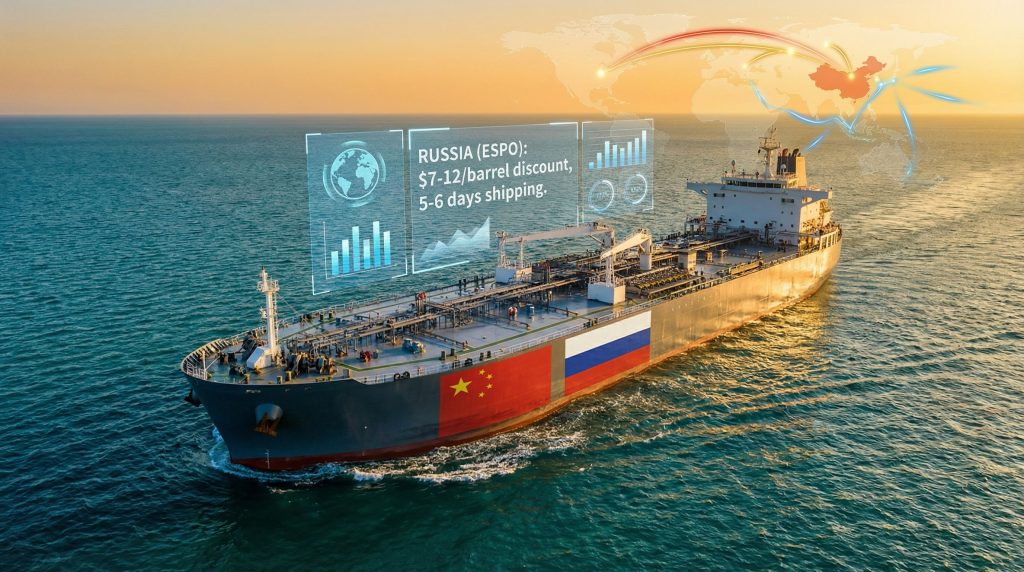
The concentration of Russian exports in Pacific terminals creates new efficiency opportunities for Asian buyers. The Kozmino terminal near Vladivostok and Sakhalin facilities handled more than 50% of January 2026 volumes, optimising delivery routes for Chinese refineries.
This geographic advantage provides multiple benefits:
• Reduced transit times: 5-6 days versus 12-14 days from traditional suppliers
• Lower transportation costs: Shorter distances reduce fuel consumption and crew expenses
• • Minimised chokepoint exposure: Routes avoid politically sensitive maritime passages
• Enhanced supply security: Direct bilateral shipping reduces third-party dependencies
The economic advantages extend beyond simple pricing. Russian crude typically trades at approximately $7 per barrel discount to ICE Brent, but the true value lies in supply chain optimisation.
Long-term Strategic Implications
Parallel Financial System Development
Energy trade relationships drive the development of alternative payment mechanisms that bypass Western financial infrastructure. These systems create permanent structural changes extending beyond current geopolitical tensions. Yuan-denominated settlements, specialised banking arrangements, and bilateral credit facilities represent foundation elements of a parallel financial architecture.
Technology Transfer Acceleration
Deepening energy partnerships facilitate broader technological cooperation in refining, petrochemicals, and renewable energy sectors. This knowledge transfer strengthens long-term strategic relationships beyond simple commodity trading, creating institutional bonds that resist political disruption. In addition, the Saudi exploration impact demonstrates how regional developments influence global energy dynamics.
The next major ASX story will hit our subscribers first
Regional Energy Bloc Formation
The bifurcation of global energy markets into Western and Eastern spheres creates new vulnerabilities and dependencies. Each bloc develops internal resilience while becoming more vulnerable to disruption from competing systems.
Eastern Energy Bloc Characteristics:
• Geographic proximity reducing transportation costs and delivery times
• Political alignment ensuring supply continuity during international tensions
• Currency diversification reducing dollar dependency
• Integrated infrastructure investments creating switching costs
Western Energy Bloc Characteristics:
• Established financial infrastructure and insurance systems
• Advanced refining technology and environmental standards
• Regulatory coordination across multiple jurisdictions
• Traditional shipping and logistics networks
Price Discovery Mechanism Evolution
Multiple pricing systems emerge as markets fragment. Western benchmarks may lose relevance for Eastern trade, creating arbitrage opportunities and complicating global price coordination. The development of alternative pricing mechanisms reflects broader systemic changes in global energy commerce.
Strategic Response Framework
For Energy Companies
Portfolio Diversification Strategies:
• Develop capabilities across multiple geopolitical spheres
• Invest in adaptable facilities that can process diverse crude types
• Build relationships with suppliers across different political alignments
• Hedge against both price volatility and geopolitical disruption
Infrastructure Flexibility:
• Design refineries for multiple crude grade compatibility
• Develop logistics networks serving different supplier regions
• Maintain relationships with various shipping and insurance providers
• Create redundant supply chain capabilities
For Government Policymakers
Strategic Reserve Management:
• Build buffer stocks to manage supply disruptions
• Coordinate with allied nations on emergency sharing arrangements
• Develop domestic production capabilities where economically viable
• Create policy frameworks supporting supply diversity
Alliance Coordination:
• Align energy policies with broader geopolitical objectives
• Develop joint infrastructure projects with strategic partners
• Coordinate sanctions policies to maximise effectiveness
• Share intelligence on supply chain vulnerabilities
Investment Implications
The restructuring of global China and Russia oil trade creates both opportunities and risks for market participants. Traditional assumptions about supply chain stability, pricing mechanisms, and geopolitical risk require fundamental reassessment.
Opportunity Areas:
• Specialised shipping and logistics serving new trade routes
• Refinery technology adaptable to changing crude slates
• Financial services supporting alternative payment systems
• Energy infrastructure in emerging trade corridors
Risk Factors:
• Stranded assets in politically exposed regions
• Regulatory changes affecting established trade relationships
• Currency volatility in alternative payment systems
• Technology transfer restrictions limiting operational flexibility
Market Psychology and Behavioral Shifts
Energy procurement decisions increasingly reflect geopolitical rather than purely commercial logic. This fundamental shift requires market participants to reassess traditional analytical frameworks and develop new approaches to risk management.
The China and Russia oil trade relationship demonstrates that strategic alignment can override short-term economic optimisation. As noted by Trading Economics data, this partnership reflects deeper structural changes in global energy flows. Watching Russia establish China as its dominant Asian outlet may ultimately push India back toward Russian purchases regardless of Western pressure, driven by the desire to avoid strategic sidelining from a long-standing partner.
Navigating the New Energy Landscape
The China and Russia oil trade relationship exemplifies the broader restructuring of global energy systems along geopolitical lines. Success in this environment requires understanding that energy security increasingly depends on political alignment rather than purely economic optimisation.
Market participants must prepare for a world where energy flows follow geopolitical rather than purely commercial logic. This creates both new opportunities and unprecedented risks in the global energy landscape. The formation of competing energy blocs represents a fundamental shift away from the globalised, market-driven systems that characterised the post-Cold War era.
Understanding these dynamics becomes crucial for investors, policymakers, and energy companies navigating an increasingly complex and politically fragmented global energy market. The strategic scenarios unfolding today will define energy security arrangements for decades to come, making adaptive capacity and geopolitical awareness essential capabilities for all market participants.
Disclaimer: This analysis involves forecasts and strategic scenarios that reflect current trends and available information. Energy markets remain subject to significant volatility based on geopolitical developments, regulatory changes, and economic conditions. Readers should conduct their own research and consult qualified professionals before making investment or strategic decisions based on this analysis.
Looking for Energy Sector Investment Opportunities?
Discovery Alert's proprietary Discovery IQ model delivers real-time alerts on significant mineral discoveries across the ASX, helping investors identify actionable opportunities in energy metals and critical commodities ahead of broader market awareness. With the global energy landscape rapidly evolving and creating new investment dynamics, subscribers gain immediate insights into companies that could benefit from these transformative shifts. Begin your 14-day free trial today to secure your market-leading advantage in this evolving sector.