June 1, 2026
Global precious metals markets face unprecedented transformation as regulatory frameworks evolve across major producing nations. While traditional supply chains have operated under established patterns for decades, recent developments in export management systems reveal the complex interplay between government policy, market psychology, and international trade dynamics. Understanding China's silver export policy becomes crucial for investors, manufacturers, and policy makers navigating an increasingly volatile landscape where perception often drives price action more powerfully than underlying fundamentals.
Understanding China's Silver Export Licensing Architecture
China's current regulatory framework represents a sophisticated evolution from earlier control mechanisms. The nation transitioned from quota-based restrictions to a licensing-only management system approximately seven years ago, establishing a structure that prioritises administrative oversight while maintaining export flexibility. This shift fundamentally altered how silver moves through international markets, creating new dynamics that many market participants continue to misunderstand.
The Ministry of Commerce maintains authority over export licensing decisions through criteria that have remained largely stable since implementation. Domestic refiners must demonstrate minimum production thresholds of 80 tons annually, with reduced requirements of 40 tons for companies based in western regions. These licenses carry no explicit volume limits and maintain two-year validity periods, providing operational predictability for qualified exporters.
Processing trade arrangements form the backbone of China's silver export system, enabling the majority of shipments through structures that exempt imported materials from value-added taxation. These arrangements allow foreign copper and zinc producers to send concentrates to Chinese refineries for processing, with refined silver subsequently re-exported under favourable tax treatment. Any meaningful restriction of exports would require dismantling these extensive tax relief structures rather than simply tightening licensing criteria.
Furthermore, the regulatory stability becomes evident through export performance data. China shipped approximately 5,100 tons of silver overseas in 2025, representing the highest export volume in at least 16 years. This record performance occurred during a period when market participants widely speculated about impending restrictions, demonstrating the gap between regulatory reality and market perception.
When big ASX news breaks, our subscribers know first
Strategic Implications for Global Silver Supply Networks
China's dominance in refined silver processing creates unique vulnerabilities and dependencies across international supply chains. The nation controls approximately 70% of global refined silver processing capacity, positioning it as an essential intermediary for silver reaching global markets. This processing dominance extends beyond domestic production, encompassing substantial volumes of imported concentrates and raw materials that undergo value-added refining before re-export.
The distinction between primary production and processing capacity proves critical for understanding supply chain risks. China's domestic refined silver production reached 109.3 million ounces, yet export volumes significantly exceed this figure. Consequently, this indicates that Chinese facilities serve as processing centres for international materials rather than purely domestic sources.
However, this structure creates different vulnerability patterns than would exist if China were primarily exporting domestically-mined silver. Major copper and zinc producers worldwide rely on Chinese refining infrastructure to extract silver byproducts from their operations. These arrangements benefit from established processing trade frameworks that provide cost advantages through tax exemptions and operational efficiencies.
Alternative refining capacity in North America, South America, and Australia exists but often operates at higher costs and with different quality specifications. The expansion of Chinese non-ferrous refining capacity has driven consistent growth in silver exports since 2019, with increases occurring in all but one year during this period.
In addition, this growth reflects both domestic capacity expansion and increased utilisation by international companies seeking processing services. The trend suggests that Chinese refining infrastructure continues gaining market share from alternative processing locations globally.
Market Psychology and Price Volatility Dynamics
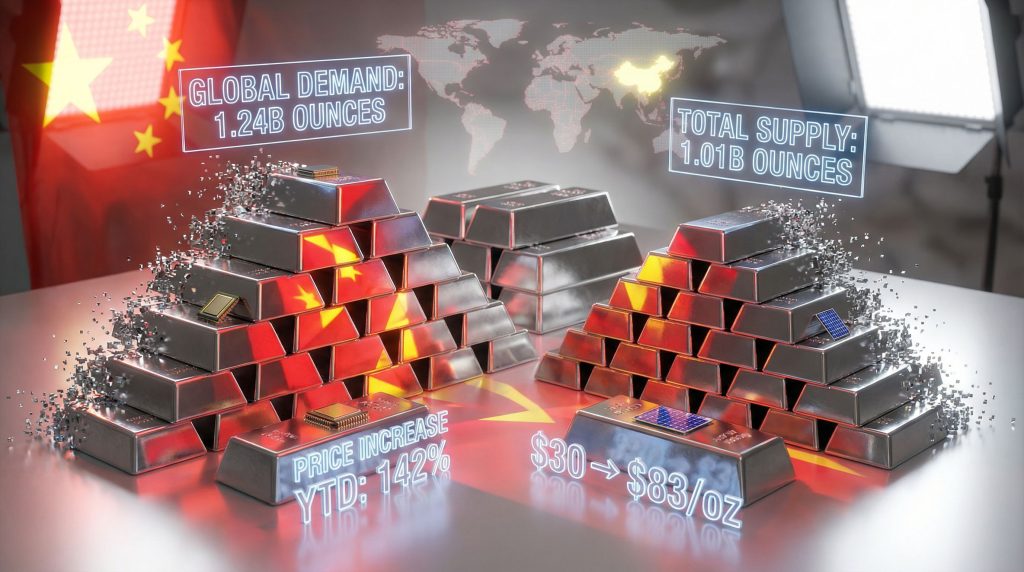
Silver price movements during late 2025 and early 2026 demonstrate how regulatory misinterpretation can create sustained market volatility independent of actual policy changes. The silver market squeeze saw prices surge from approximately $30-40 per ounce to above $95 per ounce during a period when no substantive export restrictions were implemented, illustrating the power of perception over fundamentals in driving precious metals valuations.
The catalyst for this price surge emerged from widespread misinterpretation of a Ministry of Commerce document issued in October 2025. This document simply extended existing licensing terms into 2026 and 2027 without introducing new restrictions or modifying existing requirements. However, fund managers, bullion dealers, and media outlets, particularly in India, characterised the extension as indicating imminent policy tightening.
Fear-of-missing-out dynamics accelerated as investors responded to online commentary suggesting that export controls would drastically reduce silver availability. These psychological factors created self-reinforcing buying pressure as speculative demand increased in anticipation of supply constraints that were not actually materialising. Social media amplification, including posts by influential figures, further propagated these misconceptions across global markets.
For instance, India experienced particularly acute demand surges during this period. Physical silver purchasing accelerated ahead of the Diwali festival in October, with smaller bars and coins becoming especially popular among retail investors. This demand concentration drained liquidity from London markets and contributed to benchmark price increases.
| Market Psychology Factor | Impact Timeline | Price Effect | Geographic Concentration |
|---|---|---|---|
| Policy Misinterpretation | October 2025 | Initial surge $40→$60 | Global |
| FOMO Acceleration | Nov-Dec 2025 | Sustained growth $60→$80 | India-focused |
| Social Media Amplification | December 2025 | Momentum spike $80→$95+ | Worldwide |
| Retail Demand Surge | Ongoing 2026 | Price maintenance $90+ | India, US |
Industrial Demand Fundamentals and Technology Drivers
Silver's role in emerging technologies creates underlying demand pressures that intersect with speculative market dynamics. Semiconductor manufacturing requires silver for its superior electrical conductivity properties, with demand scaling alongside global chip production expansion. The 5G infrastructure rollout necessitates silver in telecommunications equipment, base stations, and connecting hardware.
Solar photovoltaic cell production represents a rapidly growing silver consumption sector. Each solar panel requires approximately 20 grams of silver paste for electrical connections, with global solar installation growth driving proportional increases in silver demand. Electric vehicle battery systems also incorporate silver components, particularly in high-performance battery management systems and charging infrastructure.
Green energy transition initiatives across major economies create long-term structural demand for silver in renewable energy applications. Wind turbine electrical systems, grid storage technologies, and smart grid infrastructure all require significant silver quantities for optimal performance. These applications typically demand high-purity silver that commands premium pricing compared to jewellery or investment-grade materials.
Nevertheless, distinguishing between genuine industrial demand growth and speculative purchasing remains challenging during periods of price volatility. Industrial consumers often accelerate procurement schedules when prices rise rapidly, creating temporary demand spikes that can be mistaken for fundamental consumption growth. This procurement behaviour can amplify price movements initiated by speculative factors.
Regional Market Fragmentation and Premium Structures
Geographic price differentials reveal the extent to which supply chain disruptions and speculation affect regional silver markets differently. Shanghai silver premiums expanded significantly during the October-December 2025 period, reflecting both domestic demand surges and logistical constraints. These premiums indicate market tightness specific to Chinese domestic consumption rather than export supply issues.
London market liquidity experienced particular stress during late 2025, partly due to US tariff fears that encouraged inventory hoarding among American market participants. This hoarding behaviour removed substantial silver quantities from active trading circulation, creating artificial scarcity in the London trading hub despite adequate global production levels. The interaction between speculative demand and physical hoarding amplified supply chain friction.
Indian market premiums reached extraordinary levels as domestic demand accelerated throughout the speculation period. Traditional jewellery demand combined with investment buying to create sustained pressure on physical silver availability. Indian refiners reported difficulty securing adequate supply despite premium levels that would typically encourage arbitrage from other regions.
However, European markets experienced more moderate premium expansion, suggesting that speculation was less intense in these regions or that supply chains maintained better functionality. This geographic variation demonstrates how identical global supply conditions can create vastly different regional pricing patterns depending on local demand psychology and market structure.
Comparative Analysis with Other Strategic Materials
China's approach to silver export management contrasts sharply with its handling of other strategic materials. The strategic antimony policy demonstrates how rare earth export restrictions include strict quotas and licensing requirements that materially constrain international availability. Furthermore, China export controls on antimony exports face similar but less severe restrictions, while graphite processing limitations create supply chain challenges for battery manufacturers.
| Strategic Material | Control Mechanism | Market Impact Severity | Alternative Sources |
|---|---|---|---|
| Rare Earths | Quotas + Licensing | Severe disruption | Limited viable alternatives |
| Antimony | Export licensing | Moderate price volatility | Some alternative suppliers |
| Silver | Licensing only | Speculative price surge | Multiple refining locations |
| Graphite | Processing restrictions | Supply chain reconfiguration | Emerging alternative capacity |
The silver licensing system appears designed to maintain oversight capability while preserving export flexibility. This approach differs from materials where China seeks to maintain domestic value-added processing advantages or strategic stockpiling objectives. Silver's widespread industrial applications and availability from multiple global sources may limit the effectiveness of export restrictions as a policy tool.
Critical materials framework analysis suggests that silver occupies a different strategic category than rare earths or antimony. While silver has important industrial applications, alternative materials can substitute for silver in many uses, and substantial refining capacity exists outside China. These factors may explain why China maintains a less restrictive approach to China's silver export policy compared to materials with fewer substitutes or alternative suppliers.
The next major ASX story will hit our subscribers first
Future Scenarios and Strategic Adaptation Pathways
Multiple scenarios exist for the evolution of China's silver export policy, each carrying different implications for global market structure. Status quo continuation would maintain current licensing requirements without additional restrictions, allowing export volumes to fluctuate based on economic conditions rather than policy constraints. This scenario appears most consistent with current policy signals and economic incentives.
Progressive tightening scenarios involve gradual increases in licensing requirements, production thresholds, or administrative oversight. Such changes could reduce the number of qualified exporters without implementing explicit volume quotas. However, the substantial economic benefits of processing trade arrangements create powerful incentives to maintain export flexibility.
Strategic stockpiling scenarios might emerge if China perceives silver as increasingly critical for domestic technology sectors. Accumulating strategic reserves could justify export limitations, particularly if domestic demand from electronics, renewable energy, and telecommunications sectors accelerates beyond current projections. Such policies would likely develop gradually to avoid market disruption.
Conversely, geopolitical escalation scenarios could involve export restrictions as trade policy tools during international disputes. However, silver's relatively dispersed production and refining capacity globally may limit the effectiveness of such measures compared to materials with more concentrated supply chains.
Investment Strategy Frameworks and Risk Management
Investors and industrial consumers require sophisticated approaches to navigate silver market volatility driven by policy uncertainty and speculation. Physical silver positioning involves considerations of storage costs, insurance requirements, and liquidity constraints that may not apply to paper silver investments. Premium structures for physical silver can diverge significantly from futures pricing during periods of market stress.
Mining equity exposure provides leveraged participation in silver price movements while introducing additional risks related to operational performance, capital allocation, and geopolitical factors. Primary silver miners offer more direct exposure than companies producing silver as a byproduct of copper or zinc operations. Geographic diversification across mining jurisdictions can reduce political risk.
| Investment Approach | Silver Price Sensitivity | Liquidity | Storage Requirements | Regulatory Risk |
|---|---|---|---|---|
| Physical Silver | Direct 1:1 correlation | Moderate | High | Low |
| Silver ETFs | Direct with small tracking error | High | None | Low |
| Mining Equities | Leveraged 2-3x correlation | High | None | High |
| Silver Futures | Direct with contango risk | Very High | None | Moderate |
Strategic procurement approaches for industrial consumers must balance cost optimisation with supply security objectives. Long-term contracts can provide price stability but may limit flexibility during market dislocations. Inventory buffering strategies require careful analysis of carrying costs versus supply disruption risks.
Therefore, substitute material research becomes increasingly important as silver prices reach elevated levels. While silver's unique properties make substitution difficult in some applications, technological advances may enable alternative materials in specific uses. Companies with high silver intensity should evaluate substitution possibilities as part of long-term planning.
### What are the implications for resource geopolitics?
Silver's treatment within China's export control framework reflects broader trends in strategic resource management and trade policy. The licensing system provides administrative oversight capability while maintaining export flexibility, suggesting a balanced approach between economic benefits and strategic control. This model may influence how other nations approach critical material export management.
Global supply chain reconfiguration efforts gain urgency as companies recognise concentration risks in Chinese processing capacity. Alternative refining infrastructure development requires substantial capital investment and technical expertise transfer. Mexico, Peru, and North American facilities represent potential capacity expansion opportunities, though cost structures may differ from Chinese operations.
Friendshoring initiatives encourage shifting supply chains toward allied nations, but silver's technical processing requirements limit the speed of such transitions. Developing equivalent refining capacity requires years of planning, construction, and operational optimisation. These timeline constraints create persistent dependencies on existing Chinese infrastructure regardless of policy preferences.
Strategic partnership development between consuming nations and alternative suppliers could reduce dependence on Chinese processing capacity over time. However, the economic efficiency of Chinese refining operations, supported by processing trade tax advantages and scale economies, creates competitive pressures that may limit the viability of alternative arrangements without policy support.
How does this compare to historical precedents?
The evolution of China's silver export policy will likely influence how other nations with strategic material advantages structure their own export management systems. The balance between maintaining export revenues and preserving strategic flexibility represents a key policy challenge for resource-rich nations navigating increasingly complex geopolitical environments.
In addition, understanding the silver supply deficits and gold-silver ratio insights helps investors comprehend the broader market dynamics affecting China's silver export policy. These factors contribute to the complexity of predicting future policy developments and their market impacts.
Furthermore, China's silver export policy demonstrates how seemingly technical administrative procedures can create significant market volatility when misinterpreted by participants. The gap between regulatory reality and market perception highlights the importance of accurate policy analysis in commodity markets.
This analysis is for informational purposes only and should not be construed as investment advice. Precious metals markets involve substantial risk, and policy interpretations may change rapidly. Investors should conduct their own research and consult qualified financial advisors before making investment decisions.
Looking to Capitalise on China's Silver Export Policy Changes?
Discovery Alert's proprietary Discovery IQ model delivers real-time alerts on significant ASX mineral discoveries, instantly empowering subscribers to identify actionable opportunities in precious metals and commodity markets ahead of the broader market. Begin your 30-day free trial today and secure your market-leading advantage whilst navigating the evolving landscape of global resource geopolitics.