
August 6, 2026
Understanding China's Evolving Rare Earth Market Dynamics
The global rare earth elements sector continues to experience unprecedented transformation as geopolitical tensions reshape traditional supply chains. China's rare earth exports rise amid increasing scrutiny from policymakers worldwide, creating new investment dynamics and forcing manufacturers to reconsider their sourcing strategies. These elements, which power everything from smartphone screens to wind turbine generators, represent a cornerstone of the modern economy yet remain concentrated in the hands of a single dominant supplier.
Recent export data reveals China's continued dominance in this strategic sector, with rare earth magnet shipments reaching 10,763 metric tons during the first two months of 2026, marking an 8.2% increase from the previous year. This growth occurs against a backdrop of evolving export controls and shifting international trade relationships that signal broader changes in how critical minerals energy transitions move through global supply networks.
When big ASX news breaks, our subscribers know first
The Economics Behind China's Export Control Strategy
China's approach to rare earth exports reflects a sophisticated understanding of market leverage and strategic resource management. The 8.2% growth in magnet exports during January and February 2026 demonstrates how export controls can be calibrated to maintain market share while preserving strategic flexibility.
The dual nature of China's rare earth policy becomes apparent when examining specific elements. While overall magnet exports increased, certain specialised materials face tight restrictions. Yttrium compounds, crucial for defence and aerospace applications, exemplify this selective approach.
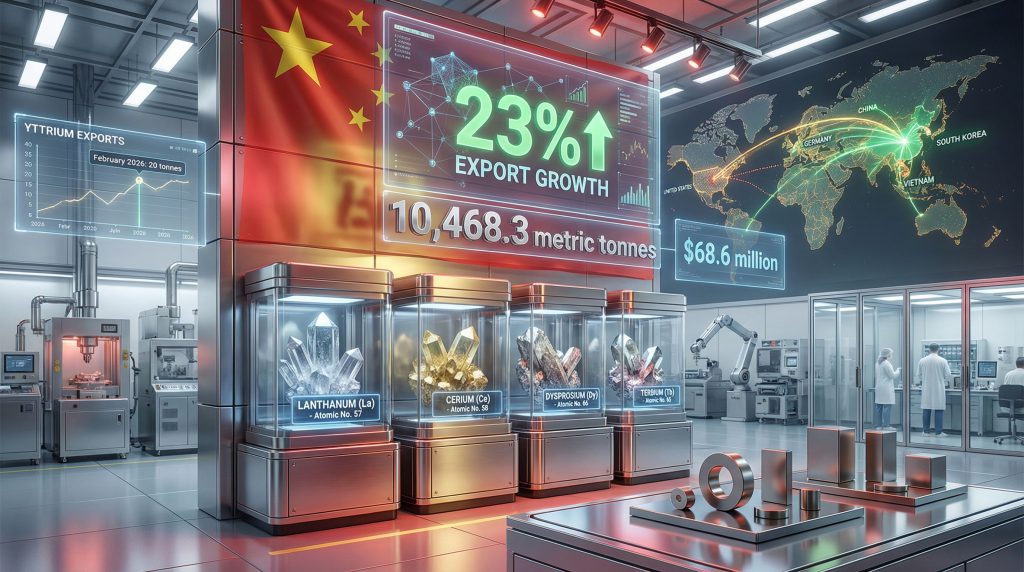
February 2026 saw China export 20 tons of yttrium oxide and related compounds, representing the largest monthly volume since export controls were imposed in April 2025. However, this still remained below 2024 levels, illustrating the nuanced approach of China export controls.
This pattern suggests China employs a tiered control system that differentiates between commercial-grade materials and those with strategic applications. The consistent growth in overall exports alongside restrictions on specific elements indicates a policy designed to maintain global market relationships while preserving leverage over critical supply chains.
Export Control Implementation Timeline
The current regulatory framework took shape in April 2025 when China placed several rare earths and associated magnets on an export control list. This marked a significant shift in how China manages its rare earth resources, moving from informal influence to formalised regulatory oversight.
Key Implementation Milestones:
- April 2025: Initial export control list established
- May-December 2025: Steady export growth despite new restrictions
- January-February 2026: 8.2% year-over-year growth in magnet exports
- February 2026: Highest yttrium export volume since controls began
The timeline reveals how China has balanced export growth with strategic control, allowing commercial applications to proceed while maintaining oversight of sensitive materials. This approach enables continued market participation while preserving the ability to restrict supplies if geopolitical circumstances warrant such action.
Regional Import Pattern Shifts and Strategic Implications
Global rare earth supply chains demonstrate remarkable diversity in their responses to China's export policies. The United States experienced a 22.5% decline in rare earth magnet imports from China, dropping to 994 tons during the January-February period. This significant reduction reflects ongoing efforts to diversify raw materials supply chains and reduce dependence on a single supplier.
In contrast, Japan increased its imports by 9.5% to 444 tons despite China blocking exports to specific military and industrial companies within Japan. This resilience suggests that Japanese importers have successfully navigated selective restrictions through strategic sourcing adjustments and alternative supplier relationships.
Regional Import Dynamics (January-February 2026):
| Country | Import Volume | Year-over-Year Change | Strategic Context |
|---|---|---|---|
| United States | 994 tons | -22.5% | Supply chain diversification |
| Japan | 444 tons | +9.5% | Strategic resilience despite selective restrictions |
| Germany | Top 5 destination | Data not disclosed | European manufacturing hub |
| South Korea | Top 5 destination | Data not disclosed | Electronics production centre |
| Vietnam | Top 5 destination | Data not disclosed | Manufacturing relocation trends |
The geographic distribution of imports reveals how different regions approach supply security. European markets appear to maintain stable import relationships, while Asian economies demonstrate growth despite selective restrictions. This geographic diversity in import patterns suggests that China's rare earth exports rise affects regions differently based on their strategic relationships and alternative sourcing capabilities.
Why Are Month-to-Month Fluctuations Important?
Understanding rare earth trade requires acknowledging the inherent volatility in monthly data. Seasonal demand patterns, inventory management cycles, and contract timing all contribute to fluctuations that may not reflect underlying trends. The 22.5% decline in US imports, while significant, must be viewed within this context of natural trade variations.
Furthermore, this volatility factor becomes crucial when assessing long-term supply security. Companies relying on rare earth materials must account for both policy-driven changes and natural market fluctuations when developing sourcing strategies. The combination creates a complex risk environment requiring sophisticated supply chain management approaches.
Geopolitical Leverage and Diplomatic Timing
The intersection of rare earth exports with high-level diplomacy became apparent in February 2026 when the White House confirmed that President Donald Trump's planned trip to China would be delayed by approximately six weeks. This postponement occurred against the backdrop of evolving trade relationships and supply chain considerations that extend beyond traditional economic factors.
China's selective export restrictions demonstrate how critical materials can be wielded as tools of statecraft. The fact that Japan experienced company-specific restrictions while maintaining overall import growth illustrates the precision with which export controls can be applied. This granular approach enables diplomatic pressure on specific entities while preserving broader economic relationships.
The timing of export data releases and diplomatic announcements may not be coincidental. By demonstrating continued export growth alongside selective restrictions, China signals both its willingness to maintain market relationships and its capacity to impose costs on specific actors when circumstances require such measures.
Strategic Communication Through Trade Data
Export statistics serve multiple purposes beyond mere economic reporting. They communicate policy intentions to international partners, signal market conditions to domestic producers, and demonstrate regulatory capabilities to global supply chain managers. The 8.2% growth in rare earth magnet exports sends a message of market stability while the yttrium restrictions remind observers of China's strategic control.
This dual messaging reflects sophisticated statecraft that uses economic data as a form of diplomatic communication. Consequently, international partners can interpret export growth as a signal of continued cooperation while understanding that specific restrictions remain possible for strategic materials.
According to the South China Morning Post, "China's selective approach to rare earth exports demonstrates sophisticated trade policy management that balances commercial interests with strategic objectives".
Investment Implications and Market Psychology
The rare earth sector presents unique investment challenges that combine geological constraints, geopolitical risks, and technological evolution. However, the ongoing US‑China trade war creates additional complexities for investors seeking exposure to critical materials markets.
Investment Risk Factors:
- Supply concentration in a single dominant producer
- Export control volatility affecting pricing and availability
- Long development timelines for alternative sources
- Technological substitution risks for specific applications
- Regulatory uncertainty in multiple jurisdictions
Opportunity Vectors:
- Alternative processing capacity development outside China
- Recycling technology for rare earth recovery
- Downstream manufacturing closer to end-use markets
- Strategic inventory management services
- Materials research for substitute technologies
The psychological aspects of rare earth investing involve understanding how market participants respond to supply security concerns. Fear of disruption often drives investment into alternative sources even when current supplies remain adequate. This psychology can create boom-bust cycles that reward patient capital and penalise reactive investment strategies.
How Is Geographic Diversification Changing?
Investment flows increasingly favour projects that reduce geographic concentration risk. Australia, Canada, and other jurisdictions with rare earth resources benefit from investor preference for supply chain diversification. These trends accelerate when export restrictions remind markets of concentration risks.
For instance, manufacturing relocation represents another investment theme driven by supply chain considerations. Companies seeking to reduce rare earth logistics risks may relocate production closer to alternative suppliers or develop regional supply networks that bypass traditional concentration points.
According to Metal.com, "The surge in dysprosium exports highlights how China maintains flexibility in its rare earth strategy while managing strategic supply chains".
Technical Considerations and Quality Factors
Rare earth elements encompass seventeen metallic elements with distinct properties and applications. The quality and grade of these materials significantly impact their suitability for specific uses, creating technical considerations that extend beyond simple quantity measures.
Light rare earth elements, including lanthanum and cerium, typically face fewer export restrictions due to their abundance and widespread applications. Heavy rare earth elements like dysprosium and terbium command higher prices and strategic attention due to their scarcity and critical applications in high-performance magnets.
Element Classification and Applications:
- Light Rare Earths: More abundant, lower strategic sensitivity, broader commercial applications
- Heavy Rare Earths: Scarce, high strategic value, critical for advanced technologies
- Permanent Magnets: Require both light and heavy elements, varying compositions for different applications
- Processing Complexity: Multi-stage refining required, technological barriers to entry
The technical complexity of rare earth processing creates natural barriers to supply chain diversification. Establishing alternative processing capabilities requires significant capital investment, technical expertise, and environmental management capabilities. These factors contribute to the persistence of supply concentration despite ongoing diversification efforts.
Processing Technology and Barriers
Rare earth processing involves complex chemical separation techniques that remove impurities and isolate individual elements. This processing stage represents a critical bottleneck in the supply chain, requiring specialised facilities and technical knowledge that few companies possess outside China.
In addition, environmental considerations add another layer of complexity to rare earth processing. The separation processes generate radioactive waste and chemical byproducts that require careful management. Regulatory approval for new processing facilities can take years and faces significant public opposition in many jurisdictions.
The next major ASX story will hit our subscribers first
Future Supply Chain Evolution and Strategic Planning
The rare earth sector continues evolving as companies, governments, and investors respond to supply concentration risks and geopolitical uncertainties. Long-term trends suggest gradual diversification while China maintains its dominant position through cost advantages and established infrastructure, particularly as mining industry innovation accelerates.
Emerging Supply Chain Characteristics:
- Regional processing hubs serving local markets
- Increased recycling of rare earth-containing products
- Strategic inventory management by government and industry
- Technology development for material substitution
- Enhanced international cooperation on critical minerals
The 20 tons of yttrium compounds exported in February 2026, while representing the highest monthly volume since export controls began, still remained below 2024 levels. This pattern illustrates how export controls can maintain strategic leverage while allowing limited market participation.
Companies developing long-term sourcing strategies must account for multiple scenarios including continued Chinese dominance, gradual supply diversification, and potential supply disruptions. This uncertainty creates value for flexible sourcing arrangements and alternative material research.
What Should Industry Participants Do?
Manufacturing companies should develop multi-source procurement strategies that reduce dependence on single suppliers while maintaining cost competitiveness. This may involve accepting higher costs for supply security or investing in alternative technology development.
Investors seeking exposure to rare earth markets should consider the full value chain from mining through processing to end-use applications. Different segments face varying risk profiles and growth prospects based on their position within the supply network.
The critical nature of rare earth elements in modern technology ensures continued strategic importance regardless of short-term trade fluctuations. Understanding both the technical and geopolitical dimensions of these markets enables better decision-making for all stakeholders.
The 8.2% growth demonstrating that China's rare earth exports rise during early 2026 represents just one data point in an evolving global story of strategic resource management, technological innovation, and international cooperation in critical materials supply chains.
Disclaimer: This analysis contains forward-looking statements and market projections that involve inherent uncertainties. Rare earth markets face significant volatility from geopolitical, technological, and economic factors. Investment decisions should consider multiple scenarios and risk factors beyond those discussed in this article. Market conditions can change rapidly, and past performance does not guarantee future results.
Looking to Capitalise on Critical Minerals Market Opportunities?
Discovery Alert's proprietary Discovery IQ model delivers instant alerts on significant ASX mineral discoveries, including rare earth and critical minerals sectors that are reshaping global supply chains. With China's export dynamics creating new investment opportunities, subscribers gain immediate access to actionable insights that identify emerging companies positioned to benefit from supply chain diversification. Start your 14-day free trial today at Discovery Alert and secure your advantage in this rapidly evolving market.