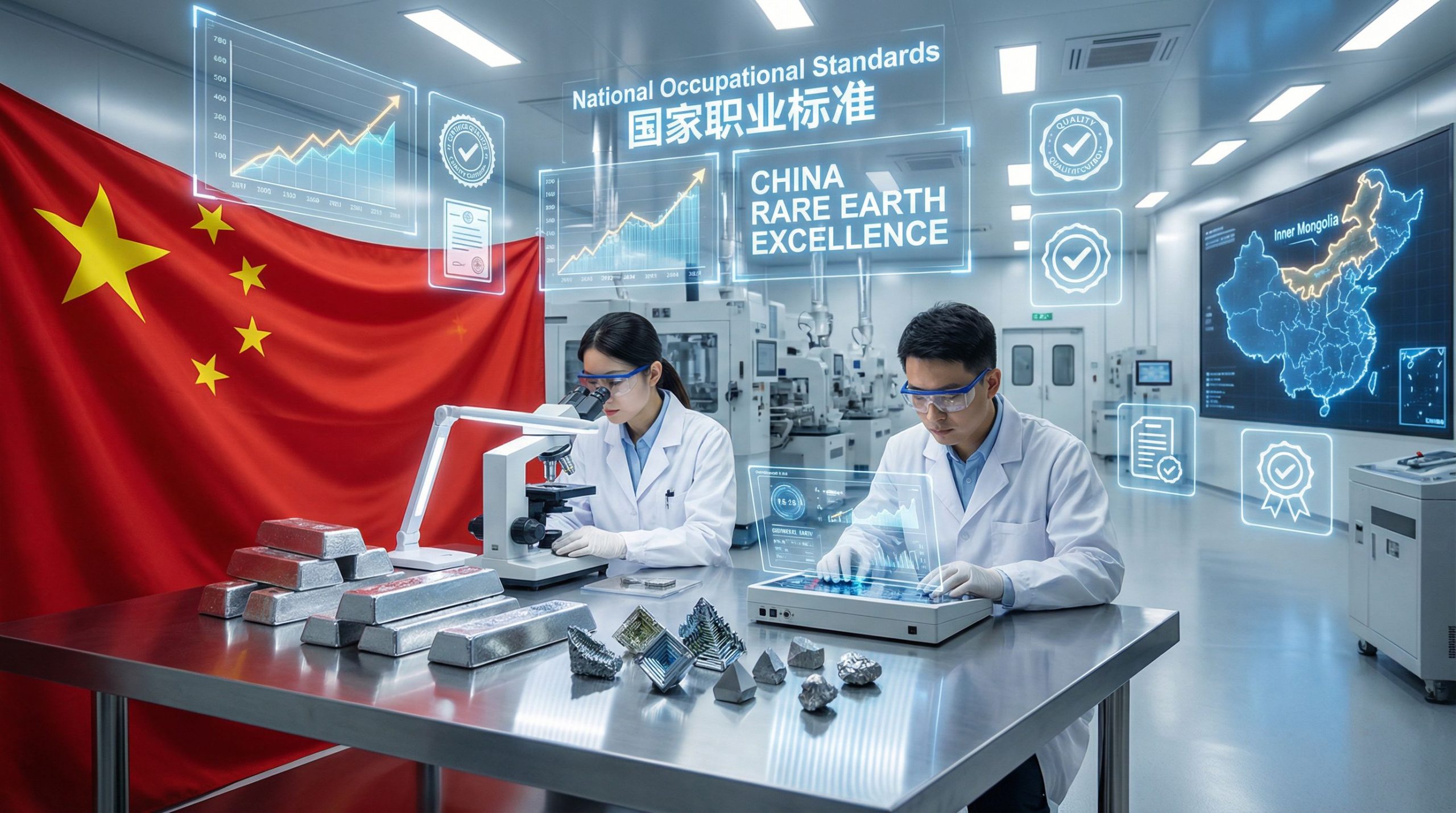
The battle for critical minerals dominance has entered a new phase, one where technical expertise may prove more decisive than raw material control. While geopolitical tensions continue to reshape supply chains across strategic industries, the most sophisticated players are recognizing that sustainable competitive advantage requires more than mining concessions or processing facilities. The development of Chinese rare earth occupational standards exemplifies this shift towards systematizing human capital that transforms raw materials into advanced technologies.
This strategic shift reflects a broader understanding of mining industry evolution in the 21st century. Nations and corporations that can standardize, scale, and continuously upgrade their technical workforce will ultimately control the value chains that matter most for economic security. Furthermore, the rare earth sector, despite its seeming focus on geological resources, exemplifies this human-centric approach to strategic competition.
Understanding China's Revolutionary Workforce Certification Framework
Beijing's establishment of Chinese rare earth occupational standards represents a fundamental transformation in how critical mineral industries approach human capital development. These comprehensive benchmarks create the first systematic pathway for certifying technical competency across rare earth processing operations, addressing what Chinese officials acknowledge as a significant capability gap in their domestic workforce.
The regulatory architecture encompasses two primary specializations: rare earth smelting operations and materials production technology. This dual-track approach reflects the technical complexity of modern rare earth processing, where traditional metallurgical skills must integrate with advanced materials science and precision manufacturing techniques.
Core Framework Components:
• Technical competency assessments covering chemical processing, equipment operation, and quality control
• Environmental compliance and safety protocol certifications
• Production optimization and supply chain integration training
• Continuous professional development requirements linked to technological advancement
The certification system operates within China's established vocational education infrastructure, creating seamless pathways from technical schools through advanced professional development. This integration ensures that workforce standards evolve alongside technological requirements while maintaining consistent quality across different regions and facilities.
Assessment Methodology:
The standards employ multi-level evaluation frameworks that combine theoretical knowledge with practical skills demonstration. Candidates must demonstrate proficiency across interconnected competency areas, reflecting the interdisciplinary nature of modern rare earth processing.
Northern Rare Earth's leadership in developing these standards leverages the company's position as China's largest rare earth producer to create benchmarks that reflect real-world operational requirements rather than academic abstractions.
Strategic Timing and Economic Drivers Behind the Initiative
The introduction of Chinese rare earth occupational standards in 2023-2025 aligns with several converging strategic imperatives that extend beyond immediate workforce needs. China's timing reflects careful coordination between industrial policy objectives, geopolitical positioning, and long-term economic planning.
Xi Jinping's directives regarding Inner Mongolia's rare earth capabilities provide the political framework for this initiative, positioning workforce development as integral to national strategic resource security. The connection to China's construction of "two major rare earth bases" indicates systematic infrastructure development designed to consolidate competitive advantages.
Market Growth Context:
Global rare earth demand has experienced unprecedented expansion driven by electric vehicle adoption, renewable energy infrastructure, and defense applications. The International Energy Agency projects rare earth requirements could increase by 300-500% by 2030, creating acute pressure on processing capacity and technical expertise.
China's acknowledgment of existing skills gaps reveals the sophisticated nature of next-generation rare earth applications. Traditional mining and basic processing competencies prove insufficient for high-purity materials production, magnetic alloy development, and specialized ceramic applications required by advanced technologies.
"Strategic Insight: The workforce standards initiative represents China's recognition that maintaining rare earth dominance requires transitioning from volume-based to capability-based competitive advantages."
Economic Integration Objectives:
The standards development parallels China's broader industrial upgrading strategy, which emphasizes moving up value chains rather than simply expanding production capacity. In addition, by standardizing workforce capabilities, Beijing creates the foundation for premium product positioning and technology export opportunities.
This approach addresses growing competition from Western rare earth development projects by establishing systematic advantages in human capital that cannot be quickly replicated through capital investment alone.
Global Competitive Landscape Analysis
The absence of equivalent workforce standardization programs in Western nations creates stark competitive disparities that extend beyond immediate market dynamics. While China systematises rare earth technical education, other major economies rely primarily on ad-hoc industry training and general mining or materials science programs.
Comparative Workforce Development Approaches:
| Region | Training Infrastructure | Certification Systems | Government Coordination |
|---|---|---|---|
| China | Integrated national standards | Mandatory certification pathways | State-directed development |
| United States | Fragmented industry programs | Company-specific certifications | Limited federal involvement |
| Australia | Mining-focused institutions | General mineral processing standards | State-level coordination |
| European Union | Research-oriented programs | Varied national approaches | Regional framework funding |
The United States lacks dedicated rare earth processing workforce development infrastructure despite significant federal investment in critical minerals research. However, the Department of Energy's Critical Materials Institute focuses primarily on technological development rather than systematic workforce training, creating potential bottlenecks for domestic supply chain development.
Australia's mining education system, while sophisticated, emphasises traditional mineral extraction and processing rather than the specialised chemical separation and advanced materials techniques required for rare earth applications. State-level vocational programmes provide general mining skills but lack rare earth-specific competency frameworks.
European Fragmentation Challenges:
European Union approaches to rare earth workforce development vary significantly among member states, with limited coordination at the continental level. Germany's technical education system provides strong materials science foundations, but rare earth-specific training remains concentrated in research institutions rather than production-oriented vocational pathways.
France's nuclear industry experience offers relevant chemical processing expertise, yet systematic rare earth workforce development has not emerged as a policy priority. For instance, the EU's Horizon Europe programme funds rare earth research but lacks the integrated workforce development approach that characterises China's strategy.
Technical Competency Requirements and Certification Processes
Chinese rare earth occupational standards establish detailed performance benchmarks that reflect the sector's evolution from basic mineral processing to advanced materials manufacturing. The technical requirements demonstrate sophisticated understanding of rare earth value chains and their integration with downstream applications.
Rare Earth Smelting Specialist Competencies:
• Chemical separation processes utilising solvent extraction and precipitation techniques
• High-temperature pyrometallurgical operations with precise temperature and atmosphere control
• Analytical testing and quality assurance protocols for purity verification
• Waste stream management and environmental compliance procedures
• Equipment maintenance and troubleshooting for specialised processing machinery
The smelting specialist certification addresses the complexity of rare earth chemical processing, where minor variations in technique can significantly impact product purity and yield. These standards require demonstrated competency across multiple separation technologies, reflecting the diversity of rare earth processing approaches.
Materials Production Technician Specialisations
Advanced materials production encompasses the transformation of processed rare earth compounds into functional materials for specific applications. This specialisation requires understanding of crystallography, magnetic properties, and materials characterisation techniques.
• Magnetic alloy composition and processing for permanent magnet production
• Ceramic and phosphor material development for electronic applications
• Surface treatment and coating technologies for specialised applications
• Quality control and performance testing methodologies
• Innovation processes for materials optimisation and application development
Certification Assessment Framework:
The evaluation process combines written examinations covering theoretical knowledge with practical skills demonstrations conducted in operational environments. Candidates must demonstrate competency across interconnected technical domains while maintaining safety and environmental compliance standards.
Ongoing professional development requirements ensure certified workers remain current with technological advances and evolving industry practices. This continuous learning framework addresses the rapid pace of innovation in rare earth applications.
Supply Chain and Market Implications
The implementation of Chinese rare earth occupational standards creates cascading effects throughout global supply chains that extend far beyond immediate production impacts. Consequently, standardised workforce capabilities enable quality consistency, production optimisation, and technological innovation that strengthen China's competitive positioning.
Immediate Quality and Production Benefits:
Certified workers demonstrate measurable improvements in processing efficiency, waste reduction, and product consistency. These operational advantages translate into cost reductions and reliability benefits that enhance China's competitiveness against alternative supply sources.
The standards create systematic approaches to production optimisation, enabling facilities to achieve higher yields and purities while reducing environmental impacts. This combination addresses both economic and regulatory pressures facing the rare earth industry, supporting broader energy transition strategy goals.
Long-term Strategic Consequences:
Workforce standardisation establishes barriers to entry for potential competitors by creating expertise requirements that cannot be quickly developed through capital investment alone. Western rare earth projects must now compete not only on cost and supply security but also on technical capability and workforce competency.
The certification system enables China to position itself as a technology transfer partner for international rare earth development projects, creating revenue opportunities and strategic influence beyond direct material sales.
"Market Dynamic: Chinese rare earth producers with certified workforces can command premium pricing for high-specification materials while maintaining cost advantages in standard grades."
Innovation and Technology Development
Systematic workforce development accelerates innovation cycles by ensuring technical personnel possess the foundational competencies required for advanced research and development initiatives. This capability enables faster commercialisation of new rare earth applications and processing technologies, particularly in emerging data-driven operations.
Furthermore, the standards create pathways for integrating academic research with industrial practice, facilitating technology transfer from universities and research institutions to commercial operations.
Western Response Strategies and Investment Implications
The establishment of Chinese rare earth occupational standards necessitates strategic reconsideration by Western governments and investors developing alternative supply chains. Traditional approaches emphasising capital investment and resource access prove insufficient when competing against systematised human capital advantages.
Critical Workforce Development Gaps:
Western rare earth development projects face acute shortages of experienced technical personnel across all aspects of processing and materials production. Universities provide materials science and chemical engineering graduates, but rare earth-specific expertise requires years of specialised training and experience.
The ageing workforce in traditional mining and metallurgical industries compounds these challenges, as institutional knowledge transfers inadequately to new entrants. Unlike other technical fields, rare earth processing expertise concentrates in relatively few facilities globally, limiting training opportunities.
Strategic Response Options:
• Development of Western rare earth technical training centres with industry-academic partnerships
• International collaboration agreements for workforce exchange and knowledge transfer
• Investment in process automation technologies to reduce dependence on specialised human expertise
• Acquisition or partnership strategies with existing operators possessing technical capabilities
Investment Due Diligence Considerations:
Rare earth project evaluation must now incorporate workforce readiness assessments alongside traditional geological and economic analyses. Projects lacking access to certified technical personnel face extended development timelines and elevated operational risks.
However, investors should evaluate management teams' strategies for workforce development, including partnerships with educational institutions, collaboration agreements with experienced operators, and budgetary allocations for training and certification programmes. This assessment becomes particularly critical when considering CRM facility insights for European supply chain development.
Competitive Positioning Analysis:
Chinese rare earth producers with certified workforces possess sustainable competitive advantages that cannot be quickly replicated through market-based solutions. Western projects must develop differentiated value propositions that acknowledge these systematic disadvantages while emphasising alternative strengths.
Supply chain security, regulatory compliance, and geographical proximity may offset technical capability gaps in specific market segments, but long-term competitiveness requires addressing workforce development systematically.
Geopolitical Dimensions and National Security Considerations
China's workforce standardisation initiative represents a sophisticated evolution in critical minerals competition that extends traditional geopolitical frameworks beyond resource control to encompass human capital dominance. This approach creates strategic vulnerabilities for Western nations that have historically emphasised material access over processing capabilities.
Strategic Dependency Implications:
The concentration of rare earth technical expertise in China creates dependencies that persist even when alternative supply sources become available. Western facilities may require Chinese technical partnerships or personnel exchanges to achieve operational competency, creating ongoing strategic vulnerabilities.
These human capital dependencies prove more persistent than material supply relationships, as technical expertise develops over years or decades rather than through immediate market transactions or diplomatic arrangements.
Technology Transfer and Intellectual Property Considerations:
Systematic workforce development enables China to position itself as an essential partner for international rare earth projects, creating opportunities for technology acquisition and strategic intelligence gathering. Western companies seeking Chinese technical expertise may inadvertently transfer proprietary knowledge or operational insights.
The certification standards could establish Chinese technical practices as global industry benchmarks, influencing international standards development and creating preferences for Chinese equipment, processes, and methodologies.
Defence Industrial Base Implications
Military applications require the highest purity and most specialised rare earth materials, demanding exceptional technical expertise for consistent production. China's workforce standardisation directly impacts Western defence supply chain security by controlling access to necessary technical competencies.
The integration of civilian and military rare earth applications means that workforce standards developed for commercial purposes directly benefit defence-related production capabilities, creating dual-use advantages for Chinese strategic planning. This becomes particularly relevant given ongoing US-China trade impacts on global supply chains.
Investment Decision Framework and Risk Assessment
The emergence of Chinese rare earth occupational standards fundamentally alters the risk-reward calculations for rare earth investment decisions across global markets. Traditional evaluation frameworks emphasising geological resources, capital requirements, and market access must incorporate workforce capability assessments as primary determinants of project viability.
Enhanced Due Diligence Requirements:
Rare earth investments now require comprehensive workforce readiness evaluations that assess technical personnel availability, training programme development, and certification pathway implementation. Projects without credible workforce development strategies face elevated execution risks and extended timelines.
Management team evaluation must emphasise technical leadership experience in rare earth processing, educational institution partnerships, and demonstrated capability in workforce development. Generic mining or materials processing experience provides insufficient background for rare earth operational requirements.
Valuation Impact Analysis:
Chinese rare earth producers with certified workforces command valuation premiums reflecting their sustainable competitive advantages and reduced operational risks. These companies demonstrate measurable improvements in production consistency, quality metrics, and innovation capabilities.
Western rare earth development projects face valuation discounts reflecting workforce development challenges, extended timelines for operational competency, and ongoing dependencies on Chinese technical expertise or personnel.
Portfolio Strategy Implications
Diversified critical minerals investment strategies must balance rare earth exposure with workforce development capabilities across different geographical regions. Pure-play rare earth investments carry elevated risks without corresponding workforce development assets or partnerships.
Strategic partnerships between Western rare earth developers and educational institutions, established operators, or technology companies provide pathways for addressing workforce challenges while maintaining portfolio diversification benefits.
Risk Mitigation Approaches:
• Technology licensing agreements that include comprehensive training and technical support
• Joint venture structures with experienced rare earth operators
• Investment in process automation to reduce dependence on specialised workforce
• Government partnership programmes providing workforce development support
• Insurance products covering workforce development and operational readiness risks
Future Scenarios and Strategic Implications
The trajectory of Chinese rare earth occupational standards creates multiple potential futures for global critical minerals competition, each carrying distinct implications for investors, policymakers, and industry participants. Understanding these scenarios enables strategic positioning and risk management across different potential outcomes.
Scenario 1: Chinese Technical Hegemony
Continued expansion and refinement of workforce standards creates insurmountable competitive advantages for Chinese rare earth operations. Western projects struggle with workforce development challenges, creating persistent dependencies on Chinese technical expertise and processing capabilities.
This scenario features premium pricing for Chinese rare earth products, limited successful Western alternative supply development, and strategic leverage for China in trade negotiations and technology transfer discussions.
Scenario 2: Western Response and Competition
Coordinated Western government and industry initiatives develop alternative workforce training programmes and technical education pathways. International collaboration creates competitive technical capabilities while maintaining supply chain diversification objectives.
This balanced scenario features multiple technically competent rare earth supply sources, competitive market dynamics, and reduced Chinese leverage over critical materials supply chains.
Scenario 3: Technology Disruption
Breakthrough innovations in rare earth processing automation, alternative materials development, or recycling technologies reduce dependence on specialised human expertise. Technology-driven solutions enable Western supply chain development despite workforce disadvantages.
This disruptive scenario could diminish the strategic value of Chinese workforce standards while creating new competitive dynamics based on technological innovation and automation capabilities.
Investment Positioning Strategies:
Each scenario requires different investment approaches and risk management strategies. Successful positioning demands flexibility across multiple potential futures while maintaining exposure to upside opportunities in preferred scenarios.
Conservative strategies emphasise Chinese rare earth producers with demonstrated workforce capabilities and competitive positioning. In contrast, aggressive approaches focus on Western alternative development projects with credible workforce development strategies or technology differentiation.
Conclusion: Redefining Critical Minerals Competition
China's introduction of Chinese rare earth occupational standards marks a pivotal transition in global critical minerals competition from resource-centric to capability-centric strategic frameworks. This systematic approach to workforce development creates sustainable competitive advantages that transcend traditional market dynamics and geopolitical relationships.
The implications extend far beyond immediate rare earth market conditions to fundamental questions about industrial competitiveness, supply chain security, and strategic autonomy in critical technology sectors. Western nations face urgent requirements for coordinated responses that address workforce development systematically rather than through fragmented market-based approaches.
For investors, the emergence of formalised workforce standards creates new evaluation criteria and risk assessment requirements that fundamentally alter traditional rare earth investment frameworks. Success increasingly depends on understanding and positioning around human capital dynamics rather than solely focusing on geological resources or market access.
The strategic challenge confronting Western policymakers and industry leaders involves developing alternative pathways for technical excellence while acknowledging the systematic advantages created by China's integrated approach to workforce development. This competition will ultimately determine which nations and companies control the critical materials essential for 21st-century technological advancement.
"Final Assessment: China's workforce standardisation represents the maturation of critical minerals competition into sophisticated industrial policy integration, requiring equally sophisticated strategic responses from competitors seeking to maintain technological independence and supply chain security."
The future of rare earth competition will be determined not by those who control the most resources, but by those who can most effectively transform those resources into advanced capabilities through systematic human capital development. This transformation affects China's rare earth export controls and global supply chain dynamics fundamentally.
Ready to Stay Ahead of Critical Minerals Market Shifts?
Discovery Alert's proprietary Discovery IQ model delivers real-time alerts on significant ASX mineral discoveries, instantly empowering subscribers to identify actionable opportunities ahead of the broader market. Understand why major mineral discoveries can lead to significant market returns by exploring Discovery Alert's dedicated discoveries page, showcasing historic examples of exceptional outcomes, and begin your 30-day free trial today to position yourself ahead of the market.