European Metals Holdings Ltd
- ASX Code: EMH
- Market Cap: $72,458,455
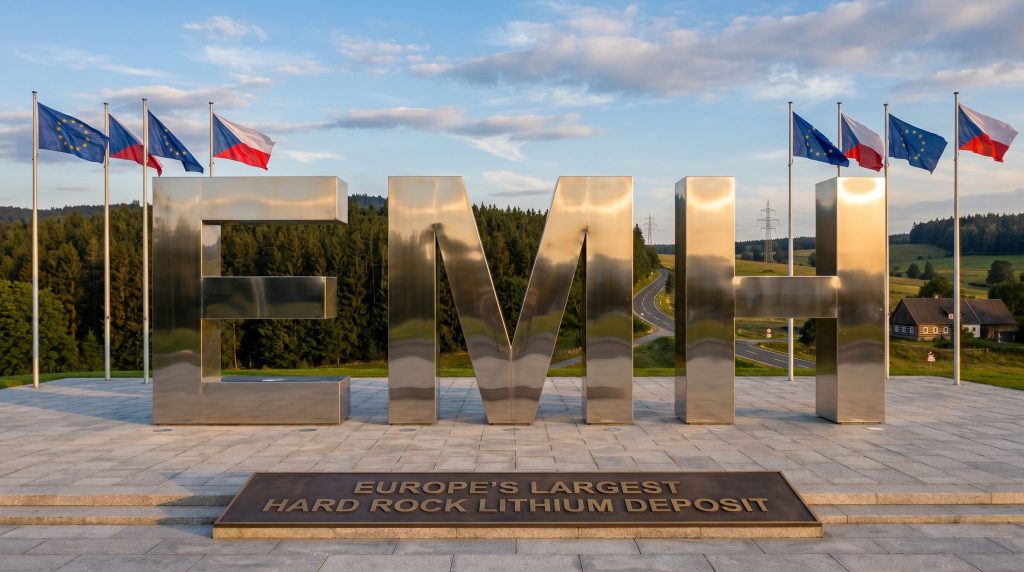
European Metals Clears Critical Permitting Hurdle at Cinovec — Europe's Largest Hard Rock Lithium Deposit Moves Closer to Production
European Metals Holdings Limited (ASX/AIM: EMH) has announced a meaningful step forward in the environmental permitting of its flagship Cinovec Lithium Project in the Czech Republic. The European Metals Cinovec lithium project EIA published in Czech Republic marks a significant milestone, with the Czech Ministry of Environment completing its review and formally publishing the Environmental Impact Assessment (EIA). A public hearing is now scheduled in the coming weeks.
Simultaneously, a cross-border EIA process involving German authorities has been formally initiated, addressing the project's transnational footprint along the Czechia-Germany border.
For investors tracking the Cinovec development timeline, these are not incremental updates — EIA publication is explicitly identified by the company as a critical path item on the route to final approval and project progression.
"We are pleased with the progress which the Project team has made in relation to the environmental permitting of the Cinovec Project. The Publishing of the EIA by the Czech Ministry of the Environment is a critical path item with regards the obtaining of the final EIA approval and progressing the Cinovec Project." — Executive Chairman Keith Coughlan
When big ASX news breaks, our subscribers know first
What Has Actually Happened — and Why It Matters
To appreciate the significance of this announcement, it helps to understand where it sits within the broader permitting sequence. The full EIA was submitted to the Czech Ministry of Environment on 31 December 2025. The Ministry has now completed its review and published the document, triggering the public consultation phase.
These are the key developments confirmed in this announcement:
- EIA published by the Czech Ministry of Environment following completion of the Ministry's internal review
- Public hearing scheduled in the coming weeks, marking the formal commencement of public consultation
- Cross-border EIA process initiated, covering the mining area only, to assess transboundary impacts on German interests — specifically cross-border hydrology and mine scheduling
Each of these steps is a sequenced prerequisite for obtaining final EIA approval. The publication of the EIA by the Ministry is the gate through which the project must pass before public engagement can occur, and the public hearing is in turn required before a final determination can be made.
Understanding the Cross-Border EIA — What It Is and Why It Applies
What Is a Cross-Border EIA?
An Environmental Impact Assessment is a formal regulatory process that evaluates the environmental consequences of a proposed project before it receives approval. When a project has the potential to cause environmental effects that cross national borders, international conventions — and in Europe, EU Directive frameworks — require that neighbouring countries be formally consulted. This is known as a transboundary or cross-border EIA.
Why Does It Apply to Cinovec?
The Cinovec deposit straddles the border between the Czech Republic and Germany. While the processing plant will be located entirely within Czechia (approximately 59 km by rail from the mine site), the underground mining operations sit at the border zone. The cross-border EIA is therefore limited in scope — it applies to the mining area only and focuses specifically on:
- Cross-border hydrological impacts (groundwater and water flows that may affect German territory)
- Mine scheduling considerations relevant to transboundary effects
Why Does This Matter for Investors?
The cross-border process adds a procedural layer, but the company has approached it proactively. A fully detailed cross-border hydrological model has already been prepared jointly by ERM (ERM International Group Limited) and DHI (Danish Hydraulic Institute) — two internationally recognised environmental consultancies — covering both the Cinovec and neighbouring Zinnwald projects together.
Furthermore, the relevant sections of the Czech EIA have been translated into German and formally transmitted to the Saxon State Council by the Czech Ministry of Environment, initiating the official process. A timeline update for this process will be provided in due course.
Cinovec at a Glance — The Project Behind the Permitting Milestone
The permitting progress announced today is occurring against the backdrop of one of Europe's most significant critical minerals development projects. The Definitive Feasibility Study (DFS), released in December 2025, confirmed the following:
| Metric | Detail |
|---|---|
| Steady-state production | 37,500 tpa battery-grade lithium carbonate (Li₂CO₃) |
| Mine operating life | 28+ years |
| Ore Reserve (Proven & Probable) | 55.4 Mt at 0.58% Li₂O |
| Total Mineral Resource | 748 Mt @ 0.19% Li₂O |
| LCE Resource (combined) | 7.45 million tonnes LCE |
| EU demand represented (2030 est.) | ~5.2% of EU lithium carbonate demand |
| EV batteries supported annually | >900,000 (50kWh basis) |
| EMH equity interest in Geomet s.r.o. | 49% (CEZ a.s. holds 51%) |
Cinovec is recognised as the largest hard rock lithium deposit in Europe and by far the largest within the European Union. The deposit sits in a historically active mining region with established infrastructure — a sealed road adjacent to the site, rail lines within 5–8 km, and an active 22 kV transmission line serving the historic mine.
Mineral Resource Breakdown
| Category | Tonnes | Grade (Li₂O) |
|---|---|---|
| Measured | 54.4 Mt | 0.58% |
| Indicated | 378.23 Mt | 0.41% |
| Inferred | 309.49 Mt | 0.39% |
Understanding Environmental Impact Assessments in Mining
Environmental Impact Assessments represent a critical regulatory framework in modern mining development. The EIA process evaluates a project's potential environmental effects across multiple domains including water resources, air quality, biodiversity, noise levels, and socio-economic impacts on local communities.
The EIA Process in European Mining
For mining projects in the European Union, the EIA process follows established frameworks under EU Environmental Directive 2011/92/EU. The process typically involves:
- Scoping: Identifying which environmental aspects require assessment
- Impact Assessment: Detailed evaluation of potential environmental effects
- Public Consultation: Community and stakeholder engagement
- Authority Review: Regulatory evaluation and approval decision
- Monitoring: Ongoing environmental compliance verification
Why EIAs Matter for Mining Investment
Environmental approval represents one of the most significant de-risking milestones in mining project development. Without EIA approval, projects cannot proceed to construction regardless of their technical or economic merits.
The publication of an EIA by regulatory authorities signals that the technical submission has met regulatory standards and can proceed to public consultation — a critical gate in the approval sequence.
Grants Secured — Confirmed Financial Support for Cinovec
The project has received confirmed grant funding from two sources, as announced in prior releases:
- USD 36 million from the EU Just Transition Fund (announced 28 April 2025)
- Up to EUR 360 million from the Czech Government (announced 7 March 2025)
In addition, Cinovec has been designated a Strategic Project under the EU Critical Raw Materials Act and a Strategic Deposit by the Czech Government — designations that reflect the formal recognition of the project's importance to European supply chains.
Where the Project Sits in the Permitting Journey
Permitting for a project of Cinovec's scale is multi-staged and sequential. The current announcement advances the European Metals Cinovec lithium project EIA published in Czech Republic through two specific gates.
Czech EIA Process — Key Sequence
- ✅ Full EIA submitted to Ministry of Environment — 31 December 2025
- ✅ Ministry review completed and EIA published — May 2026
- 🔄 Public hearing — scheduled in coming weeks
- ⏳ Public consultation period concludes
- ⏳ Final EIA approval determination
Cross-Border EIA Process (Mining Area — Germany)
- ✅ Cross-border hydrological model prepared (ERM & DHI)
- ✅ Czech EIA sections translated and transmitted to Saxon State Council
- ⏳ Cross-border consultation process underway — timeline to be advised
The company has flagged that a further update on the cross-border EIA timetable will be provided in due course.
The Investment Thesis — Permitting Progress as a Value Catalyst
For lithium development companies, permitting milestones are among the most consequential de-risking events on the path to production. Unlike exploration results or resource estimates — which define what a project could be — permitting advances define when a project can proceed. Each gate cleared reduces regulatory uncertainty and brings the project closer to a sanctionable investment decision.
The publication of the EIA and the scheduling of the public hearing represent the formal transition from technical submission to public process. This is a meaningful shift: the project is no longer awaiting ministerial review — it is now in active public consultation, with the final EIA approval as the next major milestone on the critical path.
Several factors reinforce the investment case at this juncture:
- DFS-confirmed economics at 37,500 tpa production over 28+ years provide a bankable technical foundation
- Confirmed grant funding of USD 36 million (EU) and up to EUR 360 million (Czech Government) reduces the financing burden
- CEZ as a 51% partner in Geomet s.r.o. — CEZ is one of Central Europe's largest energy groups, with a market capitalisation of approximately EUR 28.2 billion, and has stated intentions to develop energy storage and battery manufacturing projects in the region
- Europe's largest hard rock lithium deposit provides scale advantages and long-term production optionality
- Cross-border process proactively managed, with a comprehensive hydrological model already completed prior to formal initiation
Why Investors Should Keep Watching European Metals
The Cinovec Project is tracking through a defined, sequential permitting process with visible near-term milestones. The public hearing — due in the coming weeks — will be the next observable event, followed by the conclusion of the public consultation period and ultimately the final EIA approval determination.
For investors interested in European critical minerals development, few projects combine the scale, infrastructure readiness, technical validation, and confirmed financial support that Cinovec has assembled. The permitting process, while inherently complex for a project of this size and cross-border nature, is progressing through its defined stages.
The cross-border EIA with Germany adds procedural complexity; however, the preparatory work — a jointly prepared hydrological model by ERM and DHI, formal translation, and transmission to the Saxon State Council — suggests the project team has engaged with this requirement proactively rather than reactively.
The European Metals Cinovec lithium project EIA published in Czech Republic represents a critical permitting gate cleared, with a public hearing now imminent. With Europe's largest hard rock lithium deposit, a DFS-confirmed production profile of 37,500 tpa of battery-grade lithium carbonate, confirmed grant funding, and a major energy group as a joint venture partner, the Cinovec Project's permitting progress warrants close investor attention as it moves toward final EIA approval.
The next major ASX story will hit our subscribers first
Glossary of Key Terms
EIA (Environmental Impact Assessment): A formal regulatory process assessing the environmental consequences of a proposed project, required before project approval can be granted.
Cross-border EIA: An EIA process that involves consultation with neighbouring countries when a project's environmental effects may extend across national borders.
LCE (Lithium Carbonate Equivalent): The industry-standard unit for expressing lithium resources, representing the total equivalent amount of lithium carbonate (Li₂CO₃) assuming full conversion. Used to allow comparison across projects and resource types.
Li₂O (Lithium Oxide): The unit in which lithium grades are typically reported in hard rock deposits. To convert Li₂O to LCE (Li₂CO₃), multiply by 2.473.
DFS (Definitive Feasibility Study): A detailed engineering and economic study that confirms the technical and financial viability of a mining project to a level sufficient to support a final investment decision.
Ore Reserve: The economically mineable portion of a Mineral Resource, estimated with consideration of mining, processing, and economic factors. Expressed as Proven and Probable categories under the JORC Code.
Geomet s.r.o.: The Czech entity that holds the Cinovec mineral exploration licences. Owned 49% by European Metals and 51% by CEZ a.s. through its wholly owned subsidiary SDAS.
Ready to Track Cinovec's Path to Production?
European Metals Holdings (ASX/AIM: EMH) is advancing Europe's largest hard rock lithium deposit through a defined, sequential permitting process — with a public hearing now imminent, confirmed grant funding exceeding $396 million, and a DFS-validated production profile of 37,500 tpa of battery-grade lithium carbonate underpinning the investment case. For investors seeking exposure to a large-scale, strategically recognised critical minerals project at a pivotal point in its development, now is the time to learn more. Visit europeanmet.com to explore the Cinovec Project and stay across upcoming milestones.