The global transition towards sustainable resource management is fundamentally reshaping how industries approach material procurement and waste handling. This shift represents more than environmental stewardship; it signals a complete restructuring of commodity supply chains where waste streams become primary input sources. Furthermore, the circular battery economy exemplifies this transformation, converting end-of-life energy storage systems into strategic assets through sophisticated recovery processes that extract maximum value from every component.
Understanding the Circular Battery Economy Framework
The circular battery economy operates on principles that fundamentally challenge traditional resource extraction models. Rather than following linear "extract-use-dispose" patterns, this system creates continuous material flows through multiple value-extraction stages. Each battery undergoes systematic processing designed to capture different forms of economic value at sequential points in its lifecycle.
This multi-stage approach begins with secondary market deployment, where batteries with diminished capacity for electric vehicles find new applications in stationary energy storage systems. Grid-scale installations can utilise batteries operating at 70-80% of original capacity, extending useful life by 5-10 years beyond automotive applications.
Component harvesting represents the second value extraction phase, where specialised facilities disassemble battery systems to recover intact modules, cooling systems, and electronic components. This process can capture 15-25% of original battery value through direct component reuse in manufacturing or refurbishment operations.
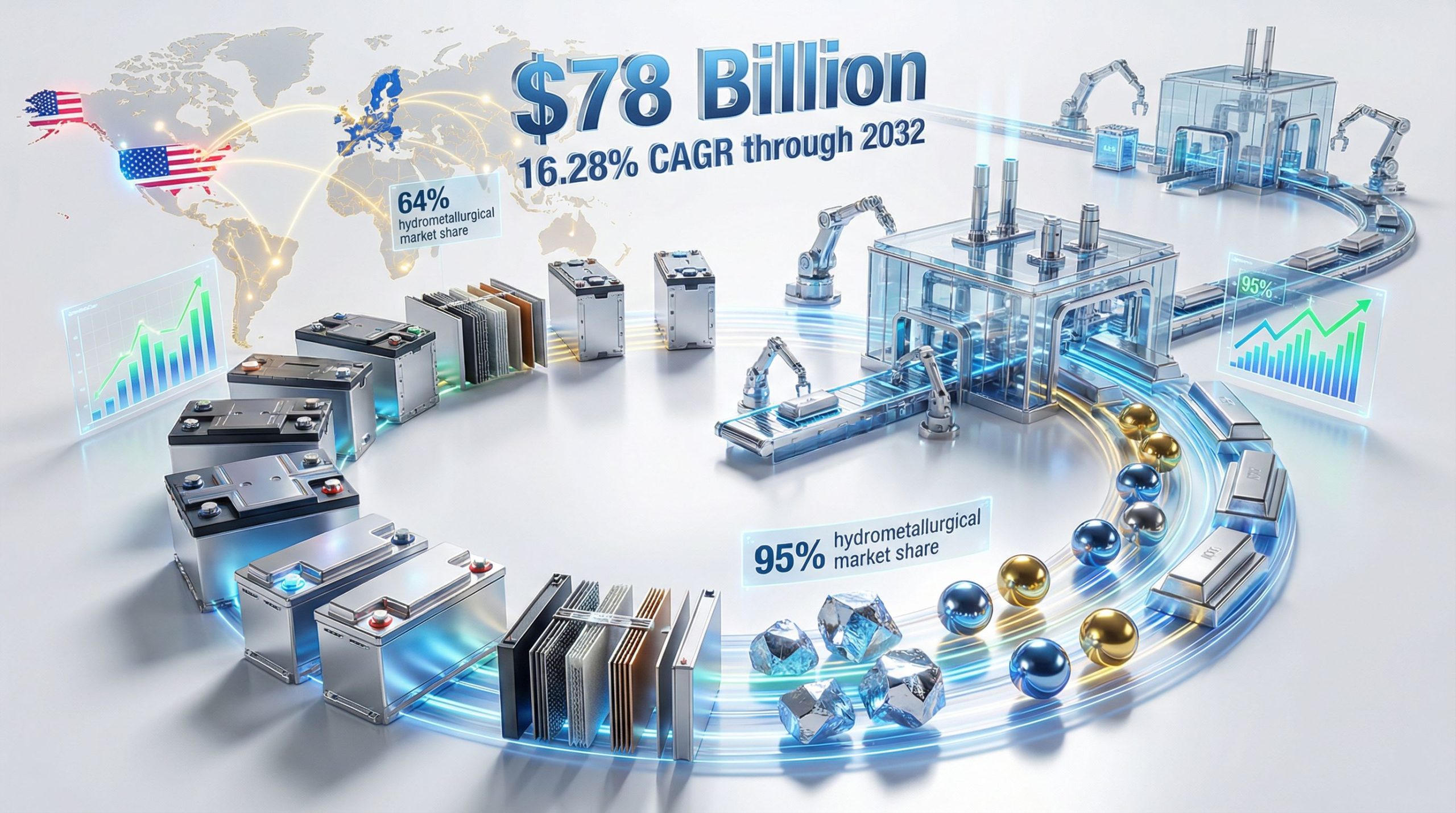
The final stage involves material recovery through chemical and mechanical processes that extract lithium, cobalt, nickel, and other strategic minerals. Advanced hydrometallurgical techniques can achieve 95% recovery rates, producing battery-grade materials that compete directly with virgin mining outputs.
Unlike traditional mining operations that target single elements, circular battery facilities function as integrated material recovery centres producing all required battery inputs simultaneously. This eliminates supply chain complexity while creating production facilities located near consumption centres rather than geological deposits.
Market Transformation Drivers Behind the $78 Billion Projection
The projected growth from $23.29 billion in 2024 to nearly $78 billion by 2032 reflects structural market forces rather than cyclical trends. This 16.28% compound annual growth rate indicates institutional recognition that circular battery systems address multiple economic pressures simultaneously.
Resource concentration risk drives much of this transformation. Current mineral processing shows dangerous geographic concentration patterns:
| Critical Mineral | Processing Concentration | Primary Risk Factor |
|---|---|---|
| Cobalt | Over 70% in limited regions | Democratic Republic of Congo political instability |
| Lithium | 60% processing concentration | Chile-Australia-China processing dominance |
| Nickel | Regional concentration | Indonesia export restrictions |
| Rare Earth Elements | 85%+ Chinese control | Geopolitical leverage concerns |
This concentration creates supply chain vulnerability that recycling infrastructure can partially mitigate. Western economies increasingly view the battery recycling breakthrough as strategic infrastructure comparable to energy or telecommunications networks, justifying substantial government investment regardless of short-term economic returns.
Demand-supply imbalances compound these pressures. Electric vehicle sales growth rates consistently exceed mineral supply expansion, creating persistent shortages that drive commodity price volatility. For instance, recycling provides the only scalable alternative to dramatically expanding mining operations in politically unstable regions.
The capital efficiency advantages of recycling versus mining operations become apparent when considering infrastructure requirements. However, recycling facilities require $50-100 million in capital investment compared to $1-5 billion for new mining operations, while achieving faster permitting timelines and reduced environmental compliance costs.
Investment Landscape and Capital Allocation Patterns
The United States dominates global investment flows, representing $8.8 billion of the total $23.29 billion global market in 2024. This 38% market share reflects aggressive federal policy support rather than natural market advantages, demonstrating how government intervention shapes circular economy development.
Venture capital and private equity funding reached record levels in 2024, with over $3.2 billion directed towards battery recycling technologies. This represents a 300% increase from 2022 levels, indicating investor recognition of long-term structural demand drivers.
Nevertheless, market timing creates significant investment risks. Current recycling capacity expansion outpaces immediate feedstock availability, creating what industry analysts term the "infrastructure-demand gap." Companies building recycling facilities today anticipate the wave of end-of-life batteries expected after 2030, requiring sustained capital commitment through periods of limited material supply.
Li-Cycle Holdings Corp exemplifies these timing challenges. The company paused construction on its Rochester Hub facility in New York due to rising costs and feedstock uncertainty, demonstrating how capital-intensive recycling infrastructure requires careful market timing.
Conversely, Redwood Materials and Glencore plc continue aggressive expansion by securing long-term feedstock agreements with automakers. This strategic approach provides guaranteed material flows, reducing investment risk while creating competitive barriers for new entrants.
Institutional investors increasingly view circular battery infrastructure as essential infrastructure comparable to utilities or telecommunications. This perspective supports higher valuations based on strategic necessity rather than traditional financial metrics, explaining the sector's premium valuations despite current profitability challenges.
Technology Economics and Process Innovation
Hydrometallurgical processes dominate commercial operations, capturing 64% of total market revenue in 2024. These chemical recovery methods achieve 95% mineral recovery rates while producing battery-grade specifications that compete directly with virgin materials.
The technology operates through systematic chemical dissolution of battery materials, followed by selective precipitation of individual metals. This process flow creates multiple revenue streams from single input materials:
- Lithium carbonate: Battery-grade purity (>99.5%)
- Nickel sulfate: Cathode production specifications
- Cobalt sulfate: High-purity industrial applications
- Copper concentrates: Wire and conductor manufacturing
- Aluminum recovery: Packaging and structural applications
Process economics favour hydrometallurgy over traditional smelting approaches. Energy consumption averages 12-15 kWh per kilogram of recovered material compared to 25-30 kWh for pyrometallurgical processes. Lower energy requirements translate directly to reduced operational costs and improved profit margins.
Black mass markets represent emerging intermediate commodity trading. This shredded battery material contains concentrated metal values but requires further processing to achieve final specifications. Market prices for black mass now range $6,000-$12,000 per ton depending on metal content and purity levels.
Recovery rate improvements continue advancing through process optimisation. Leading facilities achieve lithium recovery rates of 95%, cobalt recovery of 97%, and nickel recovery of 96%. These rates exceed many traditional mining operations whilst operating with significantly lower environmental impact.
The concept of "perfect mines" describes recycling facilities that produce all required battery materials in precise ratios. Traditional mining operations extract single elements, requiring complex supply chain coordination to assemble complete battery material sets. In addition, recycling facilities eliminate this complexity by producing balanced material outputs from integrated processes.
Regional Market Dynamics and Policy Frameworks
The Inflation Reduction Act (IRA) fundamentally altered North American market dynamics by creating artificial demand floors through domestic content requirements. Federal tax credits now require minimum percentages of battery materials sourced from domestic recycling operations, guaranteeing market demand regardless of cost competitiveness.
Automaker compliance strategies reflect this policy pressure. Major manufacturers implement minimum recycled content targets to maintain federal incentive eligibility:
- Tesla: Targeting 25% recycled content by 2027
- BMW: 30% recycled materials in all North American battery production
- Toyota: 20% minimum recycled content across hybrid and electric vehicle lines
These commitments create guaranteed offtake agreements for recycling facilities, reducing market risk and supporting investment decisions. Automakers prefer long-term supply contracts to spot market purchases, providing revenue stability for recycling operations.
European Union regulations follow different approaches through Extended Producer Responsibility mandates. Battery manufacturers bear responsibility for end-of-life processing costs, creating economic incentives for design optimisation and material recovery. This regulatory framework drives the sustainable battery recycling process where manufacturers control entire material lifecycles.
Policy convergence across Western economies treats battery recycling as both environmental compliance and economic security infrastructure, fundamentally altering global supply chain architectures through coordinated government intervention.
Regional competitive advantages emerge through different policy approaches. The United States emphasises production incentives and domestic content requirements, while Europe focuses on circular design mandates and producer responsibility. These different frameworks create distinct investment opportunities and competitive dynamics in each market.
Supply-Demand Imbalances and Market Timing
Current market conditions reflect fundamental timing mismatches between infrastructure development and material availability. Industry projections indicate 1.4 million tons of EV battery waste entering recycling streams by 2030, expanding dramatically to 8 million tons by 2040.
This growth trajectory creates significant challenges for current operations. Most electric vehicles remain relatively new, with the first generation of mass-market EVs not reaching end-of-life until the late 2020s. Recycling facilities must therefore secure alternative feedstock sources during this interim period.
Manufacturing scrap currently provides the primary material source for many facilities. Battery production generates 5-10% waste streams through quality control rejections and process optimisation. These materials provide immediate feedstock whilst companies develop collection networks for end-of-life batteries.
Collection infrastructure represents a critical bottleneck in market development. Unlike traditional recycling streams, battery recovery requires specialised handling due to fire and chemical hazards. Building comprehensive collection networks demands significant capital investment and regulatory coordination across multiple jurisdictions.
Capacity utilisation rates currently average 30-40% across the industry due to limited feedstock availability. This underutilisation creates financial pressure on facility operators whilst potentially building overcapacity for future demand surges.
Market timing creates competitive advantages for companies capable of managing the transition period effectively. Early infrastructure builders gain preferential access to feedstock through established relationships with automakers and waste management companies, creating barriers for later entrants.
How Does Technology Innovation Impact Long-term Economic Restructuring?
By 2032, recycled materials could supply 25% of global lithium demand, fundamentally altering commodity pricing mechanisms and trade flows. This transformation represents more than incremental supply additions; it creates alternative price discovery mechanisms independent of traditional mining economics.
Localisation advantages become increasingly apparent as recycling capacity scales. Processing facilities locate near consumption centres rather than mineral deposits, reducing transportation costs and supply chain complexity. This geographic rebalancing could shift competitive advantages from resource-rich regions to manufacturing centres.
Technology learning curves continue driving cost reductions across all recovery processes. Industry analysis indicates 15-20% annual cost reductions through process optimisation, scale economies, and equipment standardisation. These improvements suggest recycling could achieve cost parity with mining operations by 2028-2030.
Integration with renewable energy creates additional value streams for battery recycling operations. Facilities can provide grid balancing services through flexible power consumption, generating additional revenue whilst optimising energy costs during processing operations.
The circular battery economy enables material security independent of geological constraints or political stability in mining regions. This security premium may justify higher recycling costs during transition periods, supporting industry development through economic incentives beyond pure cost competition.
Resource quality improvements through recycling processes can exceed virgin material specifications. Recovered materials undergo purification stages that eliminate impurities common in mined minerals, potentially creating premium product categories for high-performance applications.
What Are The Primary Risk Factors Affecting Market Growth?
Commodity price volatility presents the primary risk factor for recycling economics. When virgin material prices decline, recycling operations face margin pressure that can render facilities temporarily uneconomical. Historical analysis shows 30-50% price swings in lithium and cobalt markets over 18-month periods.
Technology disruption risks could fundamentally alter battery chemistry requirements. Alternative technologies like solid-state batteries or sodium-ion systems might reduce demand for current recycling infrastructure designed for lithium-ion chemistries.
Regulatory uncertainty affects long-term investment decisions despite current policy support. Changes in government priorities or trade policies could eliminate incentive structures supporting recycling economics. Companies must therefore plan for scenarios with reduced or eliminated government support.
Feedstock competition intensifies as recycling capacity expands faster than material supply. Premium pricing for quality feedstock could compress margins and create competitive disadvantages for facilities without secured supply agreements.
Capital intensity requires sustained investment commitment through market cycles. Recycling facilities typically require 7-10 years to achieve full capacity utilisation and return on investment, exposing operators to extended periods of market risk.
Environmental compliance costs continue increasing as regulations tighten around chemical processing operations. Facility operators must budget for ongoing upgrades to meet evolving environmental standards, adding to operational complexity and capital requirements.
What Will Future Market Structure Look Like?
Vertical integration increasingly defines competitive advantage in the circular battery economy. Companies controlling multiple supply chain stages from collection through refined material production achieve better margins and market positioning than specialised operators.
Strategic partnerships with automakers provide the most sustainable competitive advantages. Long-term supply agreements guarantee feedstock access whilst creating barriers for competitors seeking to establish operations. These relationships often evolve into exclusive arrangements that dominate regional markets.
Consequently, the critical minerals recycling transition centres on recovery efficiency and product purity rather than basic processing capability. Leading companies achieve competitive moats through proprietary processes that deliver superior recovery rates or produce premium-grade materials commanding higher prices.
The sector will likely consolidate around vertically integrated players capable of managing entire material lifecycles from recovery through remanufacturing. Standalone recycling operations face competitive pressure from integrated companies that optimise across multiple value chain segments.
Geographic specialisation may emerge as different regions develop distinct competitive advantages. Processing centres near major battery manufacturing clusters gain logistical advantages, whilst facilities in resource-rich areas might focus on hybrid mining-recycling operations.
The development of comprehensive battery recycling facility solutions will ultimately determine whether the circular battery economy achieves its projected growth trajectory. Success depends on coordinated development of collection infrastructure, processing capacity, and end-user demand through the challenging transition period before large-scale battery waste becomes available.
The Strategic Implications for Global Supply Chains
The transformation from linear resource consumption to circular material flows represents one of the most significant structural changes in commodity markets since the industrial revolution. Moreover, the energy transition and critical minerals relationship creates unprecedented opportunities for companies positioned to manage complex material recovery systems.
According to the World Economic Forum's analysis of battery supply chain circularity, coordinated policy frameworks and technological advancement remain essential for achieving projected growth rates. Furthermore, research from RMI's Battery Circular Economy Initiative demonstrates that successful implementation requires collaboration across multiple stakeholders and regulatory jurisdictions.
Whether this change occurs smoothly or through market disruption depends largely on how effectively companies and governments manage the complex transition dynamics currently shaping the global circular battery economy. The integration of advanced recovery technologies with strategic policy frameworks will determine the ultimate success of this fundamental shift towards sustainable resource management.
Ready to Capitalise on the Next Circular Economy Breakthrough?
Discovery Alert's proprietary Discovery IQ model provides instant alerts on significant ASX mineral discoveries and resource sector developments, including companies developing critical battery metals and recycling technologies that could benefit from the circular economy transformation. Explore how major resource discoveries have generated substantial market returns by visiting Discovery Alert's discoveries page, and start your 30-day free trial today to position yourself ahead of emerging opportunities in Australia's evolving resource sector.