
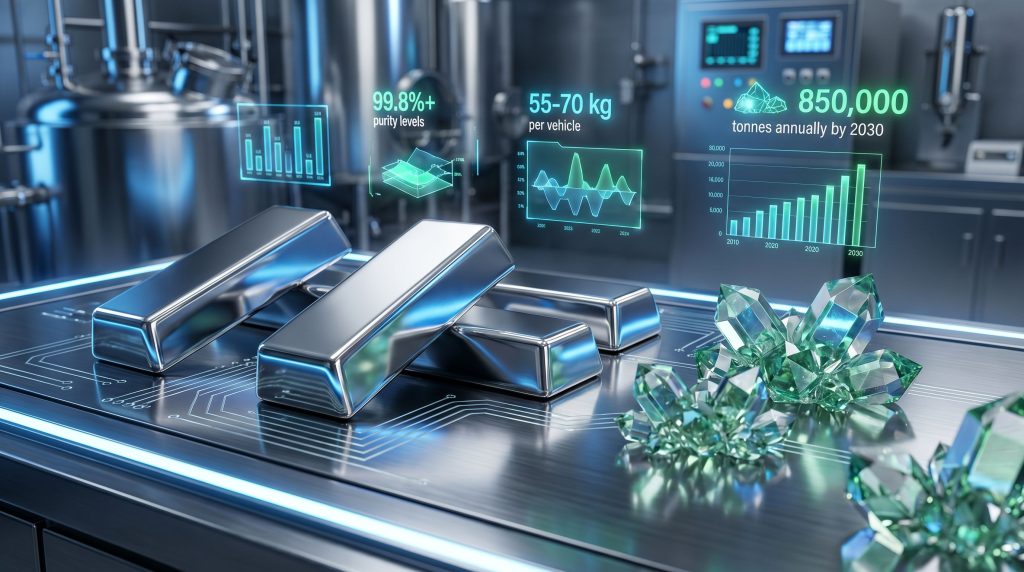
Battery manufacturing demands unprecedented material precision, with electrochemical processes requiring metals refined to tolerances that exceed traditional industrial standards. The transition from internal combustion engines to electric powertrains has created entirely new supply chains optimised for chemical purity rather than structural strength. Understanding these technical requirements reveals why global automotive manufacturers face increasing constraints in securing adequate raw material supplies for lithium-ion battery production, particularly regarding Class 1 nickel demand in EV batteries.
Chemical Purity Standards Drive EV Performance Requirements
Modern electric vehicle batteries depend on Class 1 nickel demand in EV batteries reaching purity levels of 99.8% or higher, with contaminant thresholds measured in parts per billion rather than traditional percentage tolerances. These specifications eliminate trace elements like sulfur, iron, and cobalt that would otherwise interfere with cathode chemistry and reduce overall battery performance.
Furthermore, nickel importance insights demonstrate how this critical metal enables the energy density breakthroughs necessary for commercial EV viability.
Energy Density Optimisation in High-Performance Batteries
Contemporary battery chemistries, particularly NMC 811 (80% nickel, 10% manganese, 10% cobalt) and NCA formations, incorporate 55-70 kilograms of nickel per vehicle to achieve energy densities exceeding 250 watt-hours per kilogram. This concentration enables driving ranges beyond 400 miles while maintaining acceptable vehicle weight parameters.
The relationship between nickel content and energy density follows established electrochemical principles: higher nickel concentrations in cathode materials increase voltage potential and electron capacity. However, this performance enhancement requires absolute purity standards that eliminate even trace contaminants capable of disrupting lithium-ion exchange processes.
According to research from Benchmark Minerals, the technical specifications for battery-grade nickel far exceed traditional industrial applications, creating distinct supply chains and pricing mechanisms.
Battery Chemistry Performance Trade-offs
Alternative battery technologies demonstrate the critical role of nickel in premium applications:
- LFP (Lithium Iron Phosphate): Zero nickel content but 20-30% lower energy density
- NMC 622: Moderate nickel content with balanced cost and performance
- NMC 811: High nickel content maximising energy density for premium vehicles
Premium automotive segments maintain commitment to high-nickel chemistries despite cost pressures, sustaining 12-15% annual growth in Class 1 nickel demand in EV batteries even as economy segments adopt LFP alternatives.
When big ASX news breaks, our subscribers know first
Processing Infrastructure Limitations Create Supply Bottlenecks
Converting raw nickel ore into battery-grade material requires specialised facilities operating under extreme conditions that differentiate this process from traditional metallurgy. High-Pressure Acid Leach (HPAL) operations function at 250°C temperatures and 45 bar pressure, consuming 2.5-3.0 tonnes of sulfuric acid per tonne of nickel produced.
Ore Processing Economics and Capacity Constraints
| Ore Type | Processing Method | Capital Cost | Class 1 Yield | Energy Requirements |
|---|---|---|---|---|
| Sulfide | Flotation/Smelting | $2-3 billion | 85-95% | Moderate |
| Laterite | HPAL | $4-6 billion | 70-80% | High |
| Laterite | Pyrometallurgy | $3-5 billion | 60-70% | Very High |
These capital requirements explain why new Class 1 nickel demand in EV batteries supply additions require 3-5 year construction timelines and face significant financing hurdles. Energy consumption of 45-65 megawatt-hours per tonne makes facilities vulnerable to electricity price volatility, with European operations facing 40-60% higher energy costs than Indonesian competitors.
In addition, the mining industry evolution trends illustrate how technological advancement drives both opportunities and challenges in critical mineral processing.
Geographic Concentration of Refining Capacity
Global Class 1 nickel refining remains concentrated in three primary regions:
- Finland (Harjavalta): Traditional Western processing hub
- Canada (Sudbury): Sulfide ore processing centre
- Indonesia: Emerging HPAL facilities with coal-powered operations
This geographic concentration creates supply chain vulnerabilities, particularly when combined with the 15-20% cost variations that Indonesian facilities experience based on thermal coal price fluctuations.
Critical Infrastructure Challenge: Converting Class 2 nickel to battery-grade specifications requires additional refining steps costing $2,000-4,000 per tonne, making dedicated Class 1 production facilities economically essential despite higher capital requirements.
Geopolitical Tensions Reshape Global Supply Networks
International conflicts and trade disruptions have fundamentally altered nickel supply chain dynamics, forcing automotive manufacturers to restructure sourcing strategies around political rather than purely economic considerations. Russia historically supplied 200,000+ tonnes annually through Norilsk Nickel operations, with post-2022 sanctions redirecting 60% of this volume toward Asian markets.
However, the broader US-China trade impact extends beyond bilateral relationships, affecting global commodity flows and strategic material availability.
Strategic Inventory Management Response
Battery manufacturers have responded to supply uncertainties by dramatically expanding inventory positions:
- Historical inventory: 30-45 days of nickel sulfate stockpiles
- Current inventory: 90-120 days of strategic reserves
- Working capital impact: $500 million to $1 billion for major producers
This inventory expansion represents a permanent structural shift toward supply security optimisation rather than just-in-time efficiency, fundamentally changing Class 1 nickel demand in EV batteries purchasing patterns.
Energy Cost Transmission Mechanisms
Supply chain analysis reveals how regional conflicts impact nickel availability through indirect pathways. Middle East instability affects global energy costs and shipping routes, increasing processing expenses for energy-intensive HPAL operations. Critical shipping passages like the Strait of Hormuz influence fuel prices throughout mining, refining, and logistics networks.
Since nickel processing requires substantial energy inputs, particularly for laterite ore conversion, regional energy price shocks create cascading cost increases across the entire Class 1 nickel demand in EV batteries supply chain.
North American Supply Chain Development
The Alaska Energy Metals Nikolai project exemplifies emerging Western supply alternatives. March 2025 resource estimates confirmed:
- Indicated resources: 5.6 billion pounds nickel, 1.77 billion pounds copper
- Inferred resources: 9.38 billion pounds nickel, 2.43 billion pounds copper
- Total nickel equivalent: 29.01 billion pounds across both categories
These sulfide deposits offer cleaner processing pathways and simpler conversion to battery-grade specifications compared to laterite operations, making them strategically valuable for Class 1 nickel demand in EV batteries supply diversification.
For instance, the tamarack nickel-copper project demonstrates similar potential in North American sulfide deposits.
Demand Growth Scenarios Through 2030
Electric vehicle adoption trajectories create multiple demand scenarios for battery-grade nickel, with conservative projections assuming 25% global EV penetration by 2030 requiring 850,000 tonnes annually. Aggressive scenarios reaching 40% penetration could demand 1.35 million tonnes, creating significant supply deficits.
Regional Market Development Patterns
| Region | 2025 Demand (kt) | 2030 Projection (kt) | Annual Growth Rate |
|---|---|---|---|
| China | 280 | 485 | 11.6% |
| Europe | 165 | 295 | 12.3% |
| North America | 145 | 275 | 13.7% |
| Asia-Pacific | 85 | 165 | 14.2% |
These regional variations reflect different EV adoption timelines, charging infrastructure development, and regulatory frameworks supporting electrification. North American growth rates exceed global averages due to federal incentives and automaker electrification commitments.
Research from UPCatalyst emphasises how the electric vehicle boom intensifies competition for critical raw materials through 2030.
Technology Mix Impact on Demand
Industry projections from IRENA indicate Class 1 nickel demand in EV batteries could exceed 1.09 million tonnes by 2030, while IEA data suggests broader cleantech applications might reach 1.349 million tonnes. The variation reflects different assumptions about battery chemistry evolution and application scope.
McKinsey analysis projects primary Class 1 capacity reaching only 1.2 million tonnes against demand approaching 1.5 million tonnes, indicating structural supply deficits persisting through the late 2020s.
Advanced Processing Technologies and Supply Solutions
Emerging extraction and refining technologies offer potential pathways to alleviate Class 1 nickel demand in EV batteries supply constraints. Direct Nickel Extraction (DNE) processes extract nickel directly from laterite ores without intermediate ferronickel production, potentially reducing costs by 25-35% while improving yields to 90%+.
Battery Recycling Infrastructure Development
End-of-life battery recycling represents a growing source of Class 1 nickel demand in EV batteries supply, with facilities capable of recovering 95%+ purity levels from automotive battery packs. Current recycling capacity handles less than 5% of battery nickel volumes, but projections suggest 15-20% supply contribution by 2030.
Furthermore, recent battery recycling breakthrough developments in China demonstrate technological pathways toward higher recovery rates and lower processing costs.
Recycling economics improve as battery waste volumes increase and processing technologies achieve commercial scale. The closed-loop nature of battery-to-battery recycling maintains chemical purity standards required for cathode manufacturing.
Alternative Cathode Chemistry Development
Next-generation cathode materials offer potential demand mitigation:
- NCMA formulations: Reduced cobalt content while maintaining performance
- High-manganese variants: Lower nickel requirements with acceptable energy density
- Silicon nanowire integration: Enhanced capacity without nickel increases
These developments could reduce per-vehicle nickel requirements by 20-30% while maintaining energy density targets, effectively extending available Class 1 nickel demand in EV batteries supplies across larger production volumes.
Economic Factors Driving Processing Investment
Energy-intensive refining operations make Class 1 nickel demand in EV batteries production costs highly sensitive to electricity pricing and input material availability. European refineries face competitive disadvantages due to higher energy costs, while Indonesian facilities benefit from coal-fired power despite environmental concerns.
Capital Investment Requirements and Timelines
New Class 1 nickel projects require extraordinary capital commitments:
- Development timeline: 7-10 years from discovery to production
- Capital intensity: $15,000-25,000 per annual tonne of capacity
- Total facility costs: $4-6 billion for modern HPAL operations
These requirements create structural barriers to rapid supply expansion, particularly when combined with environmental permitting processes and community engagement obligations.
Sulfuric Acid Supply Dependencies
HPAL operations depend heavily on sulfuric acid supply chains linked to global sulfur markets. Acid costs represent 15-20% of total processing expenses, with supply disruptions capable of constraining Class 1 nickel demand in EV batteries production even when ore supplies remain adequate.
Processing Economics Reality: The combination of high capital requirements, lengthy development timelines, and input supply dependencies means that Class 1 nickel supply responses lag demand growth by several years, creating persistent market tightness.
The next major ASX story will hit our subscribers first
Supply Chain Diversification and Strategic Sourcing
Automotive manufacturers and battery producers are implementing comprehensive diversification strategies to reduce exposure to supply disruptions while maintaining Class 1 nickel demand in EV batteries quality standards. These approaches balance cost optimisation with supply security considerations.
Friendshoring Initiative Economics
U.S. and European policies support domestic Class 1 nickel demand in EV batteries production through multiple mechanisms:
- Tax credits for qualifying domestic production facilities
- Loan guarantees reducing project financing costs
- Strategic stockpiling programmes providing demand certainty
These initiatives could support 200,000-300,000 tonnes of additional Western capacity by 2030, though achievement depends on successful project execution and regulatory approval timelines.
Vertical Integration Strategies
Major battery manufacturers are pursuing vertical integration from mine to cathode production to secure Class 1 nickel demand in EV batteries supply chains. Tesla, CATL, and other industry leaders invest directly in mining projects to capture processing margins while ensuring material availability.
This integration approach reduces market exposure while providing greater control over sustainability and quality standards throughout the supply chain.
North American Sulfide Deposit Advantages
Sulfide deposits in Alaska, Canada, and Minnesota offer strategic advantages for Class 1 nickel demand in EV batteries supply:
- Lower energy processing requirements compared to laterite operations
- Reduced environmental footprint with cleaner extraction methods
- Simplified refining pathways to battery-grade specifications
- Political stability in allied jurisdictions
Frequently Asked Questions
Can Existing Class 2 Nickel Be Upgraded for Battery Applications?
Converting Class 2 nickel to battery-grade material requires additional refining steps costing $2,000-4,000 per tonne, making direct Class 1 production more economical. The upgrading process involves removing impurities to achieve 99.8%+ purity standards required for Class 1 nickel demand in EV batteries.
How Long Will Class 1 Nickel Shortages Persist?
Supply-demand modelling suggests Class 1 nickel demand in EV batteries deficits could persist through 2027-2028, with market balance dependent on new refinery commissioning schedules and actual EV adoption rates. Project development timelines make rapid supply responses unlikely.
What Role Does Recycling Play in Future Supply?
Battery recycling could supply 150,000-200,000 tonnes annually by 2030, equivalent to 2-3 major mining operations. This represents 15-20% of projected Class 1 nickel demand in EV batteries, significantly reducing primary supply requirements.
How Do Processing Locations Affect Supply Security?
Geographic concentration of refining capacity in Finland, Canada, and Indonesia creates vulnerability to regional disruptions. Diversifying processing locations reduces supply chain risks while Class 1 nickel demand in EV batteries continues expanding globally.
Investment and Strategic Market Implications
Class 1 nickel demand in EV batteries represents one of the most compelling investment themes in critical materials, driven by structural supply constraints and accelerating demand growth. Project development requires specialised technical expertise and substantial capital commitments, creating barriers to entry that support long-term pricing dynamics.
Risk Assessment Framework for Nickel Projects
Investors evaluating Class 1 nickel demand in EV batteries opportunities must consider multiple risk factors:
- Technical risks: Processing complexity and metallurgical challenges
- Regulatory risks: Environmental permitting and community acceptance
- Market risks: Battery chemistry evolution and recycling competition
- Geopolitical risks: Trade policies and supply chain disruptions
Sulfide deposits generally offer lower technical risk profiles but require higher exploration investments than laterite operations.
Long-term Market Structure Evolution
The Class 1 nickel demand in EV batteries market is transitioning from commodity trading toward long-term contract structures. Battery manufacturers secure 5-10 year supply agreements at fixed or formula pricing to ensure material availability during the critical EV scaling period.
Supply Chain Security Premiums
Battery manufacturers demonstrate willingness to accept 5-10% cost premiums for supply security, particularly for materials sourced from politically stable jurisdictions. This premium structure supports investment in higher-cost but more secure Class 1 nickel demand in EV batteries projects.
The intersection of technological requirements, geopolitical realities, and capital market dynamics creates a unique investment environment where strategic positioning matters more than traditional cost optimisation. Companies developing Class 1 nickel demand in EV batteries projects in stable jurisdictions with proven ore bodies and established processing pathways offer the most attractive risk-adjusted returns in this critical materials sector.
Disclaimer: This analysis is for educational purposes only and does not constitute investment advice. Critical mineral investments carry significant risks including market volatility, regulatory changes, and operational challenges. Readers should conduct thorough due diligence and consult qualified professionals before making investment decisions.
Looking to Capitalise on Critical Battery Metal Opportunities?
Discovery Alert's proprietary Discovery IQ model delivers real-time alerts on significant nickel and battery metal discoveries across the ASX, transforming complex mineral announcements into actionable investment insights. With Class 1 nickel demand surging alongside EV adoption, subscribers gain immediate access to emerging opportunities that could benefit from this unprecedented market transformation. Begin your 14-day free trial today to position yourself ahead of the market in this critical materials sector.
