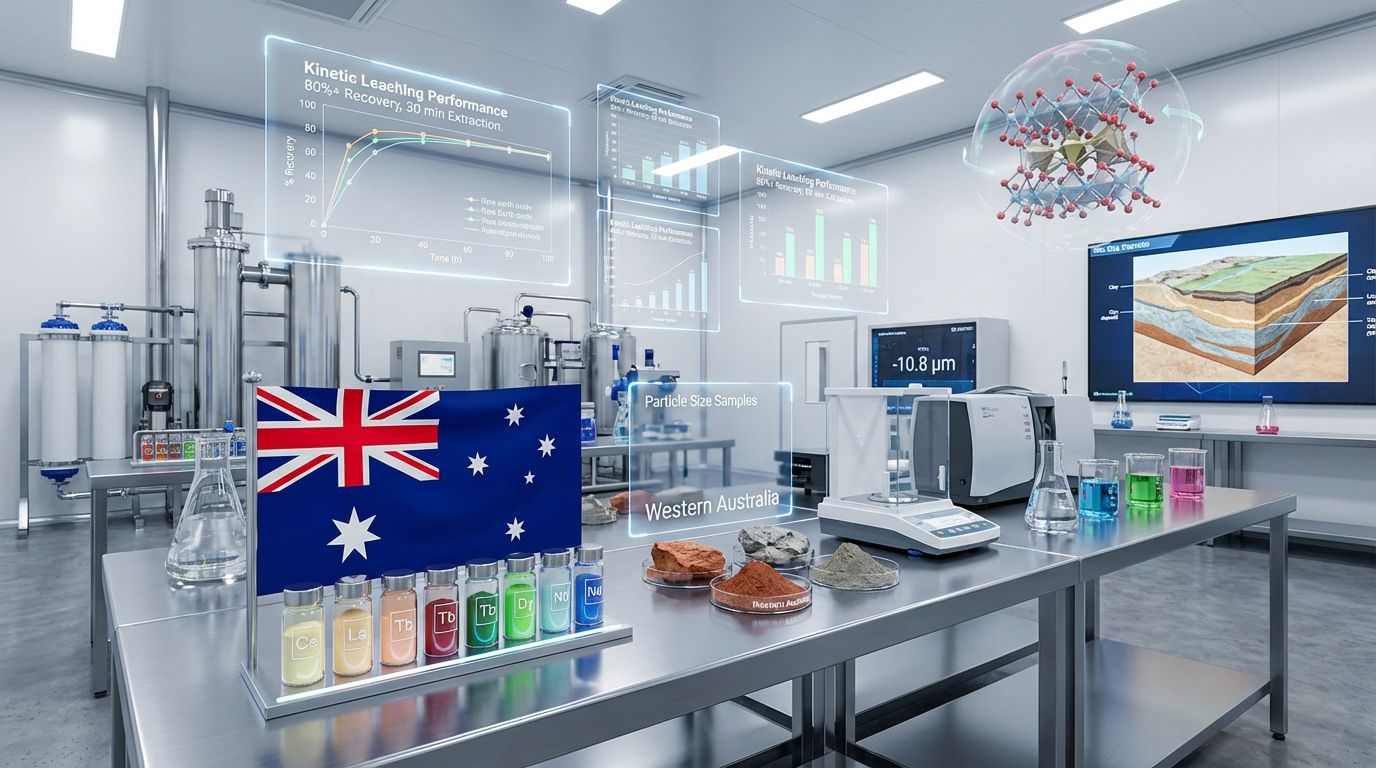
Clay-hosted rare earth deposits represent a paradigm shift in mineral extraction technology, fundamentally altering traditional processing economics through advanced metallurgical innovations. Unlike conventional hard rock systems that require extensive comminution and complex chemical circuits, clay-based formations offer inherent advantages that accelerate extraction kinetics while reducing operational complexity. The breakthrough efficiency at North Stanmore demonstrates how geological characteristics directly influence processing viability, establishing new benchmarks for heavy rare earth recovery systems that support critical minerals energy security initiatives.
Revolutionary Geological Formations in Western Australia
Clay-hosted rare earth deposits differ fundamentally from traditional hard rock formations through their unique mineral associations and structural characteristics. These systems naturally concentrate heavy rare earth elements within clay mineral matrices, creating favourable conditions for efficient extraction processes.
North Stanmore's geological profile demonstrates the potential of clay-hosted formations, containing over 35.9 million tonnes of yttrium oxide in accessible clay matrices. This concentration represents one of the largest heavy rare earth resources globally outside China-controlled supply chains. Furthermore, the deposit's formation through weathering processes has created naturally fine-grained materials with enhanced surface reactivity compared to crystalline silicate minerals found in hard rock deposits.
The geological advantages extend beyond simple mineral distribution. Clay formations typically exhibit:
- Consistent grade distribution across broad zones rather than narrow veins
- Reduced structural complexity compared to fault-controlled hard rock deposits
- Enhanced porosity and permeability facilitating chemical processing
- Absence of refractory minerals that resist conventional extraction methods
Western Australian clay deposits benefit from specific climatic conditions that concentrated rare earth elements through selective leaching and redeposition processes. The arid environment preserved these enriched zones while preventing further weathering that could disperse valuable minerals.
Processing Advantages Through Simplified Chemistry
Clay-hosted systems eliminate many complications inherent in traditional rare earth processing, particularly the management of radioactive thorium and uranium contamination. Consequently, this absence creates substantial operational and regulatory advantages that translate directly to project economics and support broader mining industry innovation initiatives.
Traditional monazite and xenotime deposits commonly contain 8-12% thorium oxide and 2-5% uranium oxide, requiring specialised radioactive waste management protocols. In contrast, clay-hosted formations at North Stanmore contain negligible levels of these elements, eliminating:
- Complex radioactive tailings storage requirements
- Specialised worker safety protocols for radiation exposure
- Extensive environmental monitoring systems
- Regulatory compliance costs associated with nuclear materials
The simplified environmental profile accelerates permitting timelines and reduces capital requirements for waste management infrastructure. For instance, projects can proceed through standard mineral processing approvals rather than nuclear facility licensing pathways.
Processing efficiency gains extend to reagent consumption and circuit design. Clay minerals naturally exhibit high surface area-to-volume ratios (100-500 m²/g) compared to comminuted hard rock particles, accelerating acid-mineral interactions without requiring energy-intensive grinding operations.
Breakthrough Kinetic Performance Metrics
Recent metallurgical testing at North Stanmore has validated extraordinary improvements in extraction kinetics, achieving approximately 80% rare earth recovery within 30 minutes compared to original assumptions of four-hour processing times. This represents an 87.5% reduction in leaching duration while maintaining high recovery rates, marking a significant advancement in the breakthrough efficiency at North Stanmore project.
| Parameter | Traditional Methods | Advanced Clay Processing | Improvement |
|---|---|---|---|
| Extraction Time | 4+ hours | 30 minutes | 87.5% reduction |
| Recovery Rate | 70-75% | 80%+ | 5-15% increase |
| Reagent Efficiency | Baseline consumption | 40% reduction | Significant savings |
| Circuit Complexity | Multi-stage systems | Simplified single-stage | Reduced complexity |
The accelerated kinetics result from optimised chemical conditions that enhance ion exchange mechanisms in clay mineral structures. Victory Metals' technical team, comprising more than 100 years of combined rare earth experience, has developed proprietary parameter combinations that maximise extraction efficiency, as reported by Global Mining Review.
These results confirm pathways to smaller leach circuits, reduced reagent consumption, and improved overall process efficiency. The breakthrough represents a major advancement for heavy rare earth extraction technology, particularly for clay-hosted systems.
Chemical Engineering Fundamentals
Acid leaching in clay matrix systems operates through fundamentally different mechanisms compared to hard rock mineral dissolution. Rare earth elements in clay formations are held primarily through electrostatic substitution rather than covalent bonding within crystal lattices, enabling rapid ion displacement under acidic conditions.
The enhanced extraction kinetics at North Stanmore reflect optimisation of several critical parameters. However, these advances align with broader mining sustainability transformation efforts across the industry:
Surface Area Optimisation
Clay particles naturally occur in the 0.1-10 micron range, providing inherently high reactive surface area without requiring energy-intensive comminution. This contrasts with hard rock ores that must be crushed and ground to achieve comparable surface area accessibility.
Temperature Control
Elevated temperatures increase molecular kinetics and ion mobility, accelerating the displacement of rare earth cations from clay mineral exchange sites. Optimal temperature ranges balance kinetic acceleration against energy costs and reagent stability.
pH Management
Acidic conditions (typically pH 0-2) maintain protonation of both the leaching acid and rare earth ion exchange sites. Precise pH control prevents over-acidification that increases reagent costs without proportional extraction benefits.
Reagent Selection
Different acids offer varying advantages for clay-hosted systems. Sulfuric acid provides cost-effectiveness with established chemistry, while hydrochloric acid delivers efficient extraction with soluble chloride byproducts. The 40% reduction in reagent consumption achieved at North Stanmore indicates optimised acid selection and dosing protocols.
Advanced Beneficiation Through Size Fractionation
Size fractionation techniques have demonstrated remarkable improvements in concentrate quality through targeted particle separation. Advanced processing at North Stanmore utilises micron-level separation (targeting -10.8 micron fractions) to enhance heavy rare earth concentrations while reducing overall processing volumes.
The beneficiation process achieves substantial grade improvements across multiple rare earth elements:
Advanced size fractionation delivers significant grade enhancements: Terbium concentrations increase by 53%, dysprosium by 25%, and scandium grades double through targeted particle separation techniques that concentrate valuable minerals in specific size ranges.
Physical concentration methods for clay-hosted deposits leverage natural particle size distributions to separate valuable minerals from gangue materials. The process reduces mass reporting to downstream circuits by approximately 73%, creating substantial savings in processing infrastructure and operating costs.
This mass reduction strategy enables:
- Smaller processing equipment with proportionally lower capital costs
- Reduced energy consumption through decreased material handling
- Enhanced concentrate quality commanding premium pricing
- Simplified downstream purification circuits
Mixed Rare Earth Oxide Production Standards
Clay-hosted processing systems at North Stanmore target 94% Total Rare Earth Oxide (TREO) content in final products, establishing quality benchmarks that align with global rare earth standards. This high-grade specification positions products for premium market segments and long-term supply agreements.
Heavy rare earth enrichment in final concentrates provides strategic positioning in critical mineral markets. Furthermore, the concentrate specifications meet requirements for technology manufacturers requiring consistent, high-quality feedstock for advanced applications including:
- Electronics manufacturing requiring pure rare earth compounds
- High-temperature applications utilising yttrium-based ceramics
- Phosphor production for lighting and display technologies
- Permanent magnet manufacturing incorporating dysprosium and terbium
Market positioning advantages include premium pricing for high-grade heavy rare earth concentrates, particularly as global supply constraints intensify. Current yttrium prices have surged over 4,400%, reflecting scarcity following China's export control implementation in December 2025, according to Market Index.
Global Supply Chain Transformation
Critical mineral supply chain analysis reveals intensifying constraints on heavy rare earth availability, creating strategic opportunities for Western clay-hosted projects. China's export controls on rare earth elements have fundamentally altered global market dynamics, creating urgent demand for alternative supply sources that complement Australia's strategic minerals reserve development.
Recent market developments include:
- Yttrium price volatility with 4,400% increases reflecting supply constraints
- Export control implementation restricting Chinese rare earth shipments
- Strategic mineral security requirements driving Western supply development
- Technology manufacturer concerns about supply chain resilience
Advanced clay-hosted processing eliminates traditional bottlenecks through rapid extraction, simplified circuits, and reduced environmental complexity. These advantages position projects as strategic alternatives to concentrated global supply chains while offering enhanced technical and economic viability.
The competitive positioning becomes particularly valuable as Western governments implement critical mineral security strategies. Australia's position as a stable jurisdiction with advanced mining expertise creates additional strategic value for clay-hosted rare earth developments.
Environmental and Regulatory Optimisation
Clay-hosted rare earth projects offer substantial environmental advantages compared to traditional hard rock operations. The absence of radioactive elements eliminates complex waste management requirements while reducing regulatory compliance costs and approval timelines.
Environmental benefits include:
- Elimination of radioactive waste management infrastructure requirements
- Reduced water consumption through efficient processing circuits
- Minimised chemical reagent usage through optimised kinetics
- Simplified monitoring protocols without radiation safety requirements
Regulatory pathway optimisation enables faster project development through standard mineral processing approvals rather than nuclear facility licensing. This acceleration can reduce development timelines by months or years compared to radioactive rare earth projects.
The streamlined environmental profile supports social licence to operate while reducing ongoing compliance costs throughout project life cycles. Additionally, these improvements support data-driven mining operations that enhance environmental monitoring and efficiency.
Commercial Viability Through Technical Innovation
Economic modelling demonstrates how metallurgical advances translate to enhanced commercial viability through multiple value drivers. Processing cost reductions through efficiency gains, combined with capital intensity improvements, create compelling project economics.
Key economic benefits include:
- Reduced processing costs through accelerated extraction kinetics
- Lower capital requirements for simplified circuit design
- Enhanced revenue potential through premium product quality
- Accelerated development timelines enabling earlier cash flow generation
Development timeline acceleration results from reduced pilot plant testing requirements and simplified process design phases. The validated metallurgical performance at North Stanmore enables faster progression to pre-feasibility and feasibility studies, with commercial production potential advancing accordingly.
Scale-up considerations include modular processing plant design opportunities that enable phased development strategies for optimal capital efficiency. Technology transfer and licensing potential creates additional revenue streams beyond direct production operations.
What Makes North Stanmore's Results Significant for the Industry?
The breakthrough efficiency at North Stanmore results represent a paradigm shift in rare earth processing economics and technical feasibility. The 87.5% reduction in processing time combined with enhanced recovery rates fundamentally alters project economics across multiple parameters.
Industry implications extend beyond individual project performance to encompass broader technological advancement in clay-hosted systems. The validated processing parameters provide a template for similar deposits globally, potentially transforming rare earth supply chain dynamics.
Technical validation at North Stanmore enables accelerated development timelines for comparable projects worldwide. The proven metallurgical performance reduces technical risk for investors and streamlines financing for clay-hosted rare earth developments.
Strategic Resource Development Framework
Australia's critical mineral strategy positions clay-hosted rare earth developments as strategic assets for national resource security and export diversification. The combination of geological advantages, processing innovations, and regulatory efficiency creates comprehensive competitive advantages.
Strategic development elements include:
- Heavy rare earth production capabilities independent of Chinese supply chains
- Technology leadership in clay-hosted processing methodologies
- Supply chain resilience for critical mineral security requirements
- Export diversification opportunities reducing commodity concentration risk
Industry transformation potential extends beyond individual projects to encompass processing technology advancement, downstream value-adding opportunities, and research collaboration platforms. Intellectual property development through metallurgical innovations creates long-term competitive advantages for Australian rare earth processing capabilities.
The breakthrough efficiency at North Stanmore demonstrates how geological understanding, combined with advanced processing techniques, can transform resource economics while addressing global supply chain vulnerabilities. As critical mineral demand intensifies, clay-hosted systems offer strategic pathways for sustainable rare earth development outside traditional supply constraints.
Ready to Capitalise on the Next Critical Minerals Breakthrough?
Discovery Alert's proprietary Discovery IQ model delivers instant notifications when ASX companies announce significant mineral discoveries, including breakthrough metallurgical results like those demonstrated at North Stanmore. Subscribers gain immediate access to actionable insights that can identify investment opportunities ahead of the broader market, ensuring you're positioned for potential gains when major discoveries transform into market-moving announcements.