
July 28, 2026
When the Desert Floods: Rethinking Climate Risk in Latin American Iron Ore Production
There is a persistent assumption embedded in the economics of dryland mining: that arid environments offer a natural hedge against weather disruption. The logic seems intuitive. Regions with minimal annual rainfall, such as Chile's northern valleys, were historically considered low-risk from a precipitation standpoint. Yet this assumption contains a dangerous blind spot. The CMP iron ore output drop after Chile storms has brought this vulnerability into sharp focus for the entire sector.
When rainfall does arrive in these hyperarid corridors, the infrastructure designed for dry conditions has almost no capacity to absorb it. Drainage systems are minimal, rail embankments are unprotected, and haul roads become impassable within hours. The very aridity that made these regions attractive for open-cut mining operations is the same characteristic that amplifies vulnerability when extreme weather strikes.
This dynamic has moved from theoretical concern to measurable financial reality for Compañía Minera del Pacífico (CMP), Chile's dominant iron ore producer, following a severe winter storm event that swept through northern Chile's mining valleys in mid-2026.
When big ASX news breaks, our subscribers know first
Understanding CMP and Its Position in Latin American Iron Ore
CMP operates as the iron ore production arm of the CAP Group, Chile's integrated steel and mining conglomerate. Its operations are geographically distributed across three principal Andean valley systems: the Valle del Huasco, the Valle del Elqui, and the Valle de Copiapó. Each corridor contains distinct deposits and connects to the Pacific coast via rail lines that serve as the critical export arteries for ore bound for regional steelmakers.
Chile is not a dominant player in global iron ore volumes the way Australia or Brazil are. Australia's iron ore dominance accounts for roughly 57% of global iron ore exports, while Brazil contributes around 20%. Chile's contribution is comparatively modest on a global scale. However, within Latin America, CMP's output plays a structurally significant role in regional steel supply chains, particularly for domestic Chilean steel production through CAP's own steelworks and for export customers across the Pacific Rim.
This regional importance means that production disruptions carry outsized consequences relative to the tonnage volumes involved. Furthermore, understanding the iron ore demand outlook is essential context for evaluating just how disruptive these supply-side shocks can become.
CMP's Ore Characteristics
CMP's iron ore types and deposits are predominantly magnetite-rich, which distinguishes them from the hematite-dominant ores common in Australia's Pilbara region and Brazil's Iron Quadrangle. Magnetite ores typically carry lower iron grades at the run-of-mine stage, commonly in the 30–40% Fe range, but are upgraded through concentration and pelletisation processes to produce a higher-value product.
This beneficiation requirement adds complexity and capital intensity to CMP's operations compared with direct-shipping ore producers. Consequently, any disruption to processing infrastructure, not just mining operations, can constrain output considerably.
The Storm Event: Geography of Impact Across Three Valleys
The winter storm system that struck northern Chile in July 2026 did not affect all three operational corridors equally. The Valle del Huasco and the Valle del Elqui bore the primary burden of the disruption, while the Valle de Copiapó continued normal operations. This differential outcome offers an important lesson about the micro-geography of infrastructure resilience and how topographic and elevation factors influence where precipitation intensity concentrates during Andean weather systems.
The storm forced temporary halts to both mining extraction and ore transport in the affected valleys. Critically, the damage extended beyond mine sites themselves to the rail corridors that connect inland operations to coastal port facilities. This distinction matters enormously for understanding recovery timelines. According to reporting on the disruption, the scale of infrastructure damage surprised many industry observers given the region's historical aridity.
Quantifying the Financial Damage
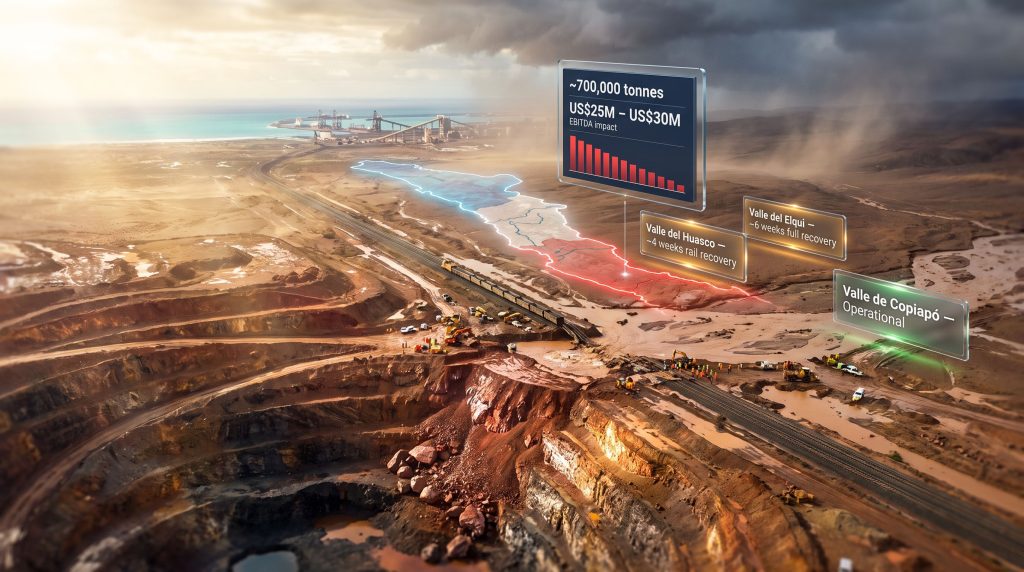
CMP's preliminary assessment of the production impact points to an output reduction of approximately 700,000 tonnes of iron ore. The associated financial damage, measured at the EBITDA level, is estimated to fall in the range of US$25 million to US$30 million.
To contextualise this figure: CMP has historically produced in the range of 10 to 12 million tonnes of iron ore products annually across its various operations. A 700,000-tonne shortfall therefore represents roughly 6–7% of annual production capacity being erased by a single weather event occurring over a matter of days. For a commodity producer operating on thin to moderate margins, this is not a rounding error. It is a material hit to quarterly earnings.
Weather-driven production losses of this scale demonstrate that climate risk has graduated from a sustainability disclosure requirement to a core financial modelling variable for mining operators across the Andean corridor.
Recovery Timelines: The Gap Between Mining and Logistics
One of the most technically important aspects of this disruption is the divergence between when ore extraction can recommence and when that ore can actually reach export markets. These are not the same event, and the gap between them has significant cash flow implications.
Valle del Huasco Recovery Profile
In the Huasco valley, mining operations are expected to restart within approximately two weeks of the storm event. However, the rail line serving this corridor sustained damage that is expected to require roughly four weeks to repair. This creates a two-week window during which ore may be physically mined but cannot be transported to port for loading.
Stockpiling capacity at mine sites is finite, and extended delays between production and shipment create both inventory management challenges and potential quality degradation risks for some ore product types.
Valle del Elqui: Compounding Downtime
The Elqui valley faces a more complex recovery scenario with a full timeline extending to approximately six weeks. This extended period stems not only from storm damage remediation but from the collision of that unplanned downtime with a pre-scheduled major maintenance shutdown.
When planned and unplanned stoppages overlap in this way, the total production loss compounds beyond what either event would have generated independently. Maintenance windows that might otherwise have been partially offset by resumed operations instead stack on top of storm-related losses, leaving no opportunity for catch-up production within the affected period.
Recovery Comparison at a Glance
| Valley | Production Restart | Rail/Logistics Recovery | Full Recovery Estimate | Primary Constraint |
|---|---|---|---|---|
| Valle del Huasco | ~2 weeks | ~4 weeks | ~4 weeks | Rail line damage |
| Valle del Elqui | ~6 weeks | ~6 weeks | ~6 weeks | Storm damage + scheduled maintenance overlap |
| Valle de Copiapó | Not disrupted | Not disrupted | Operational | No reported impact |
Infrastructure Vulnerability: A Design Problem Decades in the Making
The structural exposure revealed by this storm event is not new, but it is becoming harder to dismiss as a low-frequency tail risk. Northern Chile's mining infrastructure was largely engineered across the mid-to-late twentieth century under the prevailing assumption that extreme precipitation in the Atacama and Coquimbo zones would remain genuinely rare.
Contemporary climate science tells a different story. Andean precipitation patterns are increasingly influenced by intensifying atmospheric rivers and strengthening ENSO cycles, both of which drive episodic but highly destructive rainfall into regions that may experience near-zero precipitation for years between events. In practical terms, this means the tails of the precipitation distribution are widening, and infrastructure built for the historical average is increasingly exposed to the statistical extremes.
Comparative experience from other major iron ore jurisdictions is instructive. Australian iron ore operators in the Pilbara have invested heavily in cyclone-rated infrastructure, flood mitigation earthworks, and redundant transport corridors precisely because weather disruption risk is priced into the operational model. In Chile, however, the low historical baseline of precipitation events has meant that equivalent investment in climate-resilient infrastructure has lagged considerably.
Downstream Supply Chain Ripples
The consequences of a 700,000-tonne shortfall extend well beyond CMP's own income statement. Iron ore shipment delays from Chilean Pacific ports affect steel producers that depend on predictable input delivery schedules. When rail infrastructure is compromised, port loading activity at facilities like Puerto Guacolda near Huasco drops correspondingly, disrupting shipping schedules and potentially triggering demurrage costs or contract renegotiations.
Furthermore, the intersection of China steel and iron ore demand dynamics means that any sustained supply disruption from secondary producers can have amplified knock-on effects across global pricing benchmarks, even if Chile's absolute volumes are modest.
The binding constraint in a weather disruption event is rarely the mine itself. It is the logistics corridor connecting the mine to the market, and that corridor is frequently a single thread.
The next major ASX story will hit our subscribers first
Financial Risk Distribution and Investor Considerations
For investors tracking CAP Group's financial performance, the US$25–30 million EBITDA impact will register as a meaningful drag on the company's second-half 2026 results. The relevant questions for analysts to monitor include:
- Whether CMP issues formal production guidance revisions that quantify the full-year impact
- The extent to which insurance recoveries may offset a portion of the EBITDA erosion
- How force majeure provisions within CMP's offtake agreements interact with weather-driven shortfalls, and whether volume obligations can be deferred rather than permanently lost
- Rail repair progress as a leading operational indicator for export volume normalisation
It is worth noting that force majeure clauses in iron ore supply agreements are not uniformly drafted. Some contracts include explicit carve-outs for weather events that make them difficult to invoke unless operational disruption meets defined thresholds of duration or intensity. The legal and commercial exposure varies significantly by contract vintage and counterparty jurisdiction. In addition, broader iron ore market risks such as tariff pressures and geopolitical uncertainty may further complicate any near-term recovery in pricing for affected volumes.
Medium-Term Strategic Implications for CMP and the CAP Group
Beyond the immediate financial impact, this disruption raises legitimate strategic questions about how CMP and its parent CAP Group choose to invest in operational resilience over the coming years. Specific areas likely to attract internal review include:
- Rail corridor hardening in the Huasco valley, including improved drainage infrastructure and bridge reinforcement at vulnerable crossings
- Transport pathway diversification, potentially examining whether alternative or supplementary ore haulage options could reduce single-corridor dependency
- Early warning and monitoring systems that provide greater lead time before weather events force emergency operational shutdowns
- Stockpile buffer capacity at intermediate points between mine sites and port facilities, reducing the exposure created by the production-logistics gap identified in this event
The economics of each investment will need to be evaluated against the frequency and severity assumptions that the company uses for climate scenario planning. As those scenarios are revised upward in intensity and frequency, the return on resilience investment improves correspondingly. Notably, similar disruptions at copper operations across Chile's northern corridor in the same period suggest that weather-related infrastructure risk is a sector-wide concern, not an isolated incident for iron ore alone.
Frequently Asked Questions: CMP Iron Ore Output Drop After Chile Storms
What caused the CMP iron ore output drop after Chile storms in 2026?
A winter storm system struck northern Chile's Andean valley corridors in July 2026, forcing suspension of iron ore mining and rail transport operations in the Valle del Huasco and Valle del Elqui. The storm damaged both mine site access infrastructure and the rail lines used to move ore to Pacific coast export ports.
How large is the expected production shortfall?
Preliminary estimates indicate a reduction of approximately 700,000 tonnes, with an associated EBITDA impact of between US$25 million and US$30 million for CMP and its parent CAP Group.
Why did Copiapó operations continue while others were suspended?
The Valle de Copiapó corridor was not materially affected by the storm system, reflecting the localised geographic footprint of the precipitation event and possibly differences in valley orientation, elevation profile, and infrastructure condition that provided greater resilience against the specific storm track involved.
What is the full recovery timeline?
Huasco valley mining is expected to resume within roughly two weeks, but rail repairs needed to restore export shipments may take around four weeks. Elqui valley recovery is expected to take approximately six weeks in total, reflecting the compounding effect of storm damage and a coinciding planned maintenance shutdown.
Key Takeaways
- A single storm event in July 2026 is expected to erase approximately 700,000 tonnes of CMP iron ore production and between US$25 million and US$30 million in EBITDA, illustrating that climate risk is now a tier-one financial concern for Andean mining operators
- The production-logistics gap in the Huasco valley, where mining can restart two weeks before rail shipments resume, reveals that export infrastructure is typically the binding constraint in recovery scenarios, not mine-site operations themselves
- CMP's magnetite-based operations involve beneficiation complexity that adds additional sensitivity to any processing or logistics disruption beyond simple extraction halts
- Northern Chile's mining infrastructure was designed for historical arid-climate norms that climate science increasingly suggests no longer represent the operational baseline
- Investors monitoring CAP Group should track not only the immediate EBITDA impact but also the medium-term capital allocation response, particularly whether climate-resilient infrastructure investment is accelerated following this event
- The broader lesson for Latin American mining supply chains is that infrastructure redundancy and corridor resilience are no longer optional features of operational design. They are material factors in long-run value preservation
This article is intended for informational purposes only and does not constitute financial advice. Production estimates, financial impact figures, and recovery timelines cited reflect preliminary assessments and are subject to revision as further information becomes available. Investors should conduct independent due diligence before making investment decisions.
Want to Spot the Next Major Mineral Discovery Before the Market Does?
Discovery Alert's proprietary Discovery IQ model delivers real-time alerts on significant ASX mineral discoveries, transforming complex mineral data into clear, actionable insights for investors at every experience level — explore Discovery Alert's discoveries page to understand how historic finds have generated substantial returns, and begin your 14-day free trial to secure a market-leading edge.