June 18, 2026
India's Industrial Feedstock Paradox: Why Domestic Coal May Hold the Answer
Heavy industry runs on reliable feedstocks. When those feedstocks are imported across contested shipping lanes, the vulnerability is not theoretical — it is operational. India has learned this lesson through successive cycles of LNG price shocks and supply tightening, and the lesson has grown sharper as geopolitical instability in West Asia has raised the cost and uncertainty of every cargo arriving at Indian regasification terminals. The response now taking shape involves converting domestic coal into synthesis gas, or syngas, at scale — and Coal India syngas projects sit at the centre of this structural pivot.
When big ASX news breaks, our subscribers know first
The Feedstock Security Problem Driving Coal India Syngas Projects
India's annual natural gas consumption has settled in the range of 60 to 65 billion cubic metres (bcm), with imported LNG consistently accounting for 45 to 55 percent of total gas availability depending on domestic production levels and global pricing conditions. Qatar has historically been a principal long-term supplier, while spot cargoes have been sourced from a wider pool of producers across the Middle East, Africa, and the United States. When conflict-related disruptions affect the Red Sea or Suez Canal shipping corridors, Indian buyers face both higher freight costs and delivery uncertainty, regardless of the underlying contract terms.
The consequences are not evenly distributed across consuming sectors. Fertiliser manufacturing is consistently the single largest gas-consuming segment in India, typically absorbing around one-third of total national gas demand. Because fertiliser production is tightly linked to agricultural cropping cycles and government minimum support price commitments, it cannot be curtailed in response to price spikes the way industrial or power demand sometimes can. The result is that gas supply disruptions disproportionately threaten food security and government subsidy expenditure simultaneously.
Gas-based power generation compounds the problem from a different angle. India holds an estimated 24 to 25 GW of installed gas-fired generation capacity, yet many of these plants operate at plant load factors well below 25 percent due to chronic fuel shortages and the high cost of spot LNG. This represents a substantial volume of stranded capital — assets built to meet peak power demand that cannot run economically because their designated feedstock is either unavailable or unaffordably priced. A domestic syngas supply capable of partially substituting for natural gas at these facilities would simultaneously improve grid reliability and reduce the effective cost of underutilised generation capacity.
Furthermore, India coal market reforms in recent years have created additional momentum for rethinking how domestic coal resources are deployed across the industrial economy.
The 2024 to 2026 period has become an inflection point in India's industrial energy policy. Geopolitical instability has translated directly into feedstock insecurity, and policymakers are now treating domestically produced syngas as an active import-substitution instrument rather than a distant research ambition.
The Policy Framework Behind India's 100 Million Tonne Coal Gasification Goal
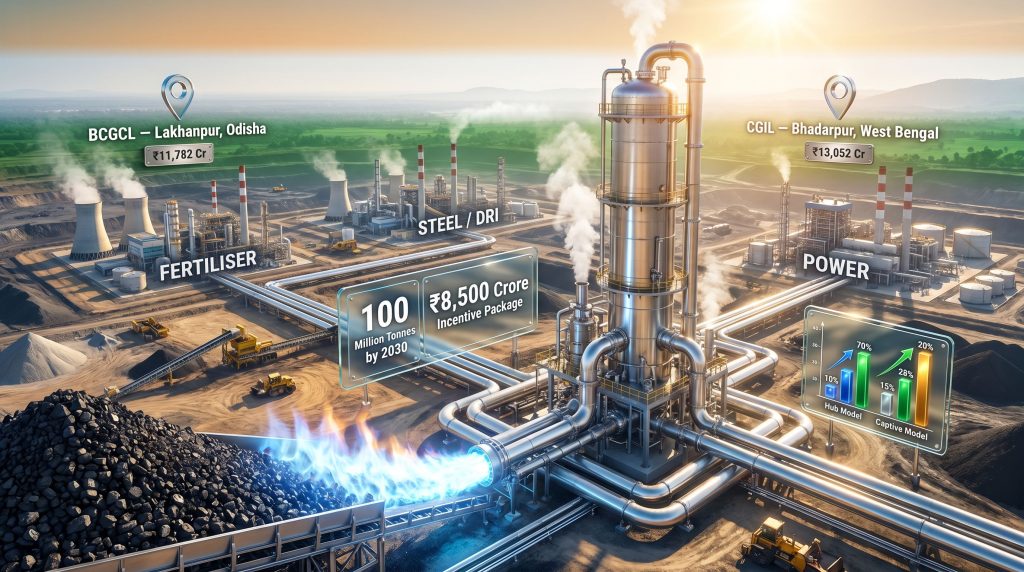
The Government of India's National Mission on Coal Gasification established a national target of 100 million tonnes of coal gasification capacity by 2030, a figure that has been reiterated across multiple Ministry of Coal communications and budget documents. To move this ambition from planning documents into commercial reality, the Union Cabinet approved a ₹8,500 crore financial incentive scheme in January 2024 specifically designed to catalyse investment in coal and lignite gasification projects.
A particularly significant feature of this incentive architecture is the 50 percent rebate on revenue-share obligations applied to coal used for gasification under commercial coal block auction terms. This mechanism directly improves the feedstock economics for project developers, effectively lowering the cost basis for coal inputs relative to combustion applications. For developers modelling long-term project returns, this rebate can be the difference between a commercially bankable project and one that requires significant concessional financing. The Press Information Bureau's official release provides further detail on the government's formal policy position underpinning these incentives.
Coal India Limited (CIL), which controls over 80 percent of India's domestic coal output, is the natural execution vehicle for this strategy. Its combination of mine ownership, land holdings, coal reserve access, and institutional scale positions it uniquely to anchor coal-to-syngas initiatives that no private developer could replicate from a standing start.
What Syngas Is and Why Its Versatility Matters
The Chemistry Behind the Opportunity
Synthesis gas is produced when coal is reacted with controlled quantities of oxygen and steam under high temperature and elevated pressure conditions. The output is a gaseous mixture dominated by hydrogen (H₂) and carbon monoxide (CO), with varying proportions of carbon dioxide and trace components depending on feedstock quality and process conditions. Critically, syngas is not an end product — it is a chemical intermediate that can be routed into multiple downstream synthesis pathways depending on what the industrial operator needs to produce.
The downstream flexibility of syngas is what makes it strategically valuable. Unlike natural gas, which is primarily methane and serves a narrower range of direct applications, syngas can be transformed into:
- Synthetic Natural Gas (SNG) — methane produced through methanation, directly compatible with existing gas pipelines and end-use equipment
- Ammonia and urea — the foundational molecules for India's fertiliser industry, currently dependent on imported gas as the hydrogen source
- Ammonium nitrate — a dual-use compound serving both specialty fertiliser and industrial explosives applications
- Methanol — a platform chemical used in fuel blending, plastics, and as a precursor for dozens of industrial derivatives
- Hydrogen — separable from syngas streams and increasingly valued as a long-term clean energy carrier
- Direct Reduced Iron (DRI) reductant — a substitute for natural gas in iron ore reduction, relevant to India's steel sector
In addition, the broader shift toward hydrogen iron ore reduction technologies globally underscores why the hydrogen-rich output of coal gasification carries growing strategic significance for steelmakers.
How Coal Gasification Works in Practice
The technical sequence from coal to conditioned syngas follows a defined process pathway that determines both output quality and project economics:
| Stage | Process Description | Primary Output |
|---|---|---|
| 1 | Coal preparation (sizing, drying) | Conditioned coal feedstock |
| 2 | Gasification reactor (high temperature, elevated pressure) | Raw syngas: H₂, CO, CO₂, trace gases |
| 3 | Gas cleaning and conditioning | Purified, specification-grade syngas |
| 4 | Downstream synthesis or direct use | SNG, ammonia, methanol, hydrogen, or fuel |
Three principal gasifier technologies are deployed commercially worldwide: fixed-bed, fluidised-bed, and entrained-flow systems. Each has different feedstock tolerance, operating pressure ranges, and suitability for specific coal ranks. India's domestically developed alternative is BHEL's Pressurised Fluidised Bed Gasification (PFBG) technology, which has been selected for the Lakhanpur, Odisha project under CIL's joint venture with BHEL.
The PFBG system offers the strategic advantage of reducing dependence on foreign gasifier vendors, though its large-scale commercial track record is still being established relative to proven Chinese and international systems. Analysts have estimated that coal gasification could save India significant annual import costs, with figures in the range of ₹60,000 to ₹90,000 crore per year cited in import-substitution assessments.
A lesser-known but commercially important feature of pithead gasification is its logistics advantage. Converting coal to gas at the mine site eliminates the cost and carbon footprint of transporting raw coal to distant industrial facilities. For India's coalfields, which are geographically concentrated in Jharkhand, Odisha, Chhattisgarh, and West Bengal but often distant from coastal industrial hubs, this pithead conversion model can materially improve delivered energy economics compared to long-haul coal rail transport.
Coal India's Two Deployment Models: Hub vs. Captive
CIL's current expressions of interest describe two structurally distinct deployment configurations. Understanding the difference matters for assessing which industrial sectors are likely to benefit first and which project financing structures are commercially viable.
| Feature | Syngas Hub Model | Captive On-Site Model |
|---|---|---|
| Physical location | CIL pithead land holdings | Adjacent to single end-user facility |
| Number of offtakers | Multiple industrial consumers | Single anchor consumer |
| Distribution method | Dedicated pipeline network | Minimal or zero pipeline distance |
| Supply customisation | Standardised syngas specification | Tailored to offtaker composition needs |
| Logistics cost reduction | High — eliminates coal transport | Moderate |
| Supply reliability | Moderate (multi-customer network) | Very high (dedicated supply) |
| Project financing complexity | Higher (multi-offtake structuring) | Lower (single offtake agreement) |
The hub model makes economic sense where multiple industrial consumers are located within viable pipeline distance of a CIL mine site. It spreads fixed capital costs across a larger combined off-take volume and creates a shared infrastructure platform. However, coordinating multiple long-term offtake agreements with different industrial buyers introduces commercial complexity that can extend project development timelines.
The captive model solves the financing problem more cleanly by concentrating risk around a single creditworthy off-taker. A large fertiliser plant, a DRI facility, or a gas power station that commits to absorbing the full output of a dedicated gasification unit provides the revenue certainty required to attract project finance on commercial terms. The trade-off is reduced flexibility and dependence on the operational continuity of a single industrial partner.
Coal India's Existing Joint Ventures: The Maharatna PSU Architecture
CIL has already moved beyond planning into structured execution through two major joint ventures with other large public sector undertakings.
Bharat Coal Gasification and Chemicals Ltd (BCGCL)
The CIL-BHEL joint venture holds a 51 percent CIL equity stake and is developing a coal-to-ammonium nitrate facility at Lakhanpur in Odisha. The reported project investment stands at ₹11,782.05 crore. The technological centrepiece is BHEL's indigenous PFBG system, which at commercial scale would validate India's domestic gasification technology pathway. Initial production capacity is targeted at 2,000 tonnes per day of ammonium nitrate, addressing India's dependence on imported ammonium nitrate for both agricultural and industrial applications.
Coal Gasification India Ltd (CGIL)
The CIL-GAIL joint venture, also structured with a 51 percent CIL equity stake, is developing a coal-to-Synthetic Natural Gas plant at Bhadarpur in West Bengal, within the Raniganj-Sanctoria coalfield region. The reported investment is ₹13,052.81 crore, making it the larger of the two anchor projects. Target output capacity is approximately 80,000 normal cubic metres per hour of SNG, produced through surface gasification followed by methanation. Because SNG is chemically equivalent to pipeline-grade natural gas, it can be injected directly into India's national gas grid infrastructure without requiring end-user equipment modifications.
The Proposed CIL-SAIL Collaboration
A prospective third collaboration targeting DRI syngas supply at Durgapur, West Bengal would extend CIL's gasification footprint into steelmaking. Direct Reduced Iron production currently relies on natural gas as the reducing agent in shaft furnaces. Replacing natural gas with coal-derived syngas offers Indian steel producers a domestic alternative, though syngas from coal carries a higher CO-to-hydrogen ratio than pure natural gas, which influences reduction kinetics and product metallisation levels. This project remains at an early feasibility and planning stage.
| JV Entity | Partners | Location | Primary Product | Investment | CIL Stake |
|---|---|---|---|---|---|
| BCGCL | CIL + BHEL | Lakhanpur, Odisha | Ammonium Nitrate | ₹11,782 crore | 51% |
| CGIL | CIL + GAIL | Bhadarpur, West Bengal | Synthetic Natural Gas | ₹13,052 crore | 51% |
| CIL-SAIL (proposed) | CIL + SAIL | Durgapur, West Bengal | DRI Reductant Syngas | TBD | TBD |
How India's Approach Compares Globally
China operates more than 70 percent of the world's commercial coal gasification capacity, predominantly for methanol, ammonia, and synthetic natural gas production. Its dominance reflects decades of state-directed investment in domestic energy security and chemical feedstock self-sufficiency. The United States pursued Integrated Gasification Combined Cycle (IGCC) power applications but saw investment decline sharply after 2015 as cheap shale gas undercut the economics. South Africa's Sasol operations represent the most mature coal-to-liquids gasification programme globally, using fixed-bed Lurgi technology developed over several decades.
| Country | Primary Application | Scale | Technology Approach |
|---|---|---|---|
| China | Chemicals, SNG, fertilisers | Over 70% of global capacity | Entrained-flow, multiple vendors |
| USA | Power (IGCC), chemicals | Declining post-2015 | Various |
| South Africa | Liquid fuels (Sasol) | Established and mature | Fixed-bed Lurgi |
| India | Fertilisers, SNG, DRI reductant | Rapidly scaling | Mixed (PFBG + international) |
India's distinguishing feature is the deliberate combination of public-sector joint venture structures with explicit import-substitution objectives. This is not purely commercial chemical production as in China, nor a power generation experiment as in the United States. It is an integrated industrial security strategy that uses coal gasification as a lever to reduce foreign currency exposure across multiple sectors simultaneously. Furthermore, the country's broader critical minerals strategy and evolving critical minerals demand from the energy transition are reinforcing the urgency of securing domestic feedstock alternatives across the industrial base.
Consequently, the global crude steel outlook also plays a role in shaping the commercial case for DRI-linked syngas demand, as steelmakers globally reassess their reducing agent strategies in response to tightening emissions standards.
The next major ASX story will hit our subscribers first
Risks That Could Affect Delivery
Technical and Operational Challenges
- Scaling fluidised-bed gasification from demonstration capacity to continuous commercial supply involves significant engineering complexity, particularly in gas cleaning train reliability and refractory management
- BHEL's PFBG system, while strategically important as a domestic technology, lacks the extensive large-scale operational history that established international gasifier vendors can provide
- Syngas composition consistency is critical: downstream ammonia synthesis, methanation, and DRI reduction each require specific hydrogen-to-carbon monoxide ratios that must be maintained reliably over long operating periods
Commercial and Financing Risks
- Development timelines for projects of this scale typically span five to eight years from investment sanction to commissioning, creating substantial exposure to commodity price movements
- If global LNG prices were to fall sharply and remain low for an extended period, the cost competitiveness of domestically produced coal syngas would narrow, potentially making imported gas more attractive to industrial buyers
- Securing long-term offtake commitments at commercially viable pricing is a prerequisite for project finance — without anchor buyers willing to commit to 15 to 20-year supply agreements, lenders will be reluctant to provide non-recourse debt at reasonable terms
Environmental and Regulatory Dimensions
Coal gasification is highly water-intensive, which raises concerns in several of India's coalfield regions that already experience water table stress. Gasification also produces slag and ash residues requiring compliant disposal. On the broader climate dimension, India's nationally determined contributions under the Paris Agreement create a tension between scaling coal-based infrastructure and the long-term decarbonisation pathway.
The counterargument is that coal gasification produces a concentrated CO₂ stream at the point of production — a characteristic that makes it more amenable to future carbon capture and storage (CCS) integration than diffuse combustion emissions. Whether CCS becomes commercially viable at Indian project scale within the relevant timeframe remains genuinely uncertain.
Disclaimer: This article contains analysis of policy frameworks, project economics, and technology assessments. Forward-looking statements regarding project timelines, investment returns, and feedstock cost competitiveness are inherently uncertain and should not be treated as investment advice. Actual outcomes may differ materially from projections based on regulatory, technical, commercial, and geopolitical factors.
Frequently Asked Questions on Coal India Syngas Projects
What are Coal India syngas projects and why are they being developed now?
Coal India Limited is developing coal-to-syngas production facilities to create a domestically sourced substitute for imported natural gas. The initiative has accelerated because gas supply disruptions linked to West Asia conflict have raised the cost and reliability risk of LNG imports. CIL's position controlling over 80 percent of India's domestic coal output makes it the natural anchor institution for this national coal gasification strategy.
What is the difference between syngas and natural gas?
Natural gas is predominantly methane. Syngas is a mixture of hydrogen and carbon monoxide derived from gasifying coal or other carbon-rich materials. Syngas can be converted into SNG, ammonia, methanol, or hydrogen, and can also serve directly as an industrial reductant or fuel, making it more chemically versatile than pipeline methane, though more technically demanding to produce and condition.
What government incentives exist for coal gasification in India?
The Union Cabinet approved an ₹8,500 crore financial incentive scheme in January 2024 for coal and lignite gasification projects. A further incentive provides a 50 percent rebate on revenue-share obligations on coal used for gasification under commercial block auctions. The national target is 100 million tonnes of coal gasification capacity by 2030.
What are the two deployment models CIL is pursuing?
The first is a centralised hub model where a gasification plant is built on CIL pithead land to supply multiple nearby industrial consumers via pipeline. The second is a captive on-site model where a gasification unit is built directly adjacent to a single large industrial consumer, maximising supply reliability and allowing production to be tailored to that consumer's specific feedstock requirements.
Key Milestones to Monitor Through 2030
The credibility of Coal India syngas projects as a national industrial feedstock strategy will be tested against a set of observable milestones over the coming years:
- CGIL SNG Plant commissioning progress at Bhadarpur — including final investment decision confirmation, engineering procurement and construction contract award, and first gas production timeline
- BCGCL ammonium nitrate plant construction advance at Lakhanpur — and critically, the commercial validation of BHEL's PFBG technology at scale
- Quality and quantity of BOO and BOM developer bids received in response to CIL's expressions of interest — a thin or low-quality bid pool would signal that commercial appetite for coal-to-syngas project development remains limited
- Industrial offtaker commitment levels — whether fertiliser plants, DRI producers, and gas power stations are willing to sign long-term syngas purchase agreements at the volumes and pricing required to make projects bankable
- Progress on the CIL-SAIL DRI syngas collaboration at Durgapur — advancement from feasibility study to formal project sanction would confirm that the steel sector is actively engaging with coal-derived syngas as a feedstock substitute
Whether India's coal gasification ambition reaches its 2030 target depends less on policy intent, which is clearly established, and more on whether the commercial and technical execution challenges can be resolved at the pace required. The groundwork being laid through CIL's joint ventures and expressions of interest represents a serious industrial commitment. The next several years will determine whether that commitment translates into operating capacity.
Want to Stay Ahead of the Next Major ASX Mineral Discovery?
Discovery Alert's proprietary Discovery IQ model delivers real-time alerts on significant ASX mineral discoveries — cutting through complex data to surface actionable opportunities for both short-term traders and long-term investors the moment they emerge. Explore how historic discoveries have generated exceptional returns and begin your 14-day free trial today to secure a genuine market-leading edge.