
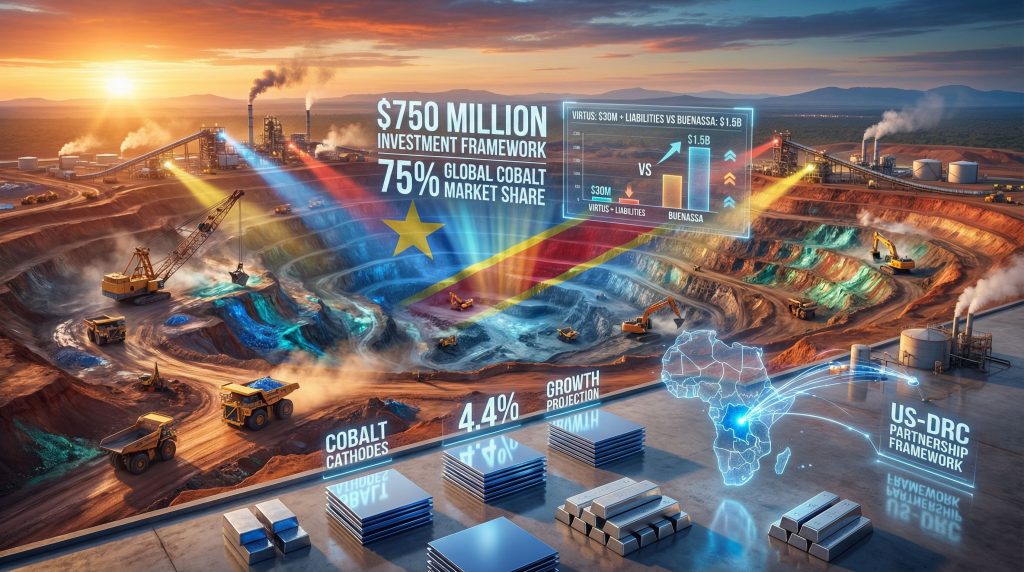
The global cobalt market exemplifies strategic vulnerability challenges, where the virtus acquisition of congo cobalt miner represents a critical test case for Western supply chain diversification efforts. Recent geopolitical tensions have highlighted how concentrated production systems create dependency risks that traditional market mechanisms cannot efficiently address.
Understanding these dynamics requires examining how financing structures, operational capabilities, and regulatory frameworks intersect with national security objectives. Furthermore, the evolution from purely commercial mining investments toward development finance-backed strategic acquisitions represents a fundamental shift in how Western governments approach resource diplomacy.
Strategic Positioning in the Global Cobalt Supply Chain
The Democratic Republic of Congo's dominance in global cobalt production creates both opportunity and vulnerability for international supply chains. With approximately 70-75% of global refined cobalt production, the DRC represents the world's most concentrated critical mineral bottleneck. Recent USGS data indicates that DRC cobalt ore production reached approximately 130,000 tonnes annually, from a global total of 190,000 tonnes in 2023.
This concentration becomes particularly significant when considering that the United States maintains 100% import dependency for cobalt, with no active primary mining operations domestically. The strategic implications extend beyond simple supply security, encompassing technological competitiveness in electric vehicle manufacturing and defense applications.
Chinese enterprises currently control an estimated 50-55% of DRC cobalt production through various subsidiaries and partnerships established during Belt and Road infrastructure investments throughout the 2000s and 2010s. This control extends through the entire value chain, from mine operations to refining and downstream processing.
The virtus acquisition of congo cobalt miner Chemaf represents a deliberate effort to establish Western-controlled supply channels within this concentrated market. The transaction structure demonstrates how US development finance can compete with traditional Chinese state-enterprise models while offering DRC stakeholders alternative partnership frameworks.
Supply Chain Vulnerability Assessment
The concentration of cobalt refining capacity compounds the geographic production risks. Approximately 95% of global cobalt refining occurs outside Africa, with significant facilities in Finland, Norway, Belgium, and increasingly China. This creates multiple chokepoints where supply disruption can cascade through global manufacturing systems.
The DRC's Katanga Province contains an estimated 3.6 million tonnes of proven cobalt reserves, concentrated in geological formations that favour cost-effective extraction at grades averaging 2-4% cobalt content. These ore bodies represent the world's highest-grade cobalt deposits, making DRC production essential for global supply chain economics.
However, the region's infrastructure limitations create operational challenges. Transportation bottlenecks, power supply constraints, and regulatory complexity add operational risk that pure market mechanisms cannot efficiently address. Additionally, this infrastructure gap has historically favoured integrated Chinese operators who could deploy comprehensive development packages including roads, power generation, and processing facilities.
When big ASX news breaks, our subscribers know first
Financial Structure: Deconstructing the $750 Million Investment Framework
The virtus acquisition of congo cobalt miner employs a sophisticated financing architecture that leverages US development finance to compete with traditional commercial mining investment models. The transaction involves a $30 million equity purchase for 95% ownership of Chemaf, combined with assumption of existing liabilities and a $750 million capital investment program.
Debt vs. Equity Allocation Analysis
| Component | Amount (USD Million) | Source | Terms |
|---|---|---|---|
| Share Purchase | 30 | Virtus-Lloyds JV | Equity investment |
| Joint Venture Equity | 200 | Lloyds Metals/Virtus | Partnership capital |
| Development Finance | 350-400* | US DFC via Orion CMC | Concessional terms |
| Commercial Debt | 150-200* | Various lenders | Market rates |
| Total Program | 750 | Mixed sources | Blended cost |
*Estimates based on disclosed structure and typical DFC facility proportions.
The financing structure achieves a debt-to-equity ratio of approximately 2.75:1, significantly more conservative than typical mining project finance ratios of 4-6:1. This lower leverage reflects both the higher risk profile of the DRC operating environment and the availability of concessional US development finance.
US International Development Finance Corporation Role
The DFC's involvement through the Orion CMC vehicle provides several critical advantages over purely commercial financing:
- Extended maturity periods (15-20 years vs. 5-7 year commercial terms)
- Below-market interest rates (estimated 4-6% vs. 8-12% comparable commercial rates)
- Political risk insurance coverage protecting against expropriation and currency convertibility
- Estimated financing cost savings of $50-100 million over the facility lifetime
This structure enables the acquisition to proceed despite Chemaf's troubled operational history and the inherent risks of DRC mining operations. Traditional commercial lenders would likely require higher returns and shorter payback periods that could compromise the project's long-term viability.
Trafigura Debt Resolution Strategy
Chemaf's existing $600 million debt obligation to Trafigura, arranged in 2022 for Mutoshi mine construction, represents a critical component of the acquisition economics. The debt restructuring approach appears designed to maintain Trafigura as a potential operational partner rather than forcing a complete write-down.
Potential resolution scenarios include:
- Debt-to-equity conversion providing Trafigura with minority ownership stake
- Extended payment terms with 7-10 year amortisation post-stabilisation
- Operational offtake agreements where Trafigura receives product rights for debt reduction
- Partial write-down at negotiated recovery rates
This collaborative approach recognises Trafigura's expertise in African commodity trading and logistics, capabilities that could prove valuable for the project's operational success.
How Does Chemaf's Asset Portfolio Stack Up Against Competitors?
Chemaf's asset portfolio centres on two primary operations with significantly different risk and return profiles. The Mutoshi mine represents the flagship development project, while the Etoile quarry provides immediate cash flow generation capability.
Production Capacity Benchmarking
| Operation | Operator | Annual Cobalt Production (kt) | Status | Strategic Position |
|---|---|---|---|---|
| Mutoshi (Chemaf) | Virtus-Lloyds JV | 40-50* | Under construction | Potential top-3 globally |
| Tenke Fungurume | Glencore/Orion | 35-40 | Operating | Established leader |
| KCC (Katanga) | Glencore | 25-30 | Operating | Mature operation |
| Boss Mining | Various Chinese | 15-20 | Operating | Growing capacity |
| Etoile (Chemaf) | Virtus-Lloyds JV | 5-10* | Operating | Expansion candidate |
*Production estimates based on project scale designations and industry comparisons.
The Mutoshi project, if completed at projected capacity, would represent a 30-40% increase to total DRC cobalt supply. This scale positions the operation as a globally significant production source, comparable to major operations controlled by established mining companies.
Operational Challenges and Turnaround Requirements
Mutoshi's construction delays reflect broader challenges in DRC mining project execution. The project timeline experienced significant disruption between the 2022 Trafigura financing and the 2026 Virtus acquisition, highlighting the risks inherent in large-scale African mining development.
Key turnaround requirements include:
- Infrastructure completion at the main processing facilities
- Power supply stabilisation through grid connection or dedicated generation
- Transportation logistics for concentrate shipment to international refineries
- Regulatory compliance with updated DRC mining code requirements
- Community engagement programs to maintain social licence to operate
The Etoile operation provides critical cash flow during the Mutoshi restart phase. As an established copper-cobalt producer, Etoile generates revenue that can support debt servicing and operational expenses while the flagship project achieves commercial production.
Reserve Quality and Expansion Potential
Chemaf controls "dozens of untapped mining permits" across Katanga Province, representing significant exploration optionality beyond the current production assets. These permits provide potential for reserve replacement and production expansion as global cobalt demand increases with electric vehicle adoption.
Similarly, the Halls Creek cobalt expansion demonstrates how strategic cobalt projects worldwide are gaining renewed attention from Western governments. The geological characteristics of Katanga Province favour continued exploration success. The region's sedimentary copper-cobalt deposits extend across multiple concession areas, with consistent mineralogy and processing requirements that enable operational synergies between different mining areas.
Why Are Multiple Bidders Competing for a Troubled Asset?
The competitive interest in Chemaf despite its operational challenges reflects several strategic factors beyond immediate production capacity. The asset's value proposition extends through reserve potential, infrastructure positioning, and regulatory relationships within the DRC mining sector.
Strategic Value Beyond Current Operations
Chemaf's partnership relationship with Gecamines, the DRC state-owned mining company, provides crucial operational advantages. Gecamines owns key licences that Chemaf leases for the Mutoshi project, creating a direct relationship with DRC government mineral policy implementation.
This relationship structure offers several benefits:
- Regulatory stability through state enterprise partnership
- Licence security for long-term operation planning
- Government revenue sharing that aligns interests with national development objectives
- Local content compliance through established supply chain relationships
Competitive Bidding Analysis
The bidding process for Chemaf attracted interest from multiple categories of potential acquirers:
US-backed consortiums focusing on critical mineral supply chain security
Indian mining companies seeking African expansion opportunities
Congolese enterprises pursuing domestic resource control
Other international miners evaluating DRC market entry
The diversity of bidder types reflects different strategic rationales for the acquisition. US government policy support provided Virtus with competitive advantages through development finance access and diplomatic backing that purely commercial bidders could not match.
What Role Does Geopolitical Strategy Play in Mining M&A?
The Virtus-Chemaf transaction represents a broader shift in how Western governments approach critical minerals energy transition objectives. The December 2025 preferential access agreement between the US and DRC establishes a framework for American investors to compete directly with Chinese state-enterprise models.
US-DRC Partnership Framework Implementation
The preferential access agreement creates specific mechanisms for US investment prioritisation:
- First consideration rights for American investors in certain mineral projects
- Development finance coordination through DFC and other US government agencies
- Technical assistance programs for DRC capacity building and infrastructure development
- Revenue optimisation support helping DRC maximise economic benefits from mineral exports
This framework positions the virtus acquisition of congo cobalt miner as a test case for broader US-Africa mining partnership models. Success could encourage similar transactions across other critical mineral supply chains where Chinese dominance creates strategic vulnerabilities.
Chinese Market Response and Counter-Strategies
Chinese enterprises historically dominated DRC mining through vertically integrated models that combined mine development, processing infrastructure, and downstream manufacturing. The Zijin mining expansion exemplifies how Chinese companies continue to pursue global resource diversification strategies.
The Chinese approach typically involved:
- Comprehensive infrastructure packages including roads, power generation, and social facilities
- Long-term offtake agreements securing production for Chinese refineries and manufacturers
- State-enterprise coordination between Chinese mining companies and broader Belt and Road initiatives
- Local partnership structures that provided technology transfer and employment opportunities
The US development finance model offers DRC stakeholders alternative partnership structures with different risk-return profiles and governance frameworks. These alternatives may become increasingly attractive as DRC government priorities evolve toward revenue maximisation and operational transparency.
Can Virtus Execute a Successful Turnaround Strategy?
Virtus Minerals' leadership team combines military and intelligence backgrounds with mining industry experience, creating a unique capability set for operating in challenging jurisdictions. However, the successful turnaround of Chemaf's operations requires both strategic navigation and technical execution across multiple complex domains.
Management Team Capabilities Assessment
The military and intelligence backgrounds of Virtus leadership provide specific advantages for DRC operations:
- Risk assessment and mitigation experience in unstable environments
- Government relations expertise for navigating complex regulatory structures
- Security planning capabilities for personnel and asset protection
- Crisis management experience for operational disruption response
However, these backgrounds may create experience gaps in technical mining operations, metallurgical processing, and commodity marketing. The partnership with India's Lloyds Metals addresses some of these gaps through operational mining experience and African market knowledge.
Technical and Regulatory Execution Risks
The Mutoshi project restart faces several critical execution challenges:
Construction completion risks including equipment installation, commissioning, and performance testing
Regulatory compliance requirements under updated DRC mining code provisions
Environmental impact management for both construction and operational phases
Community relations programs to maintain social licence and prevent operational disruption
The timeline for achieving commercial production remains uncertain, dependent on both technical execution and regulatory approval processes. Gecamines must approve the ownership transfer, while DRC government agencies must validate compliance with updated mining regulations.
Operational Partnership Integration
The joint venture structure with Lloyds Metals creates both opportunities and integration challenges. Lloyds brings:
- African operational experience through recent copper-cobalt investments in DRC
- Iron ore mining expertise transferable to copper-cobalt operations
- Indian supply chain relationships for equipment and services procurement
- Alternative financing access through Indian development finance institutions
Successful integration requires aligning different corporate cultures, operational philosophies, and risk management approaches between American and Indian partners operating in the DRC environment.
The next major ASX story will hit our subscribers first
What Are the Broader Implications for Cobalt Market Dynamics?
The virtus acquisition of congo cobalt miner occurs within a rapidly evolving cobalt market characterised by supply concentration, demand growth, and increasing geopolitical complexity. The transaction's success or failure could influence broader Western strategies for critical mineral supply chain diversification.
Supply Security for Electric Vehicle Manufacturing
Global cobalt consumption patterns are shifting rapidly with electric vehicle adoption. Current demand breakdown shows:
- Battery applications: 40-45% of global consumption
- Superalloy manufacturing: 25-30% for aerospace and industrial applications
- Chemical applications: 15-20% for catalysts and pigments
- Other applications: 10-15% including magnets and ceramics
Electric vehicle production forecasts suggest global sales could reach 35-40 million units annually by 2030, requiring proportional increases in cobalt supply. Each electric vehicle battery contains approximately 10-20 kilograms of cobalt, depending on battery chemistry and vehicle size.
Investment Flow Patterns in African Mining
The Virtus transaction demonstrates how US development finance can compete with traditional Chinese state-enterprise models in African mining. The Trump mining permits order further signals US government commitment to critical mineral supply chain diversification.
Key differentiators include:
Governance frameworks emphasising transparency and anti-corruption measures
Revenue optimisation focusing on maximising host country economic benefits
Environmental standards requiring compliance with international sustainability practices
Technology transfer providing capacity building and local skill development
This approach may prove attractive to African governments seeking to diversify their international partnership portfolios beyond traditional Chinese Belt and Road arrangements.
Timeline and Next Steps: What Investors Should Watch
The Virtus-Chemaf transaction requires multiple approvals and operational milestones before achieving commercial success. Key timeline elements include regulatory approvals, funding deployment, and production restart phases.
Key Approval Milestones
| Milestone | Timeline | Key Stakeholders | Risk Factors |
|---|---|---|---|
| Gecamines approval | 3-6 months | DRC state mining company | Licence transfer terms |
| Government ratification | 6-9 months | DRC Ministry of Mines | Political stability |
| Financial closing | 6-12 months | DFC, commercial lenders | Funding conditions |
| Production restart | 12-24 months | Technical teams | Construction completion |
The approval process involves multiple interdependent decisions where delays in one area can cascade through the entire timeline. Gecamines approval represents the most immediate hurdle, as the state enterprise must validate both the ownership transfer and operational restart plans.
Market Impact Indicators
Several market indicators will signal the transaction's progress and broader industry implications:
Cobalt price volatility reflecting supply disruption concerns and restart expectations
Competitor responses from other DRC operators and international mining companies
Development finance activity showing additional US-backed African mining investments
Chinese market strategies demonstrating responses to increased Western competition
The cobalt market has experienced significant price volatility in recent years, ranging from $5-12 per pound based on supply uncertainty and demand forecasting changes. Consequently, the US–China trade war impact on critical mineral markets continues to influence investment decisions across the sector.
Investment Portfolio Implications
The Virtus model, if successful, could influence broader critical mineral investment strategies through:
Replicable financing structures combining development finance with private capital
Risk mitigation frameworks for frontier market mining investments
Partnership models integrating Western technology with local operational capabilities
Government relations approaches emphasising mutual benefit over traditional extraction models
This transaction serves as a critical test case for whether Western-backed mining investments can compete effectively with established Chinese operations in African critical mineral supply chains.
Reshaping Critical Mineral Investment Paradigms
The virtus acquisition of congo cobalt miner Chemaf represents more than a single mining transaction. It demonstrates how geopolitical competition is reshaping investment models, financing structures, and operational approaches across critical mineral supply chains.
The integration of US development finance with private equity capital creates new possibilities for Western mining investments in strategic regions where Chinese state enterprises have historically dominated. This hybrid approach addresses both commercial viability requirements and national security objectives that pure market mechanisms cannot efficiently balance.
Success will depend on execution across technical, regulatory, and diplomatic dimensions simultaneously. The complexity of operating in the DRC while managing international stakeholder expectations requires capabilities that extend well beyond traditional mining expertise.
Furthermore, experts suggest that Virtus' acquisition of Chemaf represents a significant milestone in US efforts to diversify critical mineral supply chains. Meanwhile, analysts note that the broader context of African mining industry transformation will ultimately determine whether such partnerships can compete with established Chinese operations.
The broader implications extend through electric vehicle supply chains, defence industrial base requirements, and resource diplomacy frameworks that will shape great power competition throughout the energy transition period. Whether this model proves replicable across other critical mineral supply chains remains the fundamental strategic question for Western policy makers and private investors alike.
Disclaimer: This analysis includes forward-looking statements and projections that involve inherent risks and uncertainties. Actual outcomes may differ significantly from estimates presented. Mining investments in frontier markets carry substantial operational, regulatory, and political risks that may result in partial or total loss of invested capital.
Ready to Capitalise on Critical Mineral Discoveries?
Discovery Alert's proprietary Discovery IQ model instantly identifies significant ASX mineral discoveries, including strategic metals like cobalt that are driving the energy transition. Join thousands of investors who rely on real-time discovery alerts to spot the next major breakthrough before the broader market. Begin your 14-day free trial today and position yourself ahead of critical mineral market movements.
