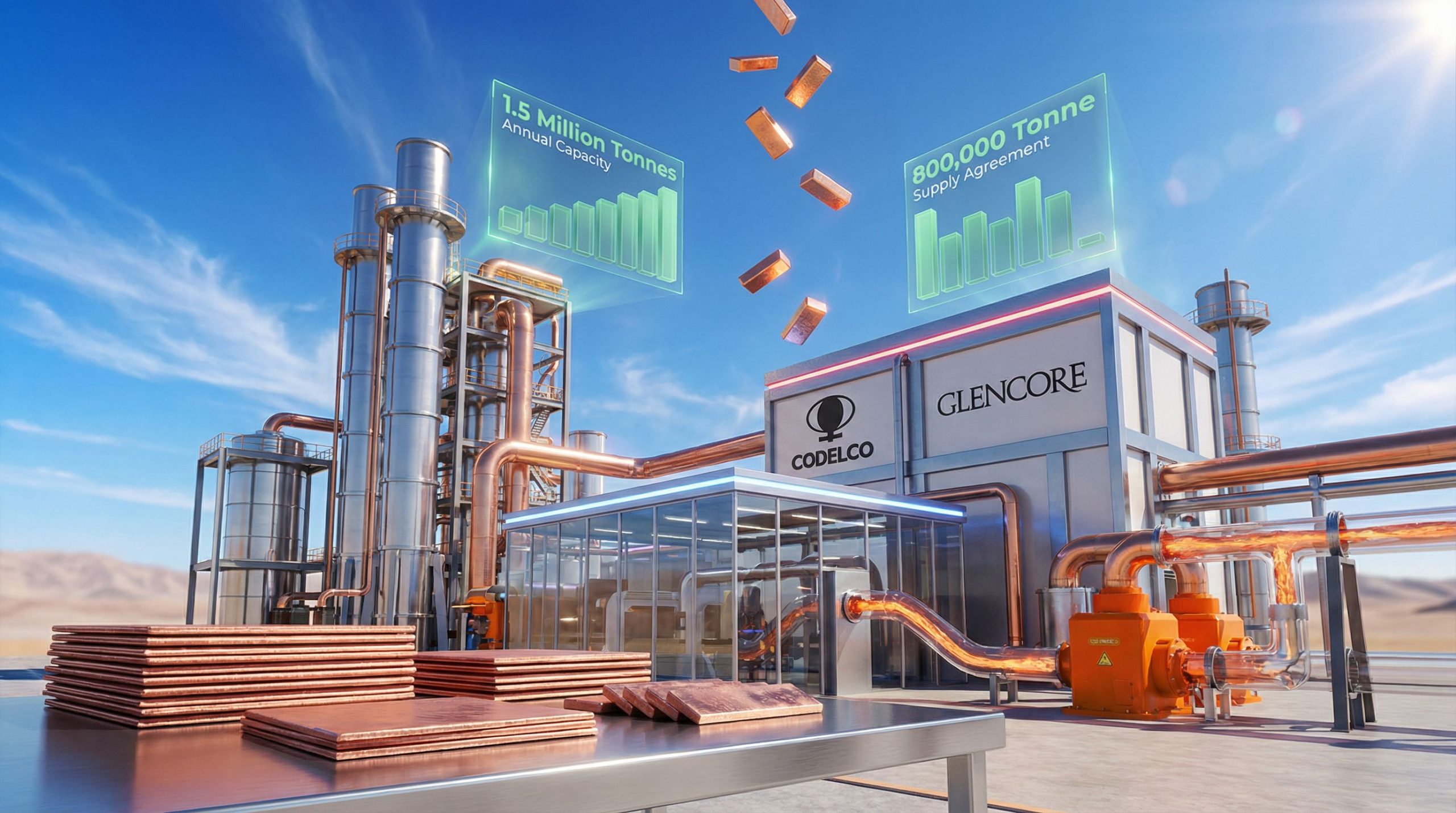
The Codelco and Glencore smelter agreement represents a transformative development in global copper processing, addressing critical infrastructure gaps while reshaping South American mining economics. This strategic partnership between Chile's state copper corporation and one of the world's largest commodity traders demonstrates innovative approaches to risk sharing and value capture in an increasingly complex mining landscape.
Global copper markets face unprecedented structural challenges as traditional supply chain models encounter geopolitical tensions, environmental constraints, and evolving economic dynamics. The mining sector increasingly seeks innovative approaches to balance capital allocation, operational risk, and value capture across the production continuum. These fundamental shifts create opportunities for strategic partnerships that redistribute traditional risk-reward frameworks while addressing critical infrastructure gaps in processing capacity.
Modern mining enterprises must navigate between maximizing extraction efficiency and developing downstream processing capabilities that enhance margin capture. The tension between core competency focus and vertical integration drives complex strategic decisions, particularly for state-owned enterprises balancing national economic interests with commercial optimization. Understanding these dynamics provides essential context for evaluating recent partnership developments in the copper processing sector.
What Does the Codelco-Glencore Partnership Mean for Global Copper Markets?
The strategic alliance between Chile's state copper corporation and Glencore represents a fundamental recalibration of South American copper processing architecture. This Codelco and Glencore smelter agreement addresses critical gaps in regional smelting capacity while establishing new competitive dynamics that extend far beyond bilateral commercial arrangements.
Strategic Context Behind Chile's Smelting Expansion
Chile's copper industry operates within a complex framework where domestic mining capacity significantly exceeds processing infrastructure. The nation produces approximately 5.8 million tonnes of copper concentrate annually while maintaining domestic smelting capacity of only 1.8 million tonnes per year, according to Chilean Copper Commission data. This structural imbalance forces Chile to export roughly 69% of its concentrate production to Asian processors, primarily in China.
The proposed 1.5 million tonne annual capacity facility would address approximately 26% of this processing deficit, representing the largest single expansion of Chilean smelting infrastructure in over two decades. Furthermore, this development connects to broader Glencore smelting challenges that the company faces globally as it seeks to optimise operations across different jurisdictions.
Located in either Antofagasta or Tocopilla Provinces, the facility positions itself strategically within Chile's copper corridor. Proximity to multiple mining operations creates significant logistical efficiencies that benefit the entire regional ecosystem.
| Current vs. Projected Chilean Smelting Capacity |
|---|
| Current Domestic Capacity: 1.8 million tonnes/year |
| Proposed New Facility: 1.5 million tonnes/year |
| Combined Future Capacity: 3.3 million tonnes/year |
| Processing Deficit Reduction: From 69% to 43% |
Market Position Analysis: From Raw Export to Value-Added Processing
The economic implications of processing copper domestically versus exporting concentrates involve multiple value capture mechanisms. Treatment charges for copper concentrates typically range $0.06-$0.15 per pound of copper content, while refining charges add another $0.01-$0.03 per pound, according to International Copper Study Group data.
Processing 800,000 tonnes of concentrate annually represents Codelco's minimum supply commitment. This would theoretically produce approximately 240,000 tonnes of refined copper, assuming standard 30% copper content in concentrates and 95% recovery rates. This volume represents roughly 15% of Codelco's current refined copper output.
Consequently, the facility generates an estimated $60-120 million in additional annual processing margins for the partnership. The revenue stability provided by the 10-year minimum commitment with 10-year extension options creates predictable cash flows that underpin project financing while reducing market volatility exposure.
Competitive Landscape Shifts in South American Copper Processing
South American copper processing capacity has remained relatively static while Asian capacity, particularly in China, expanded dramatically over the past decade. China currently operates approximately 40% of global copper smelting capacity, creating concentration risk for producers in distant markets like Chile.
The new facility establishes Chile as a more significant regional processing hub. In addition, it potentially attracts concentrate supply from neighboring Peru and Argentina. For instance, this development aligns with the Argentina copper system expansion that could benefit from enhanced regional processing capabilities.
Processing economics favour regional concentration, as freight costs from Chile to Asia typically range $40-60 per tonne. However, domestic transportation costs within Chile average $8-15 per tonne depending on distance and infrastructure quality.
How Will This 1.5 Million Tonne Facility Transform Chile's Mining Economics?
The scale and integration of the proposed smelting facility represents more than incremental capacity addition. It fundamentally alters Chile's position in global copper value chains while creating new economic dynamics across the domestic mining sector.
Processing Capacity Breakdown and Technical Specifications
Modern copper smelting facilities operating at 1.5 million tonnes annual capacity rank among the world's largest processing installations. The facility's technical specifications, while not fully disclosed, likely incorporate advanced flash smelting technology with integrated environmental control systems to meet Chile's stringent emissions standards.
Key Technical Parameters
Processing capacity represents approximately 17% of Chile's total concentrate production
Environmental standards require advanced sulfur dioxide capture and water recycling systems
Modern smelting recovery rates typically achieve 92-96% copper extraction efficiency
The 800,000 tonne minimum supply commitment from Codelco utilises approximately 53% of facility capacity in the initial operational phase. This leaves substantial capacity for additional supply agreements with other producers or spot market processing opportunities.
| Facility Utilisation Analysis | Tonnes/Year | % of Capacity |
|---|---|---|
| Codelco Committed Supply | 800,000 | 53% |
| Additional Capacity Available | 700,000 | 47% |
| Total Processing Capacity | 1,500,000 | 100% |
Revenue Model Analysis: From Concentrate Sales to Refined Copper
The transition from concentrate sales to refined copper production creates multiple value capture opportunities. Copper concentrate typically sells at $0.08-$0.12 per pound of contained copper after treatment charges, while refined copper captures full London Metal Exchange pricing minus processing costs.
Historical analysis suggests refined copper operations generate 40-60% higher margins than concentrate sales, depending on market conditions and operational efficiency. For Codelco's 240,000 tonnes of annual refined copper equivalent from this facility, the margin enhancement could reach $48-96 million annually at current copper prices.
The partnership structure distributes these enhanced margins between smelting operations and secure feedstock supply. This creates aligned incentives for long-term operational success while contributing to broader copper investment insights across international markets.
Supply Chain Optimisation Through Geographic Proximity
Chile's northern mining corridor concentrates multiple large-scale copper operations within 200 kilometres of the proposed smelter location. This geographic concentration creates significant logistical advantages compared to current practice of shipping concentrates to Asian processors.
Transportation cost savings alone could generate $25-45 per tonne in improved economics for participating mining operations. Furthermore, reduced transit times improve cash flow cycles and reduce working capital requirements for concentrate inventory.
The facility's proximity to existing port infrastructure in Antofagasta provides efficient export access for refined copper products. This maintains Chile's competitive position in global copper markets while capturing enhanced processing value domestically.
Why Did Codelco Choose Partnership Over Direct Development?
State-owned mining enterprises face unique strategic challenges when evaluating major capital investments. Codelco's partnership approach reflects sophisticated risk management while accessing specialised operational expertise unavailable through direct development.
Risk Distribution Strategy in Large-Scale Infrastructure Projects
Greenfield copper smelter development typically requires $2.5-4.5 billion USD in capital investment over 4-6 year construction periods, according to S&P Global Market Intelligence data. These projects carry significant construction, operational, and market risks that partnership structures can effectively distribute.
Glencore's global smelting portfolio includes operations across multiple continents. This provides proven technical expertise and operational risk management capabilities. The company operates major copper smelting facilities in Zambia, Australia, and Peru, demonstrating successful management of similar-scale processing operations in challenging environments.
Risk distribution through partnership allows Codelco to:
• Share construction execution risk with experienced smelting developers
• Access specialised technical expertise without internal capability development
• Distribute capital requirements across multiple balance sheets
• Leverage operational best practices from Glencore's global network
• Maintain strategic control through long-term supply commitments
Capital Allocation Efficiency: Core Mining vs. Processing Operations
Codelco currently allocates approximately $2.5 billion annually across mining operations, exploration, and infrastructure development projects. Committing additional capital to smelting development could constrain investment in core mining activities where Codelco maintains competitive advantages.
The partnership structure allows Codelco to secure processing capacity while directing capital toward mining operations. In addition, this approach supports exploration programmes and ore reserve development. This strategic focus aligns with Codelco's core competencies while accessing downstream processing capabilities through proven partners.
State-owned enterprise governance often requires careful balance between commercial optimisation and strategic national interests. The partnership approach satisfies both objectives by maintaining Chilean involvement in value-added processing while leveraging private sector efficiency and expertise.
Technology Transfer and Operational Expertise Considerations
Modern copper smelting incorporates sophisticated process control systems, environmental management technologies, and operational optimisation techniques. These require specialised knowledge and experience that Glencore's operational portfolio provides access to without requiring Codelco to develop internal expertise.
Technology transfer from Glencore's existing operations likely encompasses:
• Advanced process automation and monitoring systems
• Environmental emissions control technologies
• Energy optimisation methodologies
• Maintenance and reliability best practices
• Safety management systems
Operational expertise transfer reduces startup risk and accelerates achievement of design capacity and efficiency targets. This creates value for both partners through faster return on investment realisation.
What Are the Financial Implications of the 800,000 Tonne Supply Agreement?
Long-term supply commitments create complex financial dynamics that extend beyond simple volume and pricing arrangements. The 800,000 tonne minimum commitment establishes financial frameworks that impact both partners' strategic planning and risk management.
Long-Term Contract Structure and Pricing Mechanisms
The 10-year minimum commitment with 10-year extension options provides revenue predictability while maintaining flexibility for changing market conditions. Industry standard pricing for such arrangements typically incorporates LME-based copper pricing with treatment charge adjustments reflecting quarterly market conditions.
| Supply Agreement Structure | Details |
|---|---|
| Minimum Annual Volume | 800,000 dry tonnes |
| Initial Commitment Period | 10 years |
| Extension Option | Additional 10 years |
| Total Potential Commitment | 20 years |
Assuming 30% copper content in supplied concentrates, the annual commitment represents approximately 240,000 tonnes of refined copper equivalent. At current copper prices averaging $4.00 per pound, this volume generates approximately $2.1 billion in annual revenue from Codelco's committed supply alone.
Revenue Stability Analysis for Both Partners
For Codelco, the supply agreement provides guaranteed processing access for 15% of current concentrate production. This reduces dependency on volatile spot smelting markets and eliminates associated price uncertainty. Furthermore, this stability supports long-term mining investment planning and operational optimisation.
For Glencore, committed feedstock supply underpins smelter economics and provides stable returns on invested capital. Processing margins typically generate $60-120 million annually for operations of this scale, depending on treatment charge levels and operational efficiency.
The partnership structure creates aligned incentives through:
• Shared investment risk in facility development
• Long-term revenue predictability for both partners
• Operational flexibility through contract extension options
• Market risk mitigation through stable supply arrangements
Market Impact on Concentrate vs. Refined Copper Pricing
Removing 800,000 tonnes of Chilean concentrate from global spot markets could tighten supply for Asian smelters. Consequently, this potentially impacts treatment charge negotiations industry-wide. Reduced concentrate availability typically leads to higher treatment charges favouring mining companies over smelters.
Simultaneously, adding 240,000 tonnes of refined copper capacity could moderate refined copper premiums. This particularly affects South American markets where regional supply increases relative to demand. These market dynamics create complex interactions affecting both partners' broader operations beyond the direct partnership agreement.
The facility's 700,000 tonnes of uncommitted capacity provides opportunities for spot market processing. This allows both partners to benefit from favourable market conditions while maintaining core supply security through the long-term agreement, which aligns with broader global copper supply forecast trends.
How Does This Project Address Chile's Strategic Vulnerabilities?
Chile's copper industry faces structural vulnerabilities that extend beyond commercial considerations into strategic economic security. The Codelco and Glencore smelter agreement addresses several critical dependency risks while strengthening Chile's position in global copper markets.
Reducing Dependence on Asian Smelting Capacity
Current global copper smelting capacity concentration creates significant strategic risks for copper-producing nations. Asian smelters process approximately 60% of global copper concentrates, with China alone operating roughly 40% of world capacity.
Global Smelting Capacity Distribution
Asia controls 60% of processing capacity, creating concentration risk for distant producers
Chile exports 4.0 million tonnes annually to Asian processors
Transportation costs to Asia average $40-60 per tonne versus $8-15 domestically
Chilean producers currently ship approximately 4.0 million tonnes of concentrate annually to Asian smelters. This represents 69% of domestic concentrate production and creates multiple strategic vulnerabilities including freight cost volatility, geopolitical risk, and reduced value capture.
The new facility processes approximately 1.5 million tonnes annually, reducing Asian dependency by 37.5%. In addition, it creates more balanced geographic distribution of Chile's processing relationships.
Supply Chain Security and Geopolitical Risk Mitigation
Global supply chain disruptions during recent years highlighted vulnerabilities in long-distance commodity trading relationships. Chilean copper concentrates typically require 30-45 days transit time to Asian processors, creating extended exposure to shipping disruptions, port congestion, and geopolitical tensions.
Domestic processing reduces these risks while maintaining operational control within Chilean jurisdiction. Local processing also eliminates currency exchange risk on concentrate sales. Payments remain in Chilean pesos or USD without Asian currency exposure.
The facility's strategic location provides alternative processing capacity during potential disruptions to Asian smelting operations. These disruptions could arise from environmental regulations, operational issues, or geopolitical developments affecting international trade relationships.
Domestic Value Creation vs. Raw Material Export Strategy
Economic development theory emphasises value-added processing for commodity-dependent economies seeking sustainable growth. Chile's traditional model of raw concentrate exports captures minimal downstream value while supporting industrial development in importing nations.
Domestic smelting creates multiple economic benefits:
• Employment generation in high-skill processing operations
• Technology transfer and industrial capability development
• Tax revenue from processing operations
• Supply chain development supporting equipment and services industries
• Reduced transportation costs benefiting all regional producers
The facility generates an estimated $60-120 million in additional annual value capture for Chile's economy. Furthermore, it creates approximately 800-1,200 direct and indirect employment opportunities in northern Chile's mining regions.
What Are the Competitive Advantages of the Antofagasta Location?
Geographic positioning creates fundamental competitive advantages that extend beyond simple proximity considerations. The Antofagasta region offers unique combinations of infrastructure, logistics, and operational synergies supporting large-scale copper processing operations.
Logistical Efficiency Analysis: Mine-to-Smelter Distance Optimisation
Chile's northern copper corridor concentrates multiple world-class mining operations within 200 kilometres of potential smelter locations. Major operations including Escondida, Collahuasi, and various Codelco facilities create dense concentrate supply networks supporting efficient transportation logistics.
Transportation cost analysis reveals significant advantages:
• Domestic trucking costs: $8-15 per tonne depending on distance
• Port handling and shipping to Asia: $40-60 per tonne
• Inventory carrying costs: Reduced by 75% through shorter supply chains
• Working capital improvements: 30-45 day reduction in cash conversion cycles
These logistical efficiencies create competitive advantages benefiting all regional producers, not just direct partners in the smelting facility.
Infrastructure Synergies with Existing Mining Operations
Antofagasta region hosts extensive mining support infrastructure including specialised transportation networks, skilled workforce concentrations, and technical service providers. This established ecosystem reduces development costs and accelerates operational startup timelines.
Existing infrastructure includes:
• Power transmission networks designed for industrial-scale operations
• Water supply systems with established allocation frameworks
• Transportation networks optimised for heavy industrial traffic
• Port facilities capable of handling refined copper exports
• Skilled workforce availability experienced in copper processing operations
Port Access and Export Capability Enhancement
The Port of Antofagasta handles approximately 15 million tonnes of cargo annually. It features specialised facilities for copper concentrate and refined copper exports. Proximity to established port infrastructure eliminates need for additional logistics development while providing efficient access to global copper markets.
Refined copper exports through Antofagasta reach major consuming markets including:
• Asia: 18-25 days transit time to major ports
• North America: 12-18 days via Panama Canal
• Europe: 20-28 days via Cape Horn or Panama routes
These competitive transit times maintain Chile's market position while capturing enhanced processing value domestically.
How Will Environmental Standards Shape Project Development?
Environmental regulation represents one of the most critical factors influencing modern copper smelting facility development. Chile's regulatory framework requires sophisticated environmental management systems that influence technology selection and operational procedures.
Regulatory Compliance Framework in Chilean Mining
Chilean environmental regulation for copper smelting incorporates some of the world's most stringent emissions standards. The regulatory framework requires comprehensive environmental impact assessments, continuous monitoring systems, and community stakeholder engagement throughout project development.
Key regulatory requirements include:
• Sulfur dioxide emissions: Maximum 1,200 mg/m³ under normal operating conditions
• Particulate matter controls: Advanced baghouse filtration with 99.5% capture efficiency
• Water consumption: Recycling requirements achieving 85% water reuse rates
• Noise limitations: Strict controls protecting residential communities
• Community consultation: Mandatory stakeholder engagement processes
Technology Selection for Emissions Reduction
Meeting Chilean environmental standards requires advanced smelting technologies incorporating sophisticated emissions control systems. Modern copper smelting facilities typically employ flash furnace technology with integrated sulfuric acid production to capture sulfur dioxide emissions.
Environmental technology systems likely include:
• Flash smelting furnaces with precise temperature and atmosphere control
• Waste heat recovery systems improving energy efficiency
• Advanced gas cleaning with electrostatic precipitators and baghouses
• Sulfuric acid plants converting SO₂ emissions into saleable byproducts
• Water treatment facilities enabling closed-loop water cycling
These technologies add approximately 15-20% to facility capital costs but create operational advantages through byproduct revenue and regulatory compliance certainty.
Community Impact Assessment and Stakeholder Management
Large-scale industrial development in Chile requires extensive community engagement addressing local environmental concerns, employment opportunities, and infrastructure impacts. Successful project development depends on maintaining positive relationships with local stakeholders throughout construction and operations.
Community benefits typically include:
• Direct employment: 800-1,200 jobs during construction and operations
• Indirect economic activity: Supply chain and service sector development
• Infrastructure improvements: Roads, utilities, and community facilities
• Education and training programmes: Technical skills development initiatives
• Environmental monitoring: Community participation in ongoing oversight
What Does the 2030-2033 Timeline Reveal About Market Strategy?
Project development timelines reflect strategic market positioning and risk management considerations. The 2030-2033 operational target aligns with several important market and regulatory developments affecting global copper processing.
Prefeasibility Study Milestones and Decision Gates
The timeline suggests 2-3 years for prefeasibility studies, detailed engineering, and final investment decision processes. This duration reflects the complexity of large-scale smelting facility development and Chilean regulatory approval requirements.
Key development milestones likely include:
• 2025-2026: Prefeasibility study completion and location finalisation
• 2026-2027: Environmental permitting and detailed engineering
• 2027-2028: Final investment decision and construction commencement
• 2028-2030: Construction and commissioning phases
• 2030-2033: Staged operational ramp-up to full capacity
Construction Phase Risk Management
Construction duration of 2-3 years aligns with industry standards for facilities of this scale and complexity. The timeline allows for careful risk management while maintaining competitive positioning for early 2030s market conditions.
Construction risk mitigation strategies typically include:
• Modular construction approaches reducing weather and logistics risks
• Technology vendor partnerships providing equipment performance guarantees
• Local contractor development supporting community engagement objectives
• Contingency planning for potential delays or scope changes
• Insurance coverage protecting against construction and commissioning risks
Market Entry Timing vs. Global Copper Demand Projections
The 2030-2033 operational timeline positions the facility to benefit from projected copper demand growth. This growth stems from renewable energy infrastructure, electric vehicle adoption, and global electrification trends, which connect to broader mining industry evolution patterns.
Market analysis suggests copper demand could increase 20-40% by 2035, with supply constraints creating favourable conditions for new processing capacity. Early 2030s operational start provides competitive advantages during projected tight market conditions.
How Might This Partnership Influence Future Mining Alliances?
Strategic partnerships between state-owned enterprises and multinational mining companies create precedents that could influence industry structure globally. The Codelco and Glencore smelter agreement demonstrates innovative approaches to risk sharing and capability combination.
State-Owned Enterprise Collaboration Models
State-owned mining enterprises worldwide face similar challenges balancing commercial optimisation with strategic national interests. The partnership structure provides a template for accessing private sector expertise while maintaining strategic control.
Successful collaboration elements include:
• Technology transfer agreements providing capability development
• Risk sharing mechanisms distributing capital and operational exposure
• Long-term supply commitments ensuring mutual strategic alignment
• Governance structures balancing commercial and policy objectives
• Performance metrics measuring both financial and strategic success
Technology and Capital Sharing Frameworks
The partnership demonstrates effective frameworks for combining state enterprise assets with private sector operational expertise. This model could influence similar arrangements in other commodities and jurisdictions facing comparable strategic challenges.
Framework elements potentially applicable elsewhere include:
• Joint venture structures with defined risk and reward distribution
• Operational management agreements leveraging specialised expertise
• Technology licensing arrangements ensuring knowledge transfer
• Market access partnerships expanding commercial opportunities
• Infrastructure sharing models optimising capital utilisation
Precedent Setting for Other Resource-Rich Nations
Other major copper-producing nations including Peru, Zambia, and Mongolia face similar processing capacity constraints and dependency on distant smelters. The Chilean model provides strategic alternatives to traditional export-oriented development approaches.
Key precedent elements include:
• Domestic value addition strategies reducing raw material export dependency
• Strategic partnership structures accessing required capabilities and capital
• Regional processing hubs serving multiple mining operations
• Technology adoption pathways incorporating advanced environmental standards
• Market positioning advantages through integrated value chain development
What Are the Broader Implications for Chile's Mining Sector?
The partnership creates ripple effects extending throughout Chile's mining ecosystem. Enhanced processing capacity influences competitive dynamics, workforce development, and strategic positioning across the entire sector.
Downstream Integration Opportunities for Other Producers
Success of the Codelco and Glencore smelter agreement could encourage other Chilean producers to develop similar processing capabilities. Regional smelting capacity expansion creates opportunities for additional operators to capture downstream value rather than exporting raw concentrates.
Potential development opportunities include:
• Secondary processing facilities for specialty copper products
• Byproduct recovery operations capturing gold, silver, and other metals
• Wire and cable manufacturing serving domestic and regional markets
• Component manufacturing supporting renewable energy industries
• Recycling facilities processing copper scrap and electronic waste
Skills Development and Technology Transfer Benefits
Large-scale smelting operations require specialised technical capabilities currently limited in Chile's workforce. The facility creates opportunities for significant skills development and technology transfer benefiting the broader mining sector.
Workforce development impacts include:
• Advanced metallurgical expertise applicable across multiple operations
• Process automation skills supporting industry modernisation
• Environmental management capabilities addressing regulatory requirements
• Maintenance and reliability expertise improving operational efficiency
• Project management experience supporting future industrial development
Economic Diversification Through Value-Added Processing
Enhanced processing capability supports Chile's long-term economic diversification strategies by reducing dependence on raw commodity exports. The facility demonstrates feasibility of high-value manufacturing operations in Chile's northern mining regions.
Economic diversification benefits include:
• Industrial cluster development supporting equipment and services sectors
• Technology sector growth through advanced process control systems
• Supply chain localisation reducing import dependencies
• Export value enhancement through refined product sales
• Regional economic stability reducing commodity price volatility exposure
Investment Analysis: Risk-Reward Profile of the Partnership Structure
The partnership structure creates complex risk-reward dynamics requiring careful analysis of capital requirements, return projections, and market risk factors. Understanding these financial dynamics provides insight into strategic decision-making frameworks.
Capital Requirements and Financing Strategy
Large-scale copper smelting facilities typically require $2.5-4.5 billion in total capital investment, distributed across multiple development phases. The partnership structure allows both parties to optimise financing approaches while sharing capital burden.
| Estimated Investment Breakdown | Amount (USD Billions) | Financing Source |
|---|---|---|
| Site Development & Infrastructure | $0.8 – $1.2 | Joint partnership funding |
| Processing Equipment & Technology | $1.2 – $1.8 | Equipment financing/leasing |
| Environmental & Safety Systems | $0.3 – $0.5 | Environmental credit facilities |
| Working Capital & Contingency | $0.2 – $1.0 | Corporate credit lines |
| Total Project Investment | $2.5 – $4.5 | Mixed financing structure |
Financing strategies likely incorporate:
• Project finance structures with lender participation
• Export credit facilities supporting equipment purchases
• Environmental bond financing for sustainability components
• Development bank participation through multilateral institutions
• Corporate balance sheet funding for strategic ownership stakes
Return on Investment Projections for Both Partners
Investment returns depend on copper price assumptions, operational efficiency, and market positioning. Conservative analysis suggests 12-18% internal rates of return for projects of this scale and risk profile.
For Codelco, returns include:
• Processing margin capture: $60-120 million annually from committed supply
• Transportation cost savings: $25-45 per tonne on processed volumes
• Market risk reduction: Value from supply security and price stability
• Strategic positioning: Enhanced competitive position in global markets
For Glencore, returns encompass:
• Processing fee revenues: Based on treatment and refining charges
• Operational expertise value: Premium for specialised management capabilities
• Market expansion: Access to Chilean and regional copper processing markets
• Technology deployment: Returns from advanced processing system implementation
Market Risk Factors and Mitigation Strategies
Copper market volatility creates significant risks for large-scale processing investments. The partnership structure incorporates multiple risk mitigation mechanisms protecting both parties from adverse market conditions.
Primary risk factors include:
• Copper price volatility: Direct impact on processing margins and concentrate values
• Treatment charge fluctuations: Affecting smelter profitability
• Demand shifts: Changes in global copper consumption patterns
• Regulatory changes: Environmental or trade policy modifications
• Competition: New processing capacity affecting market dynamics
Mitigation strategies encompass:
• Long-term contracts: Providing revenue stability and volume certainty
• Flexible pricing mechanisms: Adjusting to market conditions over time
• Operational efficiency focus: Maintaining cost competitiveness
• Market diversification: Accessing multiple customer segments
• Technology upgrades: Ensuring continued operational advantages
Frequently Asked Questions About the Codelco-Glencore Agreement
What makes this partnership different from traditional mining joint ventures?
Traditional mining joint ventures typically focus on ore extraction and concentrate production. However, the Codelco and Glencore smelter agreement addresses downstream processing and value addition. The structure combines state enterprise strategic assets with multinational operational expertise, creating unique risk-sharing and technology transfer arrangements.
The partnership also incorporates long-term supply commitments that provide stability for both parties. Furthermore, it maintains operational flexibility through extension options and capacity allocation mechanisms.
How will the agreement affect copper prices in global markets?
The facility's 1.5 million tonne annual capacity represents approximately 1.2% of global copper smelting capacity, creating modest but meaningful supply additions. Removing 800,000 tonnes of Chilean concentrate from spot markets could tighten supply for competing smelters. Consequently, this potentially influences treatment charge negotiations.
However, the facility adds 240,000 tonnes of refined copper capacity. This could moderate price premiums in regional markets while improving supply security for Chilean producers. Codelco signs agreement with Glencore for Chilean smelter project according to Reuters reporting on this development.
What happens if copper demand projections change significantly?
The partnership structure incorporates flexibility mechanisms including contract extension options and uncommitted processing capacity. These allow both parties to adapt to changing market conditions. If demand grows faster than expected, the facility can expand throughput or add additional capacity modules.
If demand growth disappoints, the long-term supply commitment provides revenue stability while excess capacity can process concentrates from other sources. Alternatively, it can operate at reduced utilisation until market conditions improve. This arrangement reflects insights from Codelco and Glencore plan Chilean copper smelter as reported by Mining Technology.
How does this compare to similar projects in other countries?
The partnership structure mirrors successful developments in Australia and Peru, where state enterprises have collaborated with multinational partners to develop processing capabilities. However, Chile's project stands out for its scale, strategic location, and comprehensive environmental standards.
Similar projects typically achieve 12-18% internal rates of return with 3-5 year payback periods, depending on market conditions and operational efficiency. The Chilean facility's advantages in feedstock access and logistics positioning suggest competitive returns within this range.
Disclaimer: This analysis contains forward-looking projections based on current market conditions and publicly available information. Actual results may vary significantly due to market volatility, regulatory changes, operational factors, and other risks inherent in mining and processing operations. Investment decisions should consider comprehensive due diligence and professional financial advice.
Looking to Capitalise on Major Copper Processing Developments?
Discovery Alert's proprietary Discovery IQ model delivers instant notifications on significant copper discoveries and related mining developments across the ASX, empowering you to identify actionable opportunities ahead of the broader market. Experience how major processing partnerships like the Codelco-Glencore agreement can signal broader sector opportunities by exploring Discovery Alert's dedicated discoveries page and begin your 30-day free trial today.