
August 12, 2026
The Fiscal Reality Driving Latin America's Most Watched Energy Reversal
Across the developing world, a quiet but consequential pattern is emerging in energy governance. Nations that sprinted toward aggressive decarbonisation targets during the early 2020s are now confronting an uncomfortable arithmetic: the fiscal machinery required to fund an energy transition cannot run on depleted hydrocarbon revenues and immature renewable infrastructure simultaneously. Colombia's Colombia oil and gas policy shift under President Abelardo de la Espriella is among the clearest expressions of this tension playing out in real time.
This is not a story about climate denial or political regression. It is a story about sequencing, fiscal solvency, and the hard choices that energy-dependent economies face when idealism meets budget constraints. Understanding what is actually happening in Bogotá, and why it matters far beyond Latin America's borders, requires looking past the headlines and into the structural logic of the decision.
When big ASX news breaks, our subscribers know first
What the Previous Administration Left Behind
The Moratorium's Lasting Mark on Colombia's Energy Landscape
Former President Gustavo Petro's administration made history by suspending the issuance of new hydrocarbon exploration contracts, positioning Colombia as one of the few oil-producing nations to formally legislate a fossil fuel pause as part of a broader climate agenda. The policy was not incremental; it was a structural break, designed to redirect investment attention and political capital toward renewable development. As The Guardian reported, Colombia's commitment to stopping new oil and gas exploration was announced with global ambition.
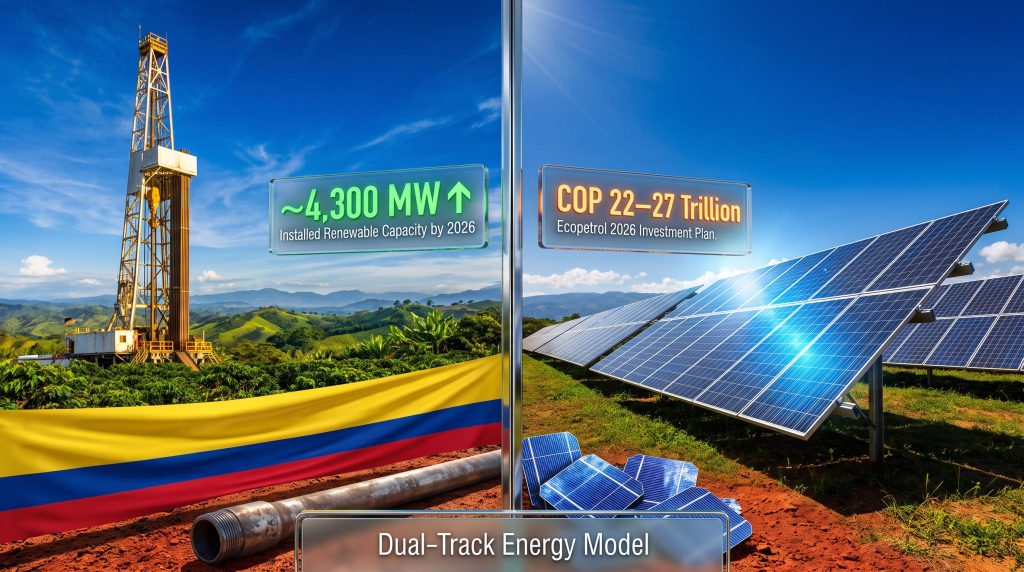
The renewable expansion that followed was, by most objective measures, extraordinary. According to data reported by World Energy Wire, Colombia's installed renewable capacity grew from approximately 200 megawatts in 2022 to more than 4,300 megawatts by 2026, a roughly 21-fold increase driven predominantly by solar photovoltaic deployment. This represents one of the most accelerated renewable build-outs in South American history during that period.
Yet critics of the moratorium consistently argued that the policy carried a critical structural flaw: it accelerated the depletion of existing hydrocarbon reserves without a replacement revenue stream capable of sustaining public finances. Colombia's oil and gas sector is not a peripheral contributor to government budgets; it is a load-bearing pillar of the national fiscal architecture. Ecopetrol's dividend transfers to the Colombian state represent a meaningful share of discretionary public spending capacity, and export earnings from hydrocarbons underpin the country's foreign exchange position and sovereign creditworthiness.
Furthermore, the commodity outlook for 2025 reinforced the view that resource-dependent economies cannot afford prolonged gaps between hydrocarbon revenue decline and renewable revenue maturity.
"The renewable gains made between 2022 and 2026 are largely irreversible in the short to medium term. The policy debate is not about dismantling clean energy infrastructure. It is about determining what structural role hydrocarbons must continue to play while that infrastructure matures."
The Renewable Capacity Legacy: A Table of Scale
| Metric | 2022 Baseline | 2026 Estimated Level |
|---|---|---|
| Installed Renewable Capacity | ~200 MW | ~4,300 MW |
| Primary Growth Driver | Solar PV | Solar PV |
| Approximate Growth Multiple | 1x | ~21.5x |
| Policy Context | Petro moratorium in force | Administration transition year |
Ecopetrol as the Engine of Strategic Recovery
Capital Allocation and the Scale of the Upstream Commitment
The incoming government has positioned Ecopetrol, Colombia's state-controlled energy company, as the primary instrument for executing its hydrocarbon revival. The company's 2026 investment plan is estimated at between COP 22 trillion and COP 27 trillion, a capital commitment that reflects the depth of the intended policy reversal.
Approximately 70% of that investment budget is allocated to upstream activities, encompassing exploration, development drilling, and production operations. This concentration of capital toward upstream functions signals a deliberate and aggressive posture focused on rebuilding productive capacity rather than maintaining existing infrastructure.
The investment plan carries the capacity to fund up to 430 development wells, a figure that would represent a level of upstream drilling activity not seen in Colombia for several years. For context, this scale of well deployment would require significant mobilisation of drilling rigs, oilfield services capacity, and technical personnel across multiple basins.
Ecopetrol's 2026 Investment Breakdown
| Capital Allocation Category | Approximate Share | Primary Operational Function |
|---|---|---|
| Upstream exploration and production | ~70% | Development wells, drilling programmes |
| Electricity transmission infrastructure | Partial remainder | Grid capacity and reliability |
| Road and logistics infrastructure | Partial remainder | Basin access and project logistics |
| Clean energy and transition projects | Partial remainder | Dual-track continuity |
Fracking: The Most Contested Element of the New Policy
President de la Espriella has confirmed that hydraulic fracturing will be authorised under a framework of strict technical and environmental standards. In practice, this commitment faces a layered set of constraints that make near-term commercial fracking a distant prospect despite the political announcement.
Colombia's constitutional architecture creates binding obligations that executive decrees cannot override:
- Environmental licensing requirements impose mandatory review timelines that are insulated from executive discretion.
- Prior consultation rights for indigenous and Afro-Colombian communities are constitutionally protected, and court precedents have consistently reinforced these protections.
- Legislative approval is almost certainly required for any substantive fracking regulatory framework, royalty restructuring, or fiscal incentive regime associated with unconventional extraction.
- Social opposition from environmental organisations and community groups in hydrocarbon-producing regions has historically proven capable of delaying or blocking projects through legal channels.
Analysts at S&P Global have noted that meaningful regulatory changes in Colombia's hydrocarbon sector, including fracking rules and royalty reform, would require congressional engagement rather than executive action alone. This creates a material gap between the speed of political announcements and the pace at which operational permits could realistically be issued and defended against legal challenge.
"The credibility of the new policy framework will ultimately be determined not by what is announced, but by how quickly the legal and regulatory architecture can be restructured to support actual capital deployment in the field."
The Energy Security Argument: Why Self-Sufficiency Frames the Entire Debate
Rethinking What Transition Actually Means
One of the more intellectually substantive contributions of the new government's position is its reframing of what genuine energy transition requires. President de la Espriella has articulated a position that an energy transition constructed on top of growing import dependency is not a real transition; it is a substitution of domestic vulnerability for external vulnerability. Broader questions around energy security and transition are, consequently, central to how Colombia's strategic calculus is being evaluated globally.
Colombia's domestic natural gas supply serves functions that extend well beyond electricity generation. Industrial processes, household energy access in regions without reliable electricity grid connections, and petrochemical feedstocks all depend on domestic gas availability. Allowing reserve depletion to accelerate without replacement production would expose Colombia to several interlinked risks:
- Rising LNG import costs that consume scarce foreign exchange, a concern amplified by shifting LNG supply dynamics across global markets.
- Supply disruption vulnerability tied to global LNG market conditions rather than domestic production decisions.
- Industrial competitiveness erosion as energy input costs rise for manufacturing and processing sectors.
- Fiscal deterioration as Ecopetrol's production base shrinks and dividend transfers to the state decline.
The Emerging Market Energy Trilemma
Colombia's situation illustrates what energy economists describe as the emerging market energy trilemma — the simultaneous and often contradictory pressure to maintain energy security, economic sustainability, and environmental commitment within a fiscal environment that cannot afford to sacrifice any of the three dimensions.
| Trilemma Dimension | Colombia's Specific Challenge |
|---|---|
| Energy Security | Sustaining domestic hydrocarbon production to limit import dependency |
| Economic Sustainability | Preserving fiscal revenues during a multi-decade energy transition |
| Environmental Commitment | Honouring climate pledges while expanding fossil fuel output capacity |
What makes Colombia's case distinctive is that the country is not simply choosing hydrocarbons over renewables. It is betting that hydrocarbon revenues can serve as the financing mechanism for the transition itself, funding the grid infrastructure, social programmes, and institutional capacity that make a long-term clean energy shift viable. In addition, renewable energy solutions being adopted across extractive industries globally suggest that a dual-track model is operationally feasible, even if politically contested.
Barriers That Could Derail the Revival
The Gap Between Policy Ambition and Operational Reality
Several structural constraints make the timeline between announcement and actual production recovery considerably longer than political communications suggest:
- Exploration lead times from contract award to first production in frontier basins typically span five to ten years, meaning that contracts signed in 2026 would not contribute meaningfully to production volumes until the early 2030s at the earliest.
- Regulatory uncertainty creates a risk premium that international oil companies incorporate into capital allocation decisions. Uncertainty about the legal durability of fracking authorisations and royalty frameworks will suppress investment appetite.
- Congressional arithmetic is not favourable for rapid reform. Environmental blocs and legislators aligned with the previous administration's transition agenda retain significant influence in a fragmented legislature.
- Social licensing challenges in hydrocarbon-producing regions cannot be engineered through legislation. Community acceptance is operationally essential and historically difficult to achieve in areas with prior conflict histories around resource extraction.
However, as Mongabay reported, Colombia's own Environment Minister has cautioned that oil revenues do not guarantee national stability — a perspective that adds further complexity to the policy debate.
Regional Context and the Investor Opportunity Map
Where Colombia Sits in the Latin American Hydrocarbon Landscape
| Country | Current Hydrocarbon Policy Posture | Transition Commitment Level |
|---|---|---|
| Colombia | Reverting to expansion with dual-track renewables | Moderate, pragmatic rebalancing |
| Brazil | Continued deepwater expansion via Petrobras | Moderate, parallel renewables growth |
| Venezuela | Attempting production recovery under sanctions | Low, fiscal survival priority |
| Ecuador | Ongoing upstream development under fiscal pressure | Moderate, budget-dependent |
For energy sector operators and investors, the Colombia oil and gas policy shift creates a re-entry calculation that is more nuanced than the headline suggests. The near-term opportunity is concentrated in oilfield services, development infrastructure, and brownfield production optimisation rather than frontier exploration, where regulatory risks and lead times are prohibitive in the short term.
Companies that reduced Colombian exposure during the moratorium period are now reassessing their positioning, but sophisticated operators will distinguish between the political signal and the regulatory substance. The former is already priced into market sentiment; the latter will take years to fully materialise. The broader picture of Australia's own resource and energy exports underscores how similarly structured commodity economies navigate comparable transitions.
A Three-Horizon Scenario Framework
- Short-term (2026 to 2027): Regulatory clarity is still forming. Early movers in services and infrastructure face lower barriers than upstream exploration entrants. The most viable capital deployment is in development drilling of existing fields where permits are already in place.
- Medium-term (2027 to 2030): If congressional reforms advance, exploration contract awards could accelerate. Fracking pilot programmes may begin in lower-risk geological settings, though commercial scale remains distant. Ecopetrol's upstream investment will be the primary driver of any measurable production recovery.
- Long-term (2030 and beyond): The viability of the dual-track model depends on whether growing renewable revenues can progressively substitute hydrocarbon fiscal contributions. This substitution is theoretically coherent but has not been demonstrated at scale in any comparable emerging economy.
"Strategic positioning for investors: The most defensible near-term exposure to Colombia's hydrocarbon revival is through services and infrastructure, where capital cycles are shorter and regulatory dependencies are lower than in exploration. Frontier exposure carries real upside but should be sized to reflect a medium-to-long-term timeline rather than an imminent production catalyst."
The next major ASX story will hit our subscribers first
Key Takeaways
Colombia's energy policy trajectory offers a concentrated view of the dilemmas confronting resource-dependent emerging economies across the global south. The country's new administration has made a clear strategic wager: that maintaining and expanding hydrocarbon production is not a retreat from energy transition, but a prerequisite for funding it responsibly.
The numbers behind this wager are substantial. An Ecopetrol investment programme of COP 22 to 27 trillion, with 70% directed upstream and capacity for up to 430 development wells, represents a genuine commitment of institutional capital. The renewable infrastructure built between 2022 and 2026, with installed capacity rising from approximately 200 MW to over 4,300 MW, will continue operating regardless of the hydrocarbon policy direction.
What remains genuinely uncertain is whether the legal, legislative, and social licensing architecture can be restructured quickly enough to convert political announcements into productive wells. That gap — between declaration and delivery — will define whether Colombia's Colombia oil and gas policy shift becomes a durable energy strategy or another chapter in the country's long history of resource policy reversals.
This article is intended for informational purposes only and does not constitute financial or investment advice. Forward-looking scenarios involve inherent uncertainty, and readers should conduct independent due diligence before making investment decisions related to any of the companies, sectors, or markets discussed.
Want to Stay Ahead of the Next Major Resource Discovery?
Colombia's energy policy reversal underscores how rapidly commodity dynamics can shift investment landscapes — and Discovery Alert's proprietary Discovery IQ model ensures subscribers receive real-time alerts the moment significant ASX mineral discoveries are announced, turning complex data across 30+ commodities into clear, actionable opportunities. Explore how historic discoveries have generated extraordinary returns on Discovery Alert's dedicated discoveries page, and begin your 14-day free trial today to position yourself ahead of the broader market.