June 1, 2026
Complex Criminal Networks Challenge Ecuador's Energy Sovereignty
Resource-dependent economies face unprecedented vulnerabilities when institutional capacity erodes faster than production decline. Ecuador's broken oil industry demonstrates how criminal networks can systematically capture energy infrastructure, creating parallel economic systems that compete directly with legitimate state operations. This transformation reflects broader patterns of institutional failure cascading through critical national infrastructure.
The convergence of narcotics trafficking, environmental degradation, and fiscal constraint creates feedback loops that accelerate energy sector decline. Traditional risk assessment frameworks prove inadequate when organized crime generates revenue streams exceeding government budgets allocated for infrastructure protection. Furthermore, oil price movements add another layer of complexity to an already unstable operating environment.
When big ASX news breaks, our subscribers know first
Infrastructure Vulnerability Patterns in Resource Transit Networks
Ecuador's broken oil industry operates within a framework of systemic vulnerabilities that compound traditional operational risks. Current production levels of 466,400 barrels per day represent a significant decline from historical capacity, reflecting both technical constraints and security-related operational disruptions.
Key Performance Indicators:
• Production capacity utilization at approximately 58% of historical peaks achieved during 2015-2016
• Annual production decline of 19% over the past decade despite global price recovery
• Infrastructure availability compromised by recurring environmental and security incidents
• Operational shutdowns lasting 45-60 days per major incident
The institutional response to these challenges reveals fundamental capacity constraints. Security expenditures now consume disproportionate shares of operational budgets, creating a resource allocation crisis where protection costs approach revenue generation potential. Consequently, energy security trends indicate increasing reliance on alternative energy sources.
Critical Vulnerability Assessment
| Risk Category | Annual Impact | Frequency | Mitigation Difficulty |
|---|---|---|---|
| Pipeline Ruptures | $150-300M | 3-5 events | Moderate |
| Criminal Sabotage | $80-150M | 15-25 events | Extremely High |
| Environmental Damage | $200-400M | 2-4 events | High |
| Forced Production Shutdowns | $500-800M | 8-12 events | High |
The March 2025 oil spill incident illustrates how single-point failures cascade through entire production systems. The release of 25,116 barrels triggered SOTE pipeline closure, reducing monthly production from 470,400 to 451,500 barrels per day within weeks. Recovery operations required extensive environmental remediation alongside technical repairs.
More severe disruptions occurred during July 2025, when simultaneous pipeline failures reduced production to 147,500 barrels per day, representing a 68% collapse from the previous month's output. This demonstrates how environmental and technical vulnerabilities interact to create system-wide operational paralysis.
Transportation Network Dependencies Create Systematic Risk
Ecuador's broken oil industry relies on petroleum export infrastructure that operates through two primary corridors handling 100% of national crude oil transportation. This design creates unavoidable single-point-of-failure vulnerabilities that extend beyond technical maintenance into fundamental strategic risk.
Pipeline Network Analysis
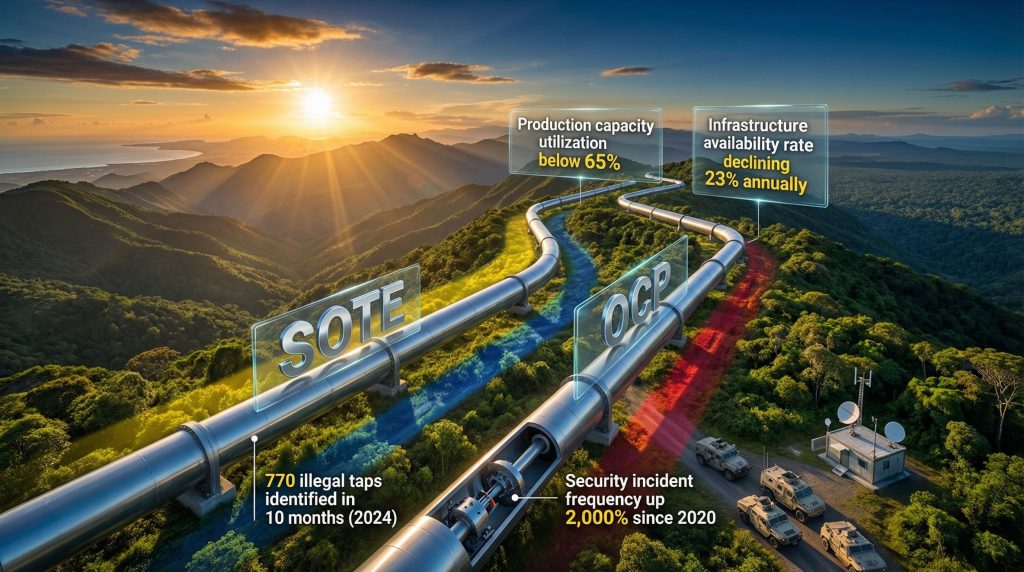
The Trans-Ecuadorian Oil Pipeline (SOTE) manages 57% of national production flows, while the Oleoducto de Crudos Pesados (OCP) system handles the remaining 43% of export capacity. Both systems traverse identical geographic corridors, meaning environmental disruptions, criminal activity, or infrastructure failures affect the entire network simultaneously.
Technical Specifications:
• Total network length: 1,030 miles traversing remote Pacific Coast and Amazon regions
• Storage capacity limitations: 2-3 million barrels total system inventory
• Storage-to-production ratio: 5-7 days operational buffer
• Alternative routing options: None currently operational
Storage constraints amplify pipeline vulnerabilities by forcing production shutdowns within days of transportation disruptions. Unlike energy systems with redundant export routes, Ecuador's operators must halt drilling operations once storage facilities reach capacity during pipeline outages.
The Coca Codo Sinclair hydroelectric dam creates additional systematic risk through environmental modification. The 1,500-megawatt facility alters downstream water flow patterns, creating accelerated erosion conditions that systematically undermine pipeline support infrastructure. This phenomenon, characterized as hungry water, represents an ongoing environmental threat that increases in severity during rainfall periods.
Environmental Risk Amplification
- Hydroelectric operations modify sediment transport downstream
- Enhanced erosion capacity undermines pipeline bedding stability
- Seasonal rainfall triggers landslides in compromised terrain
- Pipeline exposure creates recurring rupture incidents
- Extended repair cycles require 3-8 weeks per major incident
Geographic Position Amplifies Security Vulnerabilities
Ecuador's location between Colombia and Peru positions the country within the world's primary cocaine trafficking corridor. This geographic reality creates security challenges that traditional energy risk models fail to adequately address or price. Moreover, global trade disruptions compound these regional security challenges.
Trafficking Volume Indicators
According to government estimates, 70% of global cocaine supply transits through Ecuador en route to international markets. This volume reflects Colombia's dramatic production expansion, which grew from 290 metric tons annually in 2013 to 2,664 metric tons in 2023, representing a 934% increase over eleven years.
Projected 2024 cocaine production of 3,001 metric tons indicates continued growth in trafficking volumes requiring transit through Ecuadorian infrastructure. The removal of Venezuela as an alternative trafficking route following U.S. intervention has concentrated additional flows through Ecuador's ports and transport networks.
Violence Escalation Metrics
Murder rates increased from approximately 12-15 per 100,000 people in 2020 to 51 per 100,000 in 2025, representing Ecuador's highest recorded violence levels. These rates exceed regional comparisons including El Salvador and approach Venezuelan levels, indicating systematic institutional breakdown rather than isolated criminal activity.
Criminal organizations operating within this environment possess resources that fundamentally challenge government capacity for infrastructure protection. When illicit networks generate hundreds of millions in annual revenue, they can systematically outbid legitimate security spending on critical infrastructure protection.
Criminal Network Operational Sophistication
Fuel theft operations demonstrate industrial-scale organization and technical capability. The number of illegal pipeline taps increased from 36 in 2022 to 770 during the first ten months of 2024, representing a 21.4-fold increase over two years.
• Daily theft volumes: 15,000-25,000 barrels per day
• Annual criminal revenue: $180-300 million from fuel theft operations
• Technical expertise: Advanced understanding of pipeline pressure systems and distribution networks
• Market integration: Sophisticated pricing and distribution capabilities
The technical requirements for cocaine processing create inelastic demand for petroleum products. Manufacturing one kilogram of coca paste requires 75 gallons (284 liters) of gasoline, plus additional quantities for powering clandestine laboratory operations. This creates consistent demand regardless of price volatility or law enforcement pressure.
Environmental Policy Frameworks Constrain Production Capacity
Democratic environmental governance creates legally binding constraints on resource extraction that operate independently of economic incentives. The 2023 referendum mandating Yasuní National Park protection demonstrates how environmental frameworks can override short-term fiscal imperatives in resource-dependent economies.
Policy Impact Analysis
Block 43 (ITT) closure requirements affect approximately 12% of proven reserves, while broader Yasuní restrictions impact 15% of exploration potential. Indigenous rights frameworks limit access to an estimated 35% of prospective areas, creating cumulative constraints on future production capacity.
Environmental compliance costs have increased 340% since 2020, reflecting both regulatory expansion and heightened enforcement mechanisms. These increases occur simultaneously with security cost escalation, creating compounding pressure on operational margins.
Regulatory Framework Evolution
| Policy Area | Reserve Impact | Compliance Cost | Implementation Timeline |
|---|---|---|---|
| Yasuní Protection | 15% exploration | $45-65M annually | 2024-2027 |
| Indigenous Rights | 35% prospective areas | $25-40M annually | Ongoing |
| Environmental Impact | 8% current production | $80-120M annually | 2023-2026 |
| Water Resource Protection | 12% future development | $35-50M annually | 2025-2028 |
These policy frameworks reflect legitimate environmental and social priorities that compete with immediate fiscal needs. The tension between long-term sustainability and short-term revenue generation creates political dynamics that further complicate energy sector planning and investment decisions. However, comprehensive crude oil analysis remains essential for understanding market dynamics.
Security Expenditures Reshape Energy Sector Economics
Traditional energy project economics assume stable operating environments with predictable cost structures. Ecuador's broken oil industry demonstrates how security requirements can fundamentally alter industry profitability through direct cost escalation and operational disruption.
Security Cost Structure Analysis
Pipeline protection requires $180-220 million annually, representing 8-12% of sector revenue. Field security operations consume an additional $95-140 million annually, while transport escorts and emergency response add $70-105 million in combined annual expenditures.
These costs operate as fixed expenses that cannot be reduced without accepting higher risk of operational disruption. Unlike technical expenditures that improve long-term productivity, security spending represents pure overhead that reduces overall sector competitiveness.
Security Investment Categories
• Personnel deployment: Armed security teams at production facilities and along pipeline routes
• Surveillance technology: Monitoring systems for early detection of criminal activity
• Emergency response: Rapid deployment teams for incident containment and recovery
• Intelligence operations: Information gathering on criminal network activities and capabilities
• Infrastructure hardening: Physical modifications to reduce vulnerability to attack or sabotage
The effectiveness of security spending remains limited when criminal networks possess superior resources and local knowledge. Government security forces operate with bureaucratic constraints and limited local intelligence, while criminal organizations maintain comprehensive territorial control and community integration.
The next major ASX story will hit our subscribers first
Fiscal Sustainability Crisis Emerges from Production Decline
Ecuador's 2025 fiscal deficit of $5.3 billion (4% of GDP) reflects fundamental misalignment between revenue generation capacity and expenditure requirements. The 71% increase from 2024 levels occurred despite economic growth of 3%, indicating structural rather than cyclical fiscal challenges.
Fiscal Performance Indicators
Oil revenue declined 15% year-over-year while security spending increased substantially to address escalating violence and infrastructure threats. This inverse relationship creates a self-reinforcing fiscal deterioration where declining revenue necessitates increased borrowing to maintain basic security functions. Additionally, OPEC production impact affects global pricing dynamics.
| Fiscal Indicator | 2023 | 2024 | 2025 | Trend Direction |
|---|---|---|---|---|
| Oil Revenue Share | 28% | 24% | 18% | ↓ Declining |
| Security Expenditure | 12% | 16% | 22% | ↑ Rising |
| Deficit/GDP Ratio | 2.1% | 3.1% | 4.0% | ↑ Worsening |
| Debt Service Burden | 31% | 35% | 42% | ↑ Unsustainable |
Ecuador has recorded fiscal deficits for nearly two decades, with the last budget surplus occurring in 2008. This pattern indicates systematic inability to align expenditures with revenue generation, particularly during periods of commodity price volatility or production disruption.
The fiscal crisis creates additional constraints on energy sector investment by limiting government capacity to provide infrastructure support, regulatory certainty, or security guarantees that private investors require for long-term commitments.
Production Shutdowns Generate Cascading Economic Effects
Individual pipeline disruptions create immediate revenue losses of $15-25 million daily, but secondary economic impacts multiply these direct costs through supply chain disruptions, contract penalties, and investor confidence erosion.
Economic Impact Multipliers
Each major incident generates contract penalty exposure of $50-80 million beyond direct revenue losses, while insurance premium increases of 15-25% annually create permanent cost escalation. Credit rating deterioration of 2-3 notches per major incident affects government borrowing costs across all sectors.
Shutdown Impact Analysis
• Immediate production losses affect daily cash flow and debt service capacity
• Supply contract penalties create legal and financial obligations extending beyond incident duration
• Insurance cost escalation permanently increases operational expenses for all energy sector participants
• Credit rating pressure affects sovereign borrowing capacity and increases fiscal financing costs
• Investment deterrence reduces long-term exploration and development activity
The frequency and severity of production disruptions create cumulative effects that exceed the sum of individual incidents. International energy companies increasingly view Ecuador as a higher-risk operating environment, requiring premium returns to justify continued investment.
Regional Security Implications Extend Beyond National Borders
Ecuador's energy sector breakdown creates spillover effects throughout South America's Pacific corridor. Colombia and Peru face increased pressure as criminal networks seek alternative routes, while regional energy markets experience supply volatility that affects continental pricing mechanisms.
Regional Contagion Patterns
Colombian pipeline security costs have increased 45% as criminal organizations expand operations beyond Ecuador. Peruvian port security investments doubled in response to increased trafficking activity, while regional crude price volatility rose 180% due to supply uncertainty from Ecuador's production disruptions.
Cross-border criminal activity increased 320% as organizations adapt to law enforcement pressure by expanding territorial operations. This creates security challenges for neighbouring countries that must allocate additional resources to border monitoring and trafficking interdiction.
Multi-National Impact Assessment
| Country | Security Cost Increase | Infrastructure Pressure | Market Volatility Impact |
|---|---|---|---|
| Colombia | +45% | Moderate | High |
| Peru | +85% | High | Moderate |
| Brazil | +25% | Low | Low |
| Chile | +15% | Low | Moderate |
Regional energy security requires coordinated approaches that address transnational criminal networks operating across multiple jurisdictions. Individual national responses prove insufficient when criminal organisations possess resources and capabilities exceeding those of individual government security forces.
What Investment Frameworks Are Needed for High-Risk Energy Projects?
Traditional discounted cash flow models cannot adequately incorporate the political risk, security costs, and environmental policy uncertainty that characterise Ecuador's operating environment. New analytical approaches must account for non-traditional risk factors that conventional energy finance frameworks systematically underestimate.
Risk Assessment Model Limitations
Standard investment models allocate 10% weighting to political risk, but Ecuador's experience suggests 35% weighting more accurately reflects operational reality. Security risk traditionally receives 5% weighting, while actual operational experience indicates 25% weighting better captures exposure to criminal activity and infrastructure threats.
Enhanced Risk Framework
| Risk Category | Traditional Weight | Ecuador Reality | Required Adjustment |
|---|---|---|---|
| Technical Risk | 15% | 15% | No Change |
| Market Price Risk | 25% | 25% | No Change |
| Political/Regulatory | 10% | 35% | +250% |
| Security/Criminal | 5% | 25% | +400% |
| Environmental/Social | 10% | 20% | +100% |
Investment models must incorporate scenario analysis that accounts for complete operational shutdowns lasting multiple months, rather than assuming temporary disruptions with predictable recovery timelines. The frequency and duration of force majeure events in Ecuador exceed assumptions built into standard energy project finance models.
Advanced Scenario Modelling Requirements
• Extended shutdown scenarios: 3-6 month production halts with uncertain restart timelines
• Escalating security costs: Annual increases of 20-35% in protection expenditures
• Regulatory policy shifts: Democratic processes creating binding resource access restrictions
• Criminal network evolution: Adaptive responses to law enforcement and security measures
How Can Regional Cooperation Improve Energy Security?
Ecuador's crisis highlights opportunities for multinational approaches to energy infrastructure protection that could distribute risk while maintaining operational efficiency through shared security resources and alternative routing options.
Cooperative Security Mechanisms
Cross-border pipeline protection protocols could create shared responsibility for infrastructure security, reducing individual country exposure to criminal network pressure. Intelligence sharing networks would improve early detection of criminal activities that threaten energy infrastructure across multiple jurisdictions.
Alternative routing through multiple countries could provide redundancy that reduces single-point-of-failure vulnerabilities, while coordinated environmental policy frameworks could balance conservation priorities with energy security requirements.
Regional Integration Opportunities
• Shared security forces deployed across pipeline corridors in multiple countries
• Intelligence coordination for tracking criminal network activities and capabilities
• Alternative infrastructure development connecting production areas to multiple export terminals
• Policy harmonisation aligning environmental and energy regulations across borders
• Financial risk sharing through multilateral insurance and investment guarantee programs
Regional cooperation requires balancing national sovereignty concerns with collective security benefits. Successful implementation depends on creating institutional frameworks that preserve national decision-making authority while enabling coordinated responses to transnational security threats.
Implementation Challenges
Multinational cooperation faces obstacles including sovereignty concerns, resource allocation disputes, and differing national priorities for energy versus environmental protection. However, Ecuador's experience demonstrates that individual national responses prove insufficient against criminal networks operating across multiple jurisdictions.
Furthermore, according to Oil Price, the energy sector faces mounting pressure from criminal organisations that systematically target critical infrastructure. In addition, Yahoo Finance reports that geopolitical tensions continue to complicate regional security cooperation efforts.
Ecuador's energy sector collapse provides critical lessons for resource-dependent economies facing institutional governance challenges. The convergence of criminal network penetration, environmental constraints, and fiscal pressure creates conditions where traditional industry solutions prove systematically inadequate.
The country's experience reveals how quickly institutional weaknesses compound into systemic failure when criminal organisations possess resources exceeding government capacity for infrastructure protection. Success requires integrated policy approaches addressing root causes of institutional breakdown rather than treating individual symptoms through isolated technical or security interventions.
This analysis is provided for educational purposes and does not constitute investment advice. Readers should conduct independent research and consult qualified professionals before making investment or policy decisions related to energy sector development or resource governance frameworks.
Ready to Capitalise on Energy Sector Opportunities?
Discovery Alert's proprietary Discovery IQ model delivers real-time alerts on significant ASX mineral discoveries, instantly empowering subscribers to identify actionable opportunities whilst major market shifts unfold in sectors like energy and critical minerals. Explore historic examples of exceptional returns from major discoveries at Discovery Alert's discoveries page and begin your 14-day free trial today to position yourself ahead of the market during these transformative times.