July 14, 2026
The Backward-Looking Trap: Why the DRC's Cobalt Quota System Is Failing the Miners Who Built for the Future
When a single country controls the majority of global supply for a critical industrial material, its domestic policy decisions ripple far beyond its own borders. The Democratic Republic of Congo sits at the centre of the global cobalt market in exactly this position, and Congo cobalt export quotas — the export management framework constructed since early 2025 — offer a revealing case study in how resource nationalism, when implemented with structural flaws, can simultaneously achieve and undermine its own objectives.
Understanding why this matters requires stepping back from the immediate price headlines and examining the deeper mechanics of how cobalt reaches global battery supply chains, who bears the cost of policy miscalculation, and what investment signals are now being transmitted to the companies considering whether to commit future capital to Congolese operations.
When big ASX news breaks, our subscribers know first
Cobalt as a Byproduct: Why the DRC's Production Structure Makes Policy Especially Powerful
Unlike gold or copper, where mine operators target the metal directly, cobalt in the DRC is overwhelmingly extracted as a secondary output during copper processing. This byproduct relationship has a profound implication: cobalt production volumes are partially determined by copper market economics rather than cobalt economics alone. When copper prices justify high throughput, cobalt recovery increases as a consequence. When copper economics deteriorate, cobalt volumes fall without any deliberate production decision being made about cobalt itself.
This structural feature means the DRC's dominance over global cobalt production is not merely a function of geological endowment but also of copper market dynamics playing out across an enormous and complex mining landscape. MMG's Kinsevere operation illustrates this concisely. The mine produced 53,000 tonnes of copper in 2025, with cobalt representing an ancillary recovery stream dependent on the primary copper processing circuit.
The byproduct dynamic also helps explain how the oversupply problem that triggered the export restrictions developed in the first place. As copper operations across the DRC expanded through 2022 and 2023, cobalt volumes grew in parallel, flooding a market where battery demand had not yet absorbed the incremental supply. Prices collapsed, and by late 2024, some dedicated cobalt processing facilities were no longer economically justified to keep running.
A Policy Built to Solve Oversupply That Rewards the Overproducers
In February 2025, Congo's government took the decisive step of implementing a DRC cobalt export ban entirely, citing the need to address chronic oversupply and stabilise the market. By October 2025, this blanket suspension transitioned into a structured quota regime managed by ARECOMS, the country's Authority for the Regulation and Control of Strategic Mineral Substances' Markets.
The quota framework established the following key parameters:
| Policy Milestone | Timing | Detail |
|---|---|---|
| Full export suspension | February 2025 | Complete ban to address oversupply |
| Structured quota introduction | October 2025 | Pro-rata allocation based on historical exports |
| Q4 2025 export ceiling | Late 2025 | 18,125 tonnes total |
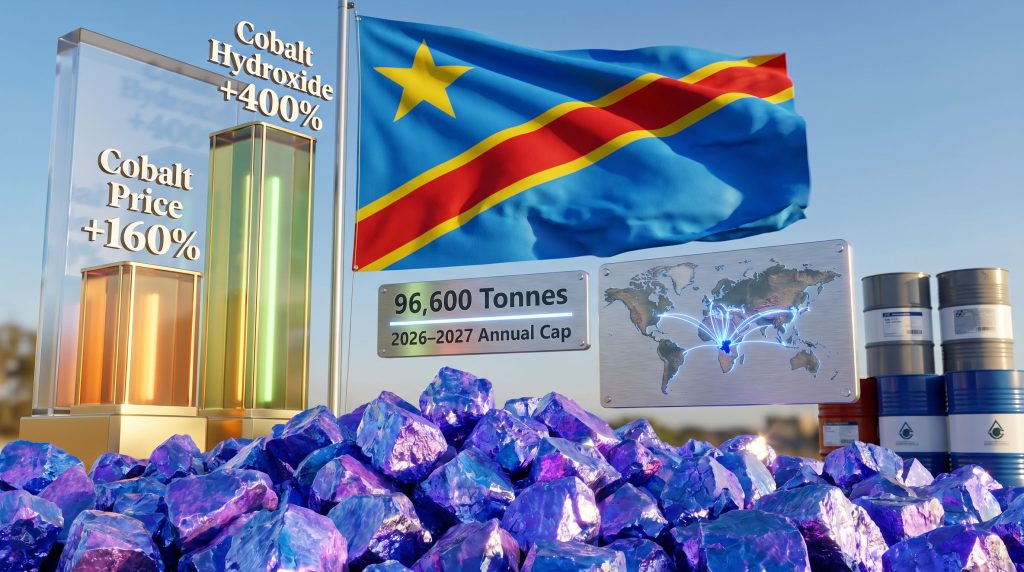
| Annual cap for 2026 and 2027 | From 2026 onwards | 96,600 tonnes per year |
| Q4 2025 rollover deadline | April 30, 2026 | Unshipped quota forfeited to strategic reserve |
| Q1 2026 rollover deadline | June 30, 2026 | Q1 shipment window closes |
The 96,600-tonne annual cap is divided into a 87,000-tonne basic producer allocation and a 9,600-tonne strategic reserve controlled directly by ARECOMS. For most operators, individual allocations within the basic pool are determined using a pro-rata formula derived from each company's export volumes across the three-year reference window ending December 2024.
The intention is clear: manage supply, support prices, and create conditions for domestic value-addition. The execution, however, has generated significant controversy. Furthermore, the cobalt export ban impacts have extended well beyond the immediate market, reshaping investment decisions across the sector.
Elisabeth Caesens, founder of advocacy group Resource Matters, identified the central contradiction at the Cobalt Institute's 2026 annual congress in Madrid. By relying exclusively on historical production data to determine allocations, the methodology proportionally rewards the companies whose aggressive output growth between 2022 and 2024 contributed most directly to the oversupply problem the export ban was designed to correct. The formula, as constructed, contains an internal logic that runs counter to the policy's own stated goals.
The Quota Exclusions That Are Costing New Investors Most Dearly
Caesens and other industry voices at the Madrid congress identified a range of commercially and socially relevant variables that the current quota framework does not consider. These exclusions are not minor technicalities. They represent the difference between a policy framework that incentivises responsible, forward-looking investment and one that calcifies the market share of incumbents regardless of their recent behaviour or future commitments.
The factors currently absent from quota calculations include:
- Planned capital investment and documented commitments to downstream expansion
- Value-addition capacity, including on-site refining or processing infrastructure already installed
- ESG compliance track records, encompassing environmental management, community investment, and governance standards
- Fiscal contributions to the Congolese economy, including royalties, corporate taxes, and local employment creation
- Forward production capacity based on commissioned plant and equipment
This is not an abstract policy debate. The absence of forward-looking criteria is inflicting direct financial damage on specific operations that invested in the DRC in good faith and now find themselves penalised for timing their commissioning outside the historical reference window.
The Care-and-Maintenance Trap: A Case Study in Quota Inequity
MMG Ltd., whose major shareholder is China Minmetals Corp., commissioned a purpose-built cobalt processing facility at its Kinsevere copper mine in September 2023. The plant was designed with annual production targets of 4,000 to 6,000 tonnes of cobalt. When cobalt prices collapsed through 2024, the commercial rationale for running the facility evaporated, and MMG made the rational market decision to place it on care and maintenance in late 2024.
Under the pro-rata quota methodology, MMG's allocation for 2026 reflects the limited export volumes generated during the period when the cobalt plant was either in early commissioning or idle. The company received a quota of 360 tonnes for 2026 against a facility capable of producing up to 6,000 tonnes annually. The gap between capacity and entitlement represents a 94% shortfall.
Aaron Chen, General Manager of MMG's Kinsevere operations, told the Cobalt Institute congress that this allocation renders cobalt production economically unviable and expressed the company's position that its economic and ESG contributions to the DRC had not been factored into the quota determination. As of its most recent reporting, MMG confirmed the cobalt plant remained on care and maintenance, with quota being fulfilled from existing on-site inventories rather than active production.
This scenario illustrates a broader structural trap affecting multiple operators:
- A company responds rationally to market signals by suspending production during a price downturn
- The suspension reduces its historical export volumes, lowering its pro-rata quota entitlement
- When prices recover and the policy framework is established, the company's quota reflects the downturn period rather than its actual capacity
- The installed asset, built at significant capital cost, cannot be reactivated profitably under the assigned quota
- The economic case for downstream investment deteriorates further, precisely when the government needs it most
The care-and-maintenance trap is particularly perverse because it punishes operators for behaving in exactly the way a market is supposed to function: reducing output when prices are too low and seeking to increase output when prices improve. The quota framework inverts this incentive structure.
Market Impact: A 160% Rally That Hasn't Fully Reached the Companies
From a pure price perspective, the DRC's export restrictions have achieved a remarkable recovery. Benchmark cobalt prices have increased approximately 160% since the restrictions were first imposed in February 2025. More dramatically, cobalt hydroxide, the primary product form exported from the DRC, has risen by more than 400% over the same period.
The price differential between benchmark cobalt (+160%) and cobalt hydroxide (+400%) is analytically significant. Cobalt hydroxide is the specific product form affected most directly by Congolese supply constraints. The larger hydroxide price appreciation reflects a tighter supply situation at the product level closest to DRC export volumes, suggesting the quota regime is having a more acute effect on hydroxide-specific supply chains than on refined cobalt markets more broadly.
Yet despite this dramatic price recovery, a paradox has emerged: actual shipment volumes are significantly undershooting allocated quota levels. According to market assessments, exports during Q4 2025 may have reached less than half of the allocated quota volumes for that period. The gap between allocated and shipped tonnes has several reinforcing causes:
- Administrative bottlenecks in export permit processing
- Documentation requirements that have created procedural delays
- Logistical constraints in physical shipping and transport
- Companies like MMG shipping from stockpiles rather than production, limiting throughput rates
The consequence is that the price signal is stronger than the underlying physical export restriction would justify on quota volumes alone. Buyers cannot access Congolese material at the allocated quota rate because the system to process and ship that material has not yet scaled to match the permit framework.
Patrick Luabeya, head of ARECOMS, has stated publicly that the quota system was designed to ensure a fair market and that the primary objective is generating local processing activity and employment rather than purely maximising cobalt prices. This dual mandate creates tension: if shipments continue to underperform allocated volumes, neither the revenue benefit for producers nor the industrial development objective for the government is being fully realised.
The next major ASX story will hit our subscribers first
Chinese Capital at Risk: The Investment Deterrent Signal
Chinese firms have deployed billions of dollars across sub-Saharan Africa to develop cobalt and copper assets, with the DRC representing the strategic centrepiece of that capital allocation. The quota framework's treatment of recently commissioned operations sends a clear deterrent signal to investors evaluating future commitments. In addition, Congolese cobalt rivalry between major powers has further complicated the investment calculus for operators on the ground.
Ning Wang, a researcher at the China Chamber of Commerce of Metals, Minerals & Chemicals Importers & Exporters, called at the Madrid congress for the DRC government to publish clearer criteria detailing what is expected of Chinese operators and how quota allocations are determined. The absence of transparent rules-based criteria is precisely the kind of regulatory ambiguity that raises the risk premium on new investment and slows capital deployment decisions.
The structural disincentives operating on future investment include:
- Quota formula risk: New capacity commissioned after the reference period receives minimal quota entitlement regardless of scale
- Care-and-maintenance penalty: Operators who paused production during the downturn are permanently disadvantaged relative to those who continued running loss-making operations
- Strategic reserve opacity: The 9,600-tonne discretionary reserve lacks published allocation criteria, creating regulatory uncertainty
- Compliance enforcement risk: ARECOMS has signalled that quota violations could result in permanent export bans, amplifying downside risk for operators
The Artisanal Mining Dimension and State-Controlled Allocation
One of the more striking features of the quota allocation is the position of Entreprise Generale du Cobalt (EGC), the state-owned entity that holds a monopoly over hand-dug cobalt supplies in the DRC. Despite only commencing formal production operations at the end of 2025, EGC received the fourth-largest quota allocation at 5,640 tonnes for 2026.
EGC's chief executive Eric Kalala has publicly indicated that the company considers even this allocation insufficient given the scale of artisanal and small-scale mining activity it manages. The preferential allocation to a state entity that sits outside the pro-rata formula applied to commercial operators adds a further layer of complexity to the framework, particularly for foreign investors assessing the equitable treatment principles underlying the system.
The artisanal and small-scale mining sector in the DRC represents a substantial portion of total cobalt production. Its formal channelling through a state monopoly entity creates a structurally different supply pathway compared to industrial mining operations, with different cost bases, quality characteristics, and logistical frameworks.
Indonesia's Role as Partial Counterweight to DRC Constraints
As Congo cobalt export quotas constrain global availability of cobalt hydroxide, Indonesia has been accelerating output from its nickel laterite operations. Indonesian cobalt reaches the market primarily as mixed hydroxide precipitate (MHP), produced via High-Pressure Acid Leach (HPAL) processing. This is a chemically distinct product from DRC cobalt hydroxide and does not substitute identically in all downstream refining pathways.
| Supply Region | Primary Product Form | 2026 Supply Outlook | Key Constraint |
|---|---|---|---|
| DRC (Congo) | Cobalt hydroxide | Quota-capped at 96,600t annually | Export quotas; logistics delays |
| Indonesia | Mixed hydroxide precipitate | Expanding; partial supply offset | Different refining pathway |
| Australia | Cobalt sulphate / mixed products | Stable; niche volumes | High cost base; limited scale |
| Philippines | Cobalt in nickel laterite | Modest growth | Processing limitations |
While Indonesia's expanding output provides meaningful relief to buyers locked out of Congolese supply, it does not eliminate the DRC supply premium for buyers whose refining infrastructure is configured specifically for cobalt hydroxide processing. However, the DRC cobalt suspension has accelerated efforts by some downstream manufacturers to diversify their sourcing strategies more deliberately.
What Genuine Policy Reform Would Need to Look Like
The conditions most frequently cited by industry participants as necessary to restore confidence in long-term DRC cobalt investment centre on a common theme: predictability. Specifically, the reforms most likely to catalyse new capital commitment include:
- Published, rules-based allocation methodology that accounts for investment commitments and ESG performance alongside historical production
- Forward-looking quota recognition for newly commissioned capacity outside the historical reference window
- Uniform compliance enforcement applied consistently across all operator categories, including state-aligned entities
- Preferential quota treatment for operators committing to in-country processing and value-addition
- Structured bilateral dialogue between the DRC government and major foreign investors on quota framework evolution
The long-term ambition of the DRC government is clear: to transition from raw material exports toward domestic beneficiation, capturing more of the value chain from cobalt hydroxide through to precursor cathode material and potentially battery-grade cobalt sulphate. This is a legitimate industrial policy objective that aligns with broader African resource development goals.
However, attracting the substantial capital required to build this processing infrastructure requires a regulatory environment where the rules governing quota allocation are understood in advance, applied consistently, and designed to reward the investment behaviour the government says it wants to encourage. As MMG's Aaron Chen noted, the company remains interested in exploring downstream value-added opportunities in the DRC but requires greater policy clarity around the quota mechanism before committing to such investment. Cobalt export conditions have, consequently, become a central concern for operators weighing their long-term presence in the region.
The DRC's cobalt quota framework has delivered impressive price recovery, but it risks trading a short-term market correction for a long-term investment deterrent if the structural inequities embedded in the allocation methodology are not addressed.
Frequently Asked Questions: Congo Cobalt Export Quotas
What is the total cobalt export quota for the DRC in 2026?
The annual cap is 96,600 tonnes, comprising 87,000 tonnes allocated to basic producers through the pro-rata formula and a 9,600-tonne strategic reserve managed at ARECOMS's discretion.
How are individual company quotas calculated?
For most producers, allocations are determined on a pro-rata basis using each company's export volumes during the three years ending December 2024. This backward-looking formula does not account for installed capacity, planned investment, or ESG performance.
Why have cobalt prices risen so sharply since restrictions began?
Benchmark cobalt prices have increased approximately 160% since the February 2025 export ban, with cobalt hydroxide rising by more than 400%. The price recovery reflects both reduced export volumes and administrative delays in processing export permits, which have kept actual shipment volumes below allocated quota levels.
Can unused quota be carried forward?
Yes, within defined windows. Q4 2025 quota had to be shipped by April 30, 2026, or it was forfeited to the strategic reserve. Q1 2026 quota can be fulfilled through June 30, 2026. Congo's government gave cobalt miners until end April to utilise their 2025 allocations before forfeiture applied.
What happens if a company ships cobalt beyond its quota?
ARECOMS has indicated that violations may result in severe penalties including permanent export bans, creating significant compliance risk for operators.
Is the quota system permanent?
The current framework is set at 96,600 tonnes annually for both 2026 and 2027. Policy direction beyond that period remains formally unspecified.
How does this affect global EV battery supply chains?
Constrained cobalt hydroxide exports from the DRC increase procurement costs for cathode manufacturers and raise input costs for lithium-ion battery production, affecting the economics of electric vehicle manufacturing globally. The impact is most acute for supply chains specifically configured around cobalt hydroxide processing rather than alternative product forms such as Indonesian MHP.
This article is intended for informational purposes only and does not constitute financial or investment advice. Cobalt price data, quota figures, and market projections referenced herein are based on reporting current as of May 2026 and are subject to change. Readers should conduct independent due diligence before making any investment decisions relating to cobalt, battery metals, or related mining equities.
Want to Stay Ahead of Major Mineral Discoveries Before the Broader Market Reacts?
The shifting dynamics in critical battery metals like cobalt underscore just how rapidly supply constraints can reshape commodity markets and investment opportunities — Discovery Alert's proprietary Discovery IQ model monitors ASX announcements in real time, instantly identifying significant mineral discoveries across more than 30 commodities and delivering actionable insights directly to subscribers. Explore how major discoveries have historically generated substantial returns on Discovery Alert's dedicated discoveries page, and begin your 14-day free trial today to ensure you're positioned ahead of the market.