Constellation Resources Ltd
- ASX Code: CR1
- Market Cap: $12,059,167
Constellation Resources Strikes High-Grade Methane and Helium at Newly Secured Ground — A Potential Basin-Scale Gas Discovery in the Making
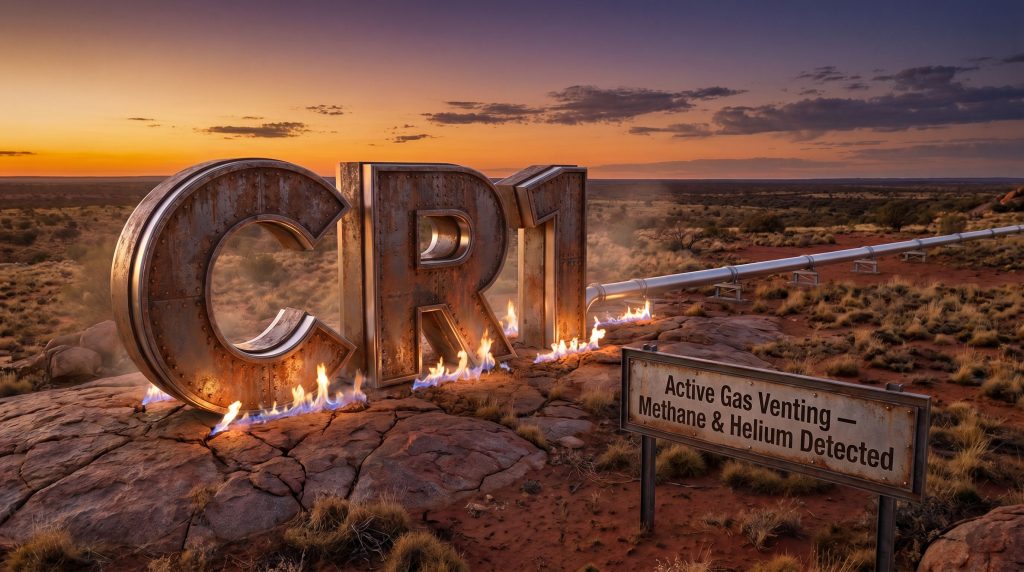
Constellation Resources (ASX: CR1) has delivered one of its most compelling exploration results to date, confirming high concentrations of methane and helium venting continuously from a shallow drillhole on newly secured ground in Western Australia's underexplored Edmund–Collier Basin. The Constellation Resources high-grade methane and helium discovery in the Edmund-Collier Basin has been validated by Australia's national science agency CSIRO and corroborated by independent laboratory analysis, pointing to what could be a recharging, basin-scale gas system — and a genuinely rare find in frontier energy exploration.
When big ASX news breaks, our subscribers know first
A Drillhole That Keeps on Giving
At the centre of this announcement is WHRD021, a diamond drillhole originally sunk in 2012 by Atlas Iron to chase iron mineralisation. It was never drilled for gas. Yet over three separate field visits spanning eight months — in September 2025, November 2025, and April 2026 — Constellation's team recorded persistent, anomalously high gas readings at the hole collar using calibrated handheld methane metres.
Gas samples collected across these visits and submitted to two independent laboratories (Atherium and ALS) returned the following air-corrected results:
| Gas | Peak Air-Corrected Concentration | Significance |
|---|---|---|
| Methane (CH₄) | Up to 97% | Commercial natural gas pipelines typically require >85% CH₄ |
| Helium (He) | Up to 0.24% | Wells >0.1% He are classified as "helium-rich" |
| Ethane (C₂H₆) | Detected | Indicator of thermogenic hydrocarbon system |
To put the helium figure in context: the recently depleted Bayu-Undan offshore gas field near Darwin — one of Australia's major LNG facilities — recorded helium concentrations of 0.09–0.21% across individual wells. Natural gases down to 0.04% helium have been demonstrated to be commercially viable in the context of LNG-associated helium purification. Finding 0.24% helium at a shallow mineral exploration hole is, as the company notes, considered highly unusual and warrants serious follow-up.
The fact that gas has been observed venting consistently on multiple visits — rather than as a one-off reading — is particularly significant. It suggests a connection to an active or recharging subsurface reservoir, not simply a finite trapped pocket of residual gas.
"The high concentrations of natural gas with notable He results from a potentially long-term venting drillhole provide important evidence of a potentially recharging, basin-scale gas system within the underexplored Edmund–Collier Basin."
— Constellation Resources ASX Announcement, 21 May 2026
CSIRO Confirms WHRD021 as the Standout Across the Entire Basin Dataset
The results from WHRD021 don't exist in isolation. As part of a 2025 basin-wide study conducted by CSIRO under a technical service agreement with Constellation, six core samples from WHRD021 were analysed for trapped gases across multiple rock types at depth.
The outcome was unambiguous: WHRD021 returned the highest readings for hydrogen (H₂), methane (CH₄), helium (He), and ethane (C₂H₆) of all drillholes analysed across the entire Edmund–Collier Basin dataset.
Selected WHRD021 extracted gas concentrations from crushed core (CSIRO analysis) are shown below:
| Sample Depth (m) | Host Lithology | He (mmol/kg) | H₂ (mmol/kg) | CH₄ (mmol/kg) | C₂H₆ (mmol/kg) |
|---|---|---|---|---|---|
| 241.86 | Hydrothermal rock | ND | 0.46 | 1.32 | 0.19 |
| 445.24 | Dolostone/dolomite boundstone | 0.01 | 0.23 | 1.61 | 0.69 |
| 544.82 | Dolarenite | 0.03 | 0.63 | 0.17 | 0.01 |
| 557.42 | Sandstone | ND | 0.98 | 0.04 | ND |
The geological profile of WHRD021 is particularly attractive from a reservoir perspective. The hole intersected alternating Proterozoic sandstones, vuggy dolomites (identified as potential reservoirs), shales, and dolerites — the latter two described as potential long-lived seals that have been in place for more than one billion years.
Furthermore, beneath these units, the basement is interpreted to be highly radiogenic Archean granites — a known source of helium through the decay of uranium and thorium.
A 1977 Gas Outburst Adds Further Historical Weight
Supporting the case for a pressurised gas system across the broader project area, a desktop review of historical exploration records uncovered a striking data point from 1977. AMOCO Minerals' percussion drillhole JRP-TP-03, drilled at the TP Prospect within SPA-0118 to approximately 300 metres depth, intersected significant volumes of combustible gas — enough to trigger a surface ignition event.
No compositional gas analysis was undertaken at the time, meaning the quality and value of that gas remains entirely uncharacterised. The company has since independently confirmed this event by contacting the geologist present on-site during drilling.
Critically, hole JRP-TP-03 was drilled down the core of an antiform within the Woodlands Fold Complex — a structural feature whose long axis extends for over 75 kilometres in an east-west direction. Anticlinal structures of this kind are among the most proven trap geometries for gas accumulations globally, offering the type of structural containment needed to support meaningful resource accumulations.
New Ground Secured: STP-SPA-0143 Granted Preferred Applicant Status
Because WHRD021 sat outside Constellation's existing licence boundary at the time of the CSIRO study, the company moved quickly to secure the ground. On 19 May 2026, Constellation was granted preferred applicant status by the Department of Mines, Petroleum and Exploration (DMPE) for STP-SPA-0143 — a 6,506 km² application that now captures WHRD021 and adjoins existing application SPA-0119.
This brings Constellation's total footprint across the Edmund–Collier Basin to five contiguous SPA/AO applications covering the entire basin, with CR1 Energy (its 100% subsidiary) holding approximately 80,000 km² across ten SPA/AO applications in total across Western Australia.
The project area benefits from a notable infrastructure advantage: the Goldfields Gas Pipeline traverses the project area, and the broader Edmund–Collier Project is bordered to the north, east, and west by natural gas transmission pipelines.
Understanding "Air-Corrected" Gas Results — What Does It Mean for Investors?
What Is Air Correction?
When gas samples are collected at the surface from a drillhole collar, atmospheric air inevitably mixes with the subsurface gas being sampled. Raw laboratory readings therefore contain a blend of the true subsurface gas composition and the surrounding air (which is predominantly nitrogen and oxygen). Air correction is a calculation that strips out the atmospheric component to reveal the true composition of gas coming from below ground.
Why Does It Matter?
For investors assessing the quality of a gas discovery, the air-corrected figure is the one that counts. A raw reading of 30% methane might look modest, but after removing the atmospheric dilution, the true subsurface concentration could be substantially higher — potentially pipeline-quality gas. In Constellation's case, air-corrected methane of up to 97% reflects a very high-purity natural gas composition.
It is worth noting that air-corrected results can be time-sensitive, particularly for helium and hydrogen, which are small atoms that can diffuse out of sample bags between collection and laboratory analysis. However, the company has used specialised multi-layer foil Cali-5-Bond bags to minimise this effect, and results have been cross-validated across two independent laboratories (ALS and Atherium), with strong correlations confirmed.
Glossary of Key Terms
- SPA (Special Prospecting Authority): A Western Australian petroleum exploration licence that permits a six-month on-ground work programme, typically a precursor to applying for a full Petroleum Exploration Permit.
- Air-corrected: Gas composition values adjusted to remove atmospheric air contamination, reflecting true subsurface concentrations.
- Vuggy dolomite: A carbonate rock with small cavities (vugs) that can store fluids or gases, making it a prospective reservoir rock.
- Antiform/Anticline: An arch-shaped fold in rock layers; one of the most favourable structural geometries for trapping gas accumulations.
- Biogenic methane: Methane produced by microbial activity, often at shallower depths.
- Thermogenic methane: Methane generated by the heating of organic material during burial — associated with conventional natural gas systems.
- Helium-3 (³He): A rare and commercially valuable isotope of helium generated by mantle processes, distinct from the more common radiogenic helium-4.
What Comes Next: Planned Activities and Milestones
Constellation has outlined a clear near-term work programme across all three SPA applications, with activities designed to systematically test the basin-scale gas hypothesis.
Immediate priorities:
- SPA-0118 and SPA-0119 — All native title approvals have been obtained; the six-month on-ground activity approval is expected shortly. Ground activities, including soil gas and drillhole collar gas surveys, are targeted for the second half of 2026.
- SPA-0143 — Stakeholder engagement to commence. On-ground soil gas and drillhole collar gas surveys to begin once all necessary approvals are in place.
- Isotopic studies — Two specific laboratory programmes are planned: helium isotope analysis to determine whether the rare and highly valuable Helium-3 (³He) isotope is present, and carbon isotope analysis of methane to determine whether the CH₄ is biogenic or thermogenic.
| Activity | Location | Status |
|---|---|---|
| On-ground soil gas and collar gas surveys | SPA-0118, SPA-0119 | Approval expected shortly; targeted 2H 2026 |
| Stakeholder engagement | SPA-0143 | To commence |
| On-ground surveys | SPA-0143 | Post-approvals |
| He isotope analysis (³He) | Basin-wide | Planned |
| CH₄ carbon isotope analysis | Basin-wide | Planned |
| Potential PEP application (if warranted) | TBD | Post-field programme evaluation |
The Investment Case: Multiple Gases, One Basin, First-Mover Advantage
What makes Constellation's position at the Edmund–Collier Basin genuinely compelling is the convergence of several independent lines of evidence pointing in the same direction — and the company's unique position as the only explorer with tenure across the entire basin.
The key pillars of the investment thesis:
- CSIRO validation: Australia's leading scientific institution has independently confirmed H₂, CH₄, He, and C₂H₆ prospectivity across the basin, with WHRD021 delivering the highest readings across all samples analysed.
- Continuously venting gas: Sustained gas emissions recorded over eight months at WHRD021 are consistent with connection to a recharging subsurface reservoir — a materially different scenario from a one-time residual gas pocket.
- Multi-commodity potential: The project hosts potential for natural hydrogen, helium (including the possibility of rare ³He), conventional natural gas (methane), and ethane — multiple commodities from a single exploration programme.
- Proven structural traps: The 75km-long antiform within the Woodlands Fold Complex provides a globally analogous structural trap geometry, whilst the 1977 AMOCO ignition event demonstrates that pressurised, combustible gas has historically been present and trapped in this system.
- Geological longevity: Dolerite seals interpreted to have been in place for more than one billion years, combined with long-lived radiogenic basement granites as a helium source, indicate the conditions for sustained, large-scale gas accumulation have existed for an extraordinary duration.
- Infrastructure adjacency: The presence of the Goldfields Gas Pipeline traversing the project area, and natural gas transmission pipelines bordering the project on three sides, provides a strategic pathway to potential future commercialisation.
- Scale of ground position: With approximately 80,000 km² held across ten SPA/AO applications, Constellation occupies the entire Edmund–Collier Basin — a position that would be virtually impossible to replicate at this stage of exploration.
The next major ASX story will hit our subscribers first
Why Investors Should Keep Constellation Resources on Their Radar
The Edmund–Collier Basin story is evolving rapidly, and each new data point adds weight to the hypothesis that this is a genuine, basin-scale gas province — one that remains almost entirely undrilled for petroleum.
The convergence of CSIRO science, independent laboratory gas analysis, and a historical precedent of pressurised combustible gas encounters across the same structural system provides a multi-layered evidence base that is rare for an explorer at this stage of development. In addition, the acquisition of STP-SPA-0143 as a direct result of following up WHRD021's outstanding results demonstrates a disciplined, data-driven approach to building out the tenement position.
With on-ground programmes scheduled to begin in the second half of 2026, isotopic studies planned to further characterise the gas system, and the possibility of Helium-3 — one of the rarest and most valuable materials on Earth — yet to be tested, the upcoming months hold multiple meaningful catalysts.
The Constellation Resources high-grade methane and helium discovery in the Edmund-Collier Basin represents a rare opportunity to gain exposure to a first-mover position in an emerging multi-commodity gas province. The combination of proven structural geology, CSIRO validation, and continuous gas venting from WHRD021 provides the type of evidence-based exploration story that sophisticated resource investors seek.
"Constellation Resources has assembled an unmatched first-mover position across an entire emerging gas basin in Western Australia, with CSIRO-validated evidence of high-grade methane and helium from a continuously venting drillhole, a 1977 historical gas ignition event confirming pressurised combustible gas in proven structural traps, and a multi-commodity exploration pipeline that now includes the potential for rare Helium-3. With on-ground programmes targeted for the second half of 2026 and isotopic studies to follow, the next twelve months could be transformative for the Edmund–Collier Project story."
Want to Catch the Next Major Gas or Mineral Discovery the Moment It Hits the ASX?
Discovery Alert's proprietary Discovery IQ model scans ASX announcements in real time, instantly identifying significant mineral and energy discoveries — turning complex data across more than 30 commodities into clear, actionable opportunities for investors at every level. Explore how historic discoveries have generated substantial returns on Discovery Alert's dedicated discoveries page, and begin your 14-day free trial today to position yourself ahead of the broader market.