July 31, 2026
When Metallurgical Proof Meets Market Timing: Why Copper Blister Quality Is Reshaping Project Economics
The global copper market is undergoing a structural transformation that extends well beyond simple supply and demand arithmetic. As smelters across Asia, Europe, and the Americas grapple with increasingly variable concentrate quality from ageing mine sources, the commercial premium attached to clean, high-purity copper feed has quietly become one of the most consequential variables in project-level economics. For development-stage copper assets, the ability to demonstrate blister-grade output from actual project concentrates is no longer just a technical milestone — it is a commercial differentiator with direct consequences for off-take pricing, smelter appetite, and project financing terms.
It is against this backdrop that Meridian Mining Cabaçal copper blister results, confirmed through independent laboratory testing in mid-2026, carry weight that extends well beyond a single data point.
When big ASX news breaks, our subscribers know first
Understanding Where Blister Copper Sits in the Value Chain
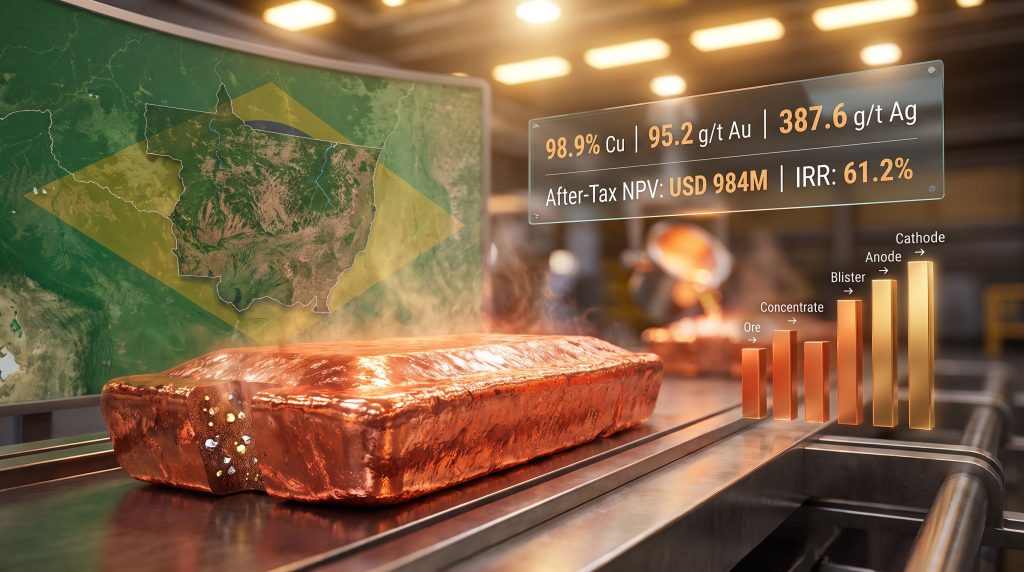
Copper does not move from ore to refined metal in a single step. The processing hierarchy follows a well-defined sequence: sulphide ore is crushed and floated to produce concentrate, concentrate is smelted to produce blister copper, blister is refined into anodes, and anodes are electrolytically refined into cathode copper — the exchange-deliverable product that underpins global copper pricing.
Blister copper, grading typically between 98.0% and 99.5% Cu, represents the critical commercial inflection point in this chain. It is the stage at which concentrate buyers (smelters) make their most consequential assessments about a project's commercial viability. The reason is straightforward: impurities that survive into the blister stage create cascading complications in the anode refinery, generating penalty charges, reducing throughput efficiency, and in some cases triggering outright rejection of feed material.
The economics are expressed through treatment charges and refining charges (TC/RC), which smelters levy against concentrate producers. Projects supplying clean, low-impurity concentrates that convert efficiently into high-grade blister negotiate materially better TC/RC terms. In a market where TC benchmarks have been volatile, this distinction can translate directly into tens of millions of dollars over a mine's operating life. For a broader view of what's driving these dynamics, the ongoing copper supply crunch offers important context.
The Minor Element Problem: Why Impurities Matter More Than Grade
A widely underappreciated aspect of copper smelting economics is that a concentrate's headline copper grade is only one dimension of its commercial value. The concentrations of so-called minor elements — arsenic, bismuth, antimony, lead, and others — often determine more of the project's effective revenue than the copper grade itself.
Smelters impose penalty clauses when minor element thresholds are exceeded, and these penalties can be steep. Arsenic, in particular, has become a growing concern as South American porphyry deposits yield higher-arsenic concentrates. Projects delivering feeds with very low minor element profiles are increasingly sought after, commanding better payability terms and stronger smelter relationships.
The commercial significance of minor element impurity levels is frequently underestimated in project economics discussions. For a long-life copper mine, the compounding effect of superior payability terms versus penalty-laden terms over a decade of production can represent a project-value differential that rivals early-stage resource upgrades.
Meridian Mining Cabaçal Copper Blister Results: What the Testwork Revealed
The Meridian Mining Cabaçal copper blister results were produced through laboratory-scale smelting and conversion trials conducted at Kingston Process Metallurgy (KPM) in Ontario, Canada — an independently recognised metallurgical testing facility with established credibility in copper pyrometallurgy. Critically, the testwork used actual sulphide concentrate samples derived from the Cabaçal project in Mato Grosso, Brazil, not synthetic blends or surrogate materials.
This distinction matters considerably. Using real project concentrates under conditions representative of commercial smelting operations means the results reflect actual project behaviour, not theoretical performance. The high recovery rates of copper, gold, and silver into the blister phase confirm that Cabaçal's concentrates convert efficiently through standard pyrometallurgical processing. Various copper processing methods have been assessed across the industry, and Cabaçal's results stand out by any measure.
Headline Metallurgical Outcomes
| Metric | Cabaçal Blister Result | Industry Typical Benchmark |
|---|---|---|
| Copper Grade (Blister) | 98.9% Cu | ~98.0–98.5% Cu (standard anode) |
| Gold Retention | 95.2 g/t Au | Variable; often lower in impure feeds |
| Silver Retention | 387.6 g/t Ag | Variable; dependent on feed quality |
| Minor Element Impurities | Very low (below anode standard) | Higher in typical commercial blister |
| Copper Recovery to Blister | High (consistent with ~94% prior testwork) | 85–95% range commercially |
The 98.9% Cu blister grade exceeds the typical range for standard commercial anodic copper, placing Cabaçal's output at the premium end of the blister quality spectrum. The retained precious metal values are especially notable: 95.2 g/t Au and 387.6 g/t Ag within the blister phase represent substantial value that carries through to the anode refining stage, where gold and silver are recovered as additional revenue streams.
How These Results Build on Earlier Cabaçal Metallurgical Work
The 2026 blister confirmation does not exist in isolation. Preliminary metallurgical testwork conducted in 2022 had already demonstrated approximately 94% copper recovery and 87% gold recovery through the flotation circuit. The 2026 smelting trials represent a step-change advance: moving from flotation recovery data to full pyrometallurgical conversion confirmation closes one of the most significant technical risk gaps in the project's development pathway.
For investors and lenders evaluating Cabaçal, this progression from flotation through to blister-grade confirmation validates the entire upstream metallurgical flowsheet. It is no longer a project with promising concentrate grades — it is a project with independently confirmed, commercially premium blister output. Indeed, smelter tests confirm the high quality of this blister copper from Cabaçal concentrates.
Cabaçal Project Fundamentals: Scale, Geology, and Economics
VMS Geology and Why It Matters
Cabaçal is classified as a Volcanogenic Massive Sulphide (VMS) copper-gold-silver deposit, located in Mato Grosso State, Brazil. Understanding VMS ore deposits helps explain why these systems have a well-documented global track record of delivering high-grade polymetallic mineralisation with characteristically clean metallurgical profiles — a geological trait that aligns directly with the low-impurity blister results now confirmed through testwork.
Unlike porphyry copper deposits, which tend to be large-tonnage, lower-grade systems often associated with elevated arsenic and other deleterious elements, VMS deposits typically deliver tighter, higher-grade mineralisation with cleaner concentrate chemistry. This geological distinction is not incidental — it is a structural reason why Cabaçal's concentrate quality outperforms many of its porphyry-sourced peers from Chile and Peru.
The broader Cabaçal VMS belt context adds a dimension that single-mine economic analyses tend to underweight. VMS systems characteristically host multiple stacked mineralised lenses across an extended corridor. The belt-scale potential at Cabaçal suggests the initial mine life represents an entry point into what could become a multi-decade production platform, a feature with direct relevance to long-duration off-take contract negotiations.
Resource Base and Economic Parameters
| Parameter | Cabaçal Figure (2026 Update) |
|---|---|
| Measured & Indicated Resource | 70.1 Mt |
| Gold Grade (M&I) | 0.6 g/t Au |
| Copper Grade (M&I) | 0.3% Cu |
| Silver Grade (M&I) | 1.3 g/t Ag |
| After-Tax NPV (2025 PFS) | USD 984 million |
| IRR (2025 PFS) | 61.2% |
| Average Annual Production | ~141,000 gold-equivalent ounces |
| Mine Life Indicated | 10+ years (initial mine) |
A USD 984 million after-tax NPV at a 61.2% IRR positions Cabaçal as an unusually high-return copper development asset by any global benchmark. For context, copper development projects achieving IRRs above 30–40% at feasibility stage are considered exceptional. A 61.2% IRR at the Pre-Feasibility Study level suggests robust economic resilience across a wide range of copper price and cost scenarios.
How Premium Blister Quality Reshapes Commercial and Financing Dynamics
The Off-Take Negotiation Advantage
Global smelting capacity has become increasingly selective about concentrate quality. The phenomenon sometimes described within industry circles as the dirty concentrate problem refers to the growing prevalence of high-impurity feeds from ageing deposits — feeds that create processing complications, raise environmental compliance costs, and reduce smelter profitability. Smelters managing these constraints naturally prioritise securing clean feed supply from development-stage projects with confirmed low-impurity profiles.
Cabaçal's commercial positioning, as articulated through the metallurgical programme, targets a specific and highly valued market niche:
- High copper purity in the concentrate-to-blister conversion pathway
- Strong payable gold and silver credits that enhance effective revenue per tonne
- Very low minor element impurity levels that minimise penalty exposure
- Appropriate sulphur content aligned with smelter acid production requirements
This combination is not easily replicated. Projects entering off-take discussions with blister-grade confirmation, rather than concentrate-only data, occupy a materially stronger negotiating position. Smelters can independently verify the product's commercial behaviour rather than relying solely on concentrate assay projections.
Implications for the Definitive Feasibility Study
The definitive feasibility study is targeted for completion in Q4 2026, with project financing preparation described as well advanced ahead of that milestone. The timing of the blister results is strategically significant: metallurgical confirmation at this stage directly feeds into DFS assumptions around smelter payability rates, revenue modelling, and off-take contract structuring.
From a technical risk perspective, metallurgical performance is one of the most common sources of DFS-stage downward revisions in copper project valuations. Confirming blister quality ahead of DFS completion removes a key uncertainty variable from lender due diligence, reducing the risk premium that debt financiers might otherwise apply to the project's capital cost structure.
What Premium Product Quality Means for Project Financing
Project financing for copper-gold assets at Cabaçal's scale typically involves a combination of senior debt, streaming arrangements, and potentially royalty financing. Each of these funding sources is influenced by demonstrated product quality in distinct ways:
- Senior debt lenders focus on revenue certainty and off-take commitment quality. Confirmed blister-grade output strengthens the likelihood of securing firm off-take terms, which in turn supports debt service coverage ratios.
- Streaming counterparties — typically precious metals streaming companies — evaluate the gold and silver payability profile with particular scrutiny. Cabaçal's 95.2 g/t Au and 387.6 g/t Ag blister retention values provide a strong foundation for stream pricing discussions.
- Royalty financiers assess long-term revenue sustainability across the mine's operating life and the broader belt. Belt-scale VMS potential and confirmed metallurgical quality both support favourable royalty terms.
The Copper Market Context: Why Timing and Concentrate Quality Converge
Structural Copper Supply Dynamics
The copper market faces a well-documented structural supply deficit driven by accelerating electrification demand — from grid infrastructure expansion to electric vehicle adoption — occurring against a backdrop of constrained greenfield development pipelines. Many of the world's largest copper mines are mature assets with declining grades, meaning new production will increasingly need to come from development-stage projects.
What is less frequently discussed is that smelter capacity faces a quality constraint, not just a volume constraint. As the average impurity profile of global copper concentrate supply worsens, smelters become more willing to pay premium terms for demonstrably clean feeds. Consequently, copper investment strategies that prioritise quality over volume are gaining traction amongst sophisticated investors. This dynamic creates a commercial tailwind for projects like Cabaçal that can deliver verified high-purity product.
Brazil's Emerging Role and the VMS Differentiation
Brazil has historically been overshadowed by Chile and Peru in global copper supply narratives. However, the country's VMS geology in states like Mato Grosso presents a structurally different proposition to the porphyry-dominant South American copper mainstream. VMS deposits in Brazil tend to deliver cleaner metallurgical profiles, higher precious metal by-product credits, and — critically — concentrate chemistry that does not carry the arsenic burden increasingly associated with mature Chilean and Peruvian porphyry sources.
Mato Grosso's established mining infrastructure and regulatory framework provide an additional layer of project execution certainty. The state has a track record of supporting large-scale mining operations, reducing the jurisdictional risk premium that investors typically attach to frontier-jurisdiction development projects.
Polymetallic By-Product Economics: A Structural Cost Advantage
One of the most consequential but underappreciated aspects of Cabaçal's economic profile is the contribution of gold and silver credits to effective copper production costs. In copper project economics, by-product credits from co-produced metals are subtracted from total cash costs to produce a net C1 cost figure — the metric most widely used to assess competitive positioning within the global copper cost curve.
With gold and silver retained at 95.2 g/t Au and 387.6 g/t Ag in the blister phase, and with average annual production of approximately 141,000 gold-equivalent ounces, Cabaçal's by-product credit contribution is substantial. Projects achieving negative or near-zero C1 copper costs through precious metal credits occupy the most defensible position on the global cost curve — a profile that attracts both strategic investor interest and smelter partnership appetite.
The next major ASX story will hit our subscribers first
Frequently Asked Questions: Meridian Mining Cabaçal Copper Blister
What is copper blister and why does it matter for mining projects?
Copper blister is an intermediate pyrometallurgical product containing approximately 98–99% copper, produced by smelting copper sulphide concentrates. It occupies the stage between concentrate and refined copper anode in the processing hierarchy. Projects demonstrating efficient conversion of their concentrates into high-purity blister gain a measurable commercial advantage in smelter negotiations, confirming feed compatibility with standard commercial processing and reducing penalty exposure.
What grade of copper blister did Cabaçal produce in testing?
Laboratory-scale smelting trials at Kingston Process Metallurgy in Ontario, Canada produced blister copper grading 98.9% Cu, with retained precious metal values of 95.2 g/t Au and 387.6 g/t Ag. Minor element impurity levels were confirmed as materially below those of typical commercial anodic copper.
What is the current resource size of the Cabaçal project?
The 2026 updated Measured and Indicated resource stands at 70.1 million tonnes, grading 0.6 g/t Au, 0.3% Cu, and 1.3 g/t Ag.
What are Cabaçal's published feasibility economics?
The 2025 Pre-Feasibility Study reported an after-tax NPV of USD 984 million and an IRR of 61.2%, with average annual production of approximately 141,000 gold-equivalent ounces. Furthermore, the full pre-feasibility study documentation is available for investors seeking detailed project analysis.
When is the Cabaçal Definitive Feasibility Study expected?
The DFS is targeted for completion in Q4 2026, with project financing preparation described as well advanced ahead of that milestone.
What type of deposit is Cabaçal?
Cabaçal is a Volcanogenic Massive Sulphide (VMS) copper-gold-silver system in Mato Grosso, Brazil, situated within a broader VMS belt considered to have multi-decade production potential beyond the initial mine life.
Key Takeaways: What the Cabaçal Blister Result Signals
- Metallurgical de-risking: Full smelting conversion confirmation at laboratory scale validates the processing flowsheet ahead of DFS finalisation
- Commercial positioning: 98.9% Cu blister with low impurities and high precious metal retention creates a differentiated off-take negotiating profile
- Financing catalyst: Premium product quality data strengthens the project's case with senior debt lenders and streaming counterparties
- DFS timeline alignment: Blister results arrive at a critical juncture, feeding directly into Q4 2026 DFS completion inputs
- Belt-scale optionality: Cabaçal's VMS system context extends the commercial case well beyond the initial mine life
- Structural market fit: Clean concentrate chemistry positions Cabaçal advantageously against the global dirty concentrate problem facing smelters
Disclaimer: This article contains forward-looking statements and financial projections sourced from publicly available Pre-Feasibility Study data. These figures are subject to change as the Definitive Feasibility Study progresses. Nothing in this article constitutes financial advice. Investors should conduct their own due diligence and consult qualified financial advisers before making investment decisions.
Further context on Brazil's mining sector developments and Latin American critical minerals projects is available through Brasil Mineral at brasilmineral.com.br.
Want To Be First When the Next Major Copper Discovery Hits the ASX?
Discovery Alert's proprietary Discovery IQ model scans ASX announcements in real time, instantly identifying significant mineral discoveries across copper and 30+ other commodities — turning complex data into actionable opportunities for investors at every level. Explore historic discovery returns to understand what early positioning can mean, then start your 14-day free trial at Discovery Alert to secure your market-leading edge.