July 28, 2026
The Hidden Governance Fault Lines Beneath Every Major Copper Market Forecast
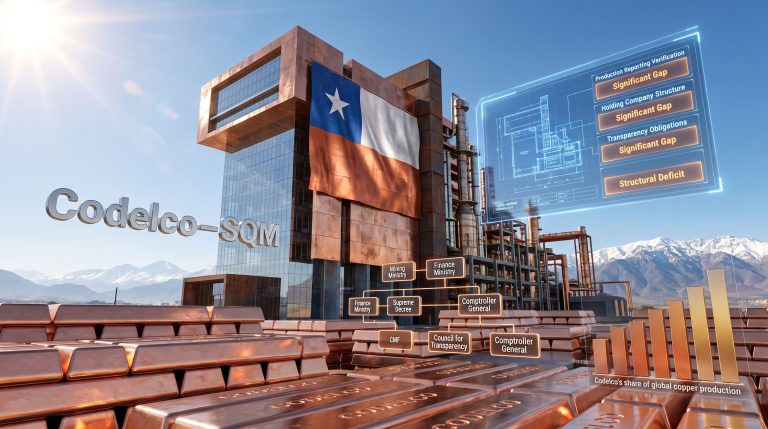
When analysts build copper supply models, they tend to focus on ore grades, capital expenditure cycles, and reserve depletion curves. What gets less attention is the institutional architecture sitting above those mines, specifically the board rooms, ministerial offices, and political cycles that determine whether a project moves forward, stalls, or gets quietly deprioritised. In state-owned mining enterprises, this governance layer is not a peripheral consideration. It is the operational mechanism itself.
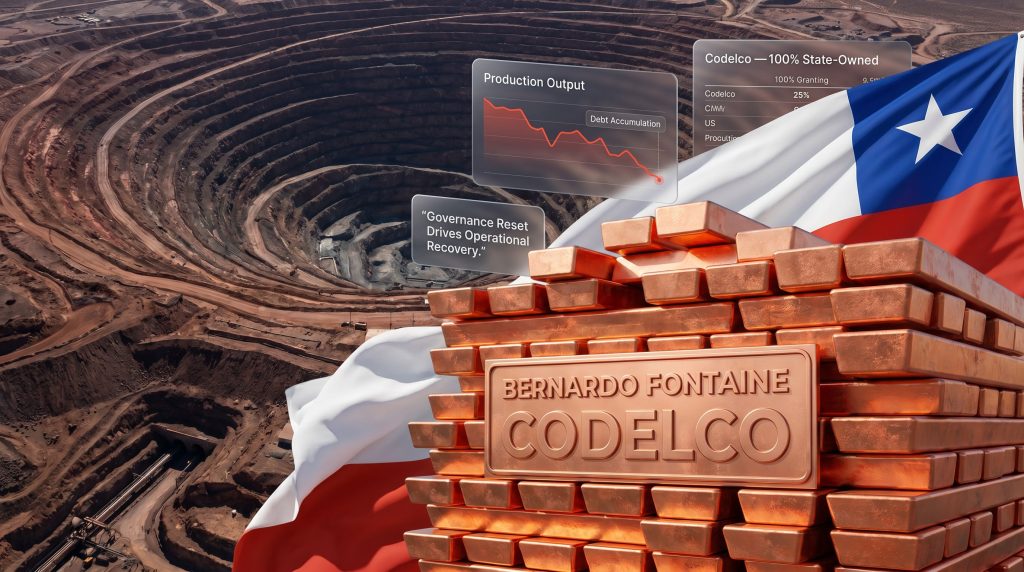
Nowhere is this dynamic more consequential for global commodity markets than at Codelco, the Chilean state-owned copper producer that sits at the heart of global supply chains. When Chile taps a new chair for Codelco, as it did recently with the appointment of Bernardo Fontaine to replace outgoing chairman Máximo Pacheco, the copper market is not simply watching a corporate reshuffle. It is watching a sovereign government recalibrate its most powerful economic instrument.
When big ASX news breaks, our subscribers know first
What Makes Codelco Structurally Unique Among Global Copper Producers
Codelco occupies a category of its own within the global mining industry. As a fully state-owned enterprise, it holds one of the largest copper reserve bases in the world and has historically been among the top copper producers contributing to annual global supply. Unlike publicly listed miners whose strategic direction is shaped by shareholder returns, index inclusion, and quarterly earnings pressure, Codelco answers directly to the Chilean state.
This means its capital allocation decisions, debt management strategies, and long-term mine development timelines are not purely commercial calculations. They are policy decisions, filtered through ministerial oversight and board structures that are themselves expressions of government priorities.
The practical consequence of this structure is significant:
- Board appointments at Codelco carry the same strategic weight as regulatory decisions at central banks
- Changes in board composition signal shifts in government expectations about financial discipline, production targets, or dividend transfers to the state
- International copper buyers, project finance providers, and downstream manufacturers must factor political governance risk into their supply assumptions when sourcing Chilean copper
For a commodity as structurally critical as copper, particularly in the context of electrification infrastructure and energy transition manufacturing, these governance signals carry real market weight.
The Architecture of Chile's Codelco Governance Intervention
Chile's government announced that Bernardo Fontaine would assume the chairmanship of Codelco's board of directors, with the appointment formalised through Chile's mining ministry. Furthermore, according to Reuters, the announcement simultaneously named Luz Granier and Alejandro Canut to the board, replacing former members Josefina Montenegro and Alejandra Wood.
The scope of this intervention is worth examining carefully. Three board positions changed in a single ministerial statement. That is not routine rotation. In governance terms, a simultaneous replacement of the chairman and two directors in one coordinated announcement typically reflects one of two things: either a scheduled end-of-term renewal across multiple seats, or a deliberate reset driven by institutional dissatisfaction with the existing oversight framework.
Given the well-documented financial and operational pressures Codelco has faced in recent years, the latter interpretation carries more analytical weight. The timing and breadth of the reshuffle suggest the Chilean government is seeking a more assertive oversight posture at the board level, not simply filling vacancies. This move is closely tied to Codelco's broader strategy amid global trade tariffs and shifting international market conditions.
Why Political Appointment Cycles Create Unique Governance Risks in Mining
In privately listed miners, poor performance triggers shareholder activism, executive turnover driven by market discipline, and in extreme cases, hostile takeover attempts or forced strategic reviews. These mechanisms are fast, sometimes ruthlessly so, and they operate continuously.
State-owned enterprises operate under a fundamentally different accountability structure. The correction mechanism is political will, which is slower to mobilise, more susceptible to competing priorities, and dependent on electoral cycles and ministerial bandwidth. The result is that governance failures at SOEs tend to accumulate over longer periods before corrective action is taken.
When that corrective action does arrive, as appears to be the case with Codelco's board reshuffle, it often comes as a compressed, multi-position intervention rather than the gradual, performance-driven turnover seen at publicly listed peers. This creates a distinct pattern in SOE governance:
- Extended periods of policy continuity under stable government
- Accumulation of structural or financial issues beneath the surface
- Political threshold breach triggering concentrated governance intervention
- New board inheriting complex legacy problems with limited immediate leverage
This pattern is not unique to Chile. It is observable across state mining enterprises globally, from West African national oil companies to Southeast Asian resource sovereigns.
The Structural Pressures That Built to a Breaking Point
Codelco's challenges did not emerge overnight. The company has been navigating a set of overlapping structural pressures that have compounded over time:
| Pressure Category | Nature of Challenge | Long-Term Implication |
|---|---|---|
| Debt accumulation | Multi-year capital borrowing for large-scale mine development | Constrained reinvestment capacity and rising interest costs |
| Cost overruns | Major underground mine projects exceeding original budget projections | Eroded margins and delayed payback periods |
| Production decline | Output trending below historical peak levels across multiple mines | Reduced global market share for Chilean copper |
| Geological transition | Shift from depleting open-pit reserves to deeper underground operations | Structurally higher per-tonne extraction costs over time |
| Aging infrastructure | Legacy surface infrastructure requiring capital renewal | Compounding maintenance costs alongside development spend |
The geological transition element deserves particular attention, as it is often underappreciated in mainstream copper market commentary. Open-pit mining and underground mining are fundamentally different engineering and economic propositions. Open-pit operations benefit from lower development costs, more straightforward logistics, and generally higher extraction rates.
Underground mining, however, requires ventilation systems, more complex ground support, hoisting infrastructure, and significantly more capital per tonne of ore extracted. Codelco's largest and most historically productive mines are transitioning precisely through this inflection point. The cost curve steepens considerably through this transition, and it arrives at exactly the moment when the company is also servicing substantial debt accumulated from prior capital cycles.
The combination of legacy debt and a capital-intensive geological transition is one of the most demanding financial scenarios a mining company can face. For a state-owned enterprise without equity market access, the pressure lands directly on the government balance sheet.
What Copper Markets Are Actually Watching After This Appointment
The appointment of a new Codelco chairman generates immediate attention in copper markets, but the real analytical question is what happens in the twelve to twenty-four months following the board transition. Three distinct trajectories are plausible, each with meaningful implications for Chile's copper price forecast and broader supply outlooks.
Trajectory One: Governance Reform Translates Into Operational Gains
The new board installs more rigorous financial controls, renegotiates or restructures project delivery frameworks, and begins to demonstrate measurable improvement in cost discipline. Market participants interpret this as evidence of supply trajectory stabilisation. Positive implications for long-term copper price sentiment.
Trajectory Two: Structural Constraints Absorb the Reform Impulse
Even with strengthened governance, the geological and financial constraints facing Codelco prove too deeply embedded for leadership changes alone to redirect. The board reshuffle is symbolically significant but does not materially alter production or cost trajectories within the investment horizon.
Trajectory Three: Political Cycle Instability Compounds Governance Risk
The initial reshuffle triggers subsequent interventions as political priorities evolve, creating strategic discontinuity. Project partners, offtake counterparties, and project finance providers begin pricing in elevated Chilean copper supply uncertainty.
The honest assessment is that elements of all three trajectories may manifest simultaneously in different parts of Codelco's operational portfolio. Large mining enterprises rarely respond uniformly to governance changes.
Comparing Governance Models Across the Global Copper Industry
Understanding how Codelco's governance structure compares to its peer group illuminates why its challenges are structurally different, not simply a matter of management performance.
| Producer | Ownership Structure | Board Accountability | Primary Governance Driver |
|---|---|---|---|
| Codelco | 100% Chilean state | Government-appointed | Political cycles and national policy |
| Freeport-McMoRan | Publicly listed (NYSE) | Shareholder-elected | Equity market discipline |
| BHP Copper Division | ASX/LSE listed | Institutional shareholders | Capital return expectations |
| Rio Tinto Copper | ASX/LSE listed | Institutional shareholders | Portfolio optimisation |
| Antofagasta | LSE listed | Controlling family and institutions | Hybrid commercial and family governance |
The fundamental difference between Codelco and its publicly listed peers is not operational capability. It is the accountability feedback loop. At a publicly listed miner, the board answers to shareholders who can sell shares, agitate for change, or support activist campaigns. The market price provides continuous, real-time governance assessment.
At Codelco, the accountability feedback loop runs through the political system. This is slower, less precise, and heavily influenced by factors entirely unrelated to mining performance. It also means that when corrections do occur, they tend to be reactive rather than anticipatory. Notably, Mining.com has reported extensively on how these dynamics have shaped Codelco's recent strategic decisions.
The Fiscal Dimension: Why Chile Cannot Afford Codelco Underperformance
Codelco serves a dual function in the Chilean economy. It is both a productive industrial enterprise and a fiscal instrument of the state. A portion of Codelco's earnings is transferred directly to the Chilean government, making the company's profitability a matter of national budget planning, not just shareholder returns.
When production declines and debt costs rise simultaneously, these government transfers are compressed. This fiscal pressure creates a direct government incentive to intervene in governance when the company underperforms. The appointment of new leadership is not purely an operational decision. It is also a fiscal one, reflecting the government's interest in restoring the earnings capacity that finances broader national spending priorities.
This intersection of mining governance and national fiscal policy is one of the least discussed but most consequential dimensions of Codelco's strategic position. It means the company operates under a form of dual mandate: produce copper efficiently and generate government revenue.
The next major ASX story will hit our subscribers first
What the Long-Term Copper Supply Story Depends On
Global copper demand is being driven by forces that are structural rather than cyclical. Electrification of transport, expansion of grid-scale renewable energy infrastructure, and the build-out of data centre and industrial electrical systems are creating sustained demand pressure. Furthermore, these demand drivers do not reverse quickly regardless of economic cycle conditions.
On the supply side, execution quality matters enormously. The copper market's ability to meet growing demand depends not just on the existence of ore reserves but on the institutional capacity to bring those reserves into production efficiently and within cost parameters that maintain producer viability. Understanding the full scope of copper market supply trends is consequently essential for any comprehensive assessment of Codelco's position.
Codelco sits at the intersection of these forces. As one of the copper industry's largest individual reserve holders, its operational trajectory has a measurable bearing on whether global copper supply meets, exceeds, or falls short of demand forecasts across the next decade. The ongoing production decline at Codelco further underscores why governance reform that genuinely accelerates project delivery and reduces cost overruns would represent a meaningful positive contribution to supply adequacy.
When Chile taps a new chair for Codelco, therefore, it is not a conclusion. It is the beginning of an observable governance experiment, one that copper market participants across manufacturing, energy infrastructure, and commodity finance will be watching with close attention over the months ahead.
This article is intended for informational purposes only and does not constitute financial advice or a solicitation to trade in any commodity or financial instrument. Forward-looking statements regarding copper market dynamics, Codelco's operational trajectory, and governance outcomes involve uncertainty and should not be treated as predictions or guarantees of future performance. Readers should conduct their own due diligence before making investment decisions.
Want To Stay Ahead Of The Next Major Mineral Discovery On The ASX?
Discovery Alert's proprietary Discovery IQ model delivers real-time alerts on significant ASX mineral discoveries, translating complex mineral data into clear, actionable insights for both short-term traders and long-term investors. Explore historic examples of exceptional discovery outcomes and begin your 14-day free trial today to position yourself ahead of the broader market.