
May 13, 2026
The global copper market stands at a critical juncture where underground mining marvels must evolve to meet unprecedented demand from electrification and renewable energy infrastructure. As traditional surface deposits become depleted and new discoveries increasingly require complex deep-mining operations, the economics of large-scale copper production face fundamental challenges around processing, transportation, and policy frameworks that could reshape international supply chains for decades.
How Deep Underground Mining Will Transform Copper Production Economics
Resolution Copper's geological profile represents one of the most technically challenging copper extraction projects ever attempted in North America. The deposit extends more than 7,000 feet below surface level, requiring underground mining infrastructure that surpasses most existing operations in complexity and capital intensity.
Breaking Down the 40 Billion Pound Production Scale
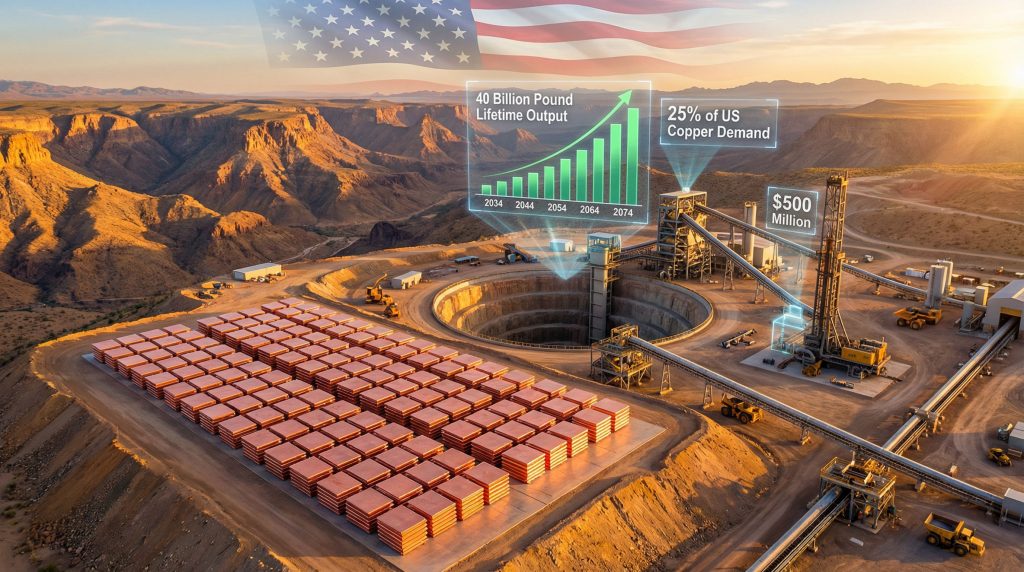
The Resolution Copper mine opening timeline targets the mid-2030s for initial production, with projected lifetime output exceeding 40 billion pounds of copper over multiple decades of operation. This massive scale translates to approximately 18.1 million metric tons of copper concentrate, positioning the project among the world's largest copper resources.
| Production Timeline | Projected Annual Output | Global Demand Percentage |
|---|---|---|
| 2034-2040 (Ramp-up) | 200,000-350,000 tons | 1.0-1.7% |
| 2040-2060 (Peak) | 400,000-500,000 tons | 2.0-2.5% |
| 2060+ (Decline) | 150,000-300,000 tons | 0.7-1.5% |
The project will supply more than 25% of total US copper demand, fundamentally altering domestic supply security and reducing import dependencies that currently exceed 60% of national consumption requirements. Furthermore, this production capacity aligns with record highs in copper prices driven by global electrification trends.
Why Arizona's Geology Creates Unprecedented Extraction Challenges
Underground mining at depths exceeding 7,000 feet presents unique geological and engineering obstacles that significantly impact operational costs and timeline feasibility. The deposit's structure requires sophisticated ventilation systems, specialised ground support technologies, and advanced ore handling mechanisms designed for extreme depth operations.
Critical infrastructure requirements include:
- High-capacity shaft systems capable of transporting equipment and ore from extreme depths
- Advanced dewatering systems to manage groundwater infiltration
- Specialised ventilation networks to maintain air quality and temperature control
- Seismic monitoring systems to ensure structural stability during extraction
Grade variations across the deposit create additional complexity for processing optimisation, with copper content fluctuating based on geological zones and depth levels. This variability directly affects concentrate quality and influences downstream smelting economics.
When big ASX news breaks, our subscribers know first
Which Market Disruptions Could Accelerate or Delay Timeline Execution
The $500 Million Drilling Campaign's Strategic Risk Mitigation
Rio Tinto's commitment to a $500 million exploration programme specifically targets the previously inaccessible 30% of the deposit, representing a critical investment in geological certainty before full development decisions. This comprehensive drilling initiative serves multiple strategic purposes beyond simple resource confirmation.
The exploration campaign addresses fundamental project risks by converting inferred resources into measured categories required for project financing and operational planning.
The drilling programme enables detailed metallurgical testing across different geological zones, providing essential data for processing facility design and concentrate quality projections. This information directly influences treatment charge negotiations with potential smelting partners and export market positioning. Additionally, Rio Tinto has indicated that the project continues advancing through regulatory processes while maintaining environmental compliance standards.
Treatment Charge Crisis Reshaping Smelting Economics
The global copper smelting industry faces an unprecedented economic inversion where treatment and refining charges have turned negative, meaning smelters now pay mines to process concentrate rather than receiving processing fees. This fundamental market disruption creates significant uncertainty around domestic processing viability.
Current smelting economics breakdown:
- Traditional model: Mines pay smelters $50-150 per ton for concentrate processing
- Current reality: Smelters pay mines due to concentrate supply shortages
- Impact on Resolution: Domestic processing becomes economically unviable without policy intervention
The negative treatment charge environment stems from global copper supply forecast constraints combined with excess smelting capacity in Asia, creating arbitrage opportunities for concentrate exports that challenge domestic processing commitments.
How Policy Architecture Will Determine Processing Location Decisions
Tariff Structure Asymmetries Creating Market Distortions
Current US trade policy implements a 50% tariff on semi-finished copper products while exempting copper ores, concentrates, and cathodes from tariff protection. This asymmetric structure creates unintended consequences for domestic smelting viability.
Policy intervention scenarios under consideration:
- Price floor mechanisms for treatment and refining charges
- Import tariffs on copper cathode to protect domestic smelting margins
- Export restrictions on copper concentrate to ensure domestic processing
The existing tariff framework fails to address the fundamental economics driving negative treatment charges, leaving domestic smelters without viable revenue models despite protective measures on finished products. However, potential tariff economic impacts could reshape these dynamics significantly.
Strategic Mineral Classification and National Security Implications
Copper's designation as a critical mineral for national security creates potential policy pathways for enhanced domestic processing support. Defense industrial base requirements increasingly emphasise supply chain resilience for copper-intensive technologies including electrical infrastructure, renewable energy systems, and defence applications.
Critical infrastructure dependencies requiring secure copper supply:
- Electrical grid modernisation and expansion projects
- Electric vehicle charging infrastructure deployment
- Wind and solar installation programmes
- Military and aerospace manufacturing requirements
Resolution Copper's domestic production capacity could significantly reduce strategic vulnerabilities associated with import dependencies from politically unstable regions.
What Regional Economic Transformation Will Emerge
Market Share Displacement Across North American Operations
Resolution Copper mine opening will fundamentally restructure North American copper market dynamics by displacing import volumes and potentially affecting existing domestic operations. The project's scale exceeds most current North American mines by significant margins.
| Major North American Copper Mines | Annual Production | Remaining Mine Life | Ownership Structure |
|---|---|---|---|
| Kennecott (Utah) | 180,000 tons | 20+ years | Rio Tinto (100%) |
| Morenci (Arizona) | 400,000 tons | 15+ years | Freeport-McMoRan (72%) |
| Resolution (Projected) | 450,000 tons | 40+ years | Rio Tinto (55%), BHP (45%) |
Integration Opportunities with Existing Infrastructure
Rio Tinto's existing Kennecott operation in Utah provides potential synergies for Resolution Copper development, particularly around smelting capacity utilisation and concentrate blending opportunities. However, current smelting economics challenge the viability of this integration strategy.
The Kennecott smelter represents one of only two remaining copper smelting facilities in the United States, alongside Freeport-McMoRan's operation. Recent operational challenges at Kennecott, including safety-related shutdowns affecting underground operations, highlight the risks associated with limited domestic processing capacity.
Which Capital Deployment Strategies Will Shape Development Phases
Phased Investment Approach Through Mid-2030s
Resolution Copper development requires massive capital expenditure spanning multiple phases from initial infrastructure through full production capacity. The phased approach allows risk mitigation and staged financial commitments based on market conditions and regulatory approvals.
Capital deployment priorities include:
- Shaft infrastructure development – Primary access and ventilation systems
- Underground development – Tunnel networks and extraction zones
- Processing facility construction – Concentrator and ancillary equipment
- Transportation infrastructure – Rail and road connections for concentrate shipment
- Water management systems – Critical for Arizona operations
Revenue Generation Modelling Under Commodity Price Volatility
Copper price volatility significantly impacts project economics, with break-even analysis indicating viability across a broad range of price scenarios. Long-term copper demand projections from electrification trends support sustained higher price levels compared to historical averages.
Hypothetical revenue scenarios:
- Conservative ($8,500/ton): Generates positive cash flow with extended payback periods
- Base case ($10,000/ton): Supports full development financing and target returns
- Optimistic ($12,000/ton): Enables accelerated development and enhanced shareholder returns
Consequently, the project's financial viability appears robust across various market conditions, particularly when considering Australia–Canada copper investment trends indicating sustained high-value opportunities in the sector.
How Global Supply Chain Dependencies Will Shift
Import Substitution Effects on Trade Flows
Resolution Copper production will substantially reduce US reliance on South American copper imports, which currently represent the largest source of foreign supply. Transportation cost advantages favour domestic production over long-distance shipping from Chile and Peru.
Industries experiencing the most significant supply chain benefits:
- Electrical grid infrastructure – Reduced supply chain risk for transmission projects
- Electric vehicle manufacturing – Domestic sourcing for battery and motor components
- Renewable energy installations – Secure copper supply for wind and solar projects
- Construction and building – Stable pricing for electrical wiring and plumbing applications
Export Market Development Potential
Despite domestic processing preferences, economic realities may drive significant concentrate exports to Asian smelters offering competitive treatment charges. This scenario creates opportunities for value-added processing development while maintaining export optionality.
Potential export markets include Japanese, Chinese, and Korean smelting facilities with excess capacity and established concentrate purchasing agreements. Export infrastructure development requires specialised port facilities and transportation logistics for concentrate handling.
The next major ASX story will hit our subscribers first
What Risk Factors Could Still Derail Operational Timeline
Remaining Regulatory and Environmental Hurdles
Environmental permitting processes continue to present timeline risks, particularly around water usage approvals and wildlife habitat protection measures. Arizona's arid climate creates specific challenges for water management that require comprehensive mitigation strategies.
Community relations with the San Carlos Apache tribe represent ongoing considerations despite legal resolution of the land exchange dispute. Cultural sensitivity and environmental stewardship remain critical factors for social licence to operate. Moreover, mining industry reports suggest that Rio Tinto continues navigating complex stakeholder relationships while advancing development plans.
Technical and Operational Complexity at Depth
Deep underground mining operations face inherent technical risks that can cause significant delays and cost overruns. Comparative analysis of similar depth operations globally indicates higher-than-average risk profiles for schedule adherence and budget control.
Case study insights from comparable deep copper operations:
- Oyu Tolgoi (Mongolia): Experienced multi-year delays and cost escalations exceeding $2 billion
- Chuquicamata Underground (Chile): Required extensive technical modifications during development
- Resolution lessons learned: Emphasise thorough geological characterisation and conservative scheduling
Safety considerations become exponentially more complex at extreme depths, requiring specialised equipment, enhanced emergency response capabilities, and comprehensive worker protection systems.
How Market Dynamics Will Respond to Mid-2030s Production Start
Price Stabilisation Potential Through Supply Security
Resolution Copper mine opening coincides with projected global copper supply deficits driven by electrification demand growth. Domestic production capacity reduces geopolitical risk premiums embedded in copper pricing and provides supply security for critical infrastructure projects.
Market modelling suggests that Resolution's production could moderate copper price volatility by reducing supply concentration in politically unstable regions and providing hedge against international trade disruptions.
Strategic Positioning for Energy Transition Acceleration
The timing of Resolution Copper mine opening aligns with peak demand periods for renewable energy infrastructure deployment and electric vehicle adoption scaling. Copper demand from energy transition applications is projected to grow at 5-7% annually through the 2030s.
When will Resolution Copper actually start producing?
Production timeline targets the early to mid-2030s, contingent on completion of the $500 million drilling programme and final development decisions.
How much copper will it produce annually?
Peak annual production is projected at 400,000-500,000 metric tons, making it one of North America's largest copper mines.
What makes this mine strategically important?
Resolution will supply over 25% of US copper demand, reducing import dependencies and providing supply security for critical infrastructure.
Will all copper stay in the United States?
Economic feasibility of domestic smelting depends on policy interventions to address negative treatment charges; export scenarios remain under consideration.
Resolution Copper mine opening represents a transformational development for North American copper supply security, though successful execution depends on resolving complex technical, economic, and policy challenges over the next decade. The project's scale and strategic importance position it as a cornerstone of domestic critical mineral supply chains supporting energy transition and infrastructure modernisation goals.
This analysis is based on publicly available information and industry projections. Actual outcomes may vary significantly based on market conditions, regulatory decisions, and operational execution. Investors should conduct independent research and consider risk factors before making investment decisions.
Ready to Invest in the Next Major Copper Discovery?
Discovery Alert instantly alerts investors to significant ASX mineral discoveries using its proprietary Discovery IQ model, turning complex mineral data into actionable insights. Understand why historic discoveries can generate substantial returns by exploring Discovery Alert's dedicated discoveries page, showcasing examples of exceptional market outcomes, and begin your 14-day free trial today to position yourself ahead of the market.