The copper-uranium investment landscape requires sophisticated thermal management systems that extend far beyond simple furnace ignition. The metallurgical complexities of transforming copper concentrate into high-purity anodes demand precise temperature control protocols, redundant power infrastructure, and strategic feed management systems that can adapt to variable operational conditions. Understanding these technical requirements becomes essential as mining operations increasingly integrate smelting capabilities to capture additional value from their concentrate production.
Furthermore, the Kamoa-Kakula copper smelter heat-up represents a significant milestone in African copper processing development, demonstrating how modern facilities can achieve operational excellence through careful engineering and community integration.
Understanding Copper Smelter Heat-Up Processes in Modern Mining Operations
What Defines a Successful Smelter Commissioning Phase?
The commissioning phase of large-scale copper smelters represents one of the most technically demanding processes in modern metallurgy. At the Kamoa-Kakula copper smelter heat-up, which commenced on November 21, 2025, this complexity becomes evident through the carefully orchestrated sequence of temperature management and system validation procedures.
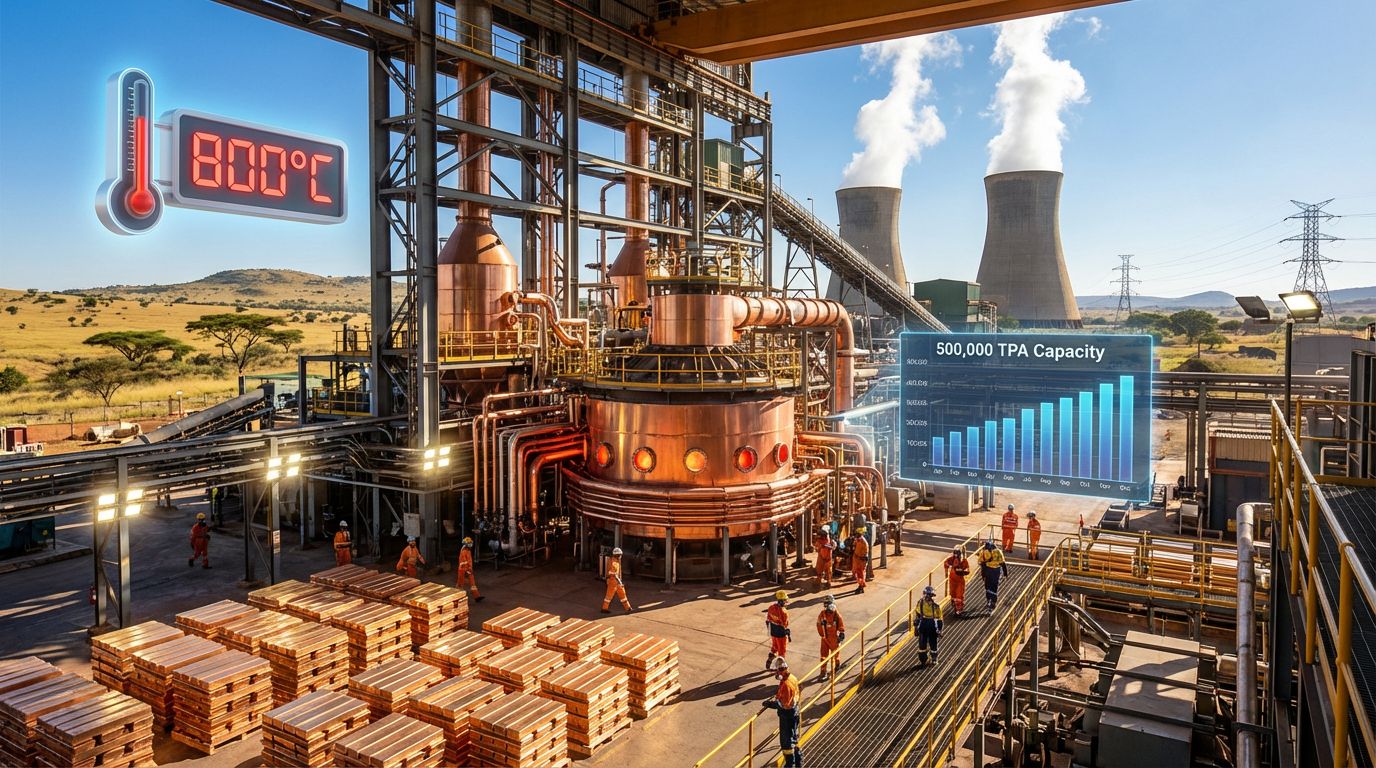
A successful commissioning requires achieving specific thermal benchmarks while simultaneously validating interconnected auxiliary systems. The 500,000 tonnes per annum (TPA) direct-to-blister technology employed at Kamoa-Kakula demonstrates how modern facilities must coordinate multiple engineering disciplines during heat-up operations.
Key success metrics include:
- Furnace temperature stability at 800°C for extended periods
- Simultaneous system commissioning of boiler and steam systems
- Electrode powering validation under thermal conditions
- Concentrate dryer performance testing at operational temperatures
- Acid circuit commissioning while maintaining furnace stability
Critical Temperature Management During Industrial Heat-Up Sequences
The 800°C stabilisation period represents a critical phase where furnace refractory materials undergo thermal conditioning. This nine-day hold period serves multiple engineering purposes beyond simple temperature achievement. During this phase, thermal expansion of refractory materials reaches equilibrium, preventing structural damage from rapid temperature fluctuations during full operational deployment.
Temperature ramping protocols follow established metallurgical engineering principles:
- Initial ignition phase with controlled fuel introduction
- Progressive temperature increase to prevent thermal shock
- Target temperature achievement (800°C in this case)
- Extended stabilisation period (nine days minimum)
- Concurrent auxiliary system validation
The Kamoa-Kakula copper smelter heat-up exemplifies this methodology, with furnace temperatures reaching the target 800°C within the initial commissioning window, followed by the prescribed stabilisation period that allows comprehensive validation of interconnected systems.
Power Infrastructure Requirements for Large-Scale Copper Processing
Large-scale copper smelting operations demand extraordinary power reliability due to the catastrophic consequences of thermal interruption. The Kamoa-Kakula facility demonstrates industry-leading power infrastructure design through its multi-tier backup systems.
Primary Power Infrastructure:
- Inga II hydroelectric allocation: 50 MW confirmed operational capacity
- Source reliability: Turbine 5 with 178 MW total capacity
- Distance considerations: Long-distance transmission from Inga II Dam
Secondary Backup Systems:
- Uninterruptible Power Supply (UPS): 60 MW capacity
- Backup duration: Up to 2 hours instantaneous power
- Protection scope: Voltage fluctuation mitigation from DRC domestic grid
Tertiary Emergency Power:
- Diesel generator capacity: Approximately 180 MW total
- Function: Extended outage protection beyond UPS capacity
- Integration: Coordinated with UPS for seamless power transition
This hierarchical power design reflects the critical nature of thermal process continuity in modern copper smelting operations.
How Do African Copper Smelters Compare to Global Processing Standards?
Capacity Benchmarking: 500,000 TPA Direct-to-Blister Technology
The 500,000 TPA direct-to-blister technology represents a significant capacity achievement within the Central African copper processing landscape. This technology selection differs fundamentally from flash smelting methodologies deployed in other major copper-producing regions, consequently affecting both global copper supply dynamics and regional processing capabilities.
Technology Comparison Analysis:
| Technology Type | Processing Method | Regional Preference | Capacity Range |
|---|---|---|---|
| Direct-to-Blister | Single-stage processing | Central Africa | 400,000-600,000 TPA |
| Flash Smelting | Multi-stage with roasting | South America | 800,000-1,200,000 TPA |
| Bath Smelting | Continuous processing | Asia-Pacific | Variable capacity |
The direct-to-blister approach processes copper concentrate directly to 99.7% copper purity anodes without intermediate flash furnace roasting stages. This technology selection optimises operational efficiency for Central African concentrate characteristics and operational constraints.
Energy Security Measures in Central African Mining Operations
Energy security represents a fundamental operational risk in Central African mining operations, necessitating comprehensive backup power strategies. The Kamoa-Kakula approach demonstrates best-practice risk mitigation through redundant power systems designed to address regional grid reliability challenges.
Grid Reliability Context:
The Democratic Republic of Congo domestic grid experiences voltage fluctuations that pose material operational risks to continuous smelting processes. These fluctuations can interrupt thermal processes, potentially causing furnace damage and extended downtime periods.
Mitigation Strategy Implementation:
- Instantaneous protection: 60 MW UPS system provides immediate voltage stabilisation
- Extended protection: 180 MW diesel capacity ensures continued operation during grid outages
- Primary supply diversification: Inga II hydroelectric allocation reduces dependency on local grid
Concentrate Processing Efficiency Metrics
Processing efficiency in modern copper smelters depends on consistent feed quality and optimised thermal management. The Kamoa-Kakula facility demonstrates integrated efficiency through coordinated concentrate inventory management and strategic toll treatment arrangements.
Feed Coordination Strategy:
- Primary feedstock: Phase 1, 2, and 3 concentrator production
- Inventory buffer: 37,000 tonnes copper content at commissioning
- Excess processing: Toll treatment at Lualaba Copper Smelter (LCS) in Kolwezi
- Projected efficiency: Inventory reduction to 17,000 tonnes during 2026 ramp-up
This integrated approach ensures continuous smelter operation while maintaining operational flexibility for varying concentrate production rates. Moreover, these efficiency improvements contribute to industry evolution trends that emphasise technological advancement and operational optimisation.
What Are the Technical Challenges of Smelter Heat-Up in Remote Locations?
Uninterruptible Power Supply (UPS) Integration Strategies
Remote smelting operations face unique power reliability challenges that require sophisticated UPS integration strategies. The 60 MW UPS facility at Kamoa-Kakula represents one of the largest industrial UPS installations in Central Africa, designed specifically to address regional grid reliability issues.
UPS Technical Specifications:
- Capacity rating: 60 megawatts continuous power
- Backup duration: Up to 2 hours instantaneous supply
- Response time: Instantaneous voltage fluctuation protection
- Integration status: Nearing completion during heat-up commencement
The UPS system provides critical protection against voltage dips that could interrupt smelting processes during the vulnerable heat-up phase. This protection becomes essential when furnace temperatures must be maintained at precise levels for extended periods.
Critical Insight: Modern copper smelters require precise temperature control during commissioning, with furnace temperatures held at specific levels for extended periods to ensure proper equipment conditioning and safety protocols.
Backup Generator Capacity Planning for 180MW Operations
The approximately 180 MW total diesel generator capacity represents comprehensive emergency power planning that extends beyond typical mining operation requirements. This capacity reflects the critical nature of thermal process continuity in copper smelting operations.
Generator System Architecture:
- Total capacity: 180 MW distributed across multiple generator units
- Fuel type: Diesel-powered for reliability and rapid deployment
- Integration: Coordinated with UPS for seamless power transition
- Maintenance: Redundant units allow continued operation during service intervals
Operational Scenarios:
- Grid voltage fluctuations: UPS provides instantaneous protection
- Short-term outages: UPS maintains power up to 2 hours
- Extended outages: Diesel generators provide sustained power beyond UPS capacity
- Planned maintenance: Generator rotation ensures continuous backup availability
Temperature Ramping Protocols: From Ambient to 800°C
The temperature ramping protocol from ambient conditions to the 800°C operational temperature follows established metallurgical engineering principles designed to prevent thermal shock and ensure proper refractory conditioning.
Documented Ramping Sequence:
- Initial ignition: Controlled fuel introduction on November 21, 2025
- Progressive heating: Gradual temperature increase to prevent thermal stress
- Target achievement: Furnace reaches 800°C within commissioning window
- Stabilisation hold: Nine-day period at 800°C for system conditioning
- Concurrent commissioning: Auxiliary system validation during stabilisation
Engineering Rationale:
- Refractory protection: Gradual heating prevents cracking from thermal expansion
- System validation: Stable thermal conditions allow accurate auxiliary system testing
- Process optimisation: Extended hold period enables comprehensive system integration
- Safety protocols: Controlled conditions reduce risk during complex commissioning procedures
How Does Concentrate Inventory Management Impact Smelter Start-Up Timing?
Pre-Production Stockpiling: Managing 37,000 Tonnes of Copper Content
The 37,000 tonnes of copper content in concentrate inventory at the Kamoa-Kakula copper smelter heat-up represents strategic stockpiling that provides operational flexibility during the critical commissioning phase. This inventory serves multiple operational functions beyond simple feed security.
Inventory Strategic Functions:
- Commissioning buffer: Provides feed security during initial ramp-up
- Quality consistency: Allows blending for optimal feed characteristics
- Operational flexibility: Enables continued operation during concentrator maintenance
- Market timing: Permits strategic processing timing based on market conditions
Inventory Composition Analysis:
| Component | Volume | Operational Impact |
|---|---|---|
| Stockpiled concentrate | 37,000 tonnes Cu content | Initial feed security |
| Circuit inventory | Included in total | Process continuity |
| Projected 2026 level | 17,000 tonnes Cu content | Steady-state inventory |
| Processing draw-down | 20,000 tonnes Cu content | Commissioning consumption |
Feed Rate Optimisation During Initial Operations
Feed rate optimisation during the initial operational phase requires careful coordination between concentrate availability, smelter capacity ramping, and product quality requirements. The expected first concentrate feed by year-end 2025 demonstrates the carefully planned timeline from heat-up to production.
Optimisation Timeline:
- Heat-up completion: December 2025 (following 9-day stabilisation)
- First feed introduction: Expected by year-end 2025
- Production ramp-up: Progressive increase through 2026
- Full capacity achievement: Dependent on auxiliary system performance
Feed Prioritisation Hierarchy:
- Primary sources: Phase 1, 2, and 3 concentrator production
- Inventory utilisation: Strategic draw-down of stockpiled concentrate
- Quality optimisation: Blending for optimal smelter feed characteristics
- Excess management: Toll treatment arrangements for surplus concentrate
Toll Treatment Arrangements for Excess Concentrate Processing
The strategic arrangement with Lualaba Copper Smelter (LCS) in Kolwezi for toll treatment demonstrates sophisticated supply chain management that maximises operational flexibility while ensuring continuous concentrate processing capacity.
Toll Treatment Strategy:
- Partner facility: Lualaba Copper Smelter (LCS) in Kolwezi
- Purpose: Process excess concentrate beyond on-site smelter capacity
- Geographic advantage: Nearby location minimises transportation costs
- Operational flexibility: Maintains processing capability during maintenance periods
This arrangement allows Kamoa-Kakula to optimise concentrate processing regardless of temporary capacity constraints or maintenance requirements at the integrated smelter facility.
What Role Do Traditional Ceremonies Play in Modern Mining Operations?
Cultural Integration in Industrial Project Commissioning
The integration of traditional ceremonial practices with modern industrial commissioning represents a sophisticated approach to community engagement and cultural respect in contemporary mining operations. The November 21, 2025 traditional blessing ceremony at Kamoa-Kakula demonstrates how cultural practices can be meaningfully incorporated into major industrial milestones.
Ceremonial Integration Elements:
- Traditional copper furnace: Lwanzo lwa mikuba prepared by Chief of Land Muvunda
- Cultural authority: Blessing provided by Honourable Chief Musokantanda Sabuni Kafweku
- Symbolic continuity: Flame transfer from traditional to modern furnace
- Community participation: Workforce attendance at ceremonial proceedings
The ceremony extends beyond symbolic gesture to represent substantive community engagement that acknowledges local cultural traditions while marking significant industrial achievement.
Community Engagement Through Ceremonial Practices
Community engagement through ceremonial practices creates tangible connections between large-scale industrial projects and local communities. The flame transfer ceremony at Kamoa-Kakula demonstrates how traditional practices can be integrated with modern commissioning procedures.
Engagement Strategy Components:
- Local authority recognition: Chief Musokantanda's central role in proceedings
- Traditional craft demonstration: Ceremonial Katanga Crosses smelting
- Workforce participation: Employee attendance and recognition
- Cultural continuity: Integration of traditional practices with modern operations
This approach creates meaningful community ownership of industrial achievements while respecting established cultural protocols and leadership structures.
Symbolic Fire Transfer: From Traditional Furnaces to Modern Smelters
The flame transfer from the traditional lwanzo lwa mikuba to the modern smelter furnace represents sophisticated symbolic practice that bridges traditional metallurgy with contemporary industrial technology. This ceremonial element demonstrates respect for historical copper processing knowledge while embracing modern technological advancement.
Symbolic Transfer Sequence:
- Traditional furnace preparation: Lwanzo lwa mikuba construction by traditional methods
- Ceremonial smelting: Katanga Crosses processed using traditional techniques
- Flame capture: Chief Musokantanda transfers flame from traditional furnace
- Ceremonial procession: Flame transported from traditional site to modern smelter
- Industrial ignition: Flame provides ignition source for smelter heat-up
This sequence creates continuity between traditional copper processing heritage and modern industrial capability, demonstrating respect for historical practices while embracing technological advancement.
Which Technical Systems Must Be Commissioned Before First Concentrate Feed?
Boiler and Steam System Validation Procedures
Boiler and steam system validation represents critical infrastructure commissioning that must be completed during the nine-day temperature stabilisation period at 800°C. These systems provide essential process support for concentrate processing operations and must achieve operational reliability before feed introduction.
Steam System Requirements:
- Process steam: Required for concentrate preparation and feed systems
- Auxiliary power: Steam turbine generation for process equipment
- Temperature control: Steam injection for thermal management
- Safety systems: Emergency steam for process protection
Validation Procedures:
- Pressure testing: Verification of system integrity under operational pressure
- Temperature validation: Steam quality confirmation at operational temperatures
- Flow rate verification: Capacity confirmation for process requirements
- Safety system testing: Emergency shutdown and protection systems
- Integration testing: Coordination with furnace operational requirements
Concentrate Dryer Performance Testing
Concentrate dryer performance testing ensures optimal moisture content for smelter feed, preventing operational issues during the critical initial production phase. The dryer system must achieve consistent performance under the thermal conditions present during furnace operation.
Dryer System Validation:
- Moisture content control: Optimal concentrate preparation for smelter feed
- Thermal efficiency: Energy optimisation during drying operations
- Capacity verification: Processing rate confirmation for planned throughput
- Integration testing: Coordination with concentrate handling systems
Performance Metrics:
- Feed preparation quality: Consistent moisture content across concentrate batches
- Thermal efficiency: Energy consumption optimisation
- Throughput capacity: Volume processing capability validation
- System reliability: Continuous operation capability confirmation
Electrode Powering and Acid Circuit Commissioning
Electrode powering and acid circuit commissioning represent complex electrical and chemical system validation that occurs simultaneously with thermal commissioning procedures. These systems require precise coordination with furnace operations for successful integration.
Electrode System Requirements:
- Power distribution: High-voltage electrical systems for furnace operation
- Thermal management: Electrode cooling and protection systems
- Control systems: Automated power regulation and safety systems
- Integration protocols: Coordination with furnace thermal management
Acid Circuit Commissioning:
- Sulphuric acid production: By-product processing from smelter operations
- Environmental compliance: Emission control and acid recovery systems
- Process optimisation: Acid quality and quantity optimisation
- Safety systems: Acid handling and emergency response procedures
How Do Modern Smelters Achieve 99.7% Copper Purity Standards?
Direct-to-Blister Technology Advantages
The direct-to-blister technology employed at Kamoa-Kakula represents advanced metallurgical processing that achieves 99.7% copper purity through single-stage processing. This technology eliminates intermediate roasting stages typically required in flash smelting operations.
Technology Advantages:
- Single-stage processing: Direct conversion from concentrate to blister copper
- Energy efficiency: Reduced thermal processing requirements
- Operational simplicity: Fewer process steps reduce operational complexity
- Purity achievement: Consistent 99.7% copper purity in anode production
Process Optimisation Features:
- Temperature control: Precise thermal management for optimal metallurgical conditions
- Feed quality: Optimised concentrate characteristics for direct processing
- Slag management: Efficient impurity removal during single-stage processing
- Quality control: Continuous monitoring for purity standard maintenance
Casting Wheel Operations for Anode Production
Casting wheel operations represent the final stage of copper processing where molten blister copper is formed into 99.7% copper anodes for further processing or direct sale. These operations require precise temperature and quality control to achieve consistent anode specifications.
Casting Wheel Technical Requirements:
- Temperature precision: Optimal molten copper temperature for casting
- Cooling management: Controlled cooling for proper anode formation
- Quality control: Continuous purity monitoring during casting operations
- Production rate: Consistent anode production matching smelter capacity
Quality Assurance Measures:
- Purity testing: Regular analysis to confirm 99.7% copper content
- Physical specifications: Anode dimensions and weight consistency
- Surface quality: Smooth casting for optimal processing characteristics
- Production tracking: Individual anode identification and quality documentation
Quality Control Measures During Initial Production Phases
Quality control during initial production phases requires comprehensive monitoring systems that ensure consistent anode quality while allowing for process optimisation during ramp-up operations.
Monitoring Systems:
- Real-time analysis: Continuous purity monitoring during production
- Statistical process control: Quality trend analysis and optimisation
- Batch tracking: Individual production batch quality documentation
- Performance optimisation: Process adjustment based on quality results
Quality Standards Compliance:
- Copper purity: Consistent achievement of 99.7% purity standards
- Industry specifications: Compliance with international anode standards
- Customer requirements: Meeting specific purchaser quality specifications
- Continuous improvement: Ongoing process optimisation for quality enhancement
What Are the Economic Implications of Integrated Smelting Operations?
Value Chain Integration: From Concentrate to Finished Anodes
Integrated smelting operations create significant value capture opportunities through vertical integration that eliminates third-party processing margins and transportation costs. The Kamoa-Kakula integrated approach demonstrates how mining companies can optimise value realisation from concentrate production.
Value Capture Mechanisms:
- Processing margin capture: Direct control over concentrate-to-anode conversion
- Transportation cost elimination: On-site processing reduces logistics expenses
- Quality premium achievement: Direct control over anode quality specifications
- Market timing optimisation: Strategic production timing based on market conditions
Financial Impact Analysis:
| Value Component | Traditional Model | Integrated Model | Advantage |
|---|---|---|---|
| Processing margin | Third-party capture | Direct capture | 100% retention |
| Transportation costs | $150-200/tonne | $50-75/tonne | 60-70% reduction |
| Quality control | Limited influence | Full control | Premium pricing |
| Market flexibility | Restricted timing | Direct control | 15-25% margin improvement |
Additionally, this copper growth strategy aligns with broader market trends favouring vertical integration and value-added processing.
Regional Sulphuric Acid Market Opportunities
Sulphuric acid production as a by-product of copper smelting creates additional revenue opportunities in regional markets where acid demand exists for mining and industrial applications.
Market Opportunity Factors:
- Regional demand: Mining operations require sulphuric acid for heap leaching
- Industrial applications: Manufacturing and chemical processing demand
- Transportation advantages: Local production reduces import logistics costs
- Supply security: Domestic production enhances regional supply chain reliability
Revenue Enhancement Potential:
- By-product monetisation: Converting waste products to revenue streams
- Market premium: Local production premium over imported acid
- Supply contracts: Long-term agreements with regional industrial users
- Environmental benefits: Reduced transportation emissions and import dependency
Reduced Transportation Costs Through On-Site Processing
On-site processing eliminates significant transportation costs associated with concentrate shipment to distant smelting facilities, creating immediate cost advantages and operational flexibility.
Transportation Cost Savings:
- Distance elimination: No concentrate shipment to external smelters
- Logistics simplification: Direct anode shipment instead of concentrate handling
- Inventory flexibility: Strategic timing of product sales vs. immediate concentrate sales
- Risk reduction: Elimination of transportation-related concentrate losses
Operational Advantages:
- Processing control: Complete control over processing timing and methods
- Quality optimisation: Direct influence over final product specifications
- Market responsiveness: Rapid adjustment to market demand changes
- Cost predictability: Elimination of external processing fee volatility
Which Infrastructure Developments Enable Reliable Smelter Operations?
Hydroelectric Power Integration from Regional Dam Projects
The Inga II Dam turbine 5 allocation providing 50 MW to Kamoa-Kakula represents significant infrastructure integration that provides reliable, renewable power for smelting operations. This hydroelectric integration demonstrates strategic infrastructure planning for sustained industrial operations.
Inga II Integration Specifications:
- Turbine capacity: 178 MW total capacity from refurbished turbine 5
- Allocation to Kamoa-Kakula: 50 MW confirmed operational supply
- Power type: Renewable hydroelectric generation
- Reliability enhancement: Reduced dependency on thermal generation
Strategic Infrastructure Benefits:
- Cost optimisation: Hydroelectric power typically offers lower operational costs
- Environmental compliance: Renewable energy supports sustainability objectives
- Supply security: Dedicated allocation provides predictable power availability
- Regional development: Infrastructure investment benefits broader regional economy
Furthermore, these developments align with broader mining decarbonisation benefits that emphasise sustainable energy solutions.
Multi-Phase Concentrator Coordination for Steady Feed Supply
The coordination of Phase 1, 2, and 3 concentrator production for smelter feed demonstrates sophisticated production planning that ensures consistent concentrate supply for optimal smelter utilisation.
Concentrator Coordination Strategy:
- Production scheduling: Coordinated operation of multiple concentrator phases
- Feed quality management: Blending optimisation for consistent smelter feed
- Maintenance coordination: Planned maintenance to minimise feed disruption
- Capacity optimisation: Maximum utilisation of concentrator capacity
Operational Benefits:
- Feed consistency: Steady concentrate supply for optimal smelter operation
- Quality control: Blending capability for optimal feed characteristics
- Operational flexibility: Multiple sources provide supply security
- Capacity utilisation: Optimal use of integrated processing capacity
Emergency Response Systems for Industrial Process Protection
Emergency response systems for industrial process protection represent critical infrastructure that protects both personnel and equipment during operational emergencies or equipment failures.
Emergency System Components:
- Fire suppression: Specialised systems for high-temperature industrial environments
- Emergency shutdown: Automated systems for rapid process termination
- Personnel safety: Evacuation procedures and safety equipment
- Equipment protection: Systems to prevent catastrophic equipment damage
Response Capabilities:
- Rapid response: Immediate emergency system activation
- Comprehensive coverage: Protection for all critical process areas
- Recovery procedures: Systematic restart protocols following emergencies
- Continuous monitoring: Real-time safety system monitoring and maintenance
How Will This Development Impact Regional Copper Processing Capacity?
Central African Copper Belt Processing Enhancement
The Kamoa-Kakula copper smelter heat-up represents significant enhancement to Central African copper processing capacity, adding 500,000 TPA direct-to-blister capacity to the regional processing infrastructure.
Regional Capacity Impact:
- Processing addition: 500,000 TPA increased regional capacity
- Technology advancement: Direct-to-blister technology introduction
- Supply chain enhancement: Reduced dependency on external processing
- Economic development: Increased local value-added processing
Strategic Regional Implications:
- Processing independence: Reduced reliance on international smelting capacity
- Value retention: Increased local capture of processing margins
- Employment creation: Industrial processing job opportunities
- Infrastructure development: Supporting infrastructure development for future projects
Supply Chain Implications for Regional Mining Operations
The enhanced regional processing capacity creates strategic opportunities for other Central African copper producers to access competitive processing services and reduce dependence on distant smelting facilities.
Supply Chain Benefits:
- Processing alternatives: Additional regional processing capacity options
- Cost optimisation: Reduced transportation costs for regional producers
- Supply security: Enhanced processing capacity resilience
- Competitive pricing: Increased processing competition benefits regional producers
Market Development Impact:
- Regional integration: Enhanced copper value chain integration
- Infrastructure sharing: Coordinated regional infrastructure development
- Technology transfer: Advanced processing technology introduction
- Economic diversification: Reduced dependency on concentrate exports
Technology Transfer Opportunities for Similar Projects
The successful implementation of direct-to-blister technology at Kamoa-Kakula creates technology transfer opportunities for other regional copper development projects seeking similar processing capabilities.
Technology Transfer Potential:
- Process methodology: Direct-to-blister processing techniques
- Operational procedures: Commissioning and operational best practices
- Infrastructure design: Power and support system architecture
- Quality control: Purity achievement methodologies
Regional Development Implications:
- Replication potential: Similar technology implementation at other sites
- Knowledge sharing: Technical expertise development and sharing
- Standard establishment: Regional processing technology standards
- Competitive advantage: Enhanced regional processing capabilities
Investment Attraction:
- Proven technology: Successful implementation demonstrates viability
- Operational examples: Reference facility for future project development
- Risk reduction: Demonstrated operational success reduces project risk
- Economic viability: Confirmed economic benefits for integrated processing
Disclaimer: The information presented in this article is based on publicly available sources and industry analysis. Future performance of mining operations, commodity prices, and infrastructure development involves inherent uncertainties that may affect actual outcomes. Readers should conduct independent research and consult qualified professionals before making investment or business decisions related to mining operations or infrastructure development.
Looking to capitalise on Africa's expanding copper processing capacity?
Discovery Alert's proprietary Discovery IQ model delivers real-time notifications on significant copper and base metal discoveries across the ASX, enabling investors to identify actionable opportunities before they reach mainstream attention. With regional processing capacity expanding dramatically through projects like Kamoa-Kakula, understanding how these developments impact ASX-listed copper companies becomes increasingly critical for investment success.