June 3, 2026
When Chemical Supply Chains Become Copper's Biggest Vulnerability
Most commodity analysts focus on ore grades, mine throughput, and smelter capacity when assessing copper supply risk. Fewer look at sulphur. Yet in 2026, a chemical compound largely absent from mainstream commodity coverage has emerged as one of the most consequential variables in the global copper market, and its disruption is exposing structural fault lines that stretch from the Persian Gulf to the heart of Sub-Saharan Africa.
Understanding why copper supply disruptions and Africa's opportunity are so deeply intertwined in 2026 requires stepping back from price charts and examining the architectural vulnerabilities beneath the market itself. Furthermore, the copper supply crunch unfolding across multiple regions simultaneously has made traditional forecasting models appear inadequate for capturing today's compounding risks.
When big ASX news breaks, our subscribers know first
Three Shocks, One Market, Zero Precedent
The copper market in 2026 is not experiencing a textbook supply-demand imbalance. It is absorbing the simultaneous impact of three distinct shocks, each capable of moving markets independently, but converging in ways that no single forecasting model was designed to handle.
The first shock originated in the Strait of Hormuz. Beginning in late February 2026, military action triggering the closure of the strait halted approximately 40,000 tonnes of copper cathode per month in seaborne trade. More critically for copper producers, the closure severed roughly 50% of the world's seaborne sulphur trade, a disruption that received almost no attention in mainstream commodity coverage but carries profound consequences for mines that extract copper through oxide ore leaching processes.
The second shock unfolded at Grasberg, one of the world's largest copper-molybdenum deposits in Indonesia. PT Freeport Indonesia cut its 2026 production target to 700 million pounds, down sharply from a prior target of 1 billion pounds, following a September 2025 mudslide that forced an immediate halt to extraction. Full operational recovery is now projected for early 2028, extending the disruption timeline well beyond initial estimates.
The third shock was infrastructural. In March 2026, heavy flooding destroyed the Kasumbalesa Bridge on the DRC-Zambia border, cutting off approximately one-third of the DRC's refined copper shipments and stranding thousands of trucks. Simultaneously, election unrest disrupted Tanzania's Port of Dar es Salaam, which typically handles roughly two-thirds of African copper exports to China. Copper was rerouted through Durban, Walvis Bay, and Beira at higher costs and longer lead times.
None of these events was foreseeable in combination. Each represents a different category of risk: geopolitical, geological, and infrastructural. Their convergence in a single calendar year has created a stress test unlike anything the copper market has faced in the modern era.
The Sulphur Famine: A Hidden Input Crisis Most Investors Are Missing
Of the three shocks, the sulphur supply disruption is the least understood and arguably the most structurally significant. To appreciate why, it helps to understand how a meaningful share of global copper production actually works.
Copper is extracted from two primary ore types: sulphide ores and oxide ores. Sulphide processing uses flotation and smelting. Oxide ore processing relies on heap leaching, a method that uses dilute sulphuric acid to dissolve copper from crushed ore. This leaching process accounts for approximately 20% of global copper output. Without sulphuric acid, the ore can sit in the ground but cannot be economically processed.
Sulphuric acid is manufactured from elemental sulphur, the bulk of which is sourced from oil and gas refining operations concentrated in the Persian Gulf. Sub-Saharan African copper producers import approximately 90% of their elemental sulphur from Gulf-region sources. When the Strait of Hormuz closed, that supply chain was severed with no meaningful domestic buffer available anywhere on the African continent.
Chile, the world's largest copper producer, faces a parallel tightening from a different direction: Chinese export restrictions on sulphuric acid have constrained acid availability across South American leaching operations. Consequently, two of the world's largest copper-producing regions are simultaneously facing the same input constraint through different mechanisms.
The cascading operational response for African producers under prolonged disruption follows a predictable hierarchy:
-
Immediate response: Prioritise higher-grade ores to maximise metal yield per unit of acid consumed, preserving production volumes as long as possible.
-
Short-term adaptation: Optimise in-plant acid recovery systems, and begin sourcing alternative sulphur from European refineries or East Asian suppliers at significantly higher freight costs and longer delivery lead times.
-
Prolonged disruption: Idle leaching circuits and declare force majeure on export contracts, resulting in estimated production cuts of 25 to 40% for affected operations.
If the Hormuz closure extends through mid-2026, this third stage becomes an operational reality for a significant portion of African oxide copper production.
Why Copper Prices Have Not Surged: The Demand Compression Paradox
Is the Market Masking Deeper Structural Stress?
Given the scale and simultaneity of these supply disruptions, the natural expectation would be a significant price spike. Yet copper has traded in a relatively narrow range since the disruptions began.
| Metric | Data Point |
|---|---|
| January 2026 peak price | Above $14,000 per tonne |
| Price increase since 2025 | Approximately 40% |
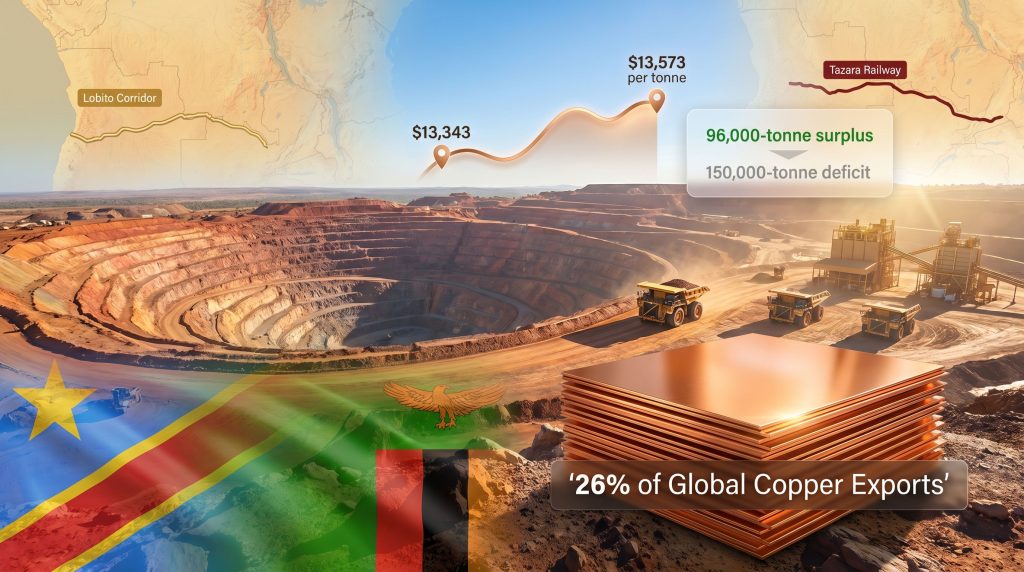
| LME 3-month contract (late February 2026) | $13,343 per tonne |
| LME 3-month contract (May 8, 2026) | $13,573 per tonne |
| World Bank average price increase forecast (2026) | ~21% year-on-year |
| World Bank projected price decline (2027) | ~8% as disruptions ease |
| Reuters sustained price forecast for 2026 | ~$10,500 per tonne |
| Demand destruction threshold | Above $15,000 per tonne |
The explanation lies in what is happening on the demand side. The International Copper Study Group (ICSG) revised its 2026 global mine production growth forecast downward from 2.3% to 1.6%, a clear acknowledgment of supply-side stress. However, the ICSG simultaneously revised its demand growth forecast from 2.1% to 1.6%, as Middle East conflict weakened the broader global economic outlook.
The result is a dramatic reversal in balance projections. The ICSG now forecasts a global refined copper surplus of approximately 96,000 tonnes for 2026, compared to a 150,000-tonne deficit projected as recently as October 2025. Supply disruptions and demand compression are effectively cancelling each other out, leaving prices structurally elevated but momentum-constrained.
This price paradox creates a distinct investment challenge. The usual signal that drives capital toward new copper development, a sustained price surge, is being suppressed even as underlying supply architecture is deteriorating. The market looks stable on the surface while becoming increasingly fragile beneath it.
This condition also exposes a speculative dynamic that contributed to the January 2026 price spike above $14,000 per tonne. The rally was partly driven by a rush among US buyers to secure refined copper ahead of potential tariff implementation, combined with speculative trading activity. When that front-loading demand dissipated, prices retreated despite the ongoing supply disruptions. This demonstrates how short-term financial positioning can temporarily decouple price from physical supply fundamentals. For those exploring copper investment strategies in this environment, understanding this decoupling is critical to avoiding mispriced risk.
Africa's Copper Sector: Strategic Weight Meets Acute Vulnerability
The African Copperbelt supplies over 26% of global copper exports. The Democratic Republic of Congo and Zambia together produce approximately one-sixth of global copper output. Copper accounts for roughly 70% of Zambia's total export revenues, making the sector a sovereign economic pillar rather than merely a commercial enterprise.
The DRC's significance extends beyond copper. The country accounts for approximately 70% of global cobalt production, a material central to lithium-ion battery manufacturing for electric vehicles and stationary energy storage. The Congolese cobalt rivalry between global powers further amplifies the region's strategic relevance to supply chains in ways that pure copper analysis typically underweights.
African producers are theoretically well-positioned to benefit from elevated copper prices. However, the sulphur famine directly undermines their ability to increase output in response to those prices. This creates what might be called a dual-exposure trap: elevated prices represent opportunity, while input supply disruption constrains the ability to capture it. Higher prices may only partially compensate for lower production volumes during prolonged acid shortages.
The Kasumbalesa Bridge collapse adds a logistics layer to this constraint. Even if mines can maintain some processing capacity, the ability to move copper to market has been materially impaired. The simultaneous disruption of both the DRC-Zambia road corridor and Tanzania's primary export port effectively squeezed the African Copperbelt from both the input supply side and the export logistics side at the same time.
The Infrastructure Opportunity: Corridor Competition as Geopolitical Strategy
The logistics disruptions of 2026 have made the strategic case for African export corridor investment impossible to dismiss. Two competing infrastructure corridors are currently reshaping how African copper reaches global markets, and mine-to-port logistics have consequently become a central competitive differentiator for producers navigating this new landscape.
| Corridor | Primary Backer | Committed Investment | Strategic Function |
|---|---|---|---|
| Lobito Corridor | United States / European Union | $553 million (DFC commitment) | Routes copper westward to Atlantic ports, reducing Indian Ocean dependency |
| Tazara Railway | China | $1.4 billion deal | Connects Zambia to Tanzania's Indian Ocean ports |
These competing investments reflect a deeper geopolitical contest over African mineral supply chains. The Kasumbalesa Bridge collapse has made the economic case for corridor redundancy undeniable. A single infrastructure failure eliminating one-third of DRC copper export capacity overnight is not an edge-case scenario — it is a demonstrated reality.
The disruptions have also accelerated a trade reallocation dynamic that was already underway. African producers are increasingly directing copper shipments toward Chinese buyers, who consume more than 50% of global copper, rather than US-bound trade flows. This reallocation creates opportunities for logistics operators, trade finance providers, and port infrastructure investors positioned along Asia-Pacific oriented trade routes.
The next major ASX story will hit our subscribers first
Five Strategic Opportunities the 2026 Disruption Cycle Has Crystallised
Beyond the immediate market dynamics, the convergence of copper supply disruptions and Africa's opportunity has crystallised five specific investment and development vectors worth understanding:
1. Export corridor infrastructure as a geopolitical asset. Projects that create route redundancy and bypass single-point-of-failure logistics architecture will command premium valuations as supply chain resilience becomes a sovereign priority.
2. Domestic sulphuric acid production capacity. The most acute structural vulnerability in African copper mining is its near-total dependence on imported sulphur. Investment in in-continent acid production could fundamentally de-risk African mining operations over a multi-decade horizon, representing a value chain upgrade rather than merely a logistics improvement.
3. Port and logistics resilience. The rerouting through Durban, Walvis Bay, and Beira following Dar es Salaam's disruption created acute congestion at alternative ports. Capacity expansion at these facilities, combined with dynamic rerouting technology, addresses both current bottlenecks and future disruption scenarios.
4. Energy transition structural demand. Copper demand is structurally underpinned by renewable energy grid buildout and electric vehicle battery manufacturing. The energy transition minerals story provides a demand floor that extends well beyond the current geopolitical cycle, meaning supply chain solutions built today address a decade-long opportunity, not merely a cyclical price event.
5. Trade finance and logistics aligned with China. As African producers accelerate reallocation toward Chinese buyers, structured trade finance, insurance, and port logistics investment aligned with China-bound trade routes will access growing deal flow.
Risk Scenarios That Could Limit Africa's Opportunity Capture
Structural opportunity does not automatically translate into captured value. Several risk scenarios could limit Africa's ability to benefit from the current disruption cycle:
-
Prolonged Hormuz closure: If the strait remains closed beyond May 2026, force majeure declarations could reduce African copper production by an estimated 25 to 40% through idled leaching circuits. Prolonged disruption would sustain sulphur famine conditions and eliminate the price premium advantage that elevated-cost alternative sourcing requires to be economically viable.
-
Demand destruction above $15,000 per tonne: Copper prices above this threshold would likely trigger significant demand destruction across construction and consumer electronics sectors, eroding the price support that currently underpins African producer economics.
-
Infrastructure execution delays: Both the Lobito Corridor and the Tazara Railway face implementation timelines measured in years, not months. The Kasumbalesa Bridge collapse illustrates how infrastructure vulnerability can translate into export revenue loss faster than infrastructure can be built.
-
Governance and policy volatility: The DRC's late 2025 halt on artisanal processing created additional supply uncertainty and illustrated how policy decisions can rapidly alter production profiles. Operators who build durable government relationships will hold structural competitive advantages over those exposed to policy volatility.
The Long View: Why the Energy Transition Compresses the Window for Action
The 2026 disruption cycle has exposed something more significant than a short-term supply imbalance. It has revealed that the African Copperbelt's infrastructure, input supply chains, and logistics networks were not designed for the volume demands that energy transition buildout will place on them over the next decade.
Global copper demand from solar energy installations, wind power grids, electric vehicle manufacturing, and battery storage systems is projected to grow substantially through the 2030s. The DRC and Zambia sit atop some of the world's richest copper and cobalt reserves. However, as UNCTAD has highlighted, resource endowment does not automatically convert into supply chain reliability, particularly when structural vulnerabilities remain unaddressed.
The events of 2026 have demonstrated with unusual clarity that the gap between Africa's resource potential and its supply chain resilience is wide, measurable, and investable. Closing that gap requires solving sulphur dependency, infrastructure redundancy, port capacity, and governance stability simultaneously rather than sequentially.
The World Bank's projection of a 21% average copper price increase in 2026, followed by approximately 8% decline in 2027 as disruptions ease, frames the near-term opportunity window. However, the structural case for African copper investment does not depend on 2026 price levels holding. It depends on whether the conditions for capturing decade-long energy transition demand are built now, while the disruption cycle has made the vulnerabilities impossible to ignore.
Whether persistent supply constraints or softening demand ultimately dominate the 2026 copper market remains the central analytical question for the months ahead. What the year has already confirmed is that copper supply disruptions and Africa's opportunity are both irreplaceable and deeply contingent on resolving structural vulnerabilities that no single price cycle can fix on its own. Analysis from SP Global Market Intelligence reinforces this view, noting that supply chain uncertainty for copper miners is now a defining strategic concern rather than a transient operational risk.
This article draws on market analysis and reporting from Ecofin Agency. Readers seeking ongoing coverage of African commodity markets and supply chain developments may find value in exploring analysis from Ecofin Agency and African Mining. This article contains forward-looking statements and price forecasts sourced from third-party institutions including the World Bank and the International Copper Study Group. These projections involve inherent uncertainty and should not be construed as investment advice. Past price performance is not indicative of future results.
Want to Stay Ahead of the Next Major Copper Discovery on the ASX?
Discovery Alert's proprietary Discovery IQ model scans ASX announcements in real time, instantly identifying significant mineral discoveries — including copper — and delivering actionable insights before the broader market reacts. Explore how historic discoveries have generated substantial returns on Discovery Alert's dedicated discoveries page, and begin your 14-day free trial today to position yourself at the forefront of the next major find.