The critical minerals energy transition represents a fundamental shift in how large-scale facilities manage power consumption and generation. Contemporary mining operations require continuous electricity supply to maintain processing equipment, conveyors, and extraction machinery across 24-hour operational cycles. Traditional diesel generators and grid-dependent systems create vulnerabilities through fuel price volatility and supply chain disruptions.
Battery energy storage systems have emerged as the technological bridge between renewable energy generation and industrial power demands. These systems capture excess energy during peak production periods and redistribute power when generation capacity falls below consumption requirements. The underlying electrochemical processes within lithium iron phosphate batteries enable this energy conversion through ion exchange mechanisms that maintain structural stability across thousands of charge-discharge cycles.
Modern industrial facilities increasingly implement hybrid energy architectures combining multiple storage technologies with renewable generation sources. This integration requires sophisticated control systems that monitor grid frequency, voltage stability, and load balancing to optimise energy delivery efficiency. The result represents a departure from conventional power management toward autonomous energy ecosystems capable of operating independently from traditional utility infrastructure.
Core Technology Components of Modern Battery Storage Systems
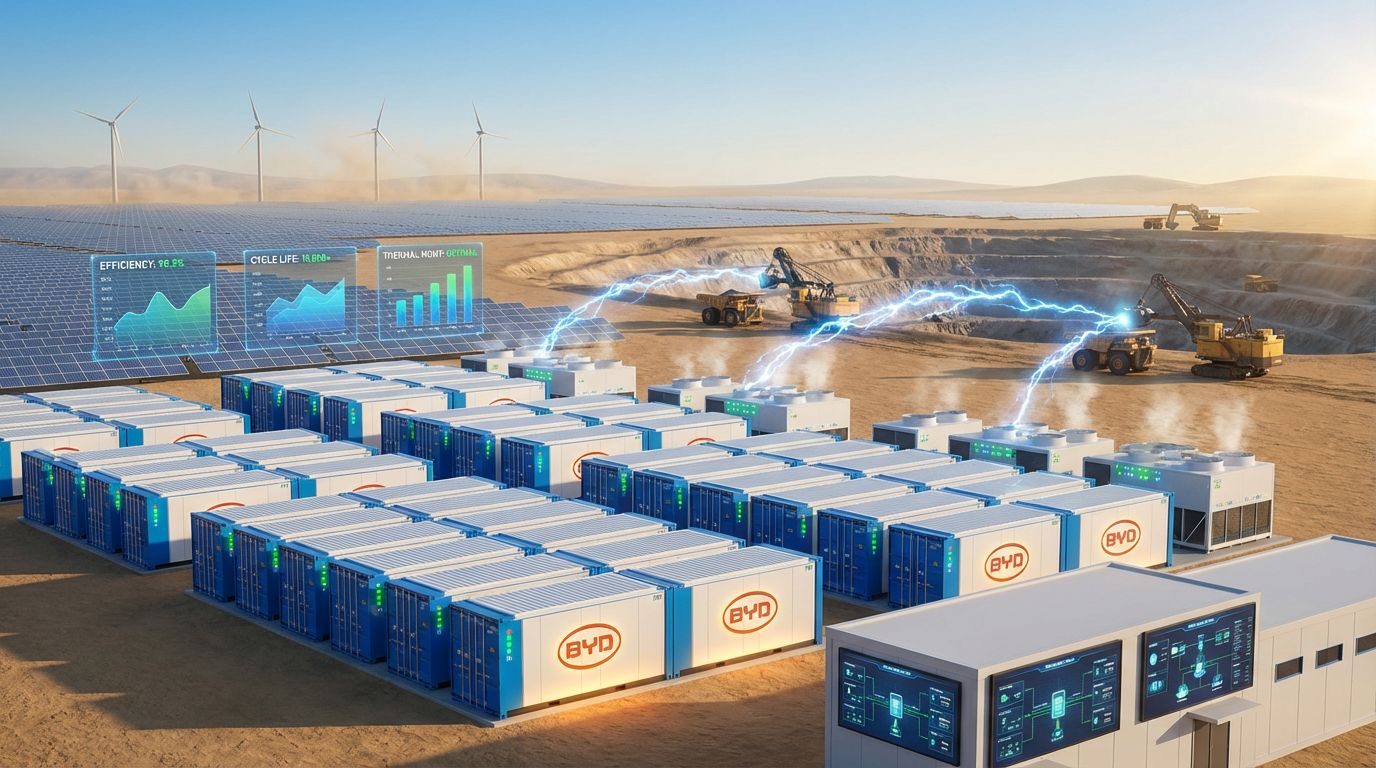
BYD Battery Energy Storage System architecture relies on modular container-based designs that enable scalable deployment across diverse industrial applications. The foundation technology utilises lithium iron phosphate chemistry, which provides enhanced thermal stability compared to conventional lithium-ion alternatives. This chemistry selection directly addresses safety concerns in high-temperature industrial environments where equipment operates continuously under extreme conditions.
The BYD Blade Battery innovation framework incorporates cell-to-system integration that maximises volumetric efficiency while maintaining thermal management capabilities. Fortescue's North Star Junction installation demonstrates this technology through 48 energy storage containers delivering 250MWh capacity with 50MW power output sustained over five-hour periods. This configuration represents one of the largest mining sector deployments globally, establishing performance benchmarks for similar industrial applications.
Advanced thermal management systems integrate liquid cooling technology specifically engineered for Pilbara region conditions, where ambient temperatures frequently exceed 40°C during summer months. The cooling infrastructure maintains optimal operating temperatures across the entire battery array, preventing thermal runaway conditions that could compromise system safety or performance. This engineering approach enables continuous operation under environmental stresses that would degrade alternative battery technologies.
Grid integration capabilities encompass frequency regulation, voltage support, and reactive power compensation functions essential for maintaining electrical system stability. The Pilbara Energy Connect network integration demonstrates how large-scale storage systems provide ancillary services beyond simple energy storage, including grid stabilisation during renewable energy intermittency periods.
| System Component | North Star Junction Specification | Performance Standard |
|---|---|---|
| Total Capacity | 250MWh | Continuous 5-hour discharge |
| Power Output | 50MW | Sustained delivery capability |
| Container Units | 48 modules | Modular scalability |
| Chemistry Type | Lithium Iron Phosphate | Enhanced safety profile |
| Cooling System | Liquid thermal management | Pilbara temperature optimisation |
Industrial Applications and Heavy Industry Requirements
Mining sector energy storage requirements extend beyond typical commercial applications due to the scale and continuity demands of resource extraction operations. Heavy machinery including crushers, grinding mills, conveyor systems, and processing equipment require consistent power delivery to maintain operational efficiency. Interruptions in power supply directly impact production throughput, creating significant economic consequences for mining operations.
BYD Battery Energy Storage System technology addresses these requirements through high-capacity power delivery systems capable of supporting industrial load profiles. The 50MW output capability at North Star Junction provides sufficient capacity to power multiple mining processes simultaneously while maintaining reserve capacity for emergency situations. This power delivery sustained over five-hour periods enables mining operations to maintain productivity during peak demand cycles or grid instability events.
Extreme environment resilience becomes critical in mining applications where equipment operates in harsh climatic conditions including desert temperatures, dust exposure, and humidity fluctuations. The Pilbara region deployment represents one of the most challenging environments globally for electrical equipment, with temperatures exceeding 45°C and significant dust contamination from mining operations. Furthermore, the mining industry evolution demands robust solutions that ensure continued performance under environmental stresses that would compromise conventional energy storage technologies.
Renewable energy integration capabilities enable mining operations to capture solar and wind energy during peak generation periods for deployment during high-demand operational cycles. According to Dino Otranto, Fortescue Metals and Operations Chief Executive Officer, this technology allows operations to store solar power and deploy renewable energy when needed most, significantly reducing diesel and gas consumption across mining sites.
Scalable deployment configurations accommodate varying operational requirements across different mining facilities. Fortescue's planned Eliwana installation features 120MWh capacity, demonstrating system flexibility to match specific site requirements rather than implementing standardised configurations. This adaptability enables mining companies to optimise energy storage investments based on individual facility power consumption patterns and renewable energy generation capacity.
Battery energy storage systems represent fundamental changes in how mining operations manage power consumption, enabling transition from fossil fuel dependency toward renewable energy independence.
Implementation Strategies and Project Development
Large-scale BYD Battery Energy Storage System deployment requires comprehensive project planning encompassing energy demand analysis, site assessment, and grid integration requirements. Mining operations typically consume between 20-200MW during peak processing periods, necessitating detailed load profiling to determine optimal storage capacity and power delivery specifications.
Fortescue's implementation strategy demonstrates phased deployment approaches that balance immediate operational benefits with long-term decarbonisation objectives. The North Star Junction installation serves as the foundation deployment, providing operational experience and performance data to optimise subsequent installations. The 4-5GWh planned rollout over coming years indicates systematic scaling based on proven technology performance rather than speculative deployment.
Container-based deployment methodology enables standardised installation processes while maintaining flexibility for site-specific requirements. The 48-container configuration at North Star Junction provides modular architecture that can be expanded or reconfigured based on changing operational demands. This approach reduces installation complexity and enables faster commissioning compared to custom-built energy storage facilities.
Grid connection infrastructure requires specialised electrical equipment to manage high-voltage integration with existing mining electrical systems. The Pilbara Energy Connect network integration demonstrates how storage systems connect with transmission infrastructure spanning hundreds of kilometres across remote mining regions. Fortescue has constructed 460km of transmission lines as part of the project, establishing grid backbone capacity to support multiple storage installations across different mining sites.
Performance testing and validation protocols ensure systems meet operational requirements before commercial deployment. The North Star Junction installation underwent comprehensive commissioning procedures to verify power delivery capability, thermal management performance, and grid synchronisation functions. This validation process establishes operational parameters for subsequent installations while identifying potential optimisation opportunities.
Environmental impact considerations encompass land use minimisation, noise reduction, and end-of-life battery material management. Container-based systems require minimal site preparation compared to constructed facilities, reducing environmental disruption during installation. In addition, the modular design enables system relocation or expansion without significant infrastructure modifications, supporting the broader mining decarbonisation trends.
Economic Analysis and Financial Benefits
Industrial BYD Battery Energy Storage System deployment generates multiple revenue streams and cost reduction opportunities that improve mining operation economics. Primary economic benefits derive from diesel fuel displacement, as renewable energy storage reduces reliance on fossil fuel generators during peak power demand periods. Mining operations in remote locations typically consume millions of litres of diesel annually for power generation, creating significant fuel cost exposure and supply chain dependencies.
Peak demand charge management represents substantial cost savings opportunities for grid-connected mining operations. Industrial electricity consumers face demand charges based on maximum power consumption during peak rate periods, often comprising 30-50% of total electricity costs. Energy storage systems enable strategic power deployment during high-cost periods, reducing peak demand exposure and lowering overall electricity expenses.
Grid stability service revenue potential exists through ancillary service markets where storage systems provide frequency regulation and voltage support services to utility operators. The 50MW/5-hour capability at North Star Junction positions the system to participate in grid service markets, generating additional revenue streams beyond direct operational benefits. Australian energy markets increasingly compensate storage systems for grid stabilisation services as renewable energy penetration increases system complexity.
Long-term operational economics benefit from extended system lifespan and minimal maintenance requirements compared to diesel generators. Battery energy storage systems typically operate for 15-20 years with gradual capacity degradation, while maintaining consistent performance throughout their operational life. This longevity provides predictable operating costs and eliminates frequent generator maintenance, parts replacement, and fuel system servicing expenses.
Carbon credit monetisation opportunities exist through emissions reduction documentation and participation in carbon offset markets. Mining operations that displace diesel generation with renewable energy storage can quantify emissions reductions and potentially monetise these benefits through carbon credit sales. The scale of Fortescue's 4-5GWh planned deployment represents significant emissions reduction potential that could generate substantial carbon credit revenue over system lifespans.
Return on investment calculations must account for multiple benefit categories including fuel savings, demand charge reductions, maintenance cost avoidance, and potential revenue generation. While specific financial data for the North Star Junction installation remains proprietary, the scale of Fortescue's continued deployment indicates positive economic returns that justify continued investment in storage technology. However, the battery metals investment landscape continues evolving as demand increases.
Performance Monitoring and Operational Management
BYD Battery Energy Storage System operations require sophisticated monitoring and control systems to optimise performance across varying load conditions and environmental factors. Real-time performance tracking encompasses power output measurement, thermal management monitoring, and grid synchronisation verification to ensure continuous operational reliability.
The 250MWh capacity at North Star Junction generates extensive operational data including charge-discharge efficiency, thermal performance, and grid interaction parameters. This data collection enables performance optimisation through operational pattern analysis and predictive maintenance scheduling. Yin Xueqin, General Manager of BYD Energy Storage and New Battery Application, emphasises that BYD systems are engineered for high safety, reliability, and performance standards specifically designed for extreme operating conditions.
Advanced monitoring capabilities integrate with existing mining operation control systems to provide centralised energy management across multiple facilities. The integration with Fortescue's Pilbara Energy Connect network demonstrates how storage systems contribute to broader energy management strategies rather than operating as isolated installations. This system-wide approach enables optimised energy allocation across multiple mining sites based on real-time operational requirements.
How does thermal management monitoring work in extreme conditions?
Thermal management monitoring becomes critical in Pilbara region applications where ambient temperatures and solar radiation create challenging operating conditions for electrical equipment. Liquid cooling systems require continuous temperature monitoring and coolant flow verification to maintain optimal battery operating temperatures. Performance data from these monitoring systems informs operational protocols for similar deployments in extreme climate regions.
Grid synchronisation protocols ensure seamless integration with utility-scale transmission infrastructure while maintaining system stability during renewable energy fluctuations. The storage system must respond to frequency variations, voltage fluctuations, and load changes within milliseconds to provide effective grid support services. This responsiveness requires sophisticated control algorithms that balance energy storage optimisation with grid stability requirements.
Effective performance monitoring systems enable mining operations to maximise energy storage benefits while maintaining operational safety and system longevity under extreme environmental conditions.
Industry Transformation and Market Development
The deployment of BYD Battery Energy Storage System technology in mining applications represents broader industry transformation toward renewable energy integration and operational decarbonisation. Fortescue's commitment to 4-5GWh storage deployment positions the company as a leader in mining sector energy transition, potentially influencing industry-wide adoption of similar technologies.
Mining sector decarbonisation initiatives gain momentum through successful large-scale storage implementations that demonstrate technical feasibility and economic viability. The North Star Junction installation provides operational proof-of-concept for other mining companies evaluating similar technology deployments. This demonstration effect accelerates industry adoption by reducing perceived technology risks and providing performance benchmarks for comparative analysis.
Supply chain localisation strategies become increasingly important as storage system deployment scales globally. BYD's partnership with Fortescue demonstrates how international technology providers establish regional service networks to support large-scale industrial installations. The success of this partnership model influences future deployment strategies and technology vendor selection criteria across the mining industry.
Government policy frameworks increasingly support renewable energy infrastructure investment through incentives, tax credits, and regulatory requirements that favour clean energy technologies. Australian federal and state policies promote mining sector decarbonisation through various mechanisms that improve project economics for storage system deployments. These policy environments accelerate adoption timelines and reduce financial barriers for mining companies evaluating energy storage investments.
Technology cost reduction trends continue improving project economics as battery manufacturing scales globally and competition increases among system integrators. The learning curve effects from large-scale deployments like Fortescue's installation contribute to cost optimisation through operational experience and technology refinement. These cost improvements enable broader industry adoption and support business cases for smaller mining operations.
Emerging applications extend beyond basic energy storage toward comprehensive energy ecosystem integration including electric vehicle charging infrastructure, hydrogen production, and microgrid development. Future mining operations may implement storage systems that support multiple energy applications simultaneously, maximising infrastructure utilisation and economic returns. Consequently, battery recycling solutions become increasingly important as deployment scales.
Risk Assessment and Safety Considerations
Industrial BYD Battery Energy Storage System deployment requires comprehensive risk management protocols addressing fire safety, electrical hazards, and environmental protection measures. Lithium iron phosphate chemistry provides inherent safety advantages through thermal stability and reduced fire risk compared to alternative battery technologies, but industrial-scale installations still require extensive safety systems.
Fire suppression systems incorporate specialised detection and suppression technologies designed for battery installations. These systems must address unique challenges of battery fires including toxic gas generation, reignition potential, and water-based suppression limitations. Advanced suppression systems utilise inert gas flooding or specialised chemical agents that effectively extinguish battery fires without creating additional hazards.
Electrical safety standards encompass high-voltage isolation procedures, arc flash protection, and emergency shutdown protocols essential for maintenance and emergency response activities. The 50MW power capability at North Star Junction requires extensive electrical safety measures including proper lockout-tagout procedures, personal protective equipment requirements, and qualified personnel training programmes.
What environmental containment measures are essential?
Environmental containment systems address potential electrolyte leakage, thermal runaway events, and end-of-life battery material management. Container-based installations provide secondary containment capabilities that prevent environmental contamination during normal operations or emergency situations. These systems also facilitate proper material handling during battery replacement or system decommissioning activities.
System reliability and backup strategies ensure continued mining operations during storage system maintenance or unexpected failures. Redundancy planning incorporates multiple system configurations and backup power sources to prevent single points of failure that could disrupt critical mining processes. The modular container design enables partial system operation during maintenance activities, minimising operational disruptions.
Personnel training programmes provide specialised education covering battery system operations, maintenance procedures, and emergency response protocols. Mining operations must develop competencies in energy storage technology management to safely operate and maintain these systems throughout their operational lifespans. Training requirements encompass electrical safety, chemical hazard awareness, and system-specific operational procedures.
Future Technology Evolution and Development Pathways
BYD Battery Energy Storage System technology continues evolving through research and development initiatives targeting improved energy density, extended operational life, and enhanced safety characteristics. Next-generation battery technologies including solid-state designs promise higher performance specifications and expanded operational temperature ranges suitable for extreme industrial applications.
The Eliwana installation scheduled for early 2026 with 120MWh capacity represents continued technology deployment and operational experience development. This second installation provides comparative performance data and operational insights that inform future system optimisation and deployment strategies. The smaller capacity configuration demonstrates system scalability and application flexibility across different operational requirements.
Integration with emerging technologies expands storage system capabilities beyond basic energy storage toward comprehensive energy management platforms. Future systems may incorporate hydrogen production capabilities, electric vehicle charging infrastructure, and advanced grid services that generate additional revenue streams while supporting mining operation decarbonisation objectives.
Alternative chemistry exploration includes sodium-ion and other emerging battery technologies that could provide cost advantages or performance improvements for specific applications. However, lithium iron phosphate technology currently provides optimal characteristics for industrial applications requiring high safety standards, long operational life, and reliable performance under extreme conditions.
Recycling and circular economy initiatives address end-of-life battery material recovery and reuse strategies. As first-generation industrial storage systems approach end-of-life over the next decade, comprehensive recycling programmes will recover valuable materials including lithium, iron, and phosphate for new battery production. These circular economy approaches reduce environmental impact and improve long-term resource sustainability.
Grid independence capabilities continue expanding as storage capacity increases and renewable generation integration improves. Future mining operations may achieve complete energy independence through comprehensive renewable generation and storage systems that eliminate external electricity purchases. The Cloudbreak Solar Farm at 190MW capacity combined with multi-gigawatt-hour storage systems represents pathways toward complete mining operation decarbonisation and energy independence.
The evolution of battery energy storage technology enables mining operations to transition from fossil fuel dependency toward sustainable energy systems that provide operational and economic advantages while supporting global decarbonisation objectives.
Want to Capitalise on the Battery Storage Revolution?
Discovery Alert's proprietary Discovery IQ model delivers real-time alerts on significant battery metal and energy storage discoveries, instantly empowering subscribers to identify actionable opportunities ahead of the broader market. Discover how major mineral discoveries can generate exceptional returns and begin your 30-day free trial today to secure your market-leading advantage.