August 24, 2026
The Hidden Chokepoint in America's Critical Minerals Strategy
The global race to secure critical minerals is often framed as a competition to control what lies beneath the earth's surface. But that framing misses the most strategically consequential variable entirely. The real contest is not over who can extract ore from the ground, it is over who possesses the industrial infrastructure to transform that ore into usable, high-performance materials. Processing capacity, not mine count, determines which nations can manufacture advanced technologies independently and which remain perpetually dependent on others.
This distinction sits at the heart of the U.S. Department of Energy's current investment posture, and understanding it reshapes how observers should interpret the rapid scaling of DOE funding for U.S. critical minerals processing.
When big ASX news breaks, our subscribers know first
Why Mining Alone Cannot Solve the Supply Chain Problem
The United States possesses substantial in-ground mineral wealth. Significant rare earth deposits, lithium brines, graphite occurrences, and nickel-bearing formations exist across domestic geology. Yet the nation remains structurally dependent on foreign entities, particularly concentrated in Asia, for the conversion of those raw feedstocks into refined, separated, and specification-grade materials that industry can actually use.
This is the midstream bottleneck: the industrial gap that sits between ore extraction and finished material production. It encompasses solvent extraction circuits for rare earth separation, high-temperature reduction processes for magnesium metal, advanced purification systems for battery-grade lithium, and the complex electrochemical refining that produces anode-ready graphite. These are distinct industrial activities requiring purpose-built infrastructure, specialised chemistry, substantial capital investment, and deep process engineering expertise.
The U.S. has historically underinvested in precisely these capabilities. Furthermore, even when rare earths are mined domestically, they have often been shipped offshore for separation and processing before returning as finished materials at significantly higher cost and with added geopolitical exposure. The critical minerals executive order has helped draw renewed attention to this structural weakness.
Key sectors carrying acute vulnerability from this processing gap include:
- Electric vehicle drivetrain components reliant on rare earth permanent magnets
- Grid-scale energy storage systems dependent on processed lithium, graphite, and manganese
- Semiconductor fabrication requiring specification-grade silicon and specialty materials
- Defence systems incorporating rare earth-based guidance, communication, and propulsion technologies
The energy transition has elevated this processing bottleneck from an industrial efficiency problem to a national security concern, and federal investment is now being structured accordingly.
DOE Funding Architecture: From Bench Scale to Commercial Deployment
The $45.7 Million Selection Round
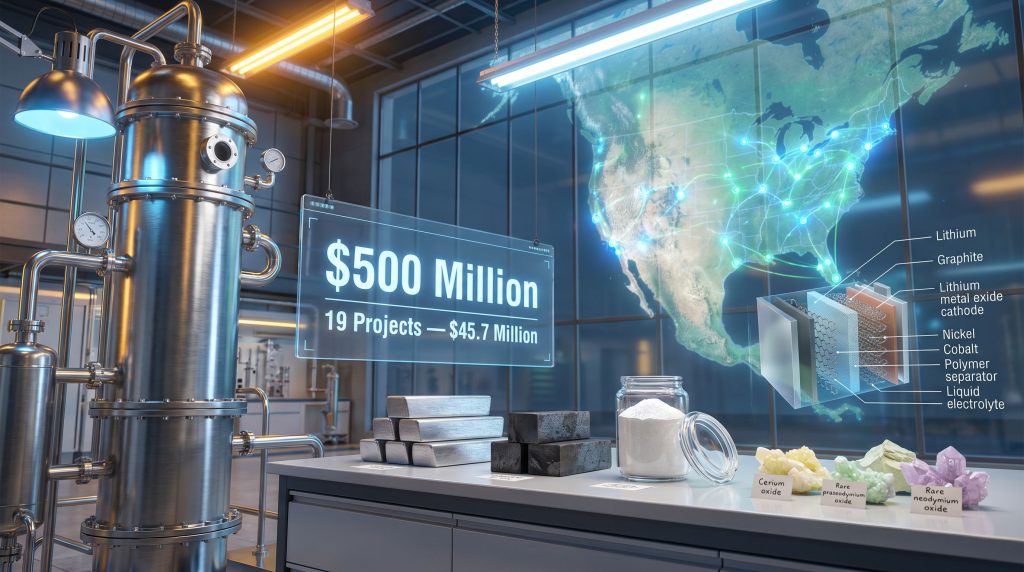
The DOE's Office of Critical Minerals and Energy Innovation selected 19 projects to collectively share $45.7 million in federal funding, structured through the Critical Material Innovation, Efficiency, and Alternatives funding opportunity. This program targets two distinct technology tiers:
Tier 1: Pilot-Scale Facilities focus on advancing rare earth element separation and magnesium metal production toward pre-commercial and commercial scale. These are the largest individual awards in the round, designed to bridge the gap between proven laboratory chemistry and industrial-scale throughput.
Tier 2: Next-Generation Technologies support bench-scale development of novel approaches to the production, recovery, separation, or concentration of critical materials. These earlier-stage projects cover a broader material set and feedstock range, feeding the innovation pipeline that will populate future pilot programmes.
Individual project values across the DOE and non-DOE cost-share components range from approximately $700,000 to $50.5 million, reflecting the significant variation in scope and development stage across selected participants.
The $500 Million Commercial-Scale Initiative
Running parallel to the innovation-focused programme is a separate DOE funding opportunity offering up to $500 million targeted explicitly at demonstration- and commercial-scale processing facilities. This initiative is not an R&D programme. It is an infrastructure deployment mechanism, focused on lithium, graphite, nickel, copper, and aluminium, with particular emphasis on battery materials manufacturing and recycling infrastructure.
The distinction between the two programmes is critical for understanding the overall policy architecture. The $45.7 million programme builds and validates new processing technologies. The $500 million programme deploys proven ones at industrial scale. For further detail on DOE critical minerals initiatives, the broader programmatic context clarifies how these two funding tiers interact strategically.
DOE Critical Minerals Funding Summary
| Programme | Total Funding | Technology Stage | Target Materials |
|---|---|---|---|
| Critical Material Innovation, Efficiency & Alternatives | $45.7 million (19 projects) | Pilot-scale and bench-scale | REEs, magnesium, graphite, lithium, nickel, cobalt, manganese, silicon |
| DOE Broader Critical Minerals Initiative | Up to $500 million | Demonstration and commercial scale | Lithium, graphite, nickel, copper, aluminium |
| DOE NETL Critical Minerals Programme | Ongoing, multiple projects | Pilot to commercial | Coal resources, acid mine drainage, produced waters |
Beyond Conventional Ore: The Expanding Feedstock Universe
One of the most analytically significant aspects of DOE's funding framework is its explicit inclusion of non-conventional and secondary feedstock categories alongside traditional ore deposits. This broadens the domestic resource base considerably and signals a policy evolution that is not fully appreciated in mainstream coverage.
Feedstock categories explicitly covered across DOE programmes include:
- Primary ore deposits from domestic mineral occurrences
- Mine waste and historical tailings where critical materials were not recovered during original processing
- Industrial byproducts and process residues from existing manufacturing and metallurgical operations
- Recycled feedstocks including end-of-life lithium-ion batteries, spent rare earth magnets, and electronic scrap
- Dilute wastewaters and brines representing unconventional aqueous recovery streams
- Coal-based resources and acid mine drainage addressed specifically through DOE's National Energy Technology Laboratory programmes
The strategic logic here is compelling: secondary and recycled feedstocks do not require new mine permits, do not face the same community opposition as greenfield extraction, and can be brought online considerably faster than conventionally developed mineral deposits.
The battery recycling process occupies a particularly important position within this framework. As electric vehicle adoption scales and first-generation EV batteries begin reaching end-of-life, the volume of recoverable lithium, nickel, cobalt, and manganese available from recycled streams will grow substantially. Federal investment in recycling-to-processing infrastructure today is, in part, an investment in a supply source that does not yet exist at meaningful scale but will within this decade.
Material-by-Material: What the Investment Targets and Why
Rare Earth Elements: The Separation Problem
REE separation is arguably the most technically demanding operation in the critical minerals processing chain. Individual rare earth elements occur together in ore and must be chemically separated through multi-stage solvent extraction processes involving hundreds of mixer-settler stages, precise pH control, and carefully formulated organic extractants. The chemistry is well understood, but building competitive, environmentally compliant separation capacity outside of established Asian facilities has proven extremely difficult.
China's dominance in REE processing is not simply a function of having more deposits. It reflects decades of deliberate industrial development, subsidised infrastructure, and accumulated process expertise. The U.S. has historically lacked commercial-scale domestic separation, sending even domestically mined rare earth concentrates offshore for this critical processing step. Consequently, DOE pilot-scale funding explicitly targets this gap, and the challenges inherent to rare earth supply chains make this one of the most pressing areas for domestic investment.
Magnesium: The Overlooked Strategic Metal
Magnesium's inclusion in the pilot-scale facility category is a significant policy signal that receives insufficient attention. The metal is essential for lightweight alloys used across aerospace, automotive, and defence manufacturing. Modern vehicle lightweighting strategies, critical for meeting fuel efficiency and EV range targets, depend on magnesium-aluminium alloy components. Yet U.S. domestic magnesium production is minimal, with the vast majority imported.
What makes magnesium particularly interesting from a supply chain perspective is that the dominant global production method, the Pidgeon process used extensively in China, is energy-intensive and labour-dependent in ways that make it economically challenging to replicate in higher-cost manufacturing environments. DOE investment in alternative magnesium production technologies suggests interest in process innovation that could change the economic calculus for domestic production.
Graphite: The Supply Chain's Most Acute Vulnerability
Among all battery materials, processed graphite represents the sharpest supply concentration risk. China accounts for the overwhelming majority of global natural graphite production and an even larger share of the purified, spheronised, and coated anode-grade graphite that battery manufacturers actually require. Synthetic graphite production, an alternative to natural graphite for battery anodes, is similarly concentrated.
The technical specifications for battery anode graphite are demanding. Natural flake graphite must undergo acid purification to reach carbon purity levels exceeding 99.95%, then be mechanically processed into spherical particles of controlled size distribution, and finally coated with pyrolytic carbon to manage first-cycle lithium loss. Each of these steps involves distinct process chemistry and equipment. DOE investment in both the $45.7 million programme and the $500 million initiative explicitly covers graphite, reflecting its recognised status as a critical vulnerability.
Battery Materials: Lithium, Nickel, Cobalt, and Manganese
These four materials form the cathode chemistry foundation of most commercial lithium-ion battery formats. Their processing requirements differ substantially:
- Lithium must be refined from spodumene concentrate or lithium brine into battery-grade lithium hydroxide or lithium carbonate, processes requiring either high-temperature kiln operations or extensive evaporation and purification infrastructure
- Nickel for battery applications requires sulphate-form processing distinct from the ferronickel and stainless steel feedstock forms that dominate conventional nickel metallurgy
- Cobalt supply is heavily concentrated in the Democratic Republic of Congo at the mining stage, with significant refining concentration in China
- Manganese is gaining renewed importance as lithium manganese iron phosphate battery chemistry gains commercial traction, representing a potential structural shift in cathode material demand
Critical Materials Coverage Across DOE Programmes
| Material | Primary Application | Supply Concentration Risk | DOE Programme Focus |
|---|---|---|---|
| Rare Earth Elements | Permanent magnets, defence electronics | Very High (China processing) | Pilot-scale facilities |
| Magnesium | Lightweight alloys, aerospace | High (import-dependent) | Pilot-scale facilities |
| Graphite | Battery anodes | Very High (China processing) | Next-gen tech, $500M |
| Lithium | EV batteries, grid storage | Moderate-High | $500M initiative |
| Nickel | Battery cathodes, alloys | Moderate | Next-gen tech, $500M |
| Cobalt | Battery cathodes | High (DRC/China) | Next-gen technologies |
| Manganese | LMFP batteries, steel | Moderate | Next-gen technologies |
| Silicon | Battery anodes, semiconductors | Moderate | Next-gen technologies |
Who Is Receiving DOE Support and How the Funding Works
Institutional Diversity Across the Project Portfolio
The 19 selected projects span a broad institutional spectrum that reflects deliberate portfolio construction rather than concentration in any single category of applicant:
- National laboratories provide deep technical expertise, existing characterisation infrastructure, and established safety frameworks for handling hazardous process chemistry
- Universities and research institutes contribute fundamental science capability and serve a workforce development function, training the next generation of processing engineers
- Private companies bring commercialisation pathways, industry partnerships, and market discipline to ensure funded technologies have a viable route beyond the laboratory
The Cost-Share Mechanism
A structural feature of DOE critical minerals funding that is often underappreciated is the cost-share requirement. Projects receiving federal dollars are required to contribute non-federal funding alongside DOE investment. This mechanism accomplishes several things simultaneously:
- It leverages private capital to extend the impact of public investment
- It functions as a market signal, indicating that industry partners believe the technology has commercial merit
- It creates alignment between DOE objectives and real-world deployment timelines
- It reduces moral hazard by ensuring recipients have genuine financial commitment to project success
The wide range of individual project values, from roughly $700,000 to $50.5 million in combined DOE and non-DOE components, reflects the maturity spectrum across selected projects and the varying capital intensity of different processing technology categories.
The next major ASX story will hit our subscribers first
The Geopolitical Dimension: Processing as Strategic Infrastructure
China's Structural Advantage and the Policy Response
China's dominance across critical minerals processing is not accidental or purely economic. It reflects a multi-decade industrial policy strategy that identified processing and refining capacity as leverage points in the global technology economy. By controlling the transformation of raw materials into specification-grade industrial inputs, China has inserted itself as an essential intermediary in supply chains that underpin everything from consumer electronics to missile guidance systems.
This leverage became viscerally apparent during periods of trade tension when export restrictions on rare earth materials and processed graphite demonstrated the vulnerability of downstream manufacturers in the U.S., Europe, and Japan. In addition, critical minerals and energy security concerns have further accelerated Western government resolve to address these dependencies at the processing level.
Control over processing infrastructure is, in a meaningful sense, control over who can independently manufacture the technologies of the 21st century. Nations that cannot process their own critical materials cannot truly claim industrial sovereignty, regardless of how many mines they operate.
How the Global Processing Race Is Unfolding
The U.S. is not acting in isolation. A coordinated, if competitive, restructuring of critical minerals processing capacity is underway across multiple major economies:
- The European Union's Critical Raw Materials Act establishes specific domestic processing benchmarks, requiring that a defined percentage of strategic materials be processed within EU borders by 2030
- Australia is investing in downstream processing infrastructure to capture more of the value chain from its world-class mineral resource base, rather than exporting raw concentrates
- Canada is pursuing both domestic processing development and bilateral processing partnerships with allies
- Japan and South Korea, deeply exposed as technology manufacturing hubs with minimal domestic mineral resources, are aggressively pursuing long-term offtake and processing agreements with resource-holding allies
The collective effect is a fundamental restructuring of where the midstream sits in global critical minerals supply chains, with the direction of change clearly pointing toward geographic diversification and away from the current concentration.
The NETL Dimension: Coal Communities and Critical Minerals Recovery
DOE's National Energy Technology Laboratory runs a parallel critical minerals programme that deserves specific attention for what it reveals about the breadth of the federal strategy. NETL's focus areas include recovery from coal-based resources, acid mine drainage, and oil and gas produced waters.
This matters for several reasons. First, it dramatically expands the domestic feedstock base by targeting waste streams from legacy fossil fuel operations that often contain meaningful concentrations of rare earths and other critical materials. Second, it creates an economic diversification pathway for communities and regions whose industrial base has historically centred on coal and fossil fuel extraction.
Acid mine drainage, for instance, is a persistent environmental liability at thousands of legacy mining sites across Appalachia and other coal-producing regions. It is also, counterintuitively, a potential source of recoverable rare earth elements and critical materials in concentrations that may prove economically viable with appropriate processing technology. DOE investment in this area simultaneously addresses an environmental remediation challenge and a supply chain development objective.
What This Means for Companies and Investors
Positioning for Federal Grant Competitiveness
As DOE scales its critical minerals funding from tens of millions toward hundreds of millions of dollars, understanding what drives competitive project selection becomes commercially important. Several structural advantages tend to characterise successful applications:
- Technology readiness level: Projects at pilot scale or with credible pilot-scale roadmaps are better positioned than pure concept-stage proposals
- Cost-share quality: Strong industrial partners with genuine financial commitment carry more weight than nominal co-investors
- National laboratory affiliations: Partnerships with established DOE laboratory networks provide technical credibility and institutional familiarity with the federal funding process
- Feedstock diversity: Projects capable of processing multiple feedstock types, including secondary and recycled streams, align more closely with the full-spectrum strategy DOE is pursuing
- Commercial pathway clarity: Funded technologies must demonstrate a plausible route from the supported development stage to self-sustaining commercial operation
The Secondary Processing Investment Thesis
For investors tracking the critical minerals space, the explicit federal prioritisation of recycled and secondary feedstocks creates a distinctive opportunity set. Companies engaged in the battery recycling process, e-scrap processing, and technology development for industrial waste stream recovery occupy a uniquely advantaged position in the current policy environment:
- They face lower permitting barriers than new mine developers
- Their feedstock base grows automatically as the installed base of EVs and energy storage systems expands
- They benefit from both federal processing investment programmes and separate recycling incentives
- Their operations can be sited closer to population centres where waste streams are concentrated
This convergence of policy tailwinds, growing feedstock availability, and lower regulatory friction makes secondary processing one of the more structurally compelling sectors within the broader critical minerals investment landscape, though investors should note that commercial-scale profitability in recycling operations remains sensitive to commodity price cycles and collection infrastructure maturity.
Challenges Federal Funding Cannot Fully Resolve
Federal investment in processing technology is a necessary but not sufficient condition for rebuilding domestic critical minerals processing capacity. Several structural constraints operate independently of available funding:
- Permitting timelines for new processing facilities, particularly those involving hazardous chemicals or located near populated areas, can extend for years and add significant cost uncertainty
- Workforce availability for specialised processing roles represents a genuine constraint; solvent extraction operators, hydrometallurgical engineers, and electrochemical process specialists are not produced in large numbers by the current U.S. education and training pipeline
- Commodity price cycles can undermine the economics of domestic processing even when technology is proven and capital is available, as was demonstrated during the rare earth price collapse of the early 2010s that shuttered several emerging Western processing operations
- Scale competition against established processors with decades of sunk costs, optimised processes, and integrated supply relationships requires sustained, multi-cycle investment rather than single-programme funding
Furthermore, defence critical materials strategies across allied nations increasingly reinforce the importance of resolving these constraints at a systemic level, not merely through individual project funding.
Disclaimer: Analysis of federal funding programmes, investment positioning, and market projections contained in this article involves forward-looking assessments that are subject to significant uncertainty. Policy priorities, commodity prices, and technology development timelines can change materially. Nothing in this article constitutes investment advice.
The 2035 Scenario: What a Reshored Processing Sector Could Look Like
Projecting forward based on current investment trajectories, a credible scenario for U.S. critical minerals processing by the mid-2030s includes the following features:
- Commercial-scale domestic REE separation capacity sufficient to process ore from U.S. and allied-nation sources without offshore dependence
- Multiple operating lithium hydroxide and lithium carbonate facilities drawing from both domestic brine and hard rock feedstocks, as well as growing recycled streams
- Anode-grade graphite production from both natural and synthetic pathways, with processing capacity that materially reduces the near-total import dependence that characterises the current situation
- Domestic magnesium production using next-generation, lower-energy processes that improve the economics relative to conventional technology
- An established battery-to-battery recycling loop capturing lithium, nickel, cobalt, and manganese from first-generation EV batteries at meaningful industrial scale
Reaching this scenario requires not just the current round of DOE funding for U.S. critical minerals processing, but sustained policy commitment across multiple budget cycles, continued private capital formation, and resolution of the permitting and workforce constraints that sit outside the direct reach of technology investment programmes. The foundation, however, is being built now, one pilot facility and bench-scale demonstration at a time.
Frequently Asked Questions
What is the DOE's Critical Material Innovation, Efficiency, and Alternatives programme?
It is a federal funding mechanism administered by the DOE's Office of Critical Minerals and Energy Innovation. The programme supports domestic critical mineral processing technology development across a spectrum from early bench-scale research to pilot-scale facility construction, targeting materials central to energy, defence, and advanced manufacturing supply chains.
How much has the DOE committed to critical minerals processing investment?
The most recent selection round committed $45.7 million across 19 projects. A separate, broader initiative targets up to $500 million for demonstration- and commercial-scale processing and battery materials manufacturing facilities. The DOE's NETL also operates an ongoing parallel programme focused on recovery from coal-based resources and related waste streams.
Why does federal investment prioritise processing over mining?
The U.S. already has access to significant in-ground mineral resources. The critical industrial gap is not extraction capacity but the downstream infrastructure required to convert raw feedstocks into refined, specification-grade materials that manufacturers can use. Processing and separation represent the strategic chokepoint where U.S. capability is most acutely insufficient relative to national need.
What feedstocks are eligible under DOE critical minerals programmes?
Eligible feedstocks span conventional ore deposits through to mine tailings, industrial byproducts, end-of-life batteries, spent magnets, electronic scrap, coal waste, acid mine drainage, and dilute wastewater streams. This broad feedstock mandate reflects a strategy that treats secondary and recycled materials as supply chain assets of comparable strategic importance to primary ore.
Who can participate in DOE critical minerals funding rounds?
Eligible applicants include national laboratories, universities, research institutes, and private companies. Most programmes require non-federal cost-share contributions and expect applicants to demonstrate credible commercialisation pathways from funded development stages toward self-sustaining industrial operation. The NETL critical minerals programme provides additional detail on how these eligibility frameworks operate across different programme types.
Want to Track ASX Companies Capitalising on the Critical Minerals Processing Boom?
Discovery Alert's proprietary Discovery IQ model delivers real-time alerts the moment significant ASX mineral discoveries are announced, transforming complex geological and commodity data into clear, actionable insights — so investors can position themselves ahead of the broader market. Explore how historic mineral discoveries have generated substantial returns and begin a 14-day free trial to secure a market-leading advantage in the critical minerals sector.