The Critical Minerals Landscape and Scandium's Strategic Positioning
Strategic mineral development operates within frameworks shaped by decades of supply chain vulnerabilities, technological advancement requirements, and geopolitical realignments. Australia's emergence as a cornerstone of Western critical minerals energy transition reflects broader shifts in global resource allocation, with specialized metals like scandium representing concentrated opportunities within this transformation.
The intersection of metallurgical excellence and strategic necessity creates unique investment dynamics, where geological assets gain valuation premiums beyond traditional mining economics. Projects like the Syerston Scandium Project exemplify this convergence, where resource quality meets supply chain security imperatives in markets characterized by extreme concentration and limited production alternatives.
Understanding Scandium's Role in Advanced Manufacturing Applications
Scandium occupies a distinctive position within the periodic table of strategic metals, offering metallurgical properties that enable next-generation manufacturing capabilities across aerospace, energy, and electronics sectors. Unlike traditional industrial metals, scandium's value proposition centres on performance enhancement rather than commodity applications.
The metal's primary industrial significance emerges through aluminium-scandium alloy systems, where small additions of scandium create substantial improvements in material performance characteristics. These alloys demonstrate enhanced strength-to-weight ratios that prove essential for aerospace applications, where weight reduction directly translates to fuel efficiency and payload capacity improvements.
Primary Application Categories:
• Aerospace alloy systems requiring superior strength and reduced weight
• Solid oxide fuel cell technologies for hydrogen and renewable energy applications
• Advanced electronics manufacturing requiring specialised material properties
• Automotive lightweighting initiatives focused on electric vehicle battery efficiency
Global scandium supply chains remain highly concentrated, with production dominated by limited sources across China and Russia. This concentration creates strategic vulnerabilities for Western manufacturing sectors, particularly aerospace and defence industries requiring reliable access to scandium-enhanced materials.
Market dynamics reflect this supply constraint through sustained pricing levels and limited availability for industrial-scale applications. The combination of restricted supply and growing technological demand creates conditions favouring new production sources capable of delivering consistent quality and volume.
Syerston's Geological Advantages and Resource Profile
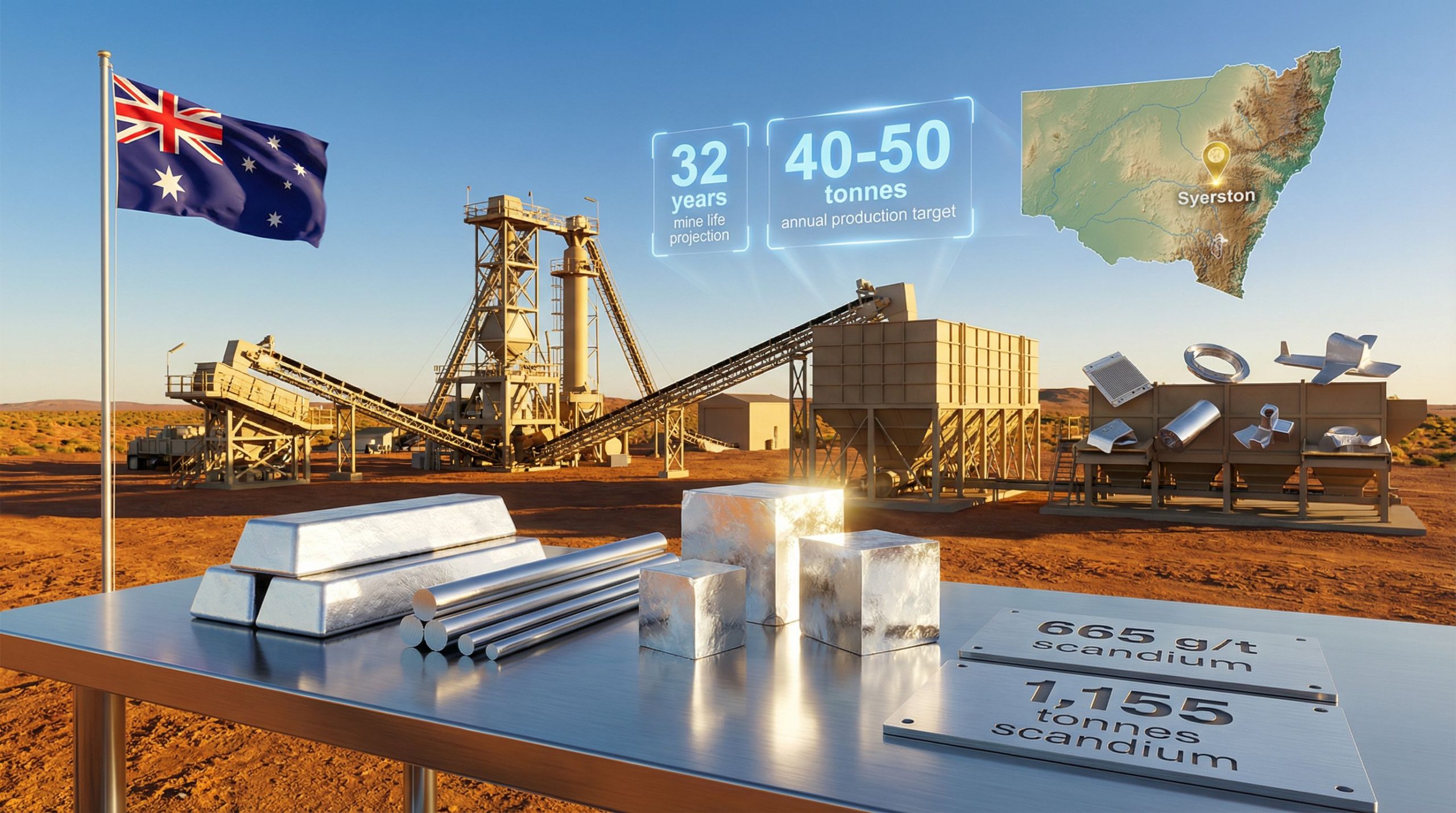
The Syerston deposit represents a rare concentration of scandium mineralisation within Australia's established mining corridor, positioned approximately 350 kilometres northwest of Sydney in New South Wales. Furthermore, the project's location within existing industrial infrastructure provides operational advantages relative to remote development sites.
Resource Characteristics Overview:
| Parameter | Specification | Development Significance |
|---|---|---|
| Total Scandium Resource | 1,155 tonnes | Substantial global market share potential |
| Average Grade | 665 grams per tonne | Premium concentration levels |
| Resource Confidence | 99% Measured & Indicated | Advanced geological certainty |
| Projected Mine Life | 32 years | Long-term production stability |
| Annual Production Capacity | 40-50 tonnes | Significant global supply contribution |
The resource's 99% classification as Measured and Indicated reflects extensive geological evaluation and sampling programs. Consequently, this provides unusual certainty for development-stage mineral projects, supporting engineering design work and financial modelling with reduced geological risk compared to typical exploration-stage assets.
Syerston's grade profile of 665 grams per tonne scandium significantly exceeds typical industrial mining thresholds, supporting economic extraction under various cost scenarios. In addition, the combination of high grade and large resource tonnage creates operational flexibility for production optimisation and market responsiveness.
The 32-year mine life projection, based on current resource estimates and planned production rates, positions the Syerston Scandium Project as a long-term supply source capable of supporting sustained industrial partnerships and technological development programs requiring reliable scandium access.
Development Progress and Pre-Construction Activities
Syerston's advancement through development stages demonstrates systematic progression from resource definition through regulatory approval and financing preparation. However, the project has achieved several critical milestones that differentiate it from early-stage exploration properties.
Completed Development Milestones:
• NSW environmental approvals secured through regulatory review processes
• Mining lease grants providing operational authorisation for extraction activities
• Water rights allocations supporting processing operations and environmental requirements
• Metallurgical piloting programmes validating processing technology and product quality
• Infrastructure corridor identification for power and transportation access
Recent capital deployment focuses on engineering optimisation, infrastructure preparation, and supply chain establishment. These pre-construction activities represent necessary steps toward final investment decisions whilst maintaining development momentum.
Engineering work encompasses detailed plant design, equipment specification, and construction planning. Infrastructure preparation involves power connection arrangements, water system development, and transportation access improvements. Supply chain establishment includes equipment procurement planning and logistics optimisation.
The systematic approach to development milestone achievement reflects experienced project management and technical capabilities. Nevertheless, execution risk remains significant, as complex mining projects frequently encounter timeline delays and cost increases during construction phases.
Financial Structure and Strategic Government Support
The Syerston Scandium Project's financing architecture combines private equity investment with strategic government backing through specialised lending mechanisms. This hybrid structure reflects both commercial viability assessments and strategic supply chain considerations within the broader mining industry evolution.
Current Financing Components:
| Funding Source | Amount | Status | Strategic Significance |
|---|---|---|---|
| Equity Placement | A$18.9 million | Completed | Private investor confidence |
| US EXIM Bank | US$67 million | Conditional letter | Government strategic support |
| Additional Equity Required | A$30-40 million | Pending | Final financing gap |
| Total Project Cost | ~A$120 million | Estimated | Competitive capital intensity |
Sunrise Energy Metals recently completed an A$18.865 million equity placement at A$4.90 per share, demonstrating institutional investor appetite for scandium development opportunities. The placement pricing and successful completion indicate market confidence in project fundamentals and management execution capabilities.
The US Export-Import Bank conditional funding letter for up to US$67 million represents significant strategic validation beyond commercial assessment. Furthermore, EXIM Bank involvement signals US government recognition of scandium's strategic importance for domestic supply chain security and advanced manufacturing competitiveness.
However, this remains a conditional commitment requiring satisfaction of specific criteria including completed financing, final engineering design, and environmental compliance verification. The conditional nature creates execution risk, as final approval depends on multiple factors beyond current control.
Current Financial Profile Analysis:
Sunrise Energy Metals operates with a market capitalisation of approximately A$922 million against trailing revenue of A$184,000, reflecting the pre-revenue nature of development-stage mining operations. The company maintains a strong balance sheet with minimal debt and sufficient cash resources for near-term operations.
Operating metrics demonstrate typical development-stage characteristics with negative operating margins, return on assets, and return on equity as expected for pre-revenue mining companies. The current ratio of 10.3 provides short-term financial flexibility during the development phase.
Strategic Partnerships and Market Positioning
Commercial validation for Syerston's development comes through strategic partnership arrangements with major industrial users, particularly in aerospace and defence sectors requiring reliable scandium supply sources.
Lockheed Martin has established an option agreement covering 25% of forecast production, representing significant commercial credibility for a development-stage project. This relationship provides market access and technical validation from a leading aerospace manufacturer with extensive experience in advanced materials applications.
The Lockheed Martin option structure offers mutual benefits through secured supply access for the aerospace company and guaranteed market access for Syerston production. Nevertheless, this remains an option arrangement rather than binding offtake contract, maintaining flexibility whilst providing strategic positioning.
Market Development Scenarios:
Conservative Growth Pathway:
• Annual demand growth: 5-7% driven primarily by aerospace applications
• Market expansion through existing technology adoption
• Gradual supply chain integration over 5-7 year timeframe
Accelerated Adoption Scenario:
• Annual demand growth: 10-15% driven by fuel cell and automotive applications
• New technology commercialisation creating additional demand categories
• Rapid supply chain development requiring immediate production capacity
Market penetration success depends on establishing reliable supply relationships that enable downstream manufacturers to invest in scandium-enhanced technologies. The thin nature of current scandium markets creates both opportunity and challenge, as limited market depth requires active development efforts.
Geopolitical Considerations and Supply Chain Security
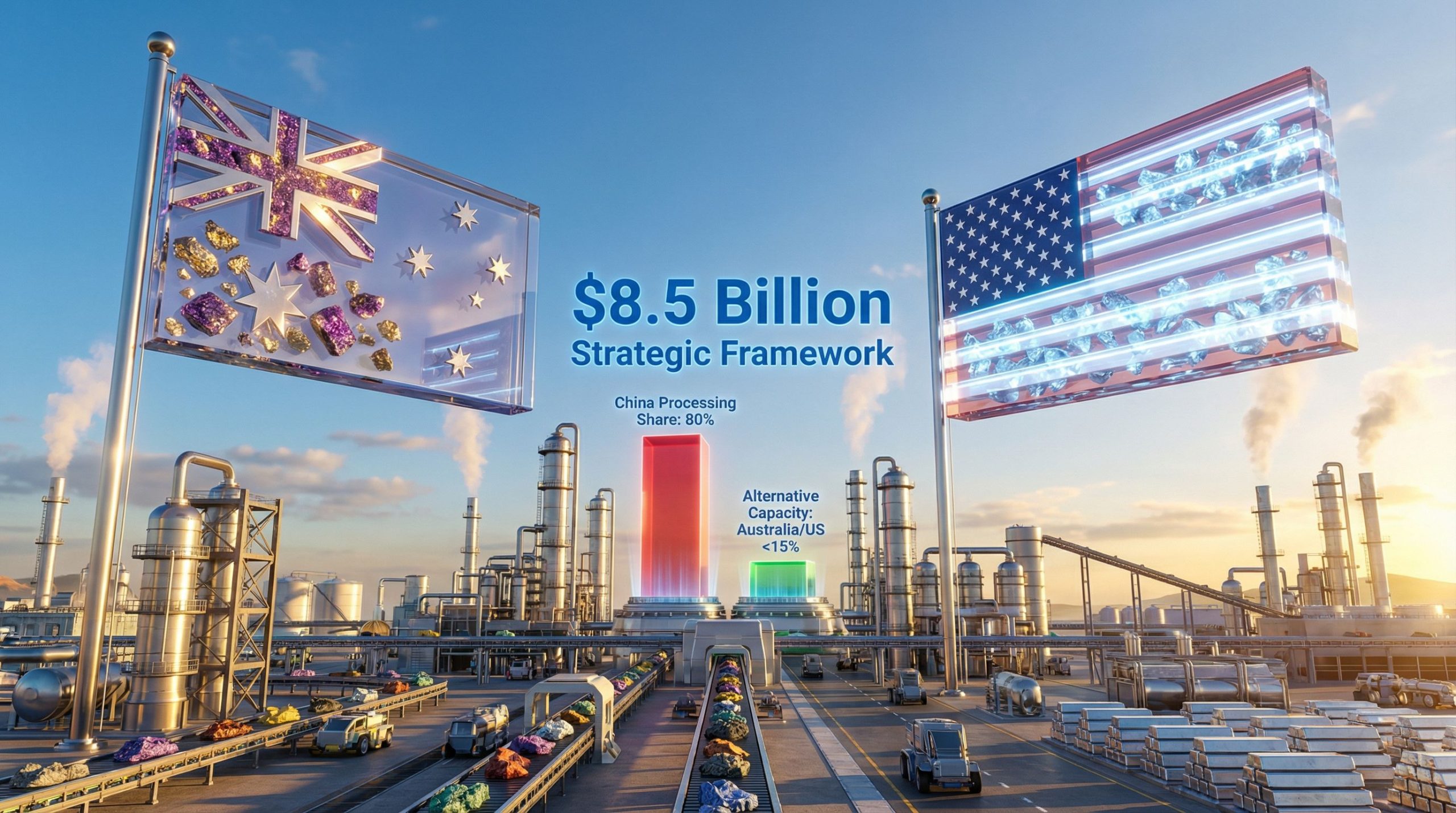
China's implementation of rare earth export controls in April 2025 has fundamentally altered critical minerals market dynamics, creating strategic imperatives for Western supply chain diversification across specialised metals including scandium. This development underscores the importance of the Australia critical minerals reserve and its role in supply chain security.
Current scandium supply chains demonstrate extreme concentration, with approximately 80% of global production originating from China and Russia. This concentration creates strategic vulnerabilities for Western manufacturing sectors, particularly aerospace and defence industries requiring reliable access to scandium-enhanced materials.
Strategic Value Drivers:
| Factor | Impact Assessment | Strategic Rationale |
|---|---|---|
| Supply Security | Critical | Only major Western primary scandium source |
| Alliance Strengthening | High | Supports US-Australia defence cooperation frameworks |
| Technology Access | Moderate | Enables advanced manufacturing capabilities |
| Industrial Development | Moderate | Potential downstream processing expansion |
The US-Australia critical minerals partnership creates preferential frameworks for projects like Syerston Scandium Project that strengthen allied supply chain resilience. AUKUS technology sharing requirements further emphasise scandium's strategic importance for advanced defence applications.
European Union raw materials green transition strategies similarly prioritise supply diversification for strategic metals, creating potential market opportunities beyond North American demand. These policy frameworks suggest sustained government support for Western scandium production capabilities.
### What Are the Primary Technical Risks?
Mining development projects face multiple risk categories spanning technical execution, market development, and operational performance. Syerston's risk profile combines typical development-stage uncertainties with scandium-specific market dynamics.
Primary Risk Categories:
Construction and Engineering Risks:
• Schedule delays due to equipment delivery or installation challenges
• Cost overruns from engineering changes or market conditions
• Technical performance variations from design specifications
• Regulatory compliance requirements creating operational constraints
Market Development Risks:
• Limited market depth constraining sales volume expansion
• Price volatility from supply-demand imbalances
• Customer concentration creating revenue dependency
• Technology adoption rates affecting demand growth
Operational Performance Risks:
• Metallurgical processing efficiency variations
• Resource grade consistency over mine life
• Environmental compliance and monitoring requirements
• Labour availability and skill requirements
Risk mitigation strategies include experienced management teams with proven track records in similar project development, conservative engineering design approaches, and extensive metallurgical testing programmes validating processing technology.
The project's advanced permitting status and established infrastructure access reduce typical development risks compared to greenfield projects in remote locations. However, execution risk remains significant given the complexity of bringing new mining operations into commercial production.
Investment Valuation Framework and Market Assessment
Traditional mining valuation methodologies require modification for scandium projects due to unique market characteristics including limited comparable transactions, thin trading volumes, and strategic value components beyond standard commodity pricing.
Valuation Approach Categories:
Net Present Value Analysis:
• Discounted cash flow modelling using conservative demand assumptions
• Sensitivity analysis across price and volume scenarios
• Risk-adjusted discount rates reflecting development stage uncertainties
• Long-term price projections based on supply-demand fundamentals
Strategic Option Valuation:
• Market expansion potential through technology adoption acceleration
• Geopolitical premium assessment for Western supply sources
• Technology development upside from new application categories
• Supply chain integration value creation opportunities
Comparable Analysis Limitations:
Limited peer group availability constrains traditional comparable company analysis. Most scandium projects remain in early development stages, providing insufficient operational data for comprehensive benchmarking. Consequently, focus shifts toward critical minerals developers with similar strategic positioning and government support mechanisms.
Commercial Production Scenarios and Success Metrics
Successful project development would position the Syerston Scandium Project as a primary global scandium producer, potentially capturing 50-70% of current global supply within five years of production commencement. This market position would provide significant pricing influence and strategic leverage.
Production Ramp-Up Projections:
| Production Year | Annual Output (tonnes) | Market Share Estimate |
|---|---|---|
| Year 1 | 25-30 | 35-40% |
| Year 2-3 | 40-45 | 50-60% |
| Steady State | 45-50 | 60-70% |
| Potential Expansion | 60-70 | 70-80% |
Market development success would reduce scandium pricing volatility through improved supply security, potentially enabling increased technology adoption rates across multiple industrial sectors. This market stabilisation effect could multiply the project's strategic value beyond direct production economics.
Long-Term Strategic Outcomes:
Successful development could establish Syerston as the foundation for expanded Australian critical minerals production, potentially attracting additional investment in downstream processing capabilities and related mineral development projects.
The project's strategic importance may evolve beyond scandium production toward broader critical minerals processing and supply chain development, supported by government industrial policy objectives and private sector partnership opportunities.
Market Psychology and Investment Considerations
Scandium markets exhibit characteristics typical of specialised metals with limited production sources and concentrated demand from specific industrial applications. Moreover, investor psychology reflects both technological optimism and execution scepticism regarding development-stage projects.
Current market sentiment demonstrates strong speculative interest driven by geopolitical supply chain concerns and government policy support for Western critical minerals production. However, this enthusiasm must be balanced against typical development-stage execution risks and market depth limitations.
Investment Risk-Return Profile:
The investment proposition combines traditional mining development returns with strategic option value from potential market expansion and geopolitical positioning. This dual-value structure requires sophisticated risk assessment and realistic return expectations.
Positive factors include world-class resource quality, strategic government backing, experienced management capabilities, and clear market applications with established customer relationships. Risk factors encompass pre-revenue development status, construction execution requirements, and market development uncertainties.
### How Does Technology Integration Impact Future Markets?
Scandium's long-term market potential depends on continued technology development and industrial adoption across multiple sectors. Current applications represent established markets, whilst emerging technologies could create additional demand categories.
Fuel cell technology advancement for hydrogen energy applications could significantly expand scandium demand as solid oxide fuel cells achieve commercial scale. Electric vehicle lightweighting initiatives similarly create potential demand growth through aluminium-scandium alloy adoption.
The project's positioning as a reliable Western supply source could enable technology development partnerships and application research programmes that expand market opportunities beyond current projections. This market development potential represents significant upside value for successful project execution.
Strategic positioning within allied supply chains creates opportunities for government-supported research and development programmes focused on advanced materials and manufacturing technologies. In addition, these partnerships could accelerate technology adoption and market development timelines.
Conclusion: Evaluating Strategic Mineral Development Opportunities
The Syerston Scandium Project exemplifies the complex intersection of geological excellence, strategic necessity, and execution challenge that characterises critical minerals development in the current geopolitical environment. Resource quality and strategic positioning create compelling value propositions, whilst development-stage risks require careful evaluation and realistic expectations.
Success depends on systematic execution across technical, financial, and commercial dimensions, supported by sustained management focus and adequate capital resources. The project's strategic importance extends beyond traditional mining economics, encompassing supply chain security and technology enablement benefits that justify premium valuations under appropriate risk-adjusted frameworks.
For investors evaluating critical minerals opportunities, considering the recent executive order on minerals alongside the Syerston development demonstrates how geological advantage, strategic positioning, and government support can combine to create compelling investment propositions despite inherent development-stage uncertainties. Careful risk assessment and realistic timeline expectations remain essential for successful investment outcomes in this specialised sector.
Investment Disclaimer: This analysis is for educational and informational purposes only and should not be considered as investment advice. Mining development projects involve significant risks including construction delays, cost overruns, market volatility, and regulatory changes. Potential investors should conduct independent due diligence and consult qualified financial professionals before making investment decisions. Past performance does not guarantee future results, and all investments carry the risk of loss.
Looking to capitalise on Australia's critical minerals boom?
Discovery Alert's proprietary Discovery IQ model delivers instant notifications on significant ASX mineral discoveries, including strategic metals and rare earth developments that could reshape global supply chains. With scandium and other critical minerals gaining strategic importance, subscribers receive actionable insights to identify emerging opportunities ahead of the broader market, positioning themselves to benefit from the next major mineral discovery.