Critical Resources Ltd
- ASX Code: CRR
- Market Cap: $25,552,684
Critical Resources Confirms 14 Pegmatite Bodies at Mavis Lake — Assays to Unlock the Next Drill Campaign
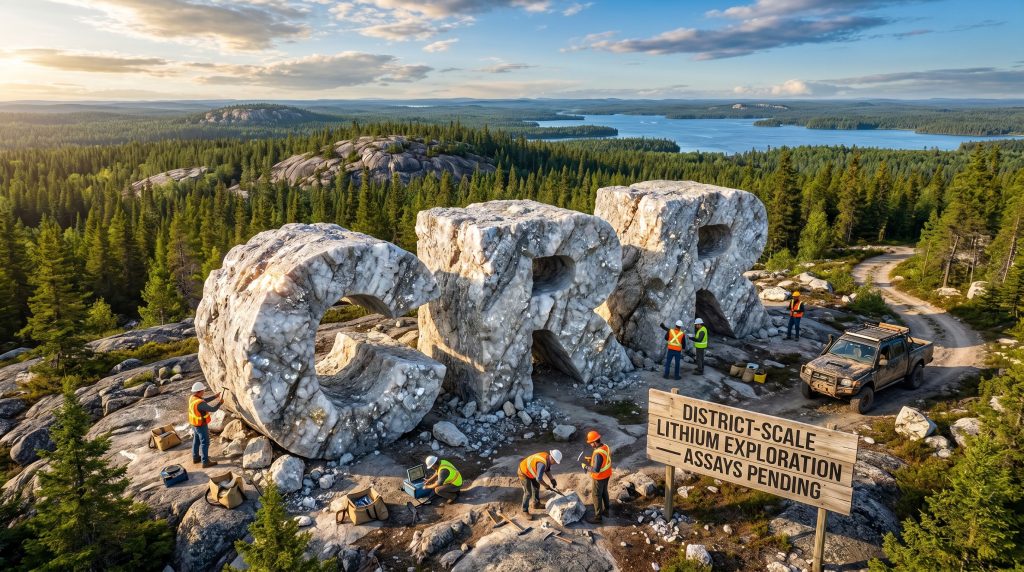
Critical Resources Limited (ASX: CRR) has completed its surface exploration program at the Corona Pegmatite Field within its 100%-owned Mavis Lake Lithium Project in Ontario, Canada, and the results have exceeded initial expectations. This Critical Resources Mavis Lake milestone confirms 14 pegmatite bodies, including 6 newly mapped occurrences, across a northern corridor that had never been systematically prospected. Assay results are now pending, with findings expected to sharpen drill targeting and accelerate CRR's ambition to build a multi-deposit lithium district from the ground up.
"The northern corridor at Mavis Lake is significantly underexplored relative to the scale of the Mavis Lake LCT pegmatite system. This program has confirmed that — 14 pegmatite bodies identified, six of them new, across ground that had not been systematically prospected. That's exactly the kind of result that sharpens our targeting and builds confidence ahead of drilling."
— Tim Wither, Managing Director, Critical Resources Limited
When big ASX news breaks, our subscribers know first
What Was Completed: A Systematic Look at the Corona Field Program
The program, which covered the Corona target and adjacent northern areas approximately 4 km north of CRR's existing 8.0 Mt @ 1.07% Li₂O Mineral Resource, was comprehensive in scope and disciplined in execution.
| Program Metric | Result |
|---|---|
| Duration | 10 days |
| Rock samples collected | 106 |
| Outcrop maps completed | 161 |
| Structural measurements recorded | 74 |
| Total pegmatite bodies identified | 14 |
| Newly mapped pegmatite bodies | 6 |
| Samples submitted for geochemical analysis | 106 |
| Assay results expected | Within 3–4 weeks |
The field team focused prospecting efforts around historical drill collars, previously identified pegmatite occurrences, and additional zones derived from CRR's existing exploration datasets. The outcome — 14 pegmatite bodies confirmed including 6 entirely new — demonstrates that the northern Mavis Lake corridor contains a broader pegmatite system than previously recognised.
Furthermore, an additional follow-up target was also identified south of the Northern target area: coarse-grained, texturally evolved pegmatites previously associated with anomalous lithium LIBS responses, which are now flagged for further assessment once geochemical data is received.
Understanding Pegmatite Fertility and Why Assays Are the Critical Next Step
What Is Pegmatite Fertility — and Why Does It Matter to Investors?
Not all pegmatites contain economic lithium mineralisation. A pegmatite is considered "fertile" when it has undergone sufficient geochemical evolution — a process called fractionation — to concentrate lithium-bearing minerals such as spodumene.
Geologists use a suite of pathfinder elements — primarily rubidium (Rb), cesium (Cs), and tantalum (Ta) — to assess how fractionated, and therefore how potentially lithium-rich, a pegmatite system is. The presence and relative concentrations of these elements act as chemical signals pointing toward the more evolved, lithium-prospective parts of a pegmatite system.
Why This Matters to CRR Investors Right Now
The 106 rock samples dispatched for geochemical analysis will return exactly this data. The results will allow CRR's technical team to rank the 14 identified pegmatite bodies by their prospectivity, effectively determining which targets warrant the allocation of drilling capital. This is the decisive step between surface observation and drill-ready targeting.
Key Technical Terms Explained:
- LCT Pegmatite: Lithium-Cesium-Tantalum type pegmatite — the class of igneous rock system that hosts spodumene lithium mineralisation
- Spodumene: The primary lithium-bearing mineral in hard rock lithium deposits
- Fractionation: The geochemical process by which a magma evolves and concentrates certain elements, including lithium
- LIBS: Laser-Induced Breakdown Spectroscopy — a field technique used to assess pegmatite geochemistry in real time
- Mineral Resource: A formally defined quantity and grade of mineralisation, classified under the JORC Code
- Exploration Target: A conceptual estimate of mineralisation potential that precedes a formal Mineral Resource — not a Mineral Resource
The Mavis Lake District: More Than a Single Deposit
The significance of the Corona program extends beyond the 14 pegmatites identified. It forms one piece of a broader, multi-target district strategy that CRR has been systematically assembling at Mavis Lake since 2022.
The project now covers over 400 km² following recent landholding expansions, and the northern exploration corridor alone hosts a pipeline of targets at varying stages of maturity:
| Target | Status / Key Characteristics |
|---|---|
| Main Zone | Current Mineral Resource: 8.0 Mt @ 1.07% Li₂O (Inferred, JORC) |
| Gullwing | Exploration Target: 7–10 Mt @ 0.3–1.2% Li₂O; ~80m widths, ~500m strike, strong surface spodumene |
| Tot | Exploration Target: 3–5 Mt @ 0.8–1.2% Li₂O; mineralised system open along southern extensions |
| Corona Field | Underexplored 5 km-scale trend; 14 pegmatites now confirmed including 6 new; assays pending |
| Little Wing | ~200m × 50m footprint with elevated Li and Rb values |
| Mavis Lake South Zone | Open along strike and at depth; contrasting structural environments |
| Coates & Drope | LIBS fractionation supports prospectivity |
| Pegmatites 18 & 19 | Spodumene-bearing systems with minimal legacy drilling |
The project-wide JORC-compliant Exploration Target stands at 18–29 Mt @ 0.8–1.2% Li₂O, reflecting the scale of what CRR is attempting to build across the full district.
Cautionary note: Exploration Targets are conceptual in nature. There has been insufficient exploration to estimate a Mineral Resource across all targets, and it is uncertain whether further exploration will result in a Mineral Resource estimation.
The Gullwing Pegmatite — the most advanced of the northern targets — is the primary focus of CRR's 2026 Northern Prospects campaign and remains the near-term priority for resource definition drilling. The Corona program was, in addition, explicitly designed to complement Gullwing advancement by expanding the district-level dataset and generating a ranked pipeline of additional follow-up targets.
Integration with the 2026 Northern Prospects Campaign
The data gathered from the Corona program does not sit in isolation. CRR will integrate the incoming assay results with its existing portfolio of geological, structural, and geophysical datasets — including surface geochemistry, LIBS fractionation studies, structural interpretation, and high-resolution aeromagnetic coverage — to build a consolidated, ranked drill target list across the entire northern corridor.
The near-term sequence of events:
- Assay results returned within 3–4 weeks, confirming lithium geochemistry and pathfinder element signatures across the 14 identified pegmatites
- Assay data integrated with CRR's broader geological, structural, and geophysical datasets
- Highest-priority drill targets ranked and confirmed across the northern Mavis Lake corridor
- 2026 Northern Prospects exploration campaign advanced — with Gullwing as the lead target for resource definition drilling
- Subsequent targets — Tot, Little Wing, Coates, Drope, Corona — forming a systematic follow-on pipeline
This structured approach reflects a deliberate strategy: advance the most mature targets toward resource definition while simultaneously expanding the district dataset to underpin longer-term exploration upside.
From the Ground to the Battery: CRR's Mine-to-Market Positioning
What distinguishes CRR from a conventional explorer is the strategic architecture being built around Mavis Lake. The project is not simply being developed as a lithium resource — it is being positioned as the upstream anchor of a fully integrated mine-to-market lithium strategy.
In parallel with its Ontario exploration activities, CRR is advancing a solid-state battery evaluation program in the United States, anchored by an Amorphous Solid-State Electrolyte (ASE) workstream delivered in collaboration with the South Dakota School of Mines & Technology, within the U.S. National Science Foundation (NSF)-supported Centre for Solid-State Electric Power Storage (CEPS) evaluation framework.
A material technical milestone was achieved in this program: laboratory results confirmed stable amorphous solid-state electrolyte performance over 1,200 hours at room temperature — addressing one of the most persistent early-stage barriers in solid-state battery development.
| Value Chain Layer | CRR Activity |
|---|---|
| Upstream | Mavis Lake Lithium Project — exploration, resource definition, district expansion |
| Midstream | Aggregate by-product commercialisation (concrete and road-building applications) |
| Downstream | Solid-state battery electrolyte development — ASE program, U.S.-based |
This vertical integration creates optionality across partnerships, IP generation, licensing, and future commercial pathways. Consequently, it directly connects the district-building work underway at Mavis Lake to a downstream technology position in next-generation energy storage.
"What we're building at Mavis Lake is not just a resource — it's the upstream anchor of a fully integrated lithium strategy… That end-to-end positioning is what distinguishes CRR from a conventional explorer, and it is what we are systematically building toward."
— Tim Wither, Managing Director
The next major ASX story will hit our subscribers first
Why Investors Should Be Watching CRR Closely
The completion of the Corona field program is a targeted, low-cost, high-information step in a methodical exploration strategy. It has expanded the known pegmatite count in the northern corridor from previously mapped occurrences to 14 confirmed bodies — 6 of which are entirely new to the geological record. That result, ahead of assays, already broadens the district-scale picture materially.
The near-term catalyst is clear and time-bound: assay results within 3–4 weeks that will directly determine which targets CRR prioritises for drilling. For investors tracking the company's 2026 Northern Prospects campaign, this is the data that controls the pace of the next phase.
Against that near-term catalyst sits a longer-term investment thesis built on several compounding factors. The Critical Resources Mavis Lake program delivers across multiple dimensions, including:
- A defined Mineral Resource of 8.0 Mt @ 1.07% Li₂O providing a credible foundation
- A project-wide Exploration Target of 18–29 Mt @ 0.8–1.2% Li₂O quantifying the district-scale upside
- A land package exceeding 400 km² across a proven LCT pegmatite corridor in a stable, infrastructure-accessible jurisdiction
- A multi-target pipeline — Gullwing, Tot, Corona, Little Wing, Coates, Drope — at various stages of maturity
- A downstream technology program in solid-state batteries, with confirmed electrolyte stability results, extending CRR's strategic reach well beyond exploration
Investment Takeaway
Critical Resources (ASX: CRR) has materially expanded the known pegmatite inventory across the northern Mavis Lake corridor, confirming 14 bodies including 6 new occurrences through a disciplined 10-day field program. With assay results due within weeks — and the 2026 Northern Prospects drill campaign being shaped by those results — investors now have a defined, near-term catalyst to monitor.
Backed by an 8.0 Mt Mineral Resource, an 18–29 Mt project-wide Exploration Target, and a mine-to-market strategy extending into solid-state battery technology, the Critical Resources Mavis Lake project is building toward a multi-deposit district with strategic reach across the full lithium value chain.
Ready to Dig Deeper Into What CRR Is Building at Mavis Lake?
With 14 pegmatite bodies now confirmed across the northern corridor, assay results due within weeks, and a 2026 drill campaign taking shape, Critical Resources (ASX: CRR) is approaching a defining phase for the Mavis Lake Lithium Project. Backed by an 8.0 Mt Mineral Resource, an 18–29 Mt project-wide Exploration Target, and a mine-to-market strategy that extends into solid-state battery technology, CRR is systematically building toward something well beyond a single deposit. Investors seeking to understand the full scope of the company's district-scale ambitions and strategic positioning can find out more by visiting criticalresources.com.au.