Critical Resources Ltd
- ASX Code: CRR
- Market Cap: $31,940,854
Critical Resources Solid-State Battery Pouch Cell Milestone: A Meaningful Step Forward
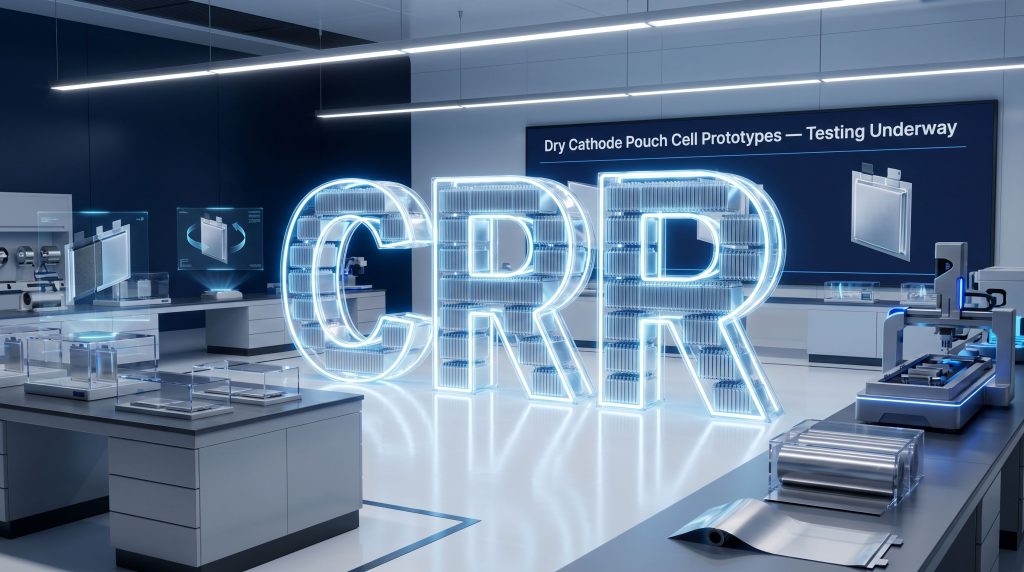
Critical Resources Ltd (ASX: CRR) has progressed its solid-state lithium-ion battery evaluation program — marking a notable Critical Resources solid-state battery pouch cell milestone — moving from coin-cell testing into full-format pouch cells, with initial electrochemical conditioning underway and solid electrolyte deposition in progress. The pouch cells incorporate the company's Dry Solvent-free Deposition (DSD) cathode composite and a liquid electrolyte baseline, representing the first time this DSD-built cathode has been assembled into a complete working cell format.
According to the ASX announcement dated 18 June 2026, this stage follows the recently reported single-step composite-layer milestone from 16 June 2026 and sits within a defined, staged development path. That path aims to integrate Amorphous Solid-State Electrolyte (ASE) materials with the DSD manufacturing process. Critical Resources Ltd continues to position this program as a capital-light, IP-focused licensing opportunity, rather than a cell manufacturing venture.
Managing Director Commentary
"Moving from coin cells to a full-format pouch cell is the step that shows our DSD process can build a real, working cell, not just prove the chemistry in a button cell. It is the first time we have built our DSD-deposited cathode into a complete cell, and the early conditioning is behaving as we'd expect. We are now depositing our sulphur-free ASE solid-state electrolyte as a thin film – integrating it into the cell is the next technical challenge, and one we expect to work through step by step, as is normal for development at this stage," said Tim Wither, managing director of Critical Resources Ltd.
When big ASX news breaks, our subscribers know first
From Button Cell to Working Pouch Cell: What Has Actually Been Achieved?
The report describes the move from coin cells to a full-format pouch cell as a standard step in battery development. Coin cells are used to confirm the basic chemistry, while pouch cells test whether that chemistry and fabrication method can operate in a more practical configuration.
According to the announcement, the following has been achieved:
- Full-format pouch cells assembled using the DSD-deposited cathode composite, approximately 15 µm thick, made up of:
- Lithium iron phosphate (LFP) cathode material
- Lithium lanthanum zirconium oxide (LLZO) as a reference solid electrolyte phase
- A carbon nanotube (CNT) network as the electronic conductor
- Liquid electrolyte baseline in pouch cells:
- Standard LiPF6 in organic carbonates (EC/DMC) is used as the reference electrolyte
- Paired with a 20 µm lithium-metal anode
- Formation cycling at 0.05C:
- Initial conditioning cycles at 0.05C (about a 20-hour charge/discharge) are reported to be behaving as expected
- Capacity, efficiency and cycle-life data are still being collected
- Parallel coin-cell work:
- CR2032 coin-cell testing of the same DSD composite on a liquid reference continues in parallel
- ASE thin-film deposition in progress:
- Deposition of the company's sulphur-free ASE solid electrolyte as a thin film is underway
- Integration of this ASE layer into the pouch cells is identified as the next technical gate
The current pouch cells deliberately use a liquid electrolyte. According to Critical Resources Ltd, this isolates the DSD manufacturing step so that results can be interpreted without the added complexity of a new solid electrolyte at the same time.
Program Progress at a Glance
The announcement sets out the status of each defined stage in the solid-state battery program:
| Program Stage | Workstream | Status |
|---|---|---|
| Electrolyte material benchmarked (ionic conductivity, stability) | ASE (electrolyte) | Complete |
| Single-step composite layer deposited (cathode + electrolyte + conductor, solvent-free) | DSD (manufacturing) | Complete |
| Coin-cell electrochemical baseline (charge/discharge vs known reference) | DSD (manufacturing) | In progress |
| Full-format pouch cell prototype | DSD + liquid electrolyte (benchmark) | In progress |
| Independent testing of DSD pouch cell | DSD + benchmark electrolyte | Planned |
| Full solid-state cell: ASE and HTE electrolytes integrated with DSD process | ASE + DSD | Planned |
For investors in Critical Resources Ltd, this table highlights that electrolyte benchmarking and composite-layer deposition have been completed, while performance testing and integration of solid electrolytes remain ahead.
Understanding the Two Core Workstreams: ASE and DSD
The solid-state battery evaluation program is built around two converging technical workstreams.
DSD Manufacturing Process – How the Cell Is Built
The Dry Solvent-free Deposition (DSD) process is described as a dry, room-temperature deposition method that:
- Uses no solvents or binders
- Requires no furnace steps
- Does not rely on compression processes
In practical terms, the DSD workstream is focused on how battery electrodes and, in later stages, electrolytes can be deposited in a single, solvent-free step. The ~15 µm cathode composite now operating in pouch cells is a direct output of this process.
For investors, if DSD is shown to work reliably at relevant formats, it may have implications for manufacturing cost, process simplicity and environmental footprint, subject to later validation and scale-up.
ASE Electrolyte – What the Cell Is Built With
The second workstream focuses on the Amorphous Solid-State Electrolyte (ASE), a sulphur-free solid electrolyte distinct from the LLZO phase used in the current DSD composite.
According to the 28 May 2026 ASX announcement, ASE has been:
- Benchmarked at ionic conductivity of 3.2 mS cm⁻¹
- Reported to have activation energy of 0.27 eV
The company describes this as superionic-class conductivity, competitive with some sulphide-class electrolytes, while avoiding sulphur. Furthermore, the announcement states that this performance is among the higher values reported for non-sulphide, non-halide amorphous solid electrolytes from a first-pass, unoptimised composition.
The current pouch cells do not yet use ASE. The roadmap targets ASE thin-film integration next, replacing the liquid electrolyte baseline.
Additional High-Temperature Electrolyte IP
Critical Resources Ltd also holds an option over High-Temperature Solid-State Electrolyte (HTE) IP, covered by US Patent 10,991,976 and developed with NASA support. The announcement notes that the US Government retains certain rights, as is standard for federally supported inventions.
The HTE electrolyte:
- Is part of the company's licensable IP portfolio
- Is not part of the current pouch-cell tests
- Is planned for later integration alongside ASE in the combined ASE + DSD stage
This portfolio approach provides Critical Resources Ltd with multiple electrolyte options for eventual pairing with the DSD process.
Educational Section: What a Pouch Cell Is and Why the Format Matters
Cell Formats in Battery Development
Battery programs generally test new materials and processes in stages that increase in complexity:
-
Coin cells (CR2032 and similar)
- Small, circular cells commonly used in laboratory testing
- Low material use, simple assembly and fast iteration
- Useful for proving whether a chemistry can function, but not representative of real devices
-
Pouch cells
- Flat, flexible cells sealed in a laminated foil pouch
- Closer in form factor to cells used in electric vehicles, consumer electronics and stationary storage
- More complex to assemble and test, but more relevant to commercial conditions
Moving from coin cell to pouch cell does not yet mean a technology is ready for market. However, it does show whether a material and process that worked in a basic test cell can be built into a more realistic device.
Key Technical Terms Explained
To support interpretation of the announcement, several technical terms can be summarised as follows:
-
C-rate
- A C-rate describes the speed of charge or discharge relative to a battery's capacity.
- 0.05C means it would take about 20 hours to fully charge or discharge the cell.
- Such low rates are commonly used in early formation cycles to allow stable interfaces to develop.
-
Formation cycling
- The initial charge/discharge cycles of a new cell.
- These cycles help form protective layers at the boundaries between electrode and electrolyte and stabilise the cell before formal performance testing.
-
Ionic conductivity (mS cm⁻¹)
- A measure of how easily ions such as lithium move through an electrolyte.
- Higher values typically mean faster ion movement, which can support better rate performance, depending on other factors.
-
Activation energy (eV)
- The energy barrier that ions must overcome to move through a material.
- Lower activation energy generally means better ion mobility at lower temperatures.
-
Solid-state electrolyte
- An electrolyte that is a solid rather than a liquid.
- Solid electrolytes aim to provide improved safety and the possibility of pairing with lithium-metal anodes, although they require sophisticated engineering to achieve stable interfaces.
For investors, understanding these basic terms can support assessment of technical statements made by Critical Resources Ltd and other solid-state battery developers.
Research Setting and Technical Oversight
The program is conducted at the South Dakota School of Mines & Technology (SDM), within the Centre for Solid-State Electric Power Storage (CEPS), which is supported by the US National Science Foundation (NSF).
The ASX announcement states that:
- The program is led at SDM by Dr Alevtina Smirnova, Director of CEPS and technical advisor to Critical Resources Ltd.
- Dr Smirnova's research team at SDM conducted the underlying experimental work.
- The scientific and technical information in the announcement relating to the solid-state battery program is based on, and fairly represents, information reviewed and approved by Dr Smirnova.
This provides a degree of external scientific oversight over the results reported by Critical Resources Ltd.
Technical Oversight
The announcement notes that Dr Alevtina Smirnova has consented to the inclusion of the technical information in the form and context in which it appears, following review of the work conducted by the CEPS research team.
What Comes Next: Defined Roadmap and Technical Gates
The 18 June 2026 announcement outlines a clear sequence of technical activities that are intended to de-risk both the DSD process and the ASE/HTE electrolyte workstreams.
Planned Next Steps
-
Complete electrochemical testing
- Finish internal testing of pouch and coin cells.
- Characterise C-rate performance and cycle life.
- Release performance results once evaluation is complete.
-
Optimise and independently validate
- Adjust cathode composition and deposition parameters in response to internal findings.
- Submit optimised baseline pouch cells (with liquid electrolyte) for independent third-party electrochemical testing, targeting a validated performance baseline.
-
Integrate solid ASE electrolyte
- Replace the liquid electrolyte baseline with ASE thin-film in pouch cells.
- Work towards a full solid-state cell using ASE as the main solid electrolyte.
-
Deposit ASE and HTE via DSD
- Trial deposition of both ASE and HTE electrolytes using the dry DSD process.
- This represents the manufacturing endpoint where both the solid electrolytes and the cathode are produced through a solvent-free route.
The announcement frames these as defined technical gates that sit within a laboratory-stage, capital-light evaluation strategy, designed to inform future prototype development and potential partnership or licensing discussions.
Roadmap Table
| Next Step | Description | Stage |
|---|---|---|
| Internal testing | C-rate and cycling characterisation of pouch and coin cells | Near term |
| Independent validation | Third-party testing of optimised DSD pouch cell on liquid baseline | Near term |
| ASE integration | Replace liquid electrolyte with ASE thin-film in pouch cells | Medium term |
| ASE + HTE via DSD | Full solid-state configuration with DSD-deposited solid electrolytes | Medium term |
For investors tracking Critical Resources Ltd, each of these steps may consequently represent potential data points for reassessing the value of the battery IP portfolio.
The next major ASX story will hit our subscribers first
Investment Context: IP Licensing and Capital-Light Approach
The announcement reiterates that Critical Resources Ltd does not currently intend to manufacture battery cells. Instead, the strategy is described as:
- Licensing battery materials and manufacturing IP
- Maintaining a capital-light approach at the laboratory stage
- Using defined technical milestones to de-risk solvent-free manufacturing pathways
According to the company, each successful stage that validates DSD in more realistic cell formats:
- Broadens potential licensing and partnership discussions
- Provides clearer data on which defence, industrial and high-reliability infrastructure customers or partners may assess the technology
The report also notes that outcomes from the solid-state battery program will inform prototype development strategy and downstream partnership, validation or licensing opportunities.
In addition, alongside the battery program, Critical Resources Ltd continues to hold a diversified asset base, including:
- Mavis Lake Lithium Project in Ontario, Canada
- Halls Peak Base Metals Project in New South Wales
- A gold portfolio in New Zealand
This combination provides exposure to both critical minerals and next-generation battery IP, with the solid-state work framed as a distinct, technology-focused arm of the broader business.
Key Takeaway for Investors
Critical Resources Ltd has advanced its solid-state battery evaluation program into full-format pouch cell testing, using a DSD-built cathode composite on a liquid electrolyte baseline. With ASE thin-film deposition already underway and integration into pouch cells identified as the next milestone, the company is progressing a staged, capital-light IP licensing strategy. Upcoming performance data and third-party validation are consequently likely to be key points of interest for investors assessing the potential of the company's battery technology portfolio.
Ready to Explore What Critical Resources Is Building in Solid-State Battery Technology?
Critical Resources Ltd (ASX: CRR) is advancing a capital-light, IP-focused solid-state battery program — with full-format pouch cell testing now underway, ASE thin-film deposition in progress, and a clear technical roadmap ahead. For investors seeking to understand the company's battery IP strategy, its diversified asset base, and the milestones that could define its next phase of growth, visit the Critical Resources website at criticalresources.com.au to learn more.