Critical Resources Ltd
- ASX Code: CRR
- Market Cap: $25,552,684
Critical Resources Expands Battery Development Programme with NTU Singapore Thermal Management Licence
Critical Resources Limited (ASX: CRR) has taken an evaluation licence from NTUitive Pte Ltd — the innovation and enterprise company of Nanyang Technological University, Singapore (NTU Singapore) — covering four technology disclosures related to the thermal management of lithium-ion batteries and high-density electronics in server and data centre infrastructure. This Critical Resources NTU Singapore thermal management licence for solid-state batteries expands CRR's existing solid-state battery evaluation programme into the critical challenge of heat control, a factor that directly governs battery performance, cycle life, and safety in elevated-temperature operating environments.
The licence, held by 62 Capital Pty Ltd with Critical Resources nominated as the entity to hold any future full commercial licence, was secured for an evaluation consideration of SGD$10,000. The option to proceed to a full commercial licence must be exercised no later than 30 September 2026, with a total scheduled licence consideration of SGD$220,000 over a ten-year period, exclusive of patent cost recovery obligations.
When big ASX news breaks, our subscribers know first
What CRR Has Licensed
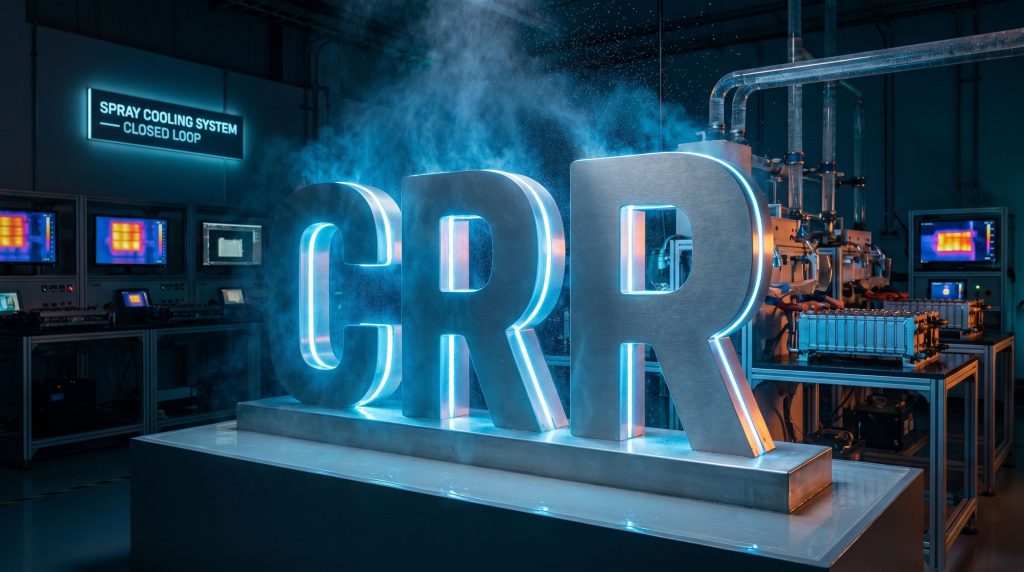
The NTU portfolio centres on a two-phase spray cooling system — a technology that has moved well beyond theoretical modelling and into prototype-validated performance. Rather than cooling an entire facility using conventional air-conditioning or refrigeration chillers, the system sprays a dielectric fluid (electrically non-conductive and commercially available) directly onto heat-generating surfaces — whether those surfaces are processors, graphics chips, or battery components.
The physics are important. When the fluid makes contact with a hot surface, it evaporates instantly. That phase change — liquid to vapour — removes heat at a rate far exceeding any system that keeps the coolant in liquid form. The vapour is captured in a sealed enclosure, condensed back to liquid using near-ambient-temperature fluid, and recirculated in a closed loop. No refrigeration chiller is required.
The portfolio's peer-reviewed performance data, published in Applied Energy (2022) and Energy (2023), supports the following validated outcomes:
| Performance Metric | NTU Two-Phase Spray System | Conventional Air-Cooled System |
|---|---|---|
| Power Usage Effectiveness (PUE) | 1.08 | ~1.69 |
| Total Facility Energy Reduction | 25.8% | Baseline |
| Chip Surface Temperature Reduction | 7°C at full load | Baseline |
| Cooling Fluid Operating Temperature | ~30°C (ambient, no chiller) | Requires refrigeration |
Beyond the core cooling mechanics, the portfolio includes a physics-based thermal model of the spray-cooled system — the foundation for Model Predictive Control (MPC), which adjusts energy use in real time in response to varying ambient temperature and load conditions. This MPC capability is directly applicable to managing battery operating temperatures within an integrated system.
Managing Director Tim Wither commented: "Our solid-state lithium-ion battery programme gives Critical Resources insight across the lithium value chain — from supply at the Mavis Lake Lithium Project through to downstream next-generation lithium-ion battery development. Thermal management sits at the centre of that downstream work: heat directly affects battery performance, cycle life and safety. The NTU portfolio represents a potential future tool for this challenge."
Why Thermal Management Matters for Solid-State Batteries
The Heat Problem in Advanced Battery Architectures
For investors less familiar with battery development, the connection between thermal management and battery performance is worth understanding clearly. In any lithium-ion battery architecture — and particularly in solid-state designs — temperature is not simply a comfort variable. It directly governs three foundational performance characteristics:
- Ionic conductivity — the ability of lithium ions to move through the electrolyte, which determines how much power the battery can deliver
- Interface stability — the integrity of the boundary between electrolyte and electrode materials, which degrades faster at elevated temperatures
- Performance degradation rate — how quickly the battery loses capacity over repeated charge/discharge cycles
For solid-state batteries operating in warm or high-density environments — think tropical climates, densely packed server rooms, or industrial applications — controlled thermal conditions are not optional. They are a prerequisite for consistent, repeatable, and safe operation.
Furthermore, CRR's solid-state battery evaluation programme is already generating datasets on electrolyte conductivity, interface stability, and cathode/electrolyte construction. As that programme moves toward prototype configurations, managing heat at the component level becomes a practical engineering requirement, not a downstream consideration. The NTU licence addresses that requirement directly.
Understanding Key Thermal Management Terms
| Term | Definition |
|---|---|
| Two-phase cooling | A cooling method where a liquid absorbs heat by evaporating (changing phase), removing far more energy than liquid-only systems |
| Dielectric fluid | An electrically non-conductive liquid safe for direct contact with electronic components and battery systems |
| Power Usage Effectiveness (PUE) | A data centre efficiency ratio; a PUE of 1.0 is perfect efficiency, meaning all power goes to computing rather than cooling overhead |
| Model Predictive Control (MPC) | A real-time control system that uses a predictive model to optimise energy use based on anticipated conditions |
| Ionic conductivity | The ability of lithium ions to travel through a battery electrolyte — higher conductivity means better power output |
| Solid-state battery | A battery architecture that replaces the liquid electrolyte with a solid material, offering potential advantages in safety, energy density, and longevity |
The Research Team Behind the Technology
The NTU thermal management portfolio was developed under the leadership of two faculty members from NTU's School of Mechanical and Aerospace Engineering:
Associate Professor Wong Teck Neng — holds a Ph.D. in Mechanical Engineering from the University of Strathclyde, with more than 35 years of expertise in two-phase flow, heat transfer, spray cooling, and thermal management of electronics.
Assistant Professor Ho Jin Yao — holds a Ph.D. in Mechanical Engineering from NTU, with more than 10 years of experience in interfacial transport, surface micro/nanostructuring, and phase change heat and mass transfer.
The research team also includes research fellow Liu Pengfei, former research fellow Ranjith Kandasamy, and former Associate Professor Toh Kok Chuan, whose contributions underpin the two peer-reviewed publications accompanying this announcement.
Associate Professor Wong Teck Neng noted: "Instead of cooling the entire data centre conventionally, we designed special sprays that target heat directly at the server level. By focusing cooling at the source of heat generation, the system enables more efficient heat removal and reduces unnecessary energy consumption. This targeted approach minimises thermal resistance and ensures that cooling capacity is utilised where it is most effective."
Assistant Professor Ho Jin Yao added: "This work demonstrates the potential of spray cooling as a high-performance solution for server thermal management. By leveraging phase change heat transfer and optimising liquid–surface interactions, the system can significantly enhance cooling efficiency for high-power electronic devices."
Transaction Structure and Development Timeline
CRR's approach to this licence is deliberately capital-light and milestone-driven. The commercial structure is straightforward:
| Term | Detail |
|---|---|
| Evaluation consideration paid | SGD$10,000 |
| Option exercise deadline | 30 September 2026 (extendable by written agreement) |
| Commercial licence duration | 10 years |
| Total scheduled licence consideration | SGD$220,000 (excl. patent cost recovery) |
| Patent cost recovery | 100% of IP registration and past patent filing expenses + 15% IP management overhead |
| Licence holder (commercial) | Critical Resources Limited |
The company will undertake a structured evaluation of the technology portfolio following finalisation of a Research Collaboration Agreement with NTU, which remains under discussion. Each stage of development is gated by independent technical and commercial validation, meaning capital is deployed only as milestones are met.
Upcoming steps in the evaluation programme include:
- Finalisation of a Research Collaboration Agreement with NTU Singapore
- Structured technical evaluation of the thermal management portfolio
- Assessment of integration potential with CRR's existing solid-state battery development programme
- Decision on whether to exercise the option for a full commercial licence by 30 September 2026
Building a Lithium Value Chain from Mine to Battery
One of the more strategically interesting aspects of CRR's trajectory is the deliberate breadth of its position across the lithium value chain. The company holds:
- Mavis Lake Lithium Project — Ontario, Canada (upstream lithium supply)
- Solid-state battery evaluation programme — downstream battery development and IP generation
- NTU thermal management licence — component-level technology applicable to both battery systems and data centre infrastructure
- Halls Peak Base Metals Project — New South Wales, Australia
- Gold portfolio — New Zealand
The Critical Resources NTU Singapore thermal management licence for solid-state batteries extends this downstream footprint in a direction that connects battery performance optimisation with the fast-growing data centre cooling market. The two-phase spray cooling system's design advantage — eliminating refrigeration chillers and operating at ambient temperature — has the greatest commercial relevance in high-density, high-ambient-temperature installations, including in Southeast Asian and other warm-climate markets.
CRR has been explicit that it will continue to direct the majority of its expenditure toward its exploration projects in the foreseeable future. However, the battery technology evaluation programmes are positioned as optionality-expanding activities — generating insight, IP exposure, and potential commercial pathways without requiring large upfront capital commitments.
The next major ASX story will hit our subscribers first
Investment Considerations for Critical Resources
CRR's expansion into thermal management IP through NTU Singapore reflects a considered approach to building downstream optionality from a lithium mining foundation. Several characteristics of this programme are worth noting:
Capital discipline: The evaluation licence cost SGD$10,000, with the full commercial licence structured over a ten-year period for SGD$220,000 — a low-cost option on technology with peer-reviewed, prototype-validated performance data.
Independent validation: The technology's performance benchmarks are published in Applied Energy and Energy, two respected peer-reviewed journals, not internal claims.
Research quality: The NTU team brings decades of specialist expertise in the exact technical domain relevant to CRR's battery programme.
Strategic coherence: Thermal management directly addresses a known bottleneck in solid-state battery development for warm-climate or high-density applications.
Milestone-gated structure: The company's evaluation approach is explicitly designed to be capital-light, with each stage requiring independent technical and commercial validation before further commitment.
The option exercise deadline of 30 September 2026 represents a near-term decision point that investors should monitor — it will indicate whether the technical evaluation has met the thresholds required for the Critical Resources NTU Singapore thermal management licence for solid-state batteries to progress to a full commercial arrangement.
Investment Summary: Critical Resources has secured a low-cost, prototype-validated thermal management technology licence from one of Asia's leading research universities, directly extending its solid-state battery evaluation programme into the critical challenge of heat control. With an option exercise deadline of 30 September 2026 and a structured, milestone-gated evaluation underway, CRR is methodically building downstream technology optionality across the lithium value chain — from the Mavis Lake Lithium Project through to next-generation battery development and now integrated thermal management. Investors should watch for the outcome of the Research Collaboration Agreement with NTU and the company's decision on the full commercial licence option.
Want to Learn More About Critical Resources' Battery Technology Programme?
Critical Resources (ASX: CRR) is methodically building a position across the full lithium value chain — from the Mavis Lake Lithium Project through to solid-state battery development and now prototype-validated thermal management technology licenced from one of Asia's leading research universities. With a capital-light, milestone-gated evaluation structure and a key commercial decision point set for 30 September 2026, CRR offers investors a rare combination of upstream resource exposure and downstream battery technology optionality. To learn more about the company and its projects, visit the Critical Resources website.