July 28, 2026
The Hidden Bottleneck Holding Back Eastern Mediterranean Gas
For more than a decade, the Eastern Mediterranean has occupied a paradoxical position in global energy markets. Geologists and upstream analysts have consistently ranked it among the most significant offshore gas frontiers of the modern era, yet the region's ability to translate discovered reserves into delivered molecules has lagged far behind its geological promise. The gap between resource identification and commercial production has been shaped not by geology, but by a far more complex set of forces: fractured bilateral relationships, absent infrastructure corridors, and the inherent difficulty of structuring commercial agreements across multiple sovereign jurisdictions simultaneously.
It is against this backdrop that the Cronos gas field Cyprus FID carries its full weight. Confirmed in July 2026, the Final Investment Decision by Eni and TotalEnergies to develop Block 6 offshore Cyprus is not simply a capital commitment to a single deepwater field. It is the resolution of years of accumulated obstacles in one of the world's most commercially promising, yet structurally complicated, upstream frontiers.
When big ASX news breaks, our subscribers know first
Cyprus in the Regional Gas Hierarchy
To appreciate what Cronos represents, it helps to understand where Cyprus has historically sat relative to its neighbours. Israel's Leviathan and Tamar fields have been producing and exporting for years. Egypt's Zohr discovery, brought onstream in 2017, rapidly became one of the largest gas fields in the Mediterranean basin and positioned Egypt as a functioning LNG export state. Cyprus, despite being geologically contiguous with these producing provinces, remained a net energy importer throughout this period.
The reasons are instructive. Cyprus lacked the domestic demand base to justify standalone LNG infrastructure, lacked a pipeline interconnection to regional markets, and faced a political environment that complicated commercial negotiations with potential partners. Block 6, the country's most commercially advanced offshore acreage, held genuine resource potential, but converting that potential into capital commitment required a solution to all three problems simultaneously.
The Cronos development solves them through a single strategic insight: rather than building new infrastructure, route the gas through infrastructure that already exists.
Field Fundamentals: What the Cronos Resource Base Actually Looks Like
The Cronos gas field is a deepwater discovery situated within Block 6 in Cypriot offshore waters. Its resource base, estimated at more than 3 trillion cubic feet (Tcf) of gas initially in place, places it firmly in the category of commercially material deepwater developments by any global standard.
The development plan is structured around four subsea production wells, a deliberately compact well count relative to the total resource size. This reflects a phased development philosophy, preserving optionality for future appraisal and expansion activity within the block while limiting upfront capital exposure. Plateau production is targeted at approximately 500 million cubic feet per day (MMcfd), a rate that would make Cronos a meaningful contributor to Mediterranean LNG supply at full capacity.
Key field parameters at a glance:
| Parameter | Detail |
|---|---|
| Field location | Block 6, offshore Cyprus (deepwater) |
| Gas initially in place | More than 3 Tcf |
| Development wells | 4 subsea wells |
| Plateau production rate | ~500 MMcfd |
| Operator | Eni (50% equity interest) |
| Partner | TotalEnergies (50% equity interest) |
| FID date | July 2026 |
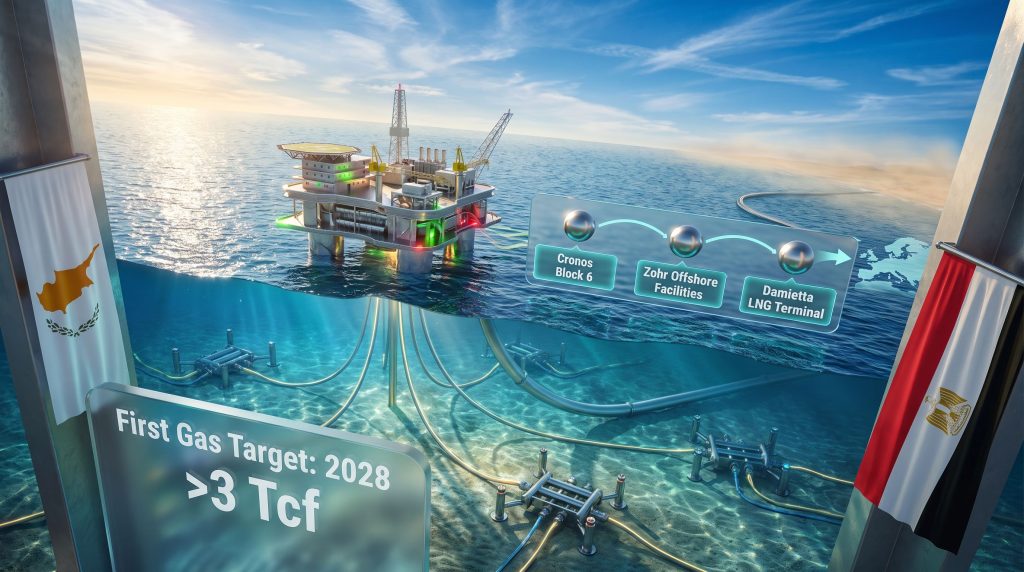
| First gas target | 2028 |
| Primary export market | European LNG buyers |
What makes the 2028 first gas target particularly notable is the speed it implies for a project of this complexity. Deepwater developments with cross-border export logistics have historically required six to eight years from FID to first production. The Cronos timeline compresses this significantly, a direct consequence of the infrastructure-sharing strategy at the heart of the project's design.
The FID That Almost Didn't Happen: A Chronology of Delays
Understanding the significance of the July 2026 FID requires acknowledging how close the project came to prolonged further delay. The original timeline had anticipated a decision as early as March 2026, but contractual negotiations between the operating partners and the Cypriot government introduced friction that stalled the process for several months.
The core dispute centred on liability frameworks within the development and production agreement. Resolving who bears financial and operational responsibility across a multi-jurisdictional project involving two supermajors, two sovereign governments, and third-party infrastructure access is a genuinely complex legal and commercial exercise. These negotiations do not move quickly by nature.
The critical turning point came in May 2026, when the Cypriot Cabinet formally approved the development and production plan, clearing the primary regulatory obstacle and establishing the sovereign-level alignment required for partners to commit capital.
A simplified timeline of the path to FID:
| Milestone | Period | Outcome |
|---|---|---|
| Original FID target | March 2026 | Missed due to contractual negotiations |
| Liability framework disputes with Nicosia | March to May 2026 | Extended negotiation period |
| Cypriot Cabinet approval of development plan | May 2026 | Regulatory pathway cleared |
| Commercial framework agreements finalised | May to July 2026 | Gas transport, processing, liquefaction, marketing |
| Final Investment Decision confirmed | July 2026 | Project formally sanctioned |
| First gas target | 2028 | On schedule post-FID |
Egypt as the Commercial Engine: Why the Damietta-Zohr Route Is the Project's Core Innovation
The export strategy underpinning the Cronos gas field Cyprus FID deserves careful examination, because it is simultaneously the project's most elegant feature and its most significant risk management mechanism.
Rather than developing greenfield LNG export infrastructure, which would require multi-billion-dollar capital commitments and add years to the development schedule, the Cronos partners have engineered the project around two existing Egyptian assets: the Zohr offshore facilities in Egyptian Mediterranean waters, and the Damietta LNG liquefaction terminal on Egypt's northern coast. This approach directly addresses the energy export challenges that have historically undermined Eastern Mediterranean project viability.
Gas produced at Cronos will travel via a subsea pipeline to the Zohr receiving infrastructure, then move onshore through Egypt's existing pipeline network to Damietta, where it will be liquefied and loaded onto LNG carriers bound primarily for European import terminals.
This approach is not merely a logistical convenience. For a field the size of Cronos, greenfield LNG infrastructure costs for comparable deepwater-to-LNG projects in the region could have been two to three times higher, with first gas potentially delayed by three to five additional years. The Egypt infrastructure-sharing model is the economic enabler that made the project viable under current gas price expectations.
The infrastructure chain in full:
| Asset | Location | Function within Cronos export chain |
|---|---|---|
| Cronos subsea wells (x4) | Block 6, Cypriot deepwater | Gas production source |
| Subsea pipeline | Cyprus to Egypt offshore corridor | Gas transport to receiving hub |
| Zohr offshore facilities | Egyptian Mediterranean waters | Receiving, transit, and processing hub |
| Damietta LNG terminal | Northern Egypt | Liquefaction and cargo loading |
| European LNG import terminals | Various EU member states | End-market delivery points |
The Damietta Terminal: An Underappreciated Strategic Asset
The Damietta LNG terminal has an interesting history that adds context to its role in the Cronos framework. Originally commissioned in 2004 as one of Egypt's first LNG export facilities, Damietta was subsequently idled for several years as rising domestic gas demand in Egypt consumed available supply. The discovery and development of Zohr transformed Egypt's gas supply balance, and Damietta re-entered service as an export facility. Its integration into the Cronos value chain now gives it a second strategic life as a regional export hub for Eastern Mediterranean gas from non-Egyptian sources.
This is a relatively under-appreciated dimension of the project: Cyprus is effectively monetising its gas resource by piggybacking on infrastructure Egypt built for its own purposes. Furthermore, Egypt benefits by utilising spare or incremental capacity at Damietta while positioning itself as the indispensable transit nation for Eastern Mediterranean LNG. The broader LNG supply outlook for the region makes this arrangement increasingly strategically valuable for both parties.
What the Cronos FID Means for European Energy Security
The timing of the Cronos gas field Cyprus FID is inseparable from Europe's post-2022 energy procurement reality. The structural disruption to Russian pipeline gas supply that accelerated from 2022 onwards created an enduring demand for alternative LNG sources with geographic proximity to European import infrastructure. Mediterranean-origin LNG carries an inherent logistical advantage over long-haul Atlantic or Pacific Basin cargoes for buyers in Southern, Central, and Eastern Europe, both in terms of shipping time and freight cost.
At plateau production of approximately 500 MMcfd, Cronos would contribute a meaningful annual LNG supply volume to European markets. For context, 500 MMcfd sustained over a full year equates to roughly 5.5 billion cubic metres (bcm) of gas annually, a supply stream large enough to matter at the margin for energy-importing European nations, though not transformative on a continent-wide scale.
The project's strategic value is therefore less about volume replacement and more about supply source diversification, adding a new node to Europe's LNG import network that is geologically distinct, politically independent, and geographically proximate. In the context of ongoing global energy trade tensions, supply diversification of this nature carries considerable strategic weight for European policymakers.
The Cronos development also complements rather than competes with existing Eastern Mediterranean supply flows. Israeli LNG from the Leviathan field, routed through Egypt's other liquefaction facility at Idku, already supplies European buyers. Cronos adds a parallel stream through Damietta, effectively deepening the Eastern Mediterranean's collective export capacity to European markets.
The next major ASX story will hit our subscribers first
The Regional Gas Hub Thesis: Ambition, Reality, and What Comes Next
Both Eni and TotalEnergies have framed the Cronos development as a foundational step toward establishing Cyprus as a regional gas hub. The concept envisions Cyprus as a coordination point for gas aggregation, processing, and export, drawing on discovered resources across multiple offshore blocks and potentially multiple jurisdictions over time.
This ambition is credible but conditional. The hub thesis depends on several factors materialising in sequence:
-
Successful execution of the Cronos development itself, demonstrating that cross-border infrastructure sharing works as planned and that the Damietta export route can reliably handle gas from non-Egyptian sources at scale.
-
Appraisal success within the remaining resource inventory of Block 6, which the operating partners have indicated could support additional development phases beyond the initial four-well programme.
-
Renewed exploration investment in other Cypriot offshore blocks, which the Cronos FID is likely to catalyse by demonstrating that Cyprus can bring a project from discovery to development decision.
-
Sustained European LNG demand and pricing levels sufficient to justify incremental upstream investment in the Eastern Mediterranean basin.
The Cronos FID is a necessary condition for the Cyprus hub thesis, but not a sufficient one. What it does provide is the proof of concept that has been missing from Cypriot offshore development for the better part of two decades.
Geopolitical Architecture: Why Bilateral Alignment Was Non-Negotiable
A dimension of the Cronos project that receives less analytical attention than it deserves is the depth of bilateral coordination it required between Cyprus and Egypt. This Egypt-Cyprus agreement is not a simple buyer-seller commercial arrangement. It encompasses pipeline transit rights through Egyptian offshore waters, access to Egyptian processing and receiving infrastructure at Zohr, liquefaction capacity allocation at Damietta, and LNG cargo marketing arrangements with European counterparties.
Each of these workstreams required government-level endorsement from both sovereign parties to give private sector operators the confidence to commit capital. The formal commercial framework agreements covering gas transportation, processing, LNG liquefaction, and marketing represent months of intergovernmental and commercial negotiation running in parallel.
Both governments publicly endorsed the project ahead of the FID confirmation, providing the political certainty that underpinned the capital commitment. This model of state-level cooperation as a prerequisite for private upstream investment is increasingly characteristic of large cross-border energy projects, and Cronos may serve as a template for future Eastern Mediterranean developments that require similar infrastructure-sharing arrangements.
The Cronos project also reinforces the emerging alignment between Cyprus, Egypt, Israel, and Greece as a de facto cooperative energy bloc within the Eastern Mediterranean, a grouping that has institutionalised some of its coordination through bodies such as the East Mediterranean Gas Forum (EMGF). A producing Cyprus strengthens the country's standing within this bloc and reduces its longstanding position as a net energy consumer dependent on imports.
Investment and Commercial Considerations
The following section contains forward-looking observations and should not be construed as financial advice. Investors should conduct independent research and consult qualified advisers before making investment decisions.
From a project economics perspective, the infrastructure-sharing model employed by Cronos has meaningful implications for capital efficiency. The elimination of greenfield LNG infrastructure from the project's scope removes what would otherwise be the single largest cost category in the development budget. However, the broader energy market volatility of recent years means that project economics must be stress-tested against a range of price scenarios. While neither Eni nor TotalEnergies has publicly disclosed detailed capex figures for Cronos, comparable deepwater developments routed through existing LNG infrastructure have historically demonstrated materially better capital intensity metrics than standalone greenfield projects.
The four-well development concept also preserves significant upside optionality. Should appraisal activity within Block 6 confirm additional recoverable volumes beyond the initial Cronos resource estimate, the existing export infrastructure at Zohr and Damietta could potentially accommodate incremental production without proportionate increases in capital expenditure, improving the economics of future development phases substantially.
For the broader Cypriot offshore licensing environment, the FID confirmation is likely to serve as a catalyst for renewed investor interest. Exploration acreage that has been held speculatively by international majors may attract fresh appraisal commitment now that the country has demonstrated a viable pathway from discovery to FID. The licensing risk premium that has historically been applied to Cypriot acreage should, rationally, compress in response to this demonstrated project viability. The favourable LNG import economics emerging across Asian markets also provide an additional demand backstop for Eastern Mediterranean production.
Key Milestones to Monitor Through 2028
With FID confirmed, the critical execution milestones that will determine whether the 2028 first gas target is achieved include:
-
Commencement of subsea drilling and infrastructure installation programmes in deepwater Block 6
-
Finalisation and execution of long-term LNG offtake agreements with European buyers, which will likely serve as the commercial foundation for project financing
-
Completion of pipeline interconnection works linking Cronos subsea infrastructure to the Zohr receiving facilities
-
Commissioning activities at Damietta to accommodate the incremental gas volumes flowing from Cyprus
-
Regulatory and operational clearances required under the bilateral Cyprus-Egypt framework for cross-border gas transit
Any slippage in the pipeline interconnection or Damietta commissioning workstreams carries the highest schedule risk, given their dependency on coordinating across two sovereign jurisdictions and multiple operating entities simultaneously.
Frequently Asked Questions: Cronos Gas Field FID
What is the Cronos gas field?
Cronos is a deepwater natural gas field located within Block 6 offshore Cyprus. It holds more than 3 Tcf of gas initially in place and is being developed by Eni as operator with a 50% interest, alongside TotalEnergies holding the remaining 50%. It represents Cyprus's first hydrocarbon production project.
What does FID mean in the context of Cronos?
A Final Investment Decision is the formal authorisation by project partners to commit full-scale capital expenditure and proceed with development construction and drilling. The Cronos gas field Cyprus FID, confirmed in July 2026, sanctioned the four-well subsea development and associated export infrastructure arrangements.
When will the Cronos gas field start producing?
First gas from Cronos is targeted for 2028. This is a relatively compressed timeline for a deepwater development involving cross-border export logistics.
How will Cronos gas reach European markets?
Produced gas will travel via subsea pipeline to Egypt's Zohr offshore facilities, move onshore through Egypt's pipeline network, be liquefied at the Damietta LNG terminal, and then exported as LNG cargoes primarily to European import terminals.
Why was the FID delayed from its original March 2026 target?
Protracted negotiations over liability frameworks within the development and production agreement between the project partners and the Cypriot government delayed the decision. The Cypriot Cabinet's approval of the development and production plan in May 2026 cleared the primary obstacle, enabling FID confirmation in July 2026.
What is the production capacity of the Cronos field?
The development is designed to achieve plateau production of approximately 500 MMcfd from four subsea wells, equating to roughly 5.5 bcm of gas annually at sustained plateau rates.
Want to Stay Ahead of the Next Major Resource Discovery?
Discovery Alert's proprietary Discovery IQ model delivers real-time alerts on significant ASX mineral discoveries, transforming complex resource data into actionable investment insights — explore historic examples of exceptional discovery returns and begin your 14-day free trial to position yourself ahead of the broader market.