Dalaroo Metals Ltd
- ASX Code: DAL
- Market Cap: $25,496,579
Dalaroo Metals Mobilises for Its Most Ambitious Greenland Field Season Yet
Dalaroo Metals Ltd (ASX: DAL; OTCQB: DALMF) has commenced mobilisation for the Dalaroo Metals Blue Lagoon Greenland exploration campaign at the Blue Lagoon Critical Minerals Project in southern Greenland, according to the latest ASX announcement dated 23 June 2026.
The company reports that this field season is designed to expand on the 2.7 kilometre mineralised corridor outlined in 2025, where peak surface results reached 4.42% ZrO₂, 99 ppm hafnium (Hf), and 0.81% Total Rare Earth Oxides (TREO). For 2026, Dalaroo Metals Ltd is moving to a dual onshore and offshore program, introducing an integrated "source to sink" approach for the first time at Blue Lagoon.
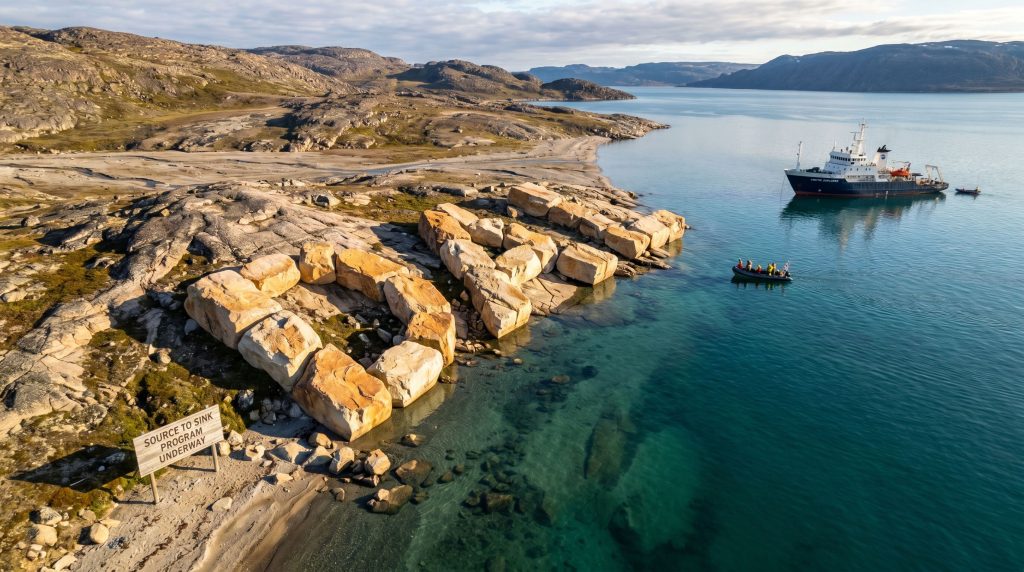
CEO John Morgan and Exploration Manager Trystan Hughes are leading the field team, with equipment and supplies currently being transported by barge through Greenland's fjords to the main landing site.
"Getting our mobilisation underway is always an exciting milestone when operating in Greenland. Moving heavy equipment, camp infrastructure, and scientific gear through these icy fjords requires meticulous planning, and our logistics partners at Xploration Services Greenland are doing a phenomenal job ensuring everything moves safely and efficiently.
Importantly, this program is designed to build upon the encouraging results from our maiden 2025 field season, which confirmed a large-scale critical minerals system extending over at least 2.7 kilometres. The integration of onshore auger drilling and offshore seabed sampling provides an exciting opportunity to test whether heavy mineral concentrations extend beyond the shoreline and potentially increase the overall scale of the system."
When big ASX news breaks, our subscribers know first
What Is New in the 2026 Field Season and Why It Matters?
According to Dalaroo Metals Ltd, the 2026 campaign introduces several material upgrades relative to the 2025 maiden program.
-
Dual-track exploration model
- Onshore auger drilling is to be combined with offshore Van Veen seabed grab sampling.
- This is intended to test both the known onshore mineralised corridor and potential extensions into the nearshore seabed.
-
Integrated logistics and Arctic execution
- Camp infrastructure, drilling rigs and marine sampling equipment are being moved by barge through local fjords.
- Local logistics specialist Xploration Services Greenland has deployed vessels and support teams to manage Arctic transit and vessel coordination.
-
Expanded licence footprint
- Recently approved licences M-516 and M-517 have enlarged the company's ground position within the Gardar Alkaline Province, which is described in the ASX announcement as globally recognised for its association with critical mineral systems.
For investors, these elements indicate that Dalaroo Metals Ltd is moving from early proof-of-concept work toward a broader-scale assessment of the Blue Lagoon system, both along strike and into adjacent marine environments.
Building on the 2025 Discovery Program
The 2026 exploration season has been framed by Dalaroo Metals Ltd as a follow-up to its 2025 maiden field program, which defined a mineralised corridor and delivered notable surface sample grades.
Key 2025 outcomes at Blue Lagoon (from prior ASX reporting):
| Parameter | 2025 result |
|---|---|
| Mineralised strike length identified | 2.7 kilometres |
| Peak ZrO₂ grade | 4.42% ZrO₂ |
| Peak hafnium | 99 ppm Hf |
| Peak TREO | 0.81% TREO |
These results were generated from surface sampling rather than drilling. According to the latest announcement, the 2026 field work is designed to:
- Test extensions of the 2.7 kilometre strike anomaly, both onshore and offshore.
- Assess whether heavy mineral concentrations (such as zircon-rich sediments) have accumulated in nearshore seabed environments through natural transport processes.
- Collect data that may support future geological modelling and, if warranted, later-stage resource definition activities.
For investors, the key question is whether the known corridor can be expanded in length, width or grade distribution, and whether offshore sediments show similar or enhanced enrichment.
Understanding the "Source to Sink" Exploration Model
The 2026 program at Blue Lagoon is built around a "source to sink" exploration model. This concept is central to the company's field strategy, and understanding it can help investors interpret upcoming newsflow.
What Does "Source to Sink" Mean in Exploration?
In geological terms, a source to sink model follows the path of minerals from where they form to where they end up being deposited.
- The source is usually a hard rock body where minerals originate. At Blue Lagoon, the source rocks are part of the Helene alkaline granite and broader Nunarsuit Complex, which are alkaline intrusive rocks.
- Over long time periods, these rocks weather and break down, releasing grains of heavy minerals such as zircon that contains zirconium and often hafnium.
- Water, ice and gravity move these grains through rivers, streams and coastal processes.
- The sink is where those dense grains finally settle and accumulate, often in river channels and floodplains, coastal beaches and dunes, and importantly for this program, nearshore seabed sediments.
Because heavy minerals are denser than ordinary sand, they can be naturally concentrated by flowing water and waves. The company's 2026 program is consequently designed to trace this path from the upstream intrusive source rocks onshore, through surrounding sediments and transport pathways, down to nearshore seabed zones where those minerals may have concentrated.
If the same mineral signature that was identified onshore is confirmed offshore in enriched seabed sediments, this would suggest that the mineral system is being expressed over a larger area and in multiple environments.
Key Technical Terms in Plain Language
Dalaroo Metals Ltd uses several technical terms in its announcement. For clarity, the core concepts can be summarised as follows:
| Term | Plain-language explanation |
|---|---|
| ZrO₂ (Zirconium dioxide) | The main oxide form of zirconium. It commonly occurs in the mineral zircon, which is used in ceramics, refractories, and specialised industrial applications, including some nuclear and advanced material uses. |
| TREO (Total Rare Earth Oxides) | A measure that adds up all rare earth oxides present in a sample. It is a standard way of reporting total rare earth content. |
| Hafnium (Hf) | A metal that often occurs alongside zirconium in zircon. It is used in nuclear reactor control rods and in semiconductor manufacturing. |
| Auger drilling | A shallow drilling technique that uses a rotating screw-like tool to bring up samples of soil or sediment. It is suited to testing unconsolidated (loose) material. |
| Van Veen grab sampler | A clam-shell type device that is lowered from a boat to the seabed. When closed, it grabs a sample of seabed sediment for analysis. |
| Ground Penetrating Radar (GPR) | A tool that sends radio waves into the ground and records the reflected signals. It helps create an image of subsurface layers without the need for extensive drilling. |
| Bathymetric profiling | Mapping the depth and shape of the seabed to identify where sediments have collected and how thick those sediments might be. |
| Gardar Alkaline Province | A geological region in South Greenland made up of ancient rift-related intrusive rocks that are internationally recognised for hosting critical mineral systems. |
For non-specialist investors, the practical takeaway is that Dalaroo Metals Ltd is combining modern geophysical tools, sediment sampling and shallow drilling to understand where heavy minerals are likely to be concentrated within and around the Blue Lagoon project area.
Why Greenland and the Blue Lagoon Geological Setting Are Relevant
The ASX announcement describes Blue Lagoon as lying within the Paleoproterozoic rift province of South Greenland, which contains sedimentary rocks originally formed from ancient seas, alongside a variety of alkaline volcanic and intrusive rocks that are often associated with rare earth and related critical mineral systems.
Within this broader setting, Blue Lagoon is located inside the Helene alkaline granite, the westernmost exposure of the Nunarsuit Complex. The Nunarsuit Complex is described as the largest of the Gardar-age intrusions in South Greenland, among the youngest of these intrusions, and composed mainly of alkaline syenitic and granitic units.
The project is furthermore bounded to the east by extensive alkalic syenite, which the company notes as supporting the potential for zirconium, niobium and rare earth elements (REE) enrichment. This combination of geological factors is important because alkaline intrusive complexes of this age and type are internationally known to host REE, zirconium, niobium and related critical minerals.
2026 Field Program: Onshore and Offshore Activities
According to the ASX announcement, mobilisation marks the transition into a month-long field campaign that has two main focus areas.
Onshore Activities
Once the barge reaches site and camp is established, the onshore team will begin a structured programme of work, including:
- Detailed geological and structural mapping — recording rock types and structural features that may control mineral distribution.
- Surface sampling and sediment characterisation — systematic collection of surface material to assess mineral content, grain types, composition and visible heavy mineral content.
- Grain-size analysis — measuring how coarse or fine the sediments are to help track how minerals have been transported.
- Systematic auger drilling — shallow drilling into sediments across prospective areas to build a 3D picture of where heavy minerals occur.
- Ground Penetrating Radar (GPR) — non-invasive geophysical imaging of subsurface layers to identify potential heavy mineral-rich zones without extensive drilling.
These activities are designed to extend the known 2.7 kilometre onshore anomaly and better define the internal distribution of heavy minerals within the sedimentary cover.
Offshore Activities
At the same time, offshore operations will focus on several complementary workstreams:
- Nearshore geochemical sampling — collecting and analysing water and sediment samples to detect trace elements associated with the mineral system.
- Bathymetric profiling — mapping seabed topography and depth to locate sediment accumulation zones that may host dense mineral layers.
- Van Veen seabed grab sampling — using local marine vessels to obtain seabed sediment samples in targeted locations, testing whether hydraulic concentration zones exist where water movement has sorted and concentrated zircon-rich minerals.
"Initiating this mobilisation is a major milestone for our technical team. Operating in Greenland demands absolute logistical precision, and hitting our shipping window means we are perfectly positioned to capitalise on this high-impact summer field season. This year, we are transitioning from a purely onshore focus to a fully integrated 'source-to-sink' campaign. Our 2025 program proved the baseline fertility of the project, tracking a 2.7-kilometre strike anomaly with peak values up to 4.42% ZrO2 and encouraging rare earth enrichment.
The 2026 campaign allows us to track these high-grade sediments from their upstream intrusive source rocks down into the nearshore environments. By deploying Van Veen grab samplers alongside onshore auger drilling, we are actively testing whether natural tidal action has created high-grade hydraulic concentrations of zircon-rich minerals on the seabed. We are eager to establish camp and get this program underway," said Trystan Hughes, Exploration Manager – Greenland and Western Australia.
For investors, the offshore component introduces an additional dimension, as it may highlight sediment-hosted heavy mineral concentrations that have different development characteristics compared with hard rock deposits.
Upcoming Catalysts and Newsflow Expectations
Dalaroo Metals Ltd has outlined a sequence of expected milestones for the 2026 season.
| Catalyst | Status (per ASX announcement) |
|---|---|
| Camp establishment and mobilisation completion | In progress |
| Commencement of auger drilling | Upcoming |
| Initial offshore seabed sampling | Upcoming |
| Geological mapping and sampling | Upcoming |
| GPR results | Upcoming |
| Metallurgical test work | Upcoming |
| Auger drilling results | Upcoming |
These activities are likely to generate a series of updates as results become available. For investors tracking the Dalaroo Metals Blue Lagoon Greenland exploration campaign, areas of particular interest will include any extension to the 2.7 kilometre mineralised corridor, evidence that offshore seabed sediments host similar or higher grade mineralisation, and initial metallurgical test work providing early indications of mineral processability.
Broader Investment Context for Dalaroo Metals Ltd
While this ASX announcement is focused on Blue Lagoon, Dalaroo Metals Ltd positions itself as a multi-asset exploration company with exposure to critical minerals and gold. According to the company profile in the same announcement, the portfolio includes:
- Blue Lagoon Project, Greenland — prospective for rare earth elements (REE), zirconium and niobium.
- Bondoukou and Bongouanou Gold Projects, Côte d'Ivoire — located in the Birimian Greenstone Belt, a well-known gold region in West Africa.
- Lyons River and Watheroo Projects, Western Australia — Australian projects which provide additional exploration exposure.
The company states that its strategy is to advance these projects using modern exploration techniques and to focus on value creation for shareholders, while maintaining responsible exploration and strong corporate governance. For investors, the Blue Lagoon field season is one component of this wider portfolio, but it currently represents a key focus area given the scale of the 2025 surface anomaly and the expanded 2026 program.
The next major ASX story will hit our subscribers first
Why Investors May Keep Dalaroo Metals Ltd on Watch
From an investor perspective, the current mobilisation at Blue Lagoon indicates that Dalaroo Metals Ltd has successfully moved into its 2026 field window in a logistically demanding environment. The company is, moreover, testing a clear geological concept via its source to sink model, linking intrusive source rocks, onshore sediments and offshore seabed environments.
The program is structured to deliver multiple data sets, including geological mapping, geophysics via GPR and bathymetry, auger drilling, and seabed sampling. The critical questions that upcoming newsflow may address include whether the 2.7 kilometre corridor can be extended or better defined at depth and width, whether offshore sediments show meaningful concentrations of zirconium, hafnium and REE, and how consistent grades are across both environments.
The Dalaroo Metals Blue Lagoon Greenland exploration campaign has been framed as the company's most extensive field season at this project to date. The combination of dual-track exploration, expanded licences M-516 and M-517, and an established logistics partnership in Greenland provides a structured context for interpreting results as they are reported to the ASX over the coming months.
Want to Learn More About Dalaroo Metals and the Blue Lagoon Critical Minerals Project?
With mobilisation now underway for its most ambitious field season to date, Dalaroo Metals Ltd (ASX: DAL) is advancing a dual onshore and offshore exploration programme across a confirmed 2.7 kilometre mineralised corridor in southern Greenland. Investors looking to understand the full scope of the Blue Lagoon Critical Minerals Project, the company's broader multi-asset portfolio, and the investment case behind its 2026 campaign can find further information at the Dalaroo Metals website.