Dalaroo Metals Ltd
- ASX Code: DAL
- Market Cap: $23,333,302
- Shares On Issue (SOI): 353,534,879
Dalaroo Metals Prepares to Turn the Drill on a 7-Kilometre West African Gold Corridor
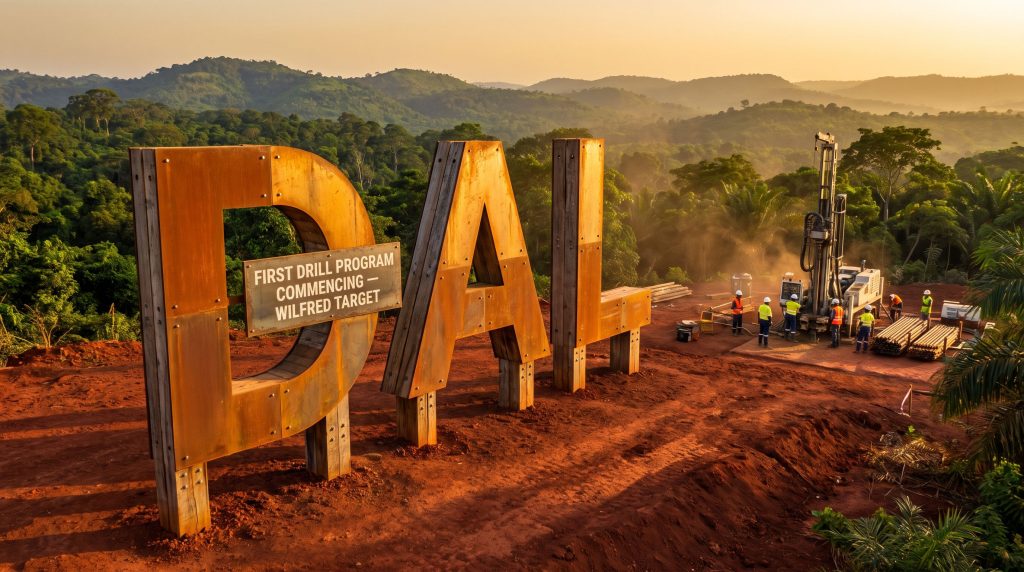
Dalaroo Metals (ASX: DAL) has advanced final planning and site preparation for its maiden drilling campaign at the Gold Ridge Prospect, part of the Bondoukou Gold Project in Côte d'Ivoire. Dalaroo Metals Gold Ridge drilling at the Bondoukou Gold Project in Côte d'Ivoire represents the company's most ambitious exploration program to date, with a planned 20,000-metre combined drilling campaign now approaching commencement. Drill pad preparation is scheduled to begin within days, followed by Reverse Circulation (RC) rig mobilisation.
The program marks a transition from surface-level geochemical work that has already identified a 7-kilometre gold-anomalous corridor, to systematic drill testing at depth for the first time. For investors, this represents the point where several years of methodical exploration groundwork meet the drill bit.
When big ASX news breaks, our subscribers know first
From Surface Anomaly to Drill Target: What's Been Built
Dalaroo's exploration team has progressively built a multi-dataset targeting model that underpins the upcoming program. The corridor hosts three named priority targets — Wilfred, Mag and Ali — each supported by a convergence of exploration evidence gathered over previous campaigns.
According to the announcement, the datasets informing the drill program include:
- Soil geochemistry, with peak results reported at 23.26 g/t gold and a 4.3-kilometre anomaly identified in earlier campaigns
- Auger drilling results
- Geological and structural mapping
- Rock-chip sampling
- Drone imagery
- Interpreted geological contacts and structures
- Distribution of artisanal workings, which the company describes as a historically reliable field indicator of mineralisation in West African gold terrains
This body of work has allowed Dalaroo to move from an initial geological concept to a defined, multi-target corridor. The upcoming drilling, furthermore, represents the first opportunity to test whether surface and near-surface gold anomalism connects to a potentially significant bedrock mineralised system.
A Three-Phase Strategy Built for Discovery Efficiency
Rather than deploying all available metres in a single undifferentiated campaign, Dalaroo has designed a staged drilling strategy applying different drilling methods to different phases of exploration.
| Phase | Method | Planned Metres | Primary Targets | Key Purpose |
|---|---|---|---|---|
| Phase 1 | RC | ~10,000m | Wilfred | Broad initial testing; identify strongest mineralised zones |
| Phase 2 | Diamond Drilling | ~10,000m (combined) | Wilfred (priority positions) plus potentially Mag and Ali | Follow up best RC results; obtain continuous core |
| Phase 3 | Diamond Drilling | Included above | Mag, Ali and Wilfred follow-up | Expand across full corridor using all available data |
| Total | RC and Diamond | ~20,000m | Wilfred, Mag, Ali | Systematic corridor-wide testing |
Drill pad preparation is scheduled to commence during the coming week, with RC drilling targeted to begin in early August 2026.
What Does the CEO Say About the Strategy?
"Our drilling strategy has been deliberately structured to apply the most appropriate drilling method at each stage of exploration. Phase 1 will use RC drilling because its faster penetration rate and lower cost per metre allow Dalaroo to efficiently test a greater number of priority positions during the initial discovery phase."
— John Morgan, CEO, Dalaroo Metals
Phase 1 Focus: Why Wilfred First?
The decision to concentrate the opening 10,000 metres of RC drilling exclusively at the Wilfred Target is described in the announcement as technically driven rather than a matter of convenience.
Wilfred is reported as the largest of the three priority targets, extending over approximately 3 kilometres within the Gold Ridge corridor. It is supported by anomalous gold geochemistry, favourable geological contacts, interpreted structures and the presence of nearby artisanal workings, which together represent the strongest convergence of exploration indicators along the corridor.
Individual RC holes are planned to reach approximately 100 to 150 metres in depth, testing priority geological, structural and geochemical targets beneath the surface and auger anomalies.
According to the announcement, the key objectives for Phase 1 at Wilfred include:
- Drill testing priority soil and auger gold anomalies
- Testing interpreted mineralised structures beneath transported and weathered cover
- Identifying areas of potential bedrock gold mineralisation
- Assessing the potential continuity of mineralisation along strike and at depth
- Determining the orientation and geometry of the principal geological targets
- Investigating the relationship between gold anomalism, geological contacts, quartz veining and interpreted structures
- Prioritising areas for targeted diamond drilling in Phases 2 and 3
- Generating the geological framework required to optimise subsequent programs
Consequently, management has stated that concentrating drilling at Wilfred rather than spreading metres across the entire 7-kilometre corridor is intended to generate a more comprehensive geological dataset and improve the likelihood of identifying coherent mineralised zones from the first campaign.
Understanding the Drilling Methods: RC Versus Diamond
What's the Difference, and Why Does It Matter to Investors?
Two drilling methods are being deployed across this campaign, each selected for specific stages of exploration.
Reverse Circulation drilling uses a rotating drill bit to crush rock, with compressed air returning rock chips to surface through the centre of the drill rods. It is faster and cheaper per metre than diamond drilling, making it suited to the initial discovery phase where the objective is to test multiple targets efficiently across a broad area. Chip samples, however, provide less geological detail than continuous core.
Diamond drilling cuts a continuous cylinder of rock, known as core, from depth using a diamond-tipped bit. This core is physically extracted and preserved, allowing detailed geological logging, structural measurements and mineralogical analysis. It is slower and more expensive than RC, but provides richer information about the orientation, continuity and nature of any mineralisation intersected.
By using RC to first identify the strongest zones within Wilfred, Dalaroo aims to avoid committing to the higher cost of diamond drilling before the geometry of the targets is sufficiently understood. In addition, Phase 1 results are intended to directly inform where and how the diamond holes in Phases 2 and 3 are positioned.
| Feature | RC Drilling | Diamond Drilling |
|---|---|---|
| Cost per metre | Lower | Higher |
| Penetration rate | Faster | Slower |
| Sample type | Rock chips | Continuous core |
| Geological detail | Moderate | High |
| Structural data | Limited | Detailed |
| Best application | Broad initial testing | Targeted follow-up |
Phases 2 and 3: Expanding Across the Full Corridor
Once Phase 1 results are assessed, Dalaroo plans to deploy the remaining ~10,000 metres of diamond drilling across the corridor in two further phases.
Phase 2 is intended to initially target the strongest positions identified by the RC program at Wilfred, using continuous core to confirm the geological setting of any mineralisation, obtain structural measurements, assess mineralisation style and alteration, and test for continuity along strike and at depth. Depending on Phase 1 results, Phase 2 may also initiate diamond drilling at priority positions within the Mag and Ali targets.
Phase 3 is planned to extend diamond drilling to the Mag and Ali targets, with additional follow-up at Wilfred where warranted:
- Mag, located in the northern portion of the Gold Ridge corridor, contains some of the strongest gold-in-soil results reported across the broader project area
- Ali, located in the southern portion of the corridor, represents a further priority target supported by gold geochemistry and structural interpretation
According to the announcement, the final design of Phases 2 and 3 will incorporate all available soil, auger, RC and diamond drilling information. The final sequencing and scale, however, remain subject to Phase 1 results, funding availability and operational conditions.
Operational Readiness: Where Things Stand Today
Dalaroo reports it has moved beyond the planning stage into active site preparation. Current pre-drilling activities include:
- Finalisation and pegging of Phase 1 drill-hole locations, in progress
- Drill pad preparation, scheduled to commence this week
- Preparation and confirmation of drill access routes, underway
- Finalisation of RC rig mobilisation requirements, underway
- Confirmation of water, fuel and field support arrangements, underway
- Finalisation of sampling, logging and quality assurance and quality control (QA/QC) procedures, underway
- Community and stakeholder engagement, ongoing
- Integration of the latest auger drilling and geological data into the final drill design, ongoing
The drilling contractor has already attended the Gold Ridge Prospect and completed site and access inspections, a step the company describes as reducing mobilisation risk.
Community Engagement as Part of the Exploration Strategy
According to the announcement, Dalaroo's Côte d'Ivoire team has maintained ongoing dialogue with local villages, community representatives, landholders and other stakeholders ahead of the drilling campaign. These discussions cover the timing and location of site preparation, access requirements and the nature of the proposed exploration activities.
The company intends to continue this engagement throughout pad preparation, rig mobilisation and the Phase 1 program, and where practicable will support local participation through employment, contracting, transport, accommodation, camp support and local procurement. Dalaroo describes its relationships with local communities as an important part of its exploration strategy and its ability to establish a long-term presence in Côte d'Ivoire.
The Investment Case: Why Gold Ridge Deserves Attention
Several factors combine to make this a notable juncture for investors following Dalaroo Metals Gold Ridge drilling at the Bondoukou Gold Project in Côte d'Ivoire.
Scale of the target: A 7-kilometre gold-anomalous corridor with three named priority targets represents a substantial exploration footprint. The project sits within the Birimian Greenstone Belt of West Africa, a geological terrain recognised globally for hosting significant gold deposits.
Quality of the targeting dataset: The Phase 1 program is underpinned by soil geochemistry — including a peak assay reported at 23.26 g/t gold — auger drilling, structural mapping, rock-chip sampling and drone imagery, a multi-method foundation intended to reduce geological uncertainty ahead of the first drill holes.
Capital-efficient program design: The staged RC-then-diamond methodology is designed to extract information from early drilling before committing to higher-cost diamond metres.
Upcoming catalysts: With pad preparation beginning this week and drilling targeted for early August 2026, assay results from Phase 1 are expected to be released progressively during the second half of 2026.
Portfolio diversification: Alongside Gold Ridge, Dalaroo holds the Blue Lagoon rare earth elements (REE), zirconium and niobium project in Greenland, the Bongouanou Gold Project in Côte d'Ivoire, and the Lyons River and Watheroo Projects in Western Australia, providing exposure across multiple commodities and jurisdictions.
What's Next: Key Milestones to Watch
| Milestone | Expected Timing |
|---|---|
| Drill pad preparation commences at Wilfred | This week (late July 2026) |
| RC rig mobilisation to site | Ahead of August 2026 |
| Phase 1 RC drilling commences | Early August 2026 |
| Progressive RC sample submissions to laboratory | During Phase 1 drilling |
| Phase 1 assay results released | Progressively during H2 2026 |
| Phase 2 diamond drilling design finalised | Following Phase 1 assessment |
| Phase 2 diamond drilling commences | Subject to Phase 1 results |
| Phase 3 diamond drilling across Mag and Ali | Later 2026, subject to results and conditions |
The next major ASX story will hit our subscribers first
Glossary of Key Terms
Reverse Circulation (RC) drilling: A drilling method that returns rock chip samples to surface using compressed air. Faster and cheaper than diamond drilling, suited to initial discovery-phase testing.
Diamond drilling (DD): A drilling method that extracts a continuous cylinder of rock, or core, for detailed geological analysis. More expensive than RC but provides richer data on mineralisation style, structure and continuity.
Gold corridor: A linear zone of anomalous gold geochemistry and geological features suggesting potential for gold mineralisation along strike.
Geochemistry and soil anomaly: The concentration of gold or indicator elements in soil or rock samples above background levels, used to identify areas warranting further investigation.
Auger drilling: Shallow, low-cost drilling used to sample through transported surface material to test for underlying geochemical anomalies.
Birimian Greenstone Belt: An ancient geological terrain across West Africa, including Ghana, Côte d'Ivoire, Burkina Faso and Mali, recognised as a prospective gold-hosting geological environment.
QA/QC: Quality assurance and quality control procedures applied to sampling and laboratory analysis to help ensure the reliability of exploration data.
JORC Code: The Australasian Code for Reporting of Exploration Results, Mineral Resources and Ore Reserves, the industry standard for reporting exploration and resource data on the ASX.
"Dalaroo Metals has built a 7-kilometre gold corridor within the Birimian Greenstone Belt of West Africa and is approaching the commencement of its first drilling program there. With a staged 20,000-metre campaign designed to progressively focus expenditure on the strongest targets, and assay results expected throughout the second half of 2026, Dalaroo Metals Gold Ridge drilling at the Bondoukou Gold Project in Côte d'Ivoire is entering an exploration phase that investors focused on early-stage gold discovery may wish to monitor closely."
Ready to Follow Dalaroo Metals Into Its Most Significant Drilling Campaign Yet?
With drill pad preparation underway at the Gold Ridge Prospect and a 20,000-metre campaign targeting a 7-kilometre gold corridor in the Birimian Greenstone Belt, Dalaroo Metals (ASX: DAL) is entering a pivotal exploration phase. Investors looking to stay across Phase 1 RC drilling results, upcoming assay releases and the broader progress of the Bondoukou Gold Project can find full company and project details at www.dalaroometals.com.au.