
August 5, 2026
When Geology Outlasts the Mine Plan: Understanding the Underground Dimension at Colosseum
Most open pit gold operations follow a predictable arc: drill, define, extract, close. The economic model is linear, the mine life finite, and the investor thesis anchored entirely to what sits above a predetermined pit boundary. But a minority of gold deposits break this pattern, not through exceptional surface grades alone, but through structural geology that refuses to terminate at the pit floor. These deposits, hosted within near-vertical pipe or corridor systems, carry an underground dimension that conventional resource estimates rarely capture in full.
The Dateline Resources Colosseum gold project underground potential sits squarely within this category. What makes it analytically interesting is not simply that mineralisation extends beyond the pit shell, but that the geological mechanism driving that extension is well understood, the surface economics are already validated through a completed Bankable Feasibility Study, and a parallel rare earth story is developing concurrently. Understanding how these threads interact requires moving beyond the headline drill results and examining the full structural picture.
When big ASX news breaks, our subscribers know first
What the Bankable Feasibility Study Actually Establishes
Before underground potential can be meaningfully assessed, the open pit baseline needs to be understood. Dateline Resources recently completed a definitive feasibility study for the Colosseum project, and the economic outputs position it as a project with genuine financial weight, not simply exploration optionality.
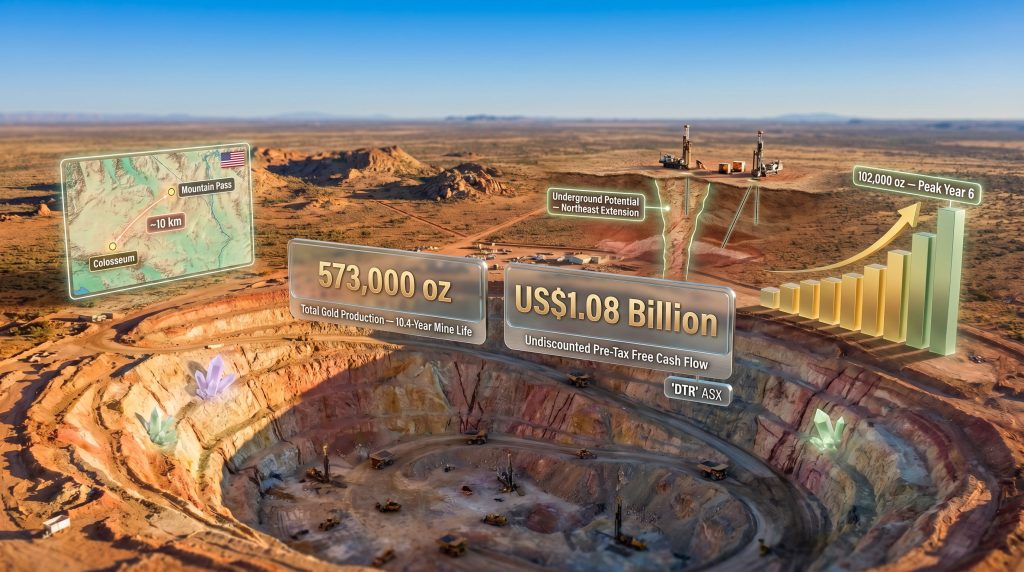
The BFS confirmed US$1.08 billion in undiscounted pre-tax free cash flow, with average annual gold production of 75,000 ounces across the first six years of operations. These are not speculative projections derived from preliminary scoping work; they represent the output of the most rigorous level of technical and economic assessment available to a mining project prior to a Final Investment Decision.
The financial metrics from the BFS, as outlined in available project documentation, are summarised below:
| Metric | Value |
|---|---|
| Total Gold Production | 573,000 oz over 10.4 years |
| Average Annual Production (First 6 Years) | 75,000 oz per year |
| Peak Annual Production | 102,000 oz (Year 6) |
| Operating Margin | Greater than US$2,500 per oz |
| Undiscounted Pre-Tax Free Cash Flow | US$1.08 billion |
| After-Tax Free Cash Flow (Base Case) | US$779 million |
| Low-Grade Stockpile Processing | 11.3 million tonnes through mid-Year 11 |
Disclaimer: Financial projections from feasibility studies are subject to commodity price assumptions, capital cost estimates, and regulatory outcomes. These figures represent the study's modelled scenarios and should not be treated as guaranteed outcomes. Investors should review the full BFS disclosure documentation and seek independent financial advice.
One aspect of the BFS that tends to be overlooked in surface-level coverage is what it excludes. Approximately 55,000 ounces of Inferred Mineral Resources sitting within the pit shell boundary have not been incorporated into the current Ore Reserve estimate. This exclusion follows standard mining industry practice, where Inferred Resources carry insufficient geological confidence to qualify for reserve classification, but it also means the stated economics are conservative relative to what full resource conversion could deliver.
In practical terms, the BFS creates a financially credible platform from which underground development planning can proceed as a logical extension, rather than a speculative leap requiring entirely new capital justification.
The Geology Behind the Underground Thesis
Why Breccia Pipe Structures Matter for Depth Continuity
Not all gold deposits are created equal from an underground development perspective. The Colosseum deposit is hosted within breccia pipe structures, a geological architecture that carries specific implications for depth continuity and underground viability.
Breccia pipes are vertical to near-vertical cylindrical bodies formed by explosive hydrothermal or intrusive events, where fragmented rock is cemented by mineralising fluids. The key characteristic relevant to underground mining is their geometry: because these structures plunge steeply downward rather than flattening out at depth, mineralisation frequently persists well below the limits of open pit extraction.
This contrasts sharply with tabular or stratiform deposits, where ore bodies may pinch or terminate as pit walls deepen. In pipe-hosted systems, the vertical geometry means that:
- Underground development via decline or shaft can follow mineralisation downward without complex directional changes
- Grade profiles at depth often remain consistent with shallow intervals, reducing dilution risk
- The investment in underground access infrastructure can be justified over longer mine life extensions
Historical analogues from pipe-hosted systems across the western United States, including examples in Arizona and Nevada, demonstrate that underground extension plans following open pit completion have added decades to mine life in structurally similar deposits.
What the 2025 and 2026 Drilling Campaigns Are Revealing
Late 2025 drilling at Colosseum's North Pit identified broad zones of consistent gold mineralisation that extended beyond the existing Mineral Resource boundary. This was not a marginal result; the intersections were described as demonstrating genuine breadth, a term in mining that typically implies wide mineralised corridors rather than narrow, high-grade veins, which carry lower dilution risk and better suit bulk underground extraction methods.
Two key drill holes from the ongoing 2026 program have advanced this picture:
- Drillhole CM26-42 extended the mineralised corridor further to the northeast and at greater depth, confirming the northeast extension trend identified in prior campaigns
- Drillhole CM25-41 expanded the mineralised zone by an additional 140 metres downhole, a meaningful step-out that implies the system has not yet approached a geometric boundary
Critically, both intersections sit outside the current Mineral Resource boundary. This matters because they represent genuine resource expansion potential rather than infill drilling within already-defined zones. Furthermore, interpreting gold drill results of this nature requires careful assessment of structural context, not just headline intercept lengths. The practical consequence is that a future Mineral Resource update incorporating these results could materially increase the total ounce inventory available for underground development planning.
Managing Director Stephen Baghdadi has indicated that the recent drill results continue to reinforce the thesis for an underground target to the northeast of the North Pit, with mineralisation remaining open and scheduled for further testing across the coming months.
The Rare Earth Dimension: A Second Economic Engine at Depth
Understanding the Strategic Context of REE Mineralisation at Colosseum
The Dateline Resources Colosseum gold project underground potential cannot be fully assessed without examining the rare earth element component, which adds a second commodity dimension that fundamentally changes the project's long-term economic calculus.
Colosseum is situated approximately 10 kilometres from Mountain Pass in San Bernardino County, California. Mountain Pass operates as the only active rare earth mining operation in the United States, a distinction that carries significant national strategic weight given ongoing concerns about supply chain concentration in critical minerals. The rare earth strategic importance of this geographic proximity is geologically meaningful, suggesting the two sites may share analogous mineralising processes and potentially similar REE-bearing lithologies.
The U.S. Department of the Interior has recognised Colosseum's rare earth potential by designating it as what has been described as the nation's second rare earth mine, a classification that reflects the national significance of the asset's REE mineralisation rather than confirmed production status.
What the Current Rare Earth Drilling Program Is Targeting
The rare earth drilling program at Colosseum has now been expanded to 18 holes, following encouraging results from initial drill holes. The key indicator being referenced by management is the presence of high-density rocks, a proxy geological signal that merits further explanation.
In rare earth exploration, high-density rock associations are considered meaningful because rare earth oxide minerals, including bastnäsite, monazite, and xenotime, are notably denser than common silicate gangue minerals. When drill core or chips exhibit anomalously high density, it suggests the presence of heavy mineral phases consistent with REE mineralisation. This is not definitive confirmation of economic grades, but it represents a geologically grounded basis for expanding the drill program.
Two dedicated drill rigs are currently targeting rare earth mineralisation simultaneously with the gold drilling program. This parallel approach reflects a deliberate strategy to advance both commodity streams within the same drilling campaign window, maximising data collection ahead of any resource update.
From an investment thesis standpoint, confirmed REE mineralisation at economic concentrations would materially expand the long-term value proposition of any underground development scenario, potentially transforming what is currently modelled as a gold-centric operation into a dual-commodity producer with exposure to critical minerals markets that carry strategic premiums.
How Colosseum Compares to Peer Open Pit Gold Projects
Structural Differentiation in the Junior-to-Mid-Cap Development Sector
Understanding where the Dateline Resources Colosseum gold project underground potential sits relative to comparable ASX-listed development assets requires examining the structural characteristics that distinguish projects with genuine post-pit optionality from those that terminate at the open pit boundary.
| Factor | Colosseum (ASX: DTR) | Typical Open-Pit-Only Project |
|---|---|---|
| Post-Open-Pit Development Pathway | Underground optionality identified and drilling active | Mine closure at pit exhaustion |
| Inferred Resources Outside Current Reserve | Approximately 55,000 oz excluded from Ore Reserve | Typically minimal or nil |
| Geological Depth Continuity | Confirmed via breccia pipe structural geometry | Variable; often uncertain |
| Dual-Commodity Upside | Gold plus rare earth elements | Single commodity exposure |
| National Strategic Asset Recognition | U.S. Department of Interior acknowledged REE significance | Rare in peer group |
The combined effect of these differentiating factors is that Colosseum carries a longer-dated optionality profile than its surface mine plan implies. The 10.4-year BFS mine life represents a floor, not a ceiling, for project duration, contingent on successful drilling outcomes and underground resource definition.
The Development Roadmap: From Open Pit to Underground
How the Three-Phase Operational Structure Works
Understanding the sequencing of Colosseum's development is important for contextualising when and how underground mining becomes relevant. The BFS outlines an operational structure that can be understood in three broad phases:
- Phase 1 (Years 1 to 6): Open pit mining at peak throughput, averaging 75,000 ounces per year with a peak of 102,000 ounces in Year 6
- Phase 2 (Years 7 to mid-11): Processing of the low-grade stockpile totalling 11.3 million tonnes, extending cashflow generation beyond active pit mining
- Phase 3 (Post-Year 11 or concurrent with late pit mining): Underground development targeting the northeast extension and any additional resource defined through current drilling
The structural elegance of this sequencing is that Phase 2 creates a cashflow bridge. Rather than facing an abrupt transition from open pit production to underground capital expenditure, the low-grade stockpile processing period provides operational continuity and, potentially, internal funding capacity during the transition window.
This reduces the financing risk profile of underground development compared to a greenfield underground project where capital must be deployed before any production revenue is generated.
The next major ASX story will hit our subscribers first
Key Risks and Investment Considerations
Technical and Geological Risks
The underground potential at Colosseum remains at an early stage of definition. Several important risk factors must be weighed alongside the opportunity:
- Resource Classification: Inferred Resources carry the lowest confidence level in the JORC resource classification framework. Conversion to Indicated or Measured status requires additional infill drilling, which introduces both time and cost variables
- Geological Uncertainty at Depth: While breccia pipe structures generally exhibit good depth continuity, no deposit is uniform. Grade variations, structural complexity, or unexpected lithological changes at depth could alter the underground economics
- Underground Capital Intensity: The transition from open pit to underground mining typically involves significantly higher capital expenditure per ounce of production, longer lead times for decline or shaft development, and greater geotechnical engineering complexity
- Mineralisation Remains Open: The fact that the deposit boundary has not been defined at depth is simultaneously the opportunity and the uncertainty
Regulatory and Jurisdictional Considerations
Operating in California introduces a permitting environment that is among the most complex for mining operations in the United States. State-level environmental review processes, community engagement requirements, and water resource considerations can materially influence development timelines. However, changes to US mining permits at the federal level may also shape the broader regulatory landscape within which projects like Colosseum operate. These factors apply to surface and underground operations alike and should be assessed independently of any federal-level recognition of the project's strategic significance.
Commodity Price Sensitivity
The BFS economics were modelled under specific gold price assumptions. Underground development viability is inherently more sensitive to gold price movements than open pit operations given higher per-ounce operating costs typical of underground extraction. Similarly, the rare earth component's contribution to overall project economics depends on REE market conditions that have historically exhibited significant price volatility. For additional context on current project economics, Dateline's Colosseum mine page provides further detail on the asset's operational parameters.
This article contains forward-looking statements and financial projections derived from company-disclosed feasibility study data. These projections involve known and unknown risks, uncertainties, and assumptions. Readers should not rely on these projections as predictions of future performance. Independent financial and geological advice should be sought before making investment decisions.
Key Milestones That Will Define the Underground Opportunity
The coming months represent a critical data collection window for assessing whether the Dateline Resources Colosseum gold project underground potential translates from geological promise into a formally defined development option. The specific milestones worth monitoring include:
- Mineral Resource Update: Incorporation of northeast extension drilling data from CM26-42, CM25-41, and subsequent holes into a revised Mineral Resource Estimate
- Inferred to Indicated Conversion: Infill drilling results that allow the geological confidence of current Inferred Resources to be upgraded
- Rare Earth Assay Results: Formal assay data from the expanded 18-hole REE drilling program, which will establish whether high-density rock indicators translate into economic REE concentrations
- Underground Scoping Study: Any formal announcement of an underground scoping or pre-feasibility study would signal management's conviction in the underground thesis
- Continued Open Pit Resource Expansion: Results from ongoing northeast extension drilling that further delineate the geometry and grade profile of the target zone
The parallel deployment of multiple drill rigs across both gold and rare earth targets accelerates data generation across all of these milestones simultaneously, compressing the timeline between current exploration activity and any formal resource update.
What distinguishes the Colosseum situation from many junior gold development stories is the combination of a financially validated surface operation and an identified, geologically credible underground extension that remains completely unpriced in current resource estimates. Whether that combination translates into long-term shareholder value will depend on the drill results yet to come.
Want to Stay Ahead of the Next Major ASX Mineral Discovery?
Discovery Alert's proprietary Discovery IQ model delivers real-time alerts on significant ASX mineral discoveries — turning complex geological and commodity data into actionable investment insights for both short-term traders and long-term investors. Explore historic examples of exceptional discovery returns and begin your 14-day free trial today to position yourself ahead of the broader market.