June 3, 2026
The Hidden Resource Sitting in Plain Sight: Rare Earths from Industrial Waste
The global race to secure rare earth elements is no longer confined to remote mining frontiers or diplomatic negotiations over ore-rich territories. A quieter but equally consequential shift is underway inside existing industrial facilities, where decades of accumulated waste are being reexamined through an entirely new lens. DOE funding for rare earth recovery from red mud is now at the centre of this shift, as vast quantities of material discarded during alumina refining are found to contain meaningful concentrations of elements that power electric motors, defence systems, and next-generation aerospace alloys. The question has never been whether those elements exist inside the waste. The question has always been whether recovering them makes economic and technical sense at scale.
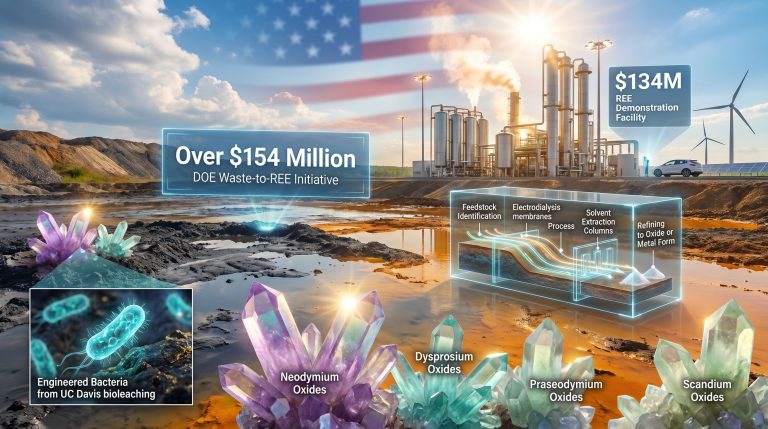
The U.S. Department of Energy has now answered that question with a $134 million funding commitment, signalling a formal transition from laboratory curiosity to industrial demonstration.
When big ASX news breaks, our subscribers know first
Understanding the Rare Earth Supply Chain Problem First
Before examining what this funding actually targets, it is worth understanding the structural vulnerability that makes it necessary. The United States is a major consumer of rare earth elements across defence, clean energy, and advanced manufacturing, yet its domestic processing infrastructure remains disproportionately thin relative to its consumption needs.
More than 85% of global rare earth separation and refining capacity is concentrated in a single foreign jurisdiction. This is not merely a trade statistic. It represents a systemic chokepoint in supply chains that underpin F-35 fighter jets, wind turbine generators, EV traction motors, and medical imaging equipment. Furthermore, federal agencies have classified REE supply disruption as a top-tier national security and energy security risk, and multiple legislative and executive mechanisms have directed agencies to accelerate domestic supply chain alternatives.
The challenge, historically, has been identifying feedstocks that are both sufficiently rich in REE content and economically accessible without requiring entirely new mining operations. Understanding the broader rare earth supply chain is essential context here, as industrial waste streams have emerged as a compelling answer on both criteria.
What Red Mud Actually Is and Why It Matters
The Bayer Process Byproduct Most People Have Never Heard Of
Red mud, formally known as bauxite residue, is the highly alkaline slurry left over after bauxite ore has been processed into alumina using the Bayer Process. For every tonne of alumina produced, roughly 1.0 to 1.5 tonnes of red mud are generated as a byproduct. Given the enormous global scale of alumina refining, this adds up fast.
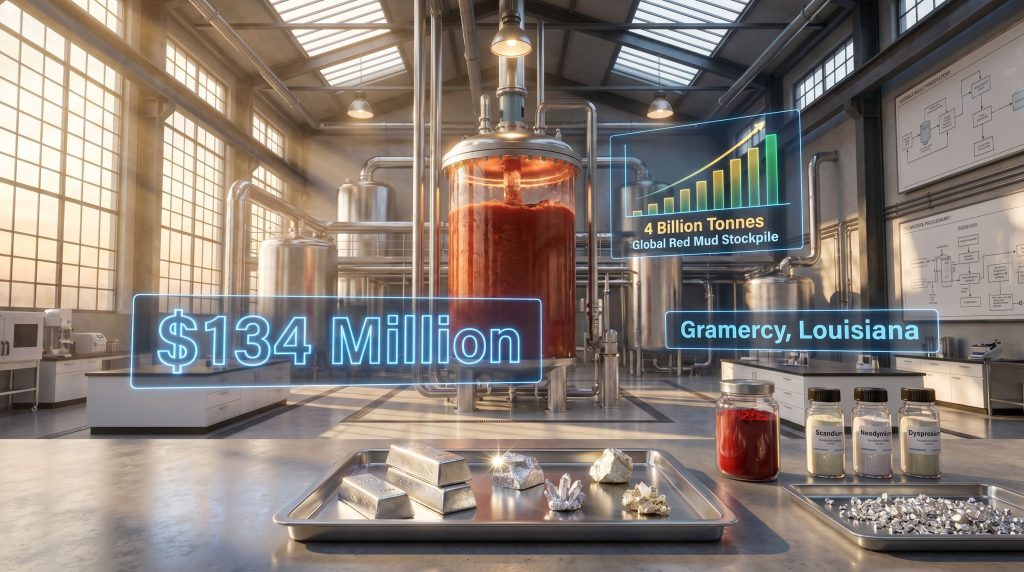
Global red mud stockpiles are estimated to exceed 4 billion tonnes, with accumulation rates of approximately 180 million tonnes per year. These stockpiles exist at refinery sites across the world, representing both a long-standing environmental liability and, increasingly, a potential resource inventory.
The material is difficult to handle. Its pH typically ranges from 10 to 13, making it corrosive and chemically reactive. It also contains trace quantities of naturally occurring radioactive materials, and its mineralogy is complex enough to frustrate straightforward chemical extraction approaches. These characteristics explain why red mud has historically been treated as waste rather than resource.
What Is Actually Inside Bauxite Residue
The REE content of red mud varies by source bauxite deposit and refinery processing conditions, but recoverable concentrations of several strategically important elements have been documented consistently. Scandium is particularly notable: its concentration in red mud can rival or exceed that found in dedicated scandium ore deposits, which are themselves rare globally. This is a fact not widely appreciated outside specialist geochemical circles.
Beyond scandium, neodymium and dysprosium are present at recoverable levels. These two elements are critical inputs for the permanent magnets used in EV motors, wind turbines, and military guidance systems. Cerium and lanthanum, while less strategically scarce, are relatively abundant in bauxite residue and carry value in catalyst and optical applications.
| REE Component | Primary Strategic Application | Concentration in Red Mud |
|---|---|---|
| Scandium | Aerospace alloys, solid oxide fuel cells | Moderate to high |
| Neodymium | Permanent magnets, EV drivetrains | Recoverable levels |
| Dysprosium | High-temperature magnets, defence hardware | Trace to moderate |
| Cerium | Catalysts, glass polishing compounds | Relatively abundant |
| Lanthanum | Fluid cracking catalysts, optics | Relatively abundant |
Heavy rare earth elements, specifically those used in high-temperature magnet applications and defence electronics, carry the highest strategic premium. Their presence in red mud, even at trace-to-moderate concentrations, is meaningful when applied to the billions of tonnes already stockpiled globally. In addition, this potential is amplified by the broader critical minerals demand surge now reshaping federal investment priorities.
How the $134 Million Is Structured Across Two Projects
Project One: Gramercy, Louisiana
The first project is geographically anchored to an existing alumina refinery in Gramercy, Louisiana. This is a deliberate design choice. By locating the facility adjacent to an active red mud generation source, the project avoids the logistical complexity and cost of transporting alkaline slurry over long distances. The site also provides access to legacy stockpiles accumulated over decades of refinery operation, creating a substantial feedstock inventory beyond what current production alone would supply.
The Colorado School of Mines leads the project, with three supporting partners:
- ElementUSA, contributing industrial development and commercialisation capability
- Pacific Northwest National Laboratory (PNNL), a DOE-affiliated national lab with deep expertise in advanced separation chemistry and process scale-up
- Principal Mineral and Rare Earth Technologies, providing rare earth processing specialisation
The facility's objective is to extract rare earth oxides from red mud feedstock and convert them into market-ready rare earth metals suitable for integration into domestic industrial supply chains. PNNL's involvement is particularly significant because national laboratory participation provides independent technical validation that strengthens credibility with downstream commercial investors.
Project Two: Phoenix Tailings and the Multi-Feedstock Approach
The second project takes a deliberately broader approach. Phoenix Tailings, a private-sector rare earth processing company already focused on waste-derived REE production, leads a consortium that includes MIT and the University of Minnesota. The facility this team is building is designed to handle multiple industrial waste streams rather than a single feedstock source, creating a more flexible processing platform.
Where the Gramercy project tests a site-specific, single-source model, the Phoenix Tailings project tests whether a generalised multi-feedstock architecture can achieve comparable output quality and consistency. The DOE's decision to fund both simultaneously reflects an acknowledgment that no single technical approach has yet proven definitively superior.
The Broader DOE Critical Minerals Funding Context
This $134 million allocation sits within a larger federal investment portfolio targeting unconventional domestic REE sources:
| DOE Program | Allocation | Target Feedstock |
|---|---|---|
| REE Extraction and Refining Demonstration | $134 million | Red mud, industrial waste, tailings |
| Coal Byproduct REE Recovery | $17.5 million | Coal ash and byproducts |
| Secondary and Unconventional Sources | Up to $19.5 million | Red mud, e-waste, mine tailings |
The cumulative signal is clear: U.S. federal policy has formally repositioned industrial and mining waste streams as legitimate domestic REE resource categories, not afterthoughts. Consequently, the critical raw materials transition now extends well beyond primary mining into the realm of waste-derived recovery.
The Processing Pathway: From Alkaline Slurry to Usable Metal
A Step-by-Step Technical Overview
Understanding how red mud is converted into market-ready rare earth metals helps clarify both the technical ambition and the engineering challenges involved:
- Feedstock preparation: Red mud is drawn from active refinery output or legacy storage ponds and assessed for REE concentration and mineralogical composition.
- Pre-treatment: The highly alkaline slurry undergoes pH neutralisation through acid addition and physical dewatering to reduce moisture content and prepare the material for downstream chemistry.
- Leaching: Acid or alkaline leaching reagents are applied under controlled conditions to solubilise rare earth elements from the mineral matrix. Selective leaching agents can preferentially mobilise target REEs while leaving gangue minerals undissolved.
- Separation: Solvent extraction or ion exchange processes isolate individual rare earth fractions from the leach solution. This stage requires significant technical precision because REEs are chemically similar and difficult to separate cleanly from one another.
- Purification and refining: Purified rare earth compounds undergo concentration and chemical conversion to produce high-purity oxide or carbonate intermediates.
- Metal production: Final reduction to metallic form is achieved through metallothermic reduction (using reactive metals such as calcium or magnesium) or electrochemical reduction in molten salt systems, depending on the specific element.
- Output: Market-ready rare earth oxides and metals are produced for use in permanent magnet alloys, aerospace materials, defence systems, and industrial applications.
A critical but underappreciated technical challenge in this process is the co-extraction of radioactive thorium and uranium, which occur naturally in bauxite and concentrate in red mud during alumina refining. Managing these radioactive trace elements requires regulatory compliance under the Nuclear Regulatory Commission framework, adding a layer of permitting complexity that pure metallurgical projects do not face. This regulatory dimension is one reason why REE extraction from red mud has moved more slowly than its chemistry alone would suggest.
These rare earth processing challenges are well documented, and overcoming them at demonstration scale is precisely what the DOE investment is designed to prove feasible. For further detail on the DOE's approach, the department's official programme overview outlines its broader strategy for domestic REE recovery from unconventional sources.
Why This Represents a Genuine Policy Shift, Not Just a Grant Program
Redefining Industrial Waste as Strategic Mineral Inventory
Federal funding programmes for rare earth recovery are not new. What distinguishes this allocation is the formal inclusion of red mud as a primary eligible feedstock in the DOE's programme documentation. This is a regulatory and policy signal with practical downstream consequences.
Alumina refineries in the United States have historically classified red mud storage as an environmental liability, subject to containment and monitoring obligations under EPA frameworks. A shift in federal framing toward red mud as a recoverable mineral resource creates potential commercial and regulatory incentives for operators to reclassify those stockpiles. Facilities that previously managed red mud purely for containment purposes may eventually face a different set of economic calculations around long-term disposal versus resource recovery.
The Demonstration-to-Scale Investment Logic
The DOE's Manufacturing Deployment Office operates on a staged commercialisation philosophy. Demonstration projects are not endpoints; they are data-generation mechanisms. The performance metrics, processing costs, throughput rates, and product purity benchmarks generated at Gramercy and the Phoenix Tailings facility will constitute the technical and financial evidence base needed to attract private capital for larger commercial-scale replication.
This is the critical gap the DOE funding for rare earth recovery from red mud is designed to bridge. Private investors have been reluctant to commit to red mud REE recovery at scale because no commercially validated processing benchmark existed. The DOE's investment is, in effect, de-risking the evidence base rather than directly funding the commercial outcome.
Geopolitical Dimension: Import Substitution Through Waste Recovery
A successful outcome at Gramercy would provide a replicable technical and regulatory blueprint applicable to other U.S. alumina refinery sites. The United States has multiple operating alumina refineries with significant red mud inventories. Even partial REE recovery across those sites would meaningfully reduce import exposure without requiring new mining permits, greenfield infrastructure, or international ore supply agreements.
This import-substitution logic is what elevates the programme beyond conventional industrial policy into the domain of energy security strategy. DOE officials have framed the projects as a mechanism to expand domestic rare earth availability by drawing value from materials already present within U.S. borders. Furthermore, the concept closely mirrors urban mining opportunities now being explored across other waste-rich sectors, rather than sourcing new primary ore from abroad. Recent reporting on the $134 million DOE commitment provides additional context on how these allocations are being received across the energy sector.
The next major ASX story will hit our subscribers first
Frequently Asked Questions
What is DOE funding for rare earth recovery from red mud?
The DOE has committed up to $134 million for two demonstration projects focused on recovering rare earth elements from industrial waste materials, including bauxite residue generated at alumina refineries. Funding is administered through the DOE's Manufacturing Deployment Office.
Who is leading the red mud rare earth recovery project in Louisiana?
The Colorado School of Mines leads the Gramercy, Louisiana project, supported by ElementUSA, Pacific Northwest National Laboratory, and Principal Mineral and Rare Earth Technologies.
Why is red mud specifically valuable for rare earth recovery?
Red mud contains recoverable concentrations of scandium, neodymium, dysprosium, cerium, and lanthanum that bypass extraction during standard alumina production. Given global stockpiles exceeding 4 billion tonnes, recovery rates that would be considered marginal per tonne still represent substantial aggregate REE output potential.
What other projects share this DOE funding?
Phoenix Tailings, working with MIT and the University of Minnesota, received a portion of the $134 million to build a multi-feedstock rare earth extraction facility. Separately, the DOE has allocated $17.5 million for coal byproduct REE recovery and up to $19.5 million for secondary and unconventional mineral sources.
What are the main technical challenges in extracting REEs from red mud?
The primary technical hurdles include managing extreme alkalinity (pH 10 to 13), handling trace naturally occurring radioactive materials, achieving selective REE separation from complex mineralogy, and scaling laboratory extraction chemistry to industrial throughput without prohibitive reagent costs. Regulatory compliance around radioactive byproduct management adds further complexity not present in conventional mining projects.
Disclaimer: This article contains forward-looking statements and projections based on publicly available information. Nothing in this article constitutes financial, investment, or regulatory advice. Readers should conduct independent research before making any investment or business decisions related to companies, technologies, or policy programmes discussed herein.
Want to Track the Next Major Critical Minerals Discovery Before the Market Does?
Discovery Alert's proprietary Discovery IQ model scans ASX announcements in real time, instantly identifying significant mineral discoveries across rare earths, critical minerals, and more than 30 other commodities — translating complex geological data into clear, actionable investment insights. Explore Discovery Alert's discoveries page to understand the historic returns major mineral discoveries have generated, and begin your 14-day free trial to position yourself ahead of the broader market.