
July 17, 2026
The Hidden Metallurgical Challenge That Shapes Gold Tailings Economics
Surface gold retreatment is rarely as straightforward as it appears. While the concept of reprocessing legacy mine waste sounds operationally simple compared to underground extraction, the metallurgical complexity hidden within decades-old tailings deposits can quietly undermine gold recovery rates, processing economics, and final product quality. One of the least-discussed obstacles in Witwatersrand tailings processing is copper contamination, and understanding how operators solve this problem reveals a great deal about what separates a genuinely efficient retreatment operation from one that merely moves material at scale.
This technical reality sits at the heart of what DRDGOLD has been engineering at its Far West Gold Recoveries operation, where the commissioning of a new DRDGOLD Far West Gold Recoveries smelt house and elution circuit on 14 July 2026 marks a turning point in how the facility functions, and what it can ultimately deliver to stakeholders over the next two decades.
When big ASX news breaks, our subscribers know first
What Far West Gold Recoveries Is and Where It Fits
Far West Gold Recoveries (FWGR) is a surface tailings retreatment operation located on the West Rand of South Africa's Gauteng province. It processes historic gold tailings deposited during decades of conventional underground mining across the Witwatersrand Basin, one of the world's most prolific gold-bearing geological formations.
FWGR operates under a joint structure involving DRDGOLD and Sibanye-Stillwater, with DRDGOLD managing the processing operations. The core processing infrastructure is the Driefontein 2 plant (DP2), which handles the mechanical and metallurgical work of extracting gold from low-grade tailings material at scale.
Within DRDGOLD's broader portfolio, which also includes its Ergo operation in the East Rand, FWGR represents the company's westward expansion into some of the most extensive tailings deposits remaining in South Africa. The strategic logic is straightforward: surface retreatment avoids the capital intensity and safety risks of underground mining while accessing gold resources that were either not fully extracted historically or were simply left behind as uneconomic at the time.
Furthermore, understanding the gold market outlook helps contextualise why operators like DRDGOLD are investing heavily in surface retreatment efficiency at this particular moment in the commodity cycle.
The Witwatersrand Basin hosts one of the world's largest concentrations of historic gold tailings, accumulated over more than a century of deep-level hard-rock mining. As conventional underground grades decline, surface retreatment has emerged as a lower-risk, lower-capital-intensity pathway to gold production, provided processing infrastructure achieves sufficient throughput scale and metallurgical efficiency.
How the Carbon-in-Leach Process Works in a Tailings Retreatment Context
Understanding the significance of the DRDGOLD Far West Gold Recoveries smelt house and elution circuit requires a working knowledge of the carbon-in-leach (CIL) process, which is the foundational metallurgical method used at DP2.
The process follows a distinct sequence:
- Tailings slurry is reclaimed from surface deposits and fed into a series of CIL tanks at the Driefontein 2 plant.
- A cyanide solution dissolves gold from the slurry, forming a gold-cyanide complex in the liquid phase.
- Activated carbon granules added to the tanks adsorb the dissolved gold, concentrating it onto carbon surfaces, a step known as loading.
- Loaded carbon is separated from the slurry and advanced through the elution circuit.
- The elution process strips gold off the carbon using a heated alkaline solution, producing a gold-rich eluate.
- The eluate passes through electrowinning cells, where electric current deposits gold as a sludge onto steel wool cathodes.
- The electrowinning sludge is dried and fed into the smelt furnace, where it is melted and poured as doré gold bars.
What Elution Actually Does and Why It Matters
Elution is a term that often gets glossed over in high-level operational summaries, yet it is arguably the most metallurgically critical step between raw tailings and a saleable gold product. The elution process relies on reversing the adsorption that occurred in the CIL tanks: by exposing loaded carbon to a hot caustic solution, typically sodium hydroxide and sodium cyanide at elevated temperatures, the gold-cyanide complex is desorbed from the carbon surface and transferred into the liquid phase as a concentrated eluate.
In tailings retreatment specifically, elution efficiency matters more than in conventional milling operations because feed grades are inherently low. When you are processing material that might contain fractions of a gram of gold per tonne, every percentage point of recovery lost through inefficient stripping directly compresses the economics of the entire operation. This is where cut-off grade economics become especially relevant to evaluating a tailings retreatment asset.
The Copper Problem: Why Witwatersrand Tailings Present a Unique Metallurgical Challenge
Here is where the operational history of FWGR becomes genuinely instructive. Witwatersrand tailings are not clean gold deposits. They are the residue of a century of hard-rock mining through geologically complex reefs that contain a range of sulphide minerals, including copper-bearing species.
When copper dissolves into the cyanide leach solution alongside gold, it competes for adsorption sites on the activated carbon. This co-loading of copper onto carbon creates a contamination problem that carries all the way through to the final doré product. The practical consequence is a gold bar with a lower payable content, meaning a higher proportion of the bar's mass is occupied by base metal contamination rather than gold.
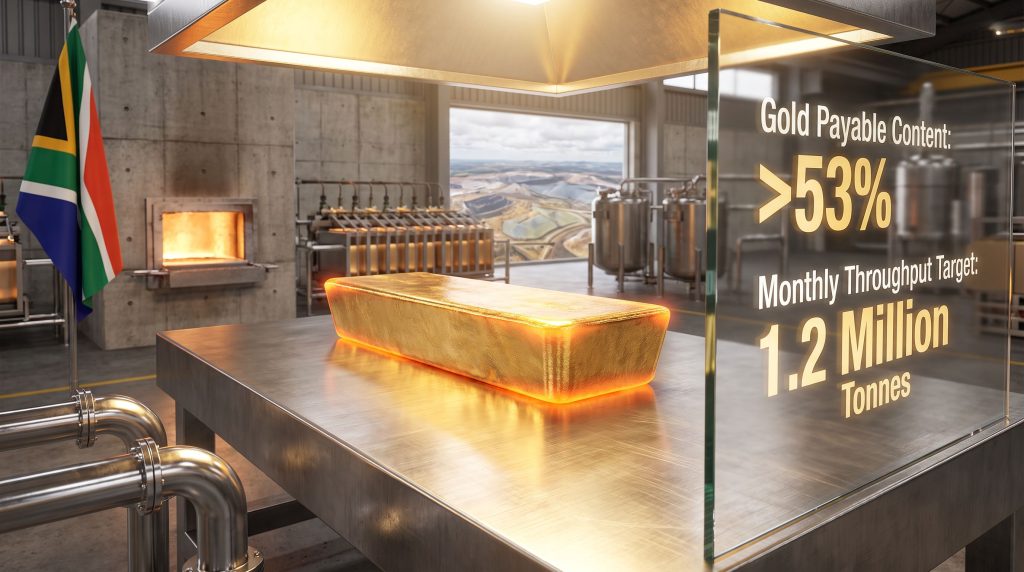
Before FWGR commissioned its copper elution circuit in May 2021, payable gold content in the smelted product was running at approximately 33%. That figure is strikingly low by industry standards and reflects just how significant the copper co-loading challenge was at this particular operation.
The R12 Million Solution and Its Measurable Impact
The copper elution circuit, commissioned at a capital cost of R12 million, was designed to address this problem by inserting a dedicated copper-stripping stage ahead of the gold elution step. By selectively desorbing copper from the loaded carbon before the gold elution circuit processes it, the system dramatically improves the purity of the gold-bearing eluate that eventually reaches the electrowinning cells and smelt furnace.
The results were material:
| Metric | Before Copper Elution Circuit | After Copper Elution Circuit |
|---|---|---|
| Gold Payable Content | ~33% | >53% |
| Payable Gold in Smelt | Below benchmark | ~99% |
| Circuit Commissioning Cost | N/A | R12 million |
| Commissioning Date | N/A | May 2021 |
Moving payable gold content from roughly one-third to over half represents an enormous improvement in product quality. According to Proactive Investors, the copper elution circuit was expected to deliver an additional 12 kg to 18 kg of gold per month, fundamentally changing the revenue equation for every bar poured. The R12 million investment, modest by mining capital standards, delivered a return that would be difficult to overstate in the context of a high-volume tailings operation.
The Smelt House Commissioning: What Changed on 14 July 2026
Prior to the commissioning of the on-site smelt house at Driefontein 2, Far West Gold Recoveries was transporting loaded carbon off-site to a third-party facility for final smelting. This dependency introduced logistical complexity, security risk across an extended chain of custody, and a time lag between gold production and gold realisation as revenue.
The commissioning of the DRDGOLD Far West Gold Recoveries smelt house and elution circuit on 14 July 2026 eliminated all of these vulnerabilities in a single operational step. FWGR is now a fully vertically integrated gold recovery operation, handling every stage of the process from raw tailings reclamation through to the pouring of finished doré bars on-site.
The inaugural pour produced a 17 kg doré gold bar, which was airlifted by helicopter immediately after production. The logistical choice underlines the security sensitivity of the product and the operational seriousness with which DRDGOLD is treating this milestone.
What Full Processing Integration Means Beyond the Headlines
The strategic implications of bringing smelting on-site extend well beyond the symbolic first pour:
- Revenue cycle compression: Gold moves from electrowinning sludge to refined product without the delays associated with off-site transport and third-party processing schedules.
- Chain-of-custody control: Every gram of gold product remains within DRDGOLD's operational perimeter until the doré bar is dispatched directly to a refinery, reducing exposure to in-transit risk.
- Cost structure improvement: Eliminating third-party smelting fees and associated transport costs reduces the per-ounce processing cost, improving margin at every gold price level.
- Operational sovereignty: FWGR is no longer dependent on external processing capacity or scheduling, which matters particularly during periods of high industry utilisation when third-party smelter access can become constrained.
The DP2 Expansion: A 140% Throughput Increase Targeting 2027
The smelt house commissioning does not exist in isolation. It is one component of a much larger capital programme that DRDGOLD has branded Vision 2028, encompassing R10 billion in total capital expenditure across its operations.
At the centre of the FWGR component of Vision 2028 is the Driefontein 2 expansion, which targets a throughput increase from the current 500,000 tonnes per month to 1.2 million tonnes per month, representing a 140% uplift in processing capacity.
| Parameter | Current | Post-Ramp-Up | Change |
|---|---|---|---|
| Monthly Throughput | 500,000 t | 1,200,000 t | +140% |
| Mine Life Extension | Baseline | ~16 additional years | Significant |
| Full Ramp-Up Target | N/A | Q3 2027 | ~12 months from commissioning |
| Capital Programme | N/A | R10 billion (Vision 2028) | Multi-year |
Why a 16-Year Mine Life Extension Is Transformative
A 16-year mine life extension is not simply a production planning metric. It reshapes the financial architecture of the entire operation in several important ways:
- Long-term offtake arrangements become viable at extended tenors, improving counterparty confidence.
- Capital investment in on-site infrastructure, including the new smelt house, is amortised across a substantially larger production base.
- The operation achieves sufficient scale to justify further incremental investment in metallurgical optimisation and automation.
- For investors and analysts assessing net asset value, a 16-year extension at significantly higher throughput rates represents a material uplift in the present value of future cash flows.
Disclaimer: Forward-looking statements regarding mine life extensions, throughput targets, and capital expenditure programmes involve inherent uncertainties. Actual outcomes may differ materially from projections due to geological, regulatory, operational, and commodity price variables. This article does not constitute financial advice.
Ramp-Up to Q3 2027: What the Timeline Requires
Reaching full throughput of 1.2 million tonnes per month by the third quarter of 2027 requires disciplined execution across several parallel workstreams: continued civil and mechanical construction at DP2, commissioning of additional processing capacity, progressive commissioning of the new smelt house at scale, and stable tailings reclamation logistics to feed the expanded plant.
The on-site smelt house, now operational, removes one potential bottleneck from this ramp-up sequence. With smelting capacity confirmed and the elution circuit performing to specification, DRDGOLD can focus the remaining execution risk on throughput infrastructure rather than downstream processing readiness.
The next major ASX story will hit our subscribers first
Surface Retreatment Economics: Why Low Grade Does Not Mean Low Value
A common misconception among investors new to the tailings retreatment sector is that low feed grades necessarily imply low-value operations. The economics of surface retreatment are fundamentally different from underground mining and need to be evaluated through a different lens. In addition, the gold price impact on mining equities makes surface retreatment assets particularly attractive during periods of elevated gold prices, as their lower cost structures amplify margin expansion.
Key factors that define retreatment economics include:
- Volume throughput: Processing millions of tonnes per month at low grade can generate substantial gold output if recovery rates are well-controlled.
- Strip ratio: Surface retreatment has no strip ratio in the conventional mining sense. Material is reclaimed from existing deposits with no blasting, tunnelling, or underground infrastructure cost.
- No new exploration risk: The tailings inventory is physically present and measurable. There is no geological discovery risk of the kind that characterises greenfield mining projects.
- Rehabilitation credit: In South Africa, retreating tailings also progressively reduces legacy environmental liability, which carries regulatory and reputational value for mining companies operating under the Mineral and Petroleum Resources Development Act framework.
- Processing efficiency as the primary value driver: Unlike underground operations where ore grade is largely fixed by geology, tailings retreatment operations can meaningfully improve their effective grade through better metallurgical recovery, which is precisely what the copper elution circuit and integrated smelt house achieve at FWGR.
Furthermore, mining sustainability transformation is increasingly relevant here, as progressive tailings remediation aligns FWGR's operational expansion with broader environmental, social, and governance expectations placed on South African mining operators.
Development Timeline: Key Milestones at Far West Gold Recoveries
| Year | Milestone | Significance |
|---|---|---|
| May 2021 | Copper elution circuit commissioned | Gold payable content rose from ~33% to >53% |
| 14 July 2026 | Smelt house and gold elution circuit commissioned | First on-site doré pour; full processing integration achieved |
| Q3 2027 (target) | Full DP2 ramp-up to 1.2 Mt/month | 140% throughput increase; 16-year mine life extension |
Frequently Asked Questions: DRDGOLD Far West Gold Recoveries Smelt House and Elution Circuit
What is the Far West Gold Recoveries smelt house?
The smelt house is an on-site facility at the Driefontein 2 plant where electrowinning sludge from the gold elution circuit is dried and melted in a furnace, producing doré gold bars that are then dispatched to a refinery. It was commissioned on 14 July 2026.
When was the new elution circuit at Driefontein 2 commissioned?
The gold elution circuit was commissioned alongside the smelt house in July 2026. The earlier copper elution circuit was commissioned in May 2021.
What is the purpose of the copper elution circuit?
It strips copper contamination from loaded carbon before the gold elution stage, preventing copper from degrading the purity of the final gold product. Without it, gold payable content in the smelt was approximately 33%.
How much did the copper elution circuit cost to build?
The copper elution circuit was commissioned at a capital cost of R12 million.
What was the weight of the first doré bar poured at the Far West smelt house?
The inaugural doré bar weighed 17 kilograms and was airlifted by helicopter immediately after production.
How will the DP2 expansion change monthly throughput?
The expansion targets an increase from 500,000 tonnes per month to 1.2 million tonnes per month, a 140% uplift, with full ramp-up targeted for Q3 2027.
What is DRDGOLD's Vision 2028 capital programme?
Vision 2028 is DRDGOLD's multi-year capital expenditure programme totalling R10 billion, directed at expanding processing capacity and extending mine life across its operations, with FWGR's DP2 expansion forming a central component.
Why does Far West Gold Recoveries process tailings rather than mine underground ore?
Surface tailings retreatment eliminates underground mining costs and risks, requires no drilling or blasting, carries no new exploration risk, and progressively remediates historical environmental liability. At sufficient scale and with efficient metallurgical recovery, it can be a highly competitive gold production model. Investors assessing exposure to this space can explore different gold mining stock types to understand where tailings operators sit within the broader investment universe.
What the Smelt House Commissioning Signals for DRDGOLD's Trajectory
The commissioning of the DRDGOLD Far West Gold Recoveries smelt house and elution circuit is best understood not as a single event but as the visible culmination of a methodical infrastructure buildout that has been progressing since the copper elution circuit was installed five years earlier.
Each investment has addressed a specific operational vulnerability: first the gold purity problem caused by copper co-loading, and now the off-site smelting dependency that limited operational control and compressed margins. The result is a processing facility that has progressively eliminated its weaknesses while positioning itself for the throughput expansion that will define its financial contribution over the next 16-plus years.
For stakeholders assessing DRDGOLD's capital discipline, the trajectory from a 33% payable gold content operation to a fully integrated producer targeting 1.2 million tonnes per month is a compelling demonstration of how staged infrastructure investment, when executed with technical rigour, can transform a legacy tailings asset into a modern, high-throughput gold operation.
Further reporting on the Far West smelt house commissioning and related South African mining industry developments is available through Mining Weekly, including first doré gold bar pour coverage of this landmark milestone at miningweekly.com.
Want to Track the Next Major ASX Gold Discovery Before the Market Does?
Discovery Alert's proprietary Discovery IQ model delivers real-time alerts the moment significant mineral discoveries are announced on the ASX, transforming complex geological data into clear, actionable insights for both traders and long-term investors — start a 14-day free trial today, or explore why historic discoveries have generated extraordinary returns for investors who acted early.