Dreadnought Resources Ltd
- ASX Code: DRE
- Market Cap: $80,152,800
Dreadnought Resources Drills Out a Growing >7km Gold Corridor at Illaara
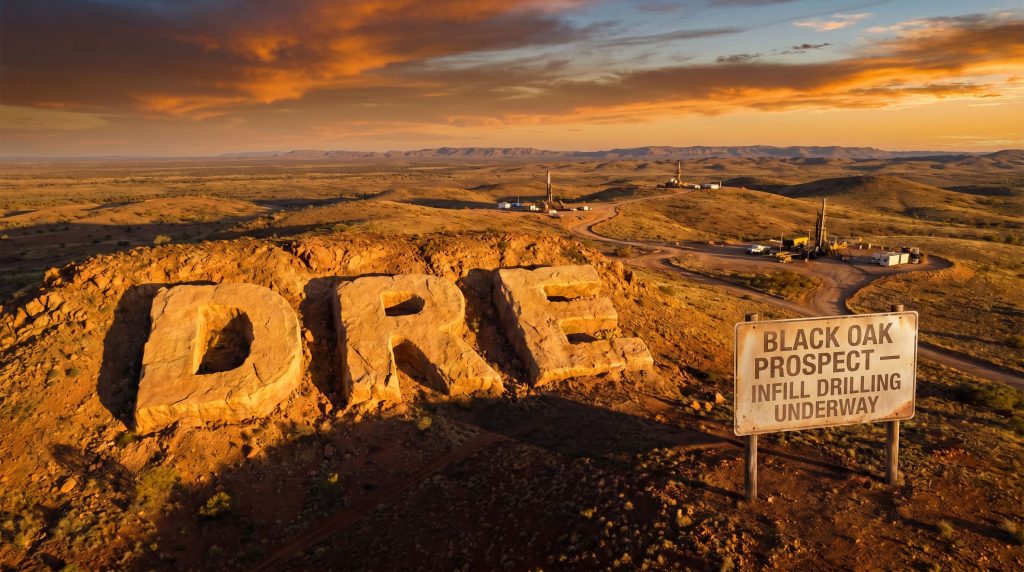
Dreadnought Resources (ASX: DRE) has reported that wide-spaced air core drilling at its 100% owned Illaara Gold Project in Western Australia has outlined a gold-bearing corridor of more than 7 kilometres strike at the Black Oak Prospect. The anomaly remains open to the north, and the result comes from a roughly 500-hole, 35,000-metre program testing about 24km of the Illaara structural zone. This adds to growing evidence that Black Oak may host a large orogenic gold system — a significant development for the Dreadnought Resources Illaara Black Oak gold corridor drilling results story.
The update is material for investors because it expands the scale of the target well beyond earlier work and sets up a more detailed follow-up phase. Dreadnought has stated that infill air core drilling at 25m to 50m spacing will commence immediately after completion of the current June 2026 program, with more assay results expected through August 2026.
"Black Oak is emerging as a genuine large-scale gold system. Wide-spaced drilling has now defined a >7km corridor of gold mineralisation, open to the north and growing, with shallow mineralisation from surface," said Dean Tuck, Managing Director of Dreadnought Resources.
When big ASX news breaks, our subscribers know first
What the Latest Illaara Drilling Results Showed
In the announcement, Dreadnought said assays had been received for a further 288 air core holes. The standout result came from hole ILAC0139, which returned:
- 21m at 0.3 g/t Au from surface, including 3m at 1.1 g/t Au from 3m
- 9m at 0.5 g/t Au from 33m, including 3m at 1.4 g/t Au from 36m
These intercepts sit about 800m along strike from previously announced reverse circulation drilling at Black Oak.
| Hole ID | Interval | Grade | Context |
|---|---|---|---|
| BORC010 | 18m from 138m | 0.3 g/t Au | incl. 1m at 1.8 g/t Au |
| BORC009 | 5m from 70m | 0.8 g/t Au | incl. 1m at 3.3 g/t Au |
| BORC005 | 8m from 76m | 0.6 g/t Au | incl. 1m at 3.1 g/t Au |
| ILAC0139 | 21m from surface | 0.3 g/t Au | incl. 3m at 1.1 g/t Au |
| ILAC0139 | 9m from 33m | 0.5 g/t Au | incl. 3m at 1.4 g/t Au |
While these remain early-stage exploration results rather than a resource estimate, the combination of width, shallow depth and strike continuity is notable. Furthermore, mineralisation begins from surface in some locations, which may simplify future follow-up work if continuity is confirmed.
Four Gold Trends Now Identified at Black Oak
How Many Trends Has the Latest Drilling Defined?
The latest drilling has done more than extend one anomaly. Dreadnought reported that four distinct gold-bearing trends have now been identified at Black Oak, ranging from approximately 2.5km to more than 7km in strike.
Those trends can be summarised as:
- Central corridor: >7km strike, open to the north
- Second trend: more than 4km strike, open along strike
- Third trend: approximately 2.5km to 4km strike, open
- Fourth trend: approximately 2.5km to 4km strike, open
Multiple parallel or related trends can indicate a broader mineralised system rather than a single isolated zone. In practical terms, this can increase the number of drill targets and improve the chances of locating stronger or more continuous mineralisation in later programs.
The announcement also noted that all four trends are associated with a suite of gold-related geochemical indicators, including silver, arsenic, antimony, tellurium and tungsten. For geologists, this is an encouraging sign that the system has a coherent chemical signature.
Why Orogenic Gold Pathfinders Matter
What Are Pathfinder Elements?
One of the more important technical aspects of this update is the reference to orogenic gold pathfinders. Pathfinder elements are metals or metalloids that tend to occur alongside gold in the fluids that form a deposit. Because they can spread more broadly than gold itself, they are often used to identify the outer footprint of a mineral system.
At Black Oak, the company highlighted the presence of Ag-As-Sb-Te-W anomalism, specifically:
- Ag = silver
- As = arsenic
- Sb = antimony
- Te = tellurium
- W = tungsten
In an orogenic gold setting, this combination can indicate that mineralising fluids moved through a large fault or shear zone. The Yilgarn Craton, where Illaara is located, is well known for this style of gold deposit.
Orogenic gold refers to gold deposits formed when hot fluids move through major faults and fractures in the earth's crust. As those fluids cool and react with surrounding rocks, gold and associated elements can be deposited. In exploration, finding both gold and its pathfinder elements across a wide area can increase confidence that drilling is tracking a real mineral system.
For investors, the practical implication is that Dreadnought is not only seeing isolated gold values. It is also seeing the supporting geochemical signature that geologists commonly use to trace larger gold systems. That does not confirm an economic deposit, but it can improve targeting confidence for the next drill phase.
Illaara Remains Lightly Drilled by Modern Standards
The broader appeal of Illaara lies in its lack of systematic historical work. According to Dreadnought, previous ownership by iron ore groups meant the belt was not properly tested for gold using modern air core drilling, despite being located in the highly productive Yilgarn Craton.
The project covers:
- About 800km² of tenure
- About 70km of strike along the Illaara Greenstone Belt
- Roughly 190km from Kalgoorlie
- Close to regional mills including Davyhurst and Bottle Creek
The company also referenced the fact that systematic air core drilling has been an important technique in discoveries such as Hemi, Gruyere, Tropicana and Garden Well. That comparison is about exploration method rather than deposit equivalence, but it does demonstrate why first-pass air core campaigns can be important in covered terrains.
Historically, Black Oak was first identified in 2007 through a roughly 3,000m auger gold-in-soil anomaly, but it was not followed up after the project focus shifted to iron ore. Dreadnought later completed surface sampling in 2020 and drilled three fence lines in 2020 and 2021, returning oxide gold intercepts that now appear to sit within a much larger corridor.
Drilling Strategy Is Shifting from Reconnaissance to Definition
What Does the Transition to Infill Drilling Mean?
The current air core program at Illaara was designed as a regional search tool rather than a resource drill-out. Dreadnought stated the program used 100m to 200m hole spacing on lines spaced 400m to 800m apart — wide spacing intended to map large-scale trends quickly and at lower cost.
The next phase, however, is more targeted.
| Program Metric | Detail |
|---|---|
| Total program | ~500 holes / ~35,000m |
| Strike tested | ~24km of Illaara structural zone |
| Assays received in this update | 288 holes |
| Initial spacing | 100m to 200m hole spacing |
| Drill line spacing | 400m to 800m |
| Program completion | June 2026 |
| Results expected through | August 2026 |
| Planned infill spacing | 25m to 50m |
Dreadnought has confirmed drilling at Black Oak will shift to 25m to 50m infill spacing, intended to define mineralised corridors more clearly and improve geological confidence. For investors, this shift is important. Wide-spaced anomalies can indicate scale, but tighter drilling is needed to test continuity and determine whether a target has genuine resource potential.
Metzke's Find Adds Project-Level Context
Illaara is not a single-prospect story. The project already contains the Metzke's Find Resource of 14,900oz at 6.8 g/t Au, with 72% in the Indicated category. Metzke's Find remains open along strike and at depth, and Dreadnought is moving it toward further study work.
The company's upcoming work plan includes:
- Updated Metzke's Find Resource in June 2026
- RC and diamond drilling at Metzke's Find starting in July 2026
- Metzke's Find study in August 2026
This existing high-grade resource gives Illaara a second layer of investor relevance. Black Oak represents growth exploration, while Metzke's Find provides an established gold inventory that may support near-term development studies.
The company has also described a self-funded explorer strategy, where funding, development, haulage and processing for Metzke's Find could be outsourced to third parties. That is a stated strategy rather than an achieved outcome, but it provides a framework for how development could support future exploration spending.
What Comes Next at Illaara?
News flow from Illaara is expected to remain active through the second half of 2026. According to the work plan in the ASX announcement, upcoming milestones include results from first-pass drilling between Black Oak and CRA Homestead, ongoing air core assays, infill drilling and resource-related updates.
| Timing | Catalyst |
|---|---|
| June 2026 | Updated Metzke's Find Resource |
| June to July 2026 | First-pass drilling results between Black Oak and CRA Homestead |
| July to August 2026 | Further Illaara air core drilling results |
| July 2026 | Start of RC and diamond drilling at Metzke's Find |
| August 2026 | Start of infill AC drilling at Black Oak and CRA |
| August 2026 | Metzke's Find Study |
This sequence should help answer the next important question: can the broad anomalies now outlined by air core drilling be narrowed into coherent mineralised corridors with enough consistency to justify deeper and more detailed work?
The next major ASX story will hit our subscribers first
Why This Update Matters to ASX Gold Investors
This announcement does not present a new resource estimate or economic study. However, several points stand out for investors tracking the Dreadnought Resources Illaara Black Oak gold corridor drilling results narrative.
First, Black Oak has expanded from a historical 3km soil anomaly into a drilled corridor of more than 7km strike, and it remains open. Second, the corridor is accompanied by a pathfinder geochemical signature consistent with an orogenic gold system. Third, mineralisation is shallow in places, including intercepts from surface.
There is also broader portfolio context. Dreadnought controls a large, consolidated land position at Illaara in a recognised gold province, while Metzke's Find already provides a defined high-grade resource on the same belt.
If the planned 25m to 50m infill program confirms continuity within the broader anomalies, Black Oak could move from a large geochemical and shallow drilling target toward something more defined. Until then, the current result is best viewed as a material scale-up in exploration footprint and a firm basis for intensified follow-up at Illaara.
Want to Catch the Next Major ASX Gold Discovery Before the Market Does?
Discovery Alert's proprietary Discovery IQ model scans ASX announcements in real time, instantly identifying significant mineral discoveries like emerging orogenic gold systems — turning complex geological data into actionable investment insights for both short-term traders and long-term investors. Explore how major ASX mineral discoveries have historically generated substantial returns on Discovery Alert's dedicated discoveries page, and begin your 14-day free trial today to position yourself ahead of the market.