The global economy faces mounting challenges as nations seek to balance economic prosperity with security considerations, leading to the widespread adoption of comprehensive economic security doctrine frameworks. Modern governments increasingly recognise that traditional free-market approaches require strategic oversight to address supply chain vulnerabilities, prevent hostile acquisitions of critical assets, and mitigate coercion through resource dependencies. Furthermore, the development of these frameworks represents a fundamental shift from passive trade policy toward active industrial strategy designed to protect national interests whilst maintaining beneficial international economic relationships.
These comprehensive approaches acknowledge that globalisation creates mutual benefits alongside systemic risks requiring careful management. However, critical minerals energy security concerns and the impact of tariffs impacting markets have accelerated the need for strategic responses across multiple sectors simultaneously.
Core Architectural Elements of Modern Economic Security
Contemporary economic security doctrine frameworks operate through three integrated mechanisms designed to address distinct aspects of economic vulnerability. Offensive competitiveness involves strategic government investments in critical sectors to maintain technological leadership and industrial capacity. In addition, defensive resilience encompasses supply chain protection mechanisms and vulnerability mitigation strategies targeting single-point failures.
Cooperative security establishes coordinated responses among ideologically aligned nations to build robust networks resistant to external coercion. These pillars work synergistically rather than independently, as domestic investment programs strengthen negotiating positions with international partners whilst defensive screening mechanisms protect the value of cooperative technology sharing arrangements.
Key Implementation Mechanisms:
- Strategic investment targeting in semiconductor manufacturing, rare earth processing, and advanced materials
- Foreign direct investment screening for technology acquisitions and critical infrastructure
- Export control coordination among allied nations
- Emergency stockpiling and supplier diversification mandates
- Public-private partnerships sharing risks and rewards in strategic sectors
Critical Material Dependencies and Systemic Vulnerabilities
Modern technological ecosystems depend heavily on materials and processing capabilities concentrated in specific geographic regions. This concentration creates cascading vulnerability structures where disruption at any single point affects multiple downstream industries simultaneously. Consequently, understanding these dependencies is essential for designing effective economic security doctrine responses.
Rare Earth Element Concentration Risks
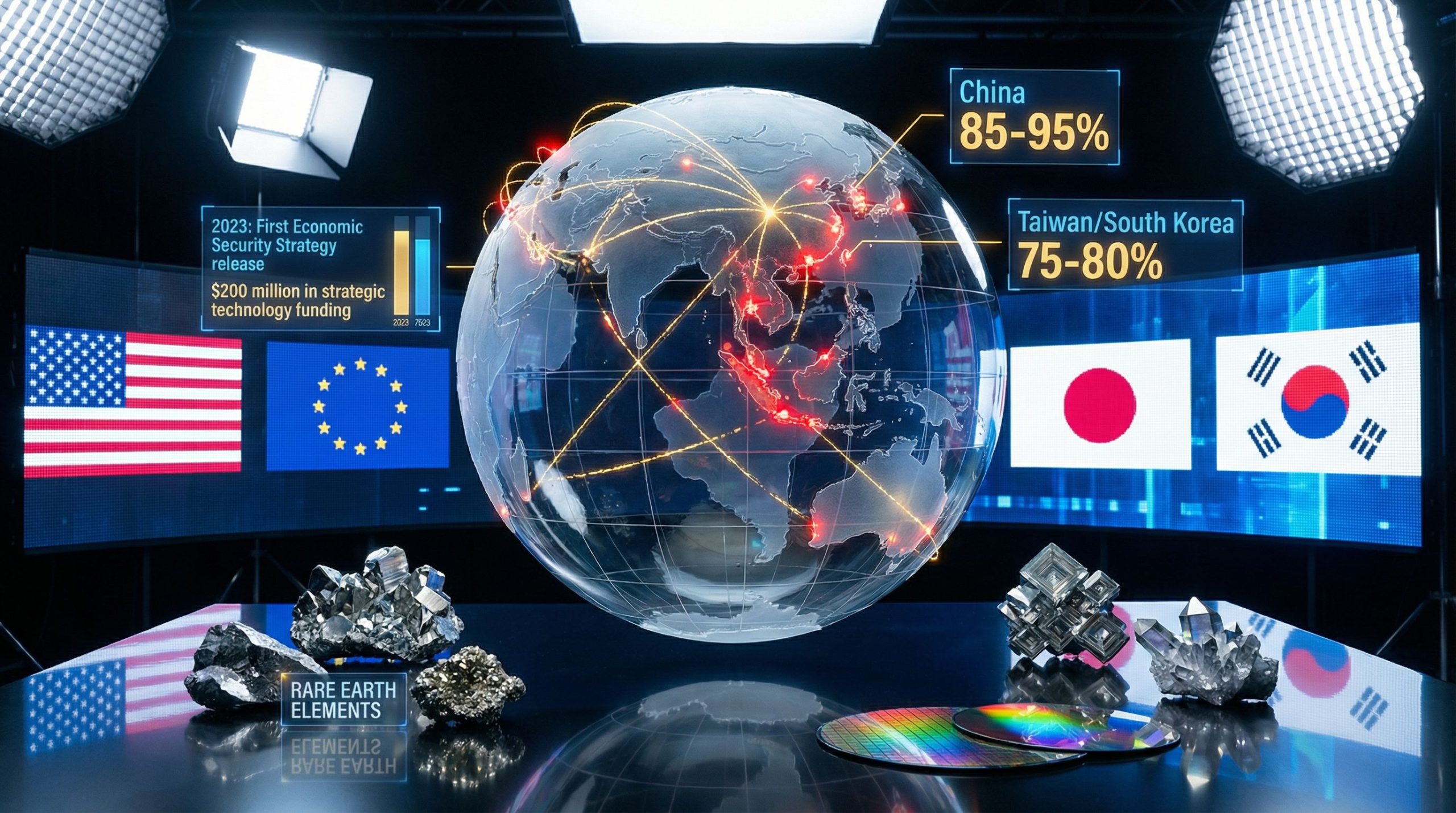
China controls 85-95% of global rare earth processing capacity despite not controlling equivalent mining volumes. For the European Union specifically, this dependency reaches 90-98% for rare earth materials critical to electric vehicle production, renewable energy systems, and advanced electronics manufacturing.
The 2010 rare earth export embargo implemented by China against Japan provides historical evidence of how material dependencies can be weaponised during geopolitical disputes. Furthermore, China reduced export quotas from 65,000 tons in 2009 to 30,000 tons in 2010-2011, representing approximately 50% reduction that created immediate supply shocks for Japanese electronics and automotive manufacturers.
Critical Material Dependencies by Processing Region:
| Material Category | Primary Processor | Global Processing Share | Strategic Applications |
|---|---|---|---|
| Rare Earth Elements | China | 85-95% | EV Motors, Wind Turbines, Defence Systems |
| Lithium Processing | China | 60-70% | Battery Cell Manufacturing |
| Semiconductor Fabrication | Taiwan/South Korea | 75-80% | All Digital Technologies |
| Cobalt Refining | Democratic Republic of Congo | 70% | High-Performance Battery Production |
Semiconductor Manufacturing Concentration
Taiwan and South Korea collectively control 75-80% of global semiconductor manufacturing capacity, with Taiwan alone representing 54% of global wafer foundry capacity. This concentration affects every sector incorporating digital technology, from automotive electronics to artificial intelligence systems to defence applications.
The semiconductor concentration differs from rare earth dependencies in that it represents advanced manufacturing capability rather than raw material access. However, building competitive semiconductor fabrication facilities requires not only massive capital investment but also specialised technical expertise and supplier ecosystems that take decades to develop.
Strategic Response Mechanisms
Economic security doctrine frameworks address these vulnerabilities through multiple complementary approaches rather than relying on single solutions. Strategic stockpiling maintains 6-12 month supply buffers of critical materials held in government or designated private facilities. Moreover, supplier diversification requirements mandate companies maintain multi-source supply relationships rather than optimising for single-supplier cost advantages.
Processing capacity building involves constructing domestic refining and processing facilities to reduce dependency on single-source processing regions. This approach requires substantial investment and extended timelines but provides the most comprehensive protection against supply disruptions.
Japan's Post-2010 Diversification Model:
- Strategic stockpile development reaching 1-2 year supply levels for critical applications
- Recycling infrastructure to recover rare earths from used magnets and electronics
- Partnership establishment with Vietnam, Myanmar, and other non-Chinese sources
- Result: Chinese rare earth dependency reduced from 90%+ to approximately 60-70%
Policy Implementation Tools and Mechanisms
Economic security doctrine frameworks require sophisticated policy tools that can distinguish between beneficial foreign investment and potentially threatening acquisitions whilst maintaining openness to legitimate international business relationships. These mechanisms must balance economic security objectives with maintaining competitive market dynamics.
Foreign Direct Investment Screening Frameworks
Modern investment screening mechanisms evaluate proposed foreign investments across multiple dimensions simultaneously. Technological sensitivity assessment determines whether acquired technology has dual-use applications with military or national security implications. In addition, market concentration analysis evaluates whether foreign acquisition would create monopolistic conditions or excessive dependency in critical sectors.
The Committee on Foreign Investment in the United States (CFIUS) exemplifies this multidimensional approach. CFIUS review powers were expanded under the 2018 Foreign Investment Risk Review Modernisation Act, broadening sectoral scope from 9 critical technology sectors to 27.
Investment Screening Methodology Components:
- Sectoral classification based on dual-use technology applications
- Control assessment evaluating operational control versus financial investment
- Entity risk rating distinguishing state-controlled from commercial investors
- End-use verification preventing military application or sanctions circumvention
- Timing restrictions during sensitive research phases or pre-commercialisation periods
Export Control Coordination
Export licensing frameworks target dual-use technologies that could enhance foreign military capabilities or circumvent international sanctions. The United States implemented comprehensive semiconductor export controls in October 2022, restricting AI semiconductor exports, high-bandwidth memory chips, and semiconductor manufacturing equipment to specific countries.
The European Union revised its Dual-Use Export Control Regulation in June 2023, expanding coverage to advanced semiconductors, semiconductor manufacturing equipment, and AI-capable chips. This coordination between allied nations prevents export control circumvention through alternative supply routes.
Major Economy Implementation Approaches
Leading economies have developed distinct but complementary approaches to economic security doctrine implementation, reflecting different industrial structures, geopolitical positions, and historical experiences with supply chain disruptions.
United States: Technological Leadership Protection
The United States approach emphasises maintaining technological leadership whilst building supply chain resilience. The CHIPS and Science Act allocates $52 billion toward domestic semiconductor manufacturing, whilst the Inflation Reduction Act provides incentives for clean energy supply chain development.
American economic security doctrine prioritises offensive competitiveness through strategic investment rather than purely defensive measures. The approach assumes that technological leadership provides the strongest foundation for economic security, making domestic innovation capacity the primary policy objective.
However, recent developments have introduced new complexities. The implementation of US‑China trade war strategies has created additional considerations for supply chain planning. Furthermore, the critical minerals executive order announced in early 2025 signals an intensification of efforts to reduce dependencies on potentially hostile nations.
U.S. Strategic Investment Priorities:
- $52 billion CHIPS Act funding for semiconductor manufacturing and research
- $369 billion Inflation Reduction Act incentives for clean energy technologies
- Expanded CFIUS authority covering 27 critical technology sectors
- Strategic petroleum reserve modernisation and critical mineral stockpiling
European Union: From Soft Power to Strategic Autonomy
The EU's 2023 Economic Security Strategy represents a fundamental transformation from traditional trade diplomacy toward assertive industrial policy. European Commissioner Maroš Šefčovič articulated this strategic pivot, emphasising that Europe must transition from reactive trade policy to proactive reshaping of industrial capabilities and supply chain dependencies.
Brussels' approach explicitly cites Japan's response to China's 2010 rare earth export embargo as the strategic template, indicating intention to build strategic stockpiles, fund recycling infrastructure, forge global partnerships, and systematically reduce Chinese material dependencies. Moreover, the development of raw materials facility design initiatives demonstrates practical implementation of these strategic objectives.
EU Economic Security Implementation Timeline:
- June 2023: Economic Security Strategy adoption
- June 2024: Foreign Subsidy Regulation enforcement begins
- 2024: Anti-Coercion Instrument deployment capability
- 2025: Comprehensive supplier diversification mandate implementation
Implementation Challenges and Market Dynamics
Economic security doctrine implementation faces substantial practical obstacles that require realistic assessment and strategic planning to overcome effectively.
Resource Allocation and Timeline Challenges
Building domestic capabilities in critical sectors requires massive capital investment, specialised technical expertise, and extended development timelines. Semiconductor fabrication facilities require $10-20 billion investments and 3-5 year construction periods. Furthermore, rare earth processing facilities require $500 million to $2 billion investments plus 2-4 year development timelines.
Implementation Resource Requirements:
- Capital Intensity: $10-20 billion per semiconductor fab, $500 million-$2 billion per rare earth processing facility
- Technical Expertise: Specialised engineering talent with 10-15 years development experience
- Timeline Reality: 3-5 years for facility construction, 5-10 years for competitive operations
- Ecosystem Development: Supplier networks, testing facilities, and logistics infrastructure
Balancing Protection with International Engagement
Economic security policies must navigate tensions between protecting against vulnerabilities and maintaining beneficial international trade relationships. Overly restrictive approaches risk economic isolation and retaliation, whilst insufficient protection leaves critical vulnerabilities exposed.
The challenge involves distinguishing between legitimate security concerns and protectionist measures that primarily benefit domestic industries at consumer expense. Consequently, effective economic security requires surgical precision rather than broad-based trade barriers.
Economic security frameworks acknowledge that international economic interdependence generates mutual benefits whilst simultaneously creating systemic vulnerabilities requiring active government intervention through strategic investment, defensive mechanisms, and coordinated international cooperation.
Future Evolution of Economic Security Frameworks
Economic security doctrines will likely undergo significant evolution as implementation experience accumulates and new technological and geopolitical challenges emerge. The integration of climate policy with security objectives creates synergies between environmental and strategic goals.
Technology Competition Intensification
Economic security frameworks will increasingly focus on emerging technologies like artificial intelligence, quantum computing, biotechnology, and advanced materials. Nations recognise that leadership in these areas determines long-term economic competitiveness and national security capabilities.
Quantum computing represents a particular focus area due to its potential to revolutionise encryption, financial systems, and military communications. Countries are establishing quantum research initiatives and restricting quantum technology exports to maintain competitive advantages.
Regional Economic Security Bloc Formation
Economic security concerns are driving formation of technology-sharing blocs among ideologically aligned nations. These arrangements coordinate trade defence measures, share critical intelligence about supply chain vulnerabilities, and jointly develop strategic technologies.
According to the European Parliament's strategic analysis, the formation of these partnerships represents a fundamental shift in how democratic nations approach collective security challenges. Furthermore, research from Bruegel's policy institute emphasises the importance of coordinated responses to economic coercion attempts.
Emerging Economic Security Partnerships:
- U.S.-Japan semiconductor cooperation agreements
- EU-Canada critical mineral partnership development
- Australia-UK-U.S. advanced technology sharing (AUKUS framework)
- Indo-Pacific rare earth supply chain initiatives
Investment Opportunities and Strategic Implications
Economic security doctrine implementation creates substantial investment opportunities in previously neglected sectors whilst transforming risk-return calculations across multiple industries.
Strategic Sector Investment Incentives
Government subsidies, tax incentives, and procurement preferences flow toward companies building domestic capabilities in critical areas identified by economic security frameworks. These policy supports often provide guaranteed demand, reduced regulatory barriers, and shared research and development costs.
High-Priority Investment Sectors:
- Rare Earth Processing: Advanced separation chemistry, permanent magnet manufacturing, recycling operations
- Battery Manufacturing: Cell production, material processing, recycling and recovery systems
- Semiconductor Fabrication: Advanced process nodes, packaging operations, testing facilities
- Advanced Materials: Carbon fibre, ceramic composites, specialised alloys for aerospace and defence
- Critical Mineral Extraction: Lithium, cobalt, graphite, and rare earth element mining operations
Public-Private Partnership Expansion
Economic security implementation relies heavily on public-private partnerships that share risks and rewards between government agencies and private enterprises. These arrangements often provide guaranteed government purchasing, reduced regulatory approval timelines, and shared intellectual property development.
For investors, public-private partnerships offer reduced downside risk through government backing whilst maintaining upside potential through commercial market access. The model proves particularly attractive for capital-intensive projects with long development timelines and uncertain market demand.
Navigating Economic Security Implementation Success
Economic security doctrines represent fundamental shifts in how nations approach international economic relationships, acknowledging that globalisation benefits require active vulnerability management through strategic policies and international cooperation.
The most effective approaches balance protection against genuine vulnerabilities with maintenance of beneficial international relationships and competitive market dynamics. Success requires sophisticated policy tools, substantial resource commitments, and coordinated responses among allied nations.
For businesses and investors, economic security implementation creates both opportunities and challenges. Companies that proactively address supply chain vulnerabilities and build domestic capabilities position themselves to benefit from government support and reduced geopolitical risk exposure.
Key Success Factors for Economic Security Implementation:
- Realistic timeline development accounting for technical and capital constraints
- Coordination mechanisms among allied nations preventing policy arbitrage
- Balance between protection and openness maintaining competitive market dynamics
- Integration with broader industrial policy and climate transition objectives
- Continuous adaptation based on implementation experience and emerging threats
The next phase of economic security doctrine development will test whether democratic nations can successfully balance economic openness with strategic protection in an era of intensifying geopolitical competition and rapid technological change.
Ready to Capitalise on Economic Security Investment Trends?
The transformation of global economic security frameworks is creating substantial opportunities in critical mineral processing, advanced manufacturing, and strategic technology sectors. Discovery Alert's proprietary Discovery IQ model delivers real-time notifications on significant ASX mineral discoveries across rare earth elements, lithium processing, and other materials essential to economic security implementation, empowering subscribers to identify actionable opportunities ahead of broader market recognition. Begin your 30-day free trial today to position yourself strategically as governments worldwide prioritise domestic supply chain development and resource independence.