
August 24, 2026
The Hidden Supply Shock That Commodity Markets Are Already Pricing In
There is a category of risk that sits outside the traditional frameworks investors rely on: slow-moving, geographically diffuse, and easily dismissed until it isn't. Climate-driven supply shocks belong firmly in this category. While equity traders debate earnings multiples and macro analysts parse central bank language, agricultural commodity markets have quietly surged to their highest levels in roughly a decade. The catalyst being priced is not yet visible in any single harvest. It is being anticipated months in advance, and the mechanism behind it is one of the most consequential and least understood forces in global food economics.
Understanding the El Niño impact on agricultural commodities requires looking past the weather headlines and into the structural transmission channels that connect Pacific Ocean temperature anomalies to supermarket shelves, sovereign food budgets, and commodity futures contracts.
When big ASX news breaks, our subscribers know first
What El Niño Actually Does to Global Agriculture
The Atmospheric Mechanism Behind Crop Disruption
El Niño is defined by the periodic warming of central and eastern Pacific Ocean surface temperatures, a shift that alters atmospheric circulation patterns with consequences that extend across multiple continents simultaneously. When sea surface temperatures in the equatorial Pacific rise significantly above their long-run average, the resulting changes in pressure gradients and wind patterns redistribute rainfall, amplify heat extremes, and disrupt the seasonal cycles that agricultural production depends upon.
The intensity of any given El Niño event is not uniform. Climate scientists differentiate between moderate, strong, and so-called super El Niño episodes, and this distinction is critical from an agricultural impact standpoint. A moderate event may reduce yields in isolated geographies. A super El Niño reshapes growing conditions across entire continents, often simultaneously, eliminating the diversification buffer that global markets ordinarily rely upon.
Historically, El Niño events recur on a cycle of approximately two to seven years. The major episodes of 1982 to 1983, 1997 to 1998, and 2015 to 2016 each caused measurable disruption to global food supply chains, with the 1997 to 1998 event widely regarded as one of the most economically damaging climate phenomena of the twentieth century.
Which Geographies Bear the Greatest Burden?
A critical and often overlooked dimension of El Niño is that its agricultural effects are geographically asymmetric. This is not a globally uniform weather event, and treating it as such leads to significant misreading of commodity price dynamics.
Regions facing intensified drought conditions during El Niño years include:
- Australia, particularly eastern and southern agricultural zones producing wheat, barley, and canola
- Southeast Asia, including Indonesia, Vietnam, and the Philippines, where both smallholder and commercial agriculture are highly sensitive to rainfall deficits
- Southern Africa, where rainfed cereal and cash crop production faces moisture stress
- Parts of Central America, where coffee and staple crop yields are closely tied to seasonal rainfall patterns
Conversely, regions exposed to excess rainfall and flooding include:
- Peru and Ecuador along South America's Pacific coast
- Southern Brazil and parts of Argentina, particularly during certain phases of strong events
- East Africa, where excessive precipitation can be as damaging to crop production as drought
- The southern United States, where flooding can disrupt planting schedules and harvest logistics
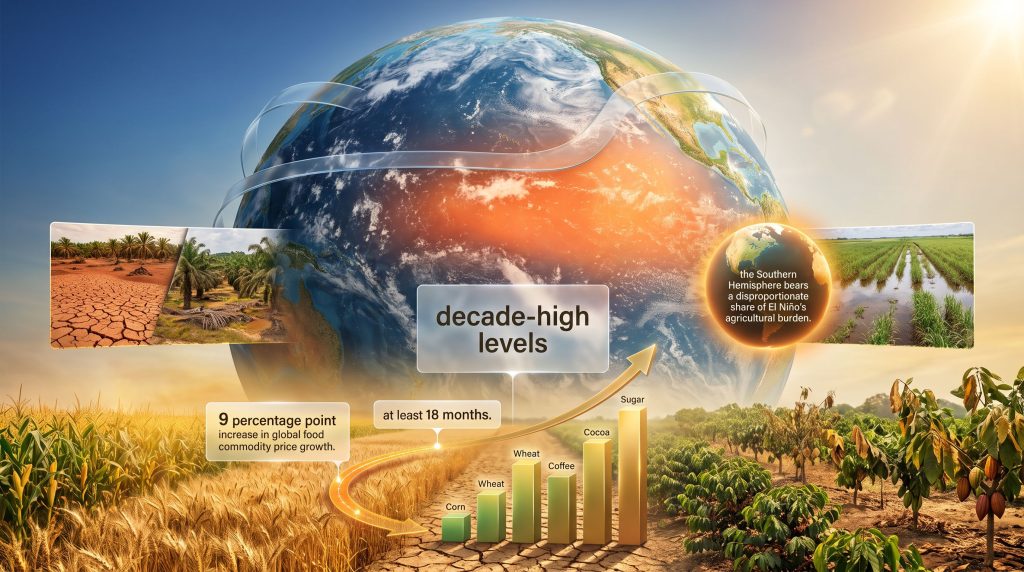
The net result is that the Southern Hemisphere and tropical producer regions bear a disproportionate share of El Niño's agricultural burden. These regions also happen to be home to some of the world's most export-oriented commodity crop systems. Furthermore, the FAO's dedicated El Niño resource hub provides ongoing assessments of how these regional dynamics evolve throughout each climate event cycle.
The World Bank has noted that while El Niño frequently damages agricultural production across Southern Hemisphere nations and parts of East Asia, its effect on global commodity prices can be partially buffered when global stockpiles are ample. The current low-inventory environment removes that buffer almost entirely.
Which Agricultural Commodities Face the Greatest Exposure
A Commodity-by-Commodity Breakdown
| Commodity | El Niño Impact | Key Exposed Regions | Price Direction |
|---|---|---|---|
| Corn | Negative (heat and drought stress) | U.S. Midwest, Southeast Asia | Upward pressure |
| Wheat | Negative (yield disruption) | Australia, South Asia, U.S. Plains | Upward pressure |
| Rice | Negative (water scarcity) | Southeast Asia, South Asia | Upward pressure |
| Soybeans | Mixed (positive in Americas, negative in Asia) | Brazil, Argentina, U.S. | Variable |
| Coffee (Robusta) | Strongly negative | Vietnam, Indonesia | Upward pressure |
| Cocoa | Strongly negative | West Africa, Southeast Asia | Upward pressure |
| Sugar | Negative (harvest disruption) | Brazil, India, Thailand | Upward pressure |
| Palm Oil | Negative (drought-related yield loss) | Indonesia, Malaysia | Upward pressure |
Corn and Wheat: Staple Crop Vulnerability
El Niño's historical relationship with U.S. wheat and corn yields is well documented. Heat accumulation during critical pollination and grain-fill windows, combined with moisture deficits in key growing regions, has repeatedly produced below-trend yields in strong El Niño years. This risk sits on top of an already structurally tightened global wheat supply environment, where geopolitical disruptions to Black Sea export corridors have reduced the redundancy that grain markets previously relied upon.
A simultaneous El Niño-driven yield shock across multiple producing regions would compound existing supply tightness in a market with limited buffer capacity. In addition, the supply chain disruptions already affecting global trade routes make these vulnerabilities considerably harder to mitigate.
The Soft Commodity Triple Threat
Three commodities stand out for the particular severity of their El Niño exposure: Robusta coffee, cocoa, and sugar.
Robusta coffee is produced overwhelmingly in Vietnam and Indonesia, the two nations that dominate global Robusta supply. Both countries experience reduced rainfall and elevated temperature stress during El Niño events, directly impairing flowering, cherry development, and ultimately yield. Because Robusta serves as the primary input for instant coffee and as a blending component in espresso, supply disruption flows rapidly into consumer price indices across multiple product categories.
Cocoa faces disruption from a different mechanism. West African producers, primarily Ivory Coast and Ghana, which together account for approximately 60% of global cocoa supply, experience erratic dry-wet cycles during El Niño years that promote fungal disease, reduce pod development, and impair bean quality. Southeast Asian cocoa production in Indonesia faces additional rainfall deficit stress.
Sugar dynamics in Brazil are more nuanced. While Brazil is the world's dominant sugar exporter, El Niño can paradoxically bring excess rainfall during harvest periods in key cane-growing states, reducing field efficiency, lowering sucrose content, and complicating logistics. The result is output disruption even in a region that theoretically benefits from above-average precipitation.
What these three commodities share is geographically concentrated production in El Niño-sensitive tropical zones, with limited ability to substitute production from unaffected regions at short notice.
Soybeans: The Partial Exception
Soybeans diverge from the broader pattern. Parts of South America, particularly Brazil and Argentina, can experience neutral to mildly positive growing conditions during El Niño years, as can portions of the U.S. soybean belt. However, Asian soybean production faces negative yield impacts, and the net price outcome is highly dependent on which regional dynamic dominates in any given season. Investors should resist treating soybeans as a straightforward El Niño hedge without conducting origin-specific analysis.
What Research Reveals About the Price Impact
Quantifying the El Niño Price Premium
Academic and institutional research consistently identifies an upward bias in global food commodity prices following significant El Niño events. Peer-reviewed studies estimate that a strong El Niño shock produces approximately a 9 percentage point increase in global food commodity price growth, with this effect emerging around 12 months after the peak of the climate event and persisting for at least 18 months thereafter.
This timeline is not intuitive. The common assumption is that weather-driven price moves are rapid and self-correcting. In reality, El Niño's agricultural damage unfolds across multiple growing seasons, and its price effects outlast media coverage of the climate event by a considerable margin. Research into El Niño's threat to global agriculture further underscores how these disruptions cascade through food systems well beyond the initial weather event.
Featured Snippet: Research indicates that a strong El Niño event can increase global food commodity price growth by approximately 9 percentage points, with the maximum effect emerging around 12 months after the climate shock and persisting for at least 18 months. The magnitude depends on event strength, global inventory levels, and regional exposure patterns.
The transmission mechanism operates through a predictable sequence:
- El Niño reduces crop output across multiple producing regions simultaneously
- Tightened global supply reduces export availability and elevates spot prices
- Futures markets reprice forward contracts to reflect reduced expected supply
- Food-importing nations initiate precautionary purchasing, further tightening availability
- Downstream food processors and consumer goods companies face input cost inflation
- Consumer price indices register food inflation with a 6 to 18 month lag relative to farm-level disruption
Why Current Market Conditions Amplify the Risk
Agricultural commodity indices, tracked broadly by instruments such as the DBA ETF, have reached decade-high levels even before any significant El Niño event has materially damaged a single major harvest. This pre-positioning is consistent with historical precedent: commodity markets began pricing in El Niño risk 6 to 9 months before peak conditions during the 1997 to 1998 episode.
The forward-looking nature of commodity markets means that by the time yield damage is confirmed in government crop reports, a significant portion of the price move may already have occurred. Investors who wait for evidence of damage before establishing exposure systematically underperform relative to those who price the probability distribution of outcomes in advance.
Critically, global grain inventory-to-use ratios have been declining, meaning there is materially less buffer capacity to absorb a production shortfall than existed during previous El Niño cycles. A combination of structurally tight supply and a building El Niño creates a compounding risk scenario with few close historical parallels outside of the 2010 to 2011 food price crisis.
Macroeconomic Amplifiers: Currency and Fiscal Dynamics
The Dollar Dimension
Agricultural commodity prices are denominated in U.S. dollars, which means that currency dynamics interact directly with supply-driven price movements. A weaker dollar environment mechanically lifts commodity prices in USD terms, providing an additional tailwind to agricultural assets beyond the fundamental supply-demand dynamic.
Persistent fiscal expansion in major developed economies, combined with elevated sovereign debt levels and structurally high government spending commitments, creates an environment predisposed toward hard asset and commodity price appreciation. When fiscal discipline appears structurally absent and currency purchasing power is under pressure, commodities function as both inflation hedges and supply-shock proxies simultaneously.
Understanding the commodity price impacts of these macro dynamics is essential context for investors considering agricultural exposure at this stage of the cycle.
Analytical Framework: The El Niño impact on agricultural commodities is best understood as a supply-side shock operating within a demand-side inflationary macro environment. Historically, this combination produces more severe and sustained price outcomes than either factor operating alone.
Regional Food Security: Where Risk Concentrates
High-Vulnerability Economies
Not all nations face El Niño agricultural risk equally. The most exposed economies combine domestic production sensitivity with significant food import dependence:
- Southeast Asia: Indonesia, the Philippines, and Vietnam simultaneously serve as major agricultural producers and food importers. El Niño damages domestic output while rising global prices increase import costs, creating a double-exposure dynamic.
- Sub-Saharan Africa: Heavily reliant on rainfed agriculture with limited irrigation infrastructure, southern and eastern Africa face humanitarian-level food security risks during strong El Niño events.
- Central America: Coffee and staple crop systems in Guatemala, Honduras, and Nicaragua are highly sensitive to the rainfall redistribution associated with El Niño, with implications for both export earnings and domestic food availability.
- South Asia: India and Pakistan face wheat and rice production risks during strong events, with downstream consequences for regional food price stability affecting hundreds of millions of consumers.
The Food Price and Social Stability Connection
Historical evidence establishes a meaningful relationship between El Niño-driven food price spikes and elevated political instability in food-import-dependent developing economies. The 2010 to 2011 food price crisis, partially attributable to weather-related supply disruptions, preceded significant political upheaval across North Africa and the Middle East.
Consequently, investors in emerging market equities, frontier market sovereign debt, and regional infrastructure assets should incorporate El Niño-driven food price risk into their geopolitical risk frameworks. These dynamics are further amplified within the context of a multipolar world economy, where food security is increasingly weaponised as a dimension of strategic competition between states.
The next major ASX story will hit our subscribers first
Investment Considerations for Agricultural Commodity Exposure
Positioning Frameworks and Vehicle Selection
Investors approaching the El Niño agricultural commodity thesis have several structural options. Furthermore, commodities diversification across multiple agricultural categories is widely regarded as a prudent approach to managing single-crop concentration risk within this theme:
- Broad commodity ETFs such as DBA or PDBC provide diversified exposure across corn, wheat, soybeans, sugar, and soft commodities without single-crop concentration risk
- Soft commodity futures in coffee, cocoa, and sugar offer more targeted exposure for investors with commodity market familiarity and appropriate risk tolerance
- Agricultural input companies, including fertilizer producers and precision agriculture technology firms, may benefit from increased demand as producers attempt to maximise yields under constrained growing conditions
- Food processing companies with high agricultural input cost exposure face margin compression risk, representing a potential underweight consideration within consumer staples allocations
Risk Factors That Could Limit the Thesis
- Event intensity uncertainty: El Niño forecasts carry material uncertainty; a weaker-than-expected event would reduce agricultural disruption and limit commodity price upside
- Technological adaptation: Drought-resistant crop varieties, precision irrigation, and improved agronomic practices may partially offset yield losses relative to historical El Niño benchmarks
- Policy intervention: Export-restricting policies by major agricultural producers, or strategic reserve releases by importing nations, can dampen price signals and create basis risk for commodity investors
- Currency effects: A strengthening U.S. dollar would mechanically offset some commodity price gains for non-USD investors, reducing portfolio-level returns
Investment Consideration: El Niño agricultural exposure is best approached as a multi-year thematic position rather than a short-term trade, given the documented 12 to 18 month lag between climate event peak and maximum commodity price impact. Position sizing should account for event strength uncertainty and the potential for policy interventions to interrupt the price transmission mechanism.
Frequently Asked Questions: El Niño and Agricultural Commodities
Does El Niño Always Cause Food Prices to Rise?
Not universally. El Niño produces mixed effects across different crops and regions. While it tends to reduce yields for corn, wheat, rice, coffee, cocoa, and sugar in key producing regions, soybeans in parts of the Americas can experience neutral or mildly positive conditions. The overall price impact depends on event strength, global inventory levels, and which producing regions experience the most severe disruption.
How Long Does El Niño's Price Impact on Agricultural Commodities Last?
Research indicates that the price effects of a strong El Niño event can persist for at least 18 months after the peak of the climate event, with the maximum commodity price impact typically emerging around 12 months after the initial shock. This multi-season transmission timeline means that commodity price effects frequently outlast media coverage of the climate event itself.
Which Agricultural Commodities Are Most at Risk?
Soft commodities, particularly Robusta coffee, cocoa, and sugar, face the highest exposure due to their concentrated production in tropical regions highly sensitive to El Niño weather patterns. Staple grains including corn, wheat, and rice in key producing regions also face significant downside yield risk during strong events.
How Does El Niño Affect Australian Agricultural Production Specifically?
Australia is among the most directly exposed developed-economy agricultural producers to El Niño. The climate pattern typically brings below-average rainfall and above-average temperatures across eastern and southern Australia, which are the country's primary grain and livestock production zones. Australian wheat, barley, and canola yields show a historically negative correlation with El Niño intensity, making Australia's agricultural export performance a useful leading indicator of global supply tightness during El Niño years.
Is El Niño the Only Factor Driving Current Agricultural Commodity Prices?
No. Decade-high agricultural commodity price levels reflect a convergence of factors, including global trade tensions, elevated energy costs affecting agricultural input prices, currency dynamics, and structural demand growth from population expansion and dietary shifts in emerging markets. El Niño represents a potential additional supply-side shock being layered on top of an already strained supply environment, which is precisely why markets appear to be front-running it at current price levels.
Key Takeaways
- El Niño functions as a simultaneous multi-commodity supply shock, reducing yields across several major crop categories at once, with the strongest effects concentrated in the Southern Hemisphere and tropical producer regions
- The maximum commodity price response typically emerges 12 months after the climate event peak and persists for at least 18 months, creating a multi-year investment thesis rather than a single-quarter trade
- Agricultural commodity markets are already at decade-high price levels, consistent with historical patterns of markets front-running supply shock expectations before harvest damage is confirmed
- The most vulnerable commodities are Robusta coffee, cocoa, sugar, corn, and wheat, all of which face production concentration in El Niño-sensitive geographies
- Soybeans represent a partial exception, with mixed regional outcomes requiring origin-specific analysis before drawing investment conclusions
- The investment thesis is reinforced by low global grain inventory buffers, a macro environment predisposed toward hard asset appreciation, and the multi-year price transmission timeline documented in peer-reviewed climate economics research
This article is intended for general informational purposes only and does not constitute financial product advice. Commodity markets carry significant risk, and past performance of agricultural assets during previous El Niño events is not a reliable indicator of future outcomes. Readers should consider their own financial objectives and consult a qualified financial adviser before making any investment decisions. Forecasts and projections referenced in this article involve inherent uncertainty and should not be relied upon as predictive of actual market outcomes.
Want to Identify the Next Major Commodity Discovery Before the Broader Market Does?
While El Niño-driven supply shocks reshape agricultural commodity markets, significant mineral discoveries on the ASX represent another powerful category of investment opportunity — and Discovery Alert's proprietary Discovery IQ model delivers real-time alerts the moment these discoveries are announced, turning complex data across 30-plus commodities into clear, actionable insights. Explore historic examples of major discoveries and their returns, then begin your 14-day free trial to ensure you are positioned ahead of the market.