Energy Independence Through Technology Transformation
Australia's resource sector faces unprecedented pressure to modernize power infrastructure systems across vast geographical distances. Traditional approaches to energy supply in remote mining regions increasingly appear economically unsustainable when measured against emerging technological alternatives. The convergence of declining battery costs, advancing renewable energy capabilities, and tightening environmental regulations creates compelling conditions for fundamental infrastructure transformation.
Mining operations typically consume extraordinary amounts of continuous power while operating in locations hundreds of kilometres from established electrical grids. This geographic isolation historically necessitated expensive diesel generation systems or complex gas infrastructure investments. However, the maturation of large-scale battery energy storage systems (BESS) presents mining companies with viable pathways toward energy self-sufficiency through integrated renewable networks.
The Fortescue BYD battery installation in Pilbara represents more than incremental technological adoption. This deployment signals systematic industry transformation toward renewable-powered mining operations capable of maintaining 24/7 production schedules while dramatically reducing operational costs and carbon emissions. Understanding these developments requires examining the technical specifications, economic drivers, and broader implications for Australian mining competitiveness.
Geographic and Operational Challenges Driving Storage Adoption
Understanding Remote Mining Energy Requirements
Australia's mining regions present unique infrastructure challenges that distinguish them from conventional industrial energy applications. The Pilbara iron ore corridor, located approximately 1,600 kilometres north of Perth, operates mining facilities at distances exceeding 500 kilometres from established grid connections. These geographic constraints create fundamental dependencies on on-site power generation systems capable of supporting continuous heavy industrial operations.
Remote mining operations require exceptional power reliability standards with downtime tolerance typically below 1% for critical processing equipment. Iron ore beneficiation plants, concentrate processing facilities, and materials handling systems demand consistent power delivery measured in megawatts rather than kilowatts. Any significant power interruption can halt production across multiple operational areas, creating cascading economic impacts that justify substantial investment in backup systems.
Temperature extremes in mining regions add complexity to energy infrastructure design. Furthermore, Pilbara summer temperatures routinely exceed 45°C, while winter conditions can drop below 15°C, requiring energy storage systems engineered for extreme environmental conditions. Dust storms, humidity variations, and infrastructure accessibility challenges further complicate power system deployment and maintenance requirements.
Cost Implications of Traditional Power Sources
Diesel fuel dependency represents one of the largest operational cost burdens for remote mining operations. Transportation logistics for fuel delivery to isolated sites typically add 40-60% premium costs above base fuel pricing due to specialised transport requirements, storage infrastructure, and safety considerations. For large-scale mining operations, diesel costs can represent 15-25% of total operational expenditure depending on commodity prices and production volumes.
Gas infrastructure development requires substantial upfront capital investments for pipeline construction or LNG transport systems. While gas provides more stable fuel costs than diesel, the infrastructure requirements often exceed hundreds of millions of dollars for comprehensive coverage across multiple mining sites. These investments carry long-term commitments that limit operational flexibility as commodity markets and production requirements change.
In addition, the economic burden extends beyond direct fuel costs to include maintenance, storage, environmental compliance, and carbon pricing exposure. Traditional power systems require specialised maintenance teams, spare parts inventory, environmental monitoring equipment, and increasingly expensive carbon offset purchases or emissions trading participation.
Grid Stability Requirements for Continuous Operations
Mining operations operate as complex electrical systems with interdependent processing equipment requiring precise power quality standards. Ore crushers, conveyor systems, processing plants, and rail infrastructure must maintain synchronised operations to achieve optimal throughput rates. Power fluctuations or outages can disrupt these sequences, requiring lengthy restart procedures that impact daily production targets.
Backup power systems traditionally required 4-6 hour autonomy to manage grid interruptions or planned maintenance windows. However, renewable energy integration demands extended storage capacity to accommodate weather-related generation variability. Solar generation intermittency requires storage systems capable of providing overnight power for 8-12 hours while maintaining reserve capacity for extended cloudy periods.
Consequently, load balancing across multiple mining facilities requires sophisticated control systems capable of managing distributed generation assets, storage systems, and varying production demands. These requirements exceed typical industrial power applications and approach utility-scale grid management complexity.
Advanced Battery Systems Meeting Industrial Power Demands
Technical Specifications for Mining Applications
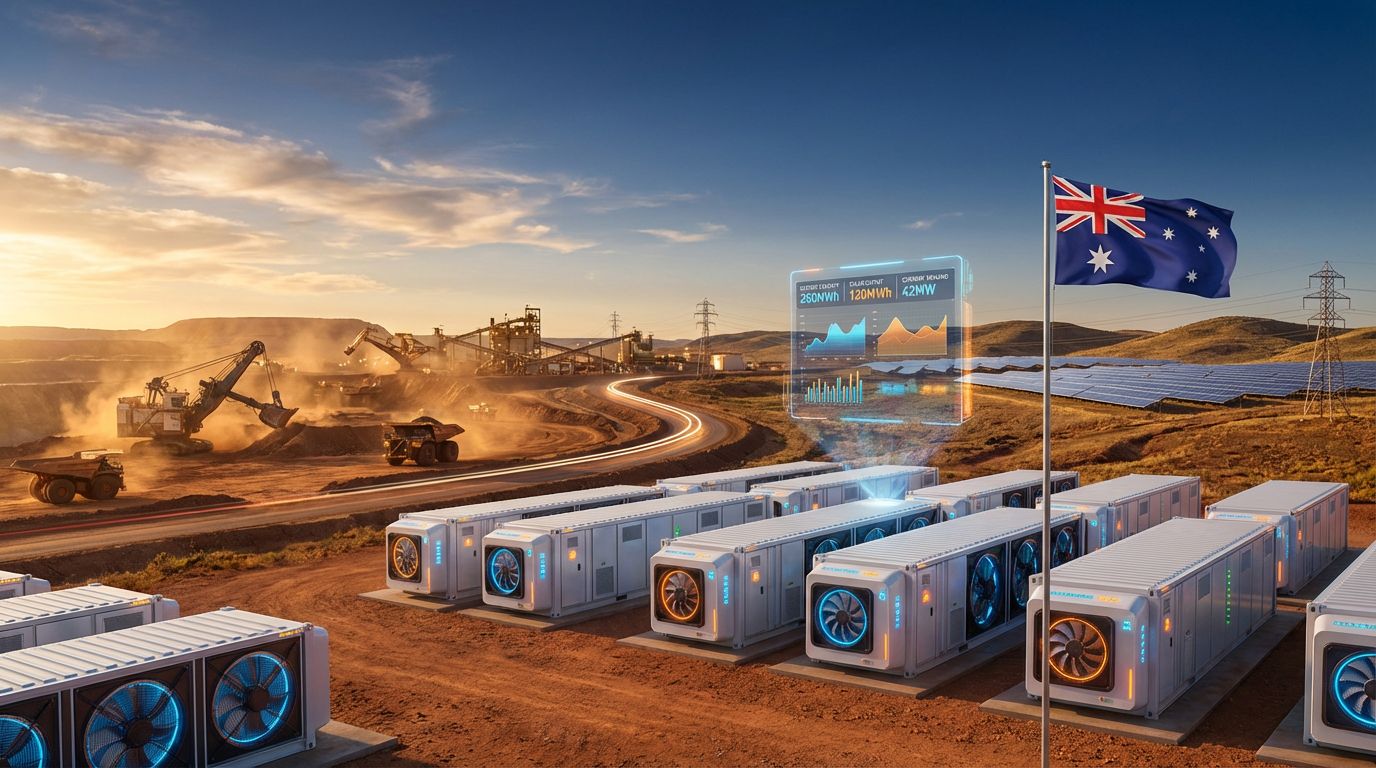
The Fortescue BYD battery installation in Pilbara at North Star Junction demonstrates the scale required for industrial mining applications. The system comprises 48 energy storage containers providing 250MWh total capacity with 50MW power output capability for 5-hour duration. This configuration represents one of the largest battery installations in Australian mining operations to date.
| System Component | Specification | Industrial Application |
|---|---|---|
| Total Capacity | 250MWh | Primary overnight power supply |
| Power Output | 50MW sustained | Peak mining operation support |
| Duration | 5 hours continuous | Standard overnight production cycle |
| Container Units | 48 modular systems | Scalable deployment architecture |
| Battery Technology | BYD Blade LFP chemistry | Extreme temperature tolerance |
BYD Blade Battery technology utilises Lithium Iron Phosphate (LFP) chemistry specifically engineered for high-temperature industrial environments. LFP systems demonstrate superior thermal stability compared to conventional lithium-ion chemistries, with operating temperature ranges from -20°C to +60°C. This thermal tolerance proves essential for Pilbara conditions where ambient temperatures regularly exceed 45°C during summer months.
System efficiency ratings achieve 92-95% round-trip efficiency, meaning stored energy experiences minimal losses during charge and discharge cycles. This efficiency level significantly exceeds diesel generation systems and approaches the performance characteristics of grid-connected power systems.
Modular Architecture Enabling Scalable Deployment
Container-based architecture enables phased expansion aligned with production capacity growth and operational requirements. Each container houses approximately 5.2MWh capacity with independent thermal management, electrical controls, and safety systems. This modularity allows mining operators to match battery deployment with operational scaling while maintaining system redundancy.
The NSJ installation represents the first phase of Fortescue's 4-5GWh planned deployment across the Pilbara Energy Connect network. The second phase includes a 120MWh system scheduled for Eliwana delivery by early 2026, demonstrating systematic rollout capabilities across multiple mining sites.
Moreover, modular deployment reduces project risk by enabling proof-of-concept validation before full-scale implementation. Initial installations provide operational data, performance validation, and maintenance experience that inform subsequent deployments. This approach contrasts with traditional infrastructure projects requiring comprehensive upfront commitments before operational validation.
Integration with Renewable Generation Assets
Battery storage systems achieve optimal economic performance when integrated with renewable generation assets. Fortescue's 190MW Cloudbreak Solar Farm, currently 50% complete, will generate approximately 380-420 GWh annually under Pilbara solar conditions. This generation capacity directly supplies daytime mining operations while charging battery systems for nighttime use.
Bidirectional inverter systems enable seamless transitions between solar generation, battery storage, and backup systems during varying operational conditions. For instance, system response times achieve less than 200 milliseconds for load changes, meeting grid stabilisation requirements while maintaining continuous mining operations.
Active thermal management systems maintain optimal battery operating temperatures through integrated cooling systems designed for extreme environmental conditions. Liquid cooling infrastructure ensures battery performance remains consistent despite Pilbara temperature extremes, extending system lifespan and maintaining efficiency ratings throughout operational cycles.
Investment Economics Driving Transformation Projects
Capital Investment Analysis and Return Modelling
Large-scale mining energy transition strategies represent multi-billion dollar infrastructure commitments requiring sophisticated financial analysis. The Fortescue BYD battery installation in Pilbara, combined with solar generation and transmission infrastructure, represents approximately $500-700 million in capital expenditure for the initial deployment phase.
Battery energy storage system costs have declined 89% from 2010 to 2024, falling from approximately $1,100/kWh to $120-150/kWh for utility-scale LFP systems. This dramatic cost reduction fundamentally alters investment economics for industrial-scale applications, creating payback periods of 5-7 years for comprehensive renewable energy systems.
Investment Analysis Insight: Mining energy transformation projects demonstrate compelling economics through operational cost reductions exceeding $500 million annually when diesel elimination, carbon cost avoidance, and maintenance savings are combined across large-scale operations.
Project lifetime modelling assumes 15-20 years of operational service with 80% capacity retention at end of life. LFP battery systems demonstrate cycle life exceeding 6,000 cycles at 80% depth of discharge, translating to decades of operational service under typical mining duty cycles.
Operational Cost Reduction Through Fuel Elimination
Diesel elimination represents the most immediate and quantifiable benefit from battery storage implementation. Large-scale Pilbara mining operations consume diesel measured in millions of litres annually, creating fuel costs of $80-150 million depending on production volumes and fuel pricing.
Transportation premiums for remote fuel delivery add substantial costs beyond base fuel pricing. Specialised transport equipment, storage infrastructure, environmental compliance systems, and safety requirements combine to create delivered fuel costs significantly exceeding metropolitan pricing. Battery storage eliminates these logistics costs entirely while reducing operational complexity.
Furthermore, maintenance cost reductions from simplified power infrastructure create additional economic benefits. Traditional diesel and gas systems require specialised maintenance teams, extensive spare parts inventory, scheduled overhauls, and environmental monitoring systems. Battery systems require minimal routine maintenance with predictive monitoring systems identifying component replacement needs before failures occur.
Carbon Pricing and Compliance Economics
Proposed Australian carbon pricing mechanisms create significant economic incentives for emissions reduction investments. Anticipated carbon prices of $50-80 AUD per tonne CO2-e would create annual compliance costs of $250-640 million for major mining operations generating 5-8 million tonnes of annual emissions.
Renewable energy systems eliminate Scope 1 and 2 emissions associated with on-site power generation while positioning mining operations for favourable treatment under emerging carbon border adjustment mechanisms. However, international customers increasingly demand low-carbon minerals, creating market premiums for sustainably produced commodities.
Environmental, Social, and Governance (ESG) compliance requirements from institutional investors create additional economic incentives for decarbonisation investments. Sustainability-linked financing opportunities offer reduced borrowing costs for projects meeting environmental performance targets, improving overall project economics.
Integrated Networks Transforming Mining Operations
Pilbara Energy Connect Architecture
The Pilbara Energy Connect network represents comprehensive energy infrastructure transformation connecting distributed renewable generation and storage systems across multiple mining sites. High-voltage transmission infrastructure utilising 132-275kV transmission lines enables power sharing between facilities while maintaining grid-quality power delivery standards.
Network architecture incorporates 6-8 major processing facilities connected through redundant transmission paths ensuring operational continuity during maintenance windows or equipment failures. Dual transmission corridors provide N+1 redundancy for critical power delivery while enabling load balancing across the network.
SCADA (Supervisory Control and Data Acquisition) systems provide real-time monitoring and automated control capabilities across the distributed energy network. These systems integrate weather forecasting data, demand prediction algorithms, and battery state-of-charge management to optimise renewable energy utilisation across multiple sites.
Smart Grid Integration and Load Management
Advanced data-driven mining operations utilise machine learning algorithms for demand forecasting with 85-92% accuracy for 24-48 hour ahead mining load profiles. These predictions enable proactive energy management, optimising solar generation capture and battery discharge scheduling to minimise operational costs while maintaining production continuity.
Solar generation prediction systems integrate cloud cover modelling with Bureau of Meteorology data for 6-12 hour solar output forecasting. This capability enables automated adjustment of battery charging schedules and backup system preparation based on anticipated weather conditions.
In addition, real-time load balancing algorithms distribute renewable energy across multiple mining sites based on production schedules, equipment demands, and system availability. Peak mining loads of 80-120MW across Pilbara operations require sophisticated coordination to maintain optimal power utilisation while preserving battery reserves for overnight operations.
Operational Resilience and Maintenance Planning
Integrated networks provide operational resilience through distributed redundancy and automated failover capabilities. Secondary systems activate automatically during primary system maintenance with less than 5-second switchover times, maintaining production continuity during planned maintenance windows.
Rolling maintenance schedules coordinate equipment servicing during low-production periods while ensuring adequate backup capacity remains available. Predictive maintenance algorithms analyse battery performance data, thermal conditions, and cycle counts to schedule component replacements before failure occurrence.
Consequently, microgrid formation capabilities enable isolated operation during grid disruptions or extreme weather events. Battery systems can maintain critical mining operations independently for extended periods, providing operational continuity unavailable through traditional power systems.
Industry-Wide Implications for Mining Transformation
Setting Precedents for Resource Sector Decarbonisation
The battery recycling breakthrough and Fortescue's deployment establishes technological and economic benchmarks for large-scale mining energy transformation across Australia's resource sector. Demonstrated performance capabilities, cost reduction achievements, and operational integration success provide validation for similar investments by other major mining companies.
Technology cost reductions through large-scale deployment create learning curve effects benefiting subsequent projects. Manufacturing economies of scale, installation experience, and supply chain development reduce project costs while improving implementation timelines for follow-on deployments.
Supply chain development for specialised mining energy storage solutions creates infrastructure supporting broader industry adoption. Local engineering capabilities, maintenance expertise, and component availability reduce project risks while supporting regional economic development in mining-intensive areas.
Global Competitiveness Through Sustainable Operations
International market dynamics increasingly favour sustainably produced commodities as customers implement supply chain decarbonisation requirements. Mining operations demonstrating low-carbon production capabilities access market premiums while avoiding potential trade restrictions under emerging carbon border adjustment mechanisms.
ESG compliance requirements from international investors and customers create competitive advantages for early adopters of renewable energy systems. Mining companies demonstrating environmental leadership attract investment capital at favourable terms while securing long-term customer relationships based on sustainability commitments.
Moreover, technology leadership positioning in sustainable resource extraction creates intellectual property opportunities and consulting revenue streams. Companies successfully implementing large-scale renewable mining operations can monetise their experience through technology licensing and project development services in international markets.
Financial Market Evaluation of Energy Infrastructure Investments
Investment Return Modelling and Performance Metrics
Financial markets evaluate mining energy infrastructure investments through comprehensive return modelling incorporating operational cost savings, carbon compliance benefits, and asset value protection. Discount rates for mining projects typically range 8-12% based on commodity exposure and operational complexity, requiring clear demonstration of value creation through energy transformation initiatives.
Cash flow modelling incorporates multiple value streams including fuel cost avoidance, maintenance savings, carbon cost reduction, and potential revenue premiums for low-carbon production. Sensitivity analysis examines project returns under various commodity price scenarios, carbon pricing implementations, and technology cost trajectories.
Key Financial Metrics for Energy Transformation Projects:
- Net Present Value (NPV): $1.2-1.8 billion over 20-year project life
- Internal Rate of Return (IRR): 12-18% depending on implementation scale
- Payback Period: 5-7 years from full operational implementation
- Carbon Cost Avoidance: $250-640 million annually at projected pricing
- Operational Cost Reduction: $500+ million annually across eliminated fuel and maintenance costs
ESG Performance and Valuation Impact
Institutional investors increasingly incorporate ESG performance metrics into valuation models and investment decisions. Mining companies demonstrating measurable emissions reductions and sustainable operational practices attract investment premiums while accessing sustainability-linked financing at favourable terms.
Carbon intensity reduction measurements provide quantifiable ESG performance indicators. Mining operations achieving 70-85% emissions reductions through renewable energy implementation demonstrate industry leadership while positioning for favourable treatment under future regulatory frameworks.
Furthermore, long-term asset value protection through climate risk mitigation becomes increasingly important as physical climate risks and regulatory requirements intensify. Energy infrastructure investments reduce stranded asset risks while ensuring operational continuity under various climate policy scenarios.
Future Technology Development and Scaling Scenarios
Emerging Battery Technologies and Performance Enhancement
Advanced mining innovation trends focus on improved energy density, extended operational lifespan, and enhanced safety characteristics for industrial applications. Next-generation LFP chemistries incorporate silicon additives and advanced electrolytes achieving 20-30% energy density improvements while maintaining thermal stability advantages.
Solid-state battery technologies under development offer potential breakthrough capabilities for mining applications. These systems promise operating temperature ranges exceeding current LFP limitations while providing 15-20% efficiency improvements and extended cycle life approaching 10,000+ cycles.
Artificial intelligence integration enables predictive energy management systems optimising renewable generation capture, storage utilisation, and load distribution across complex mining networks. Machine learning algorithms continuously improve performance through operational data analysis, weather pattern recognition, and equipment behaviour modelling.
Industry-Wide Adoption and Scaling Trajectories
Successful deployment of gigawatt-hour scale battery storage in mining operations establishes foundation infrastructure for broader industry transformation. Industry-wide adoption scenarios project $15-20 billion annually in global mining energy transformation investments through 2030 based on demonstrated performance capabilities and economic returns.
Strategic Outlook: Large-scale battery storage deployment in Australian mining creates demonstration effects accelerating decarbonisation timelines across the global resource sector while establishing Australian companies as technology leaders in sustainable mining operations.
Scaling scenarios anticipate 15-20% annual cost reductions in battery storage systems through manufacturing improvements, economies of scale, and technology advancement. These cost trajectories improve project economics while enabling adoption across smaller mining operations and diverse commodity sectors.
Policy and Regulatory Evolution Supporting Transition
Government policy frameworks increasingly support industrial renewable energy investments through direct incentives, accelerated depreciation schedules, and carbon pricing mechanisms. Proposed Australian industrial transformation programs include specific provisions for mining sector decarbonisation initiatives.
Grid connection standards and protocols for large-scale storage systems require regulatory evolution to accommodate industrial-scale battery installations. Technical standards development ensures safety, reliability, and interoperability across diverse mining energy networks while maintaining grid stability requirements.
However, international cooperation on sustainable mining technology development creates opportunities for Australian expertise export and technology transfer partnerships. Bilateral agreements supporting clean technology deployment in resource sectors expand market opportunities for proven Australian energy storage solutions.
What Does This Mean for Mining's Future?
The success of electrification and decarbonisation initiatives like the Fortescue BYD battery installation in Pilbara represents a pivotal moment in mining industry evolution. This deployment demonstrates that large-scale renewable energy integration can maintain industrial-grade power reliability while delivering substantial operational cost savings.
Beyond immediate operational benefits, these installations establish technological foundations for comprehensive industry transformation. The proven performance capabilities, economic returns, and operational integration success create compelling business cases for widespread adoption across Australian mining operations and international resource sectors.
Furthermore, the strategic implications extend beyond individual company operations to encompass national competitiveness, export market positioning, and technology leadership opportunities. Australian mining companies pioneering renewable energy integration create intellectual property assets, consulting capabilities, and market positioning advantages supporting long-term industry leadership in sustainable resource extraction.
Disclaimer: This analysis contains forward-looking statements and projections based on current industry trends and available data. Actual performance, costs, and implementation timelines may vary significantly from estimates presented. Investment decisions should incorporate comprehensive due diligence and professional financial advice. Technology performance claims and economic projections reflect industry analysis and may not represent guaranteed outcomes for specific projects or companies.
Looking to Capitalise on Australia's Mining Energy Revolution?
Discovery Alert's proprietary Discovery IQ model delivers real-time alerts on significant ASX mineral discoveries, instantly empowering subscribers to identify actionable opportunities in companies driving industry transformation like those pioneering renewable energy solutions in mining. Explore how major discoveries can lead to substantial market returns by visiting Discovery Alert's dedicated discoveries page, showcasing historic examples of exceptional outcomes, and begin your 30-day free trial today to position yourself ahead of the market.