August 9, 2026
Understanding the Diplomatic Framework Behind Energy Price Volatility
Investor sentiment in the energy sector is increasingly dictated by the interplay of nuclear diplomacy and regulatory policy. Rather than linear cause-and-effect chains, energy price swings now move in response to shifting diplomatic signals, regulatory ambiguity, and macro-trader scenario setups. The US–Iran nuclear talks in Oman have become a focal point for such volatility, with the absence of concrete milestones amplifying uncertainty for global oil benchmarks and institutional traders.
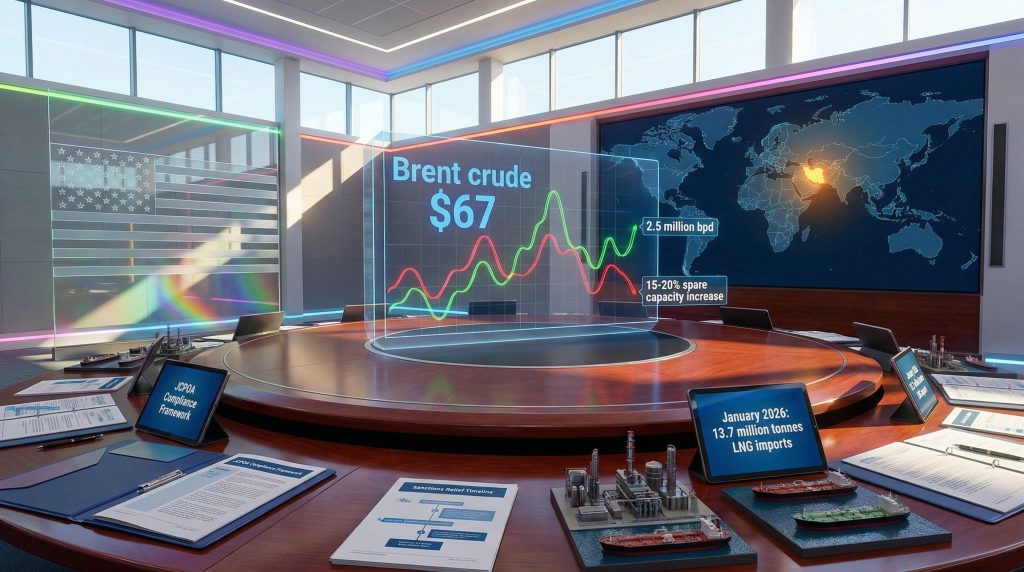
Market positioning reflects this phenomenon acutely. As of February 6, 2026, ICE Brent crude traded at $67 per barrel (down over 5% for the week), while US WTI stood at $64.15 per barrel. This marks a sharp correction from January's surge, a direct reaction to the mere announcement of renewed US–Iran nuclear talks in Oman.
The abrupt drop illustrates how quickly market sentiment adjusts to news of potential regulatory and sanctions relief—what analysts describe as the "placating effect," where opening dialogue signals future supply changes, even before any actual policy move. Furthermore, this volatility provides crucial oil price rally analysis for understanding broader market dynamics.
European and Asian refiners, anticipating possible Iranian crude re-entry, have already started assessing engineering and capital needs to accommodate changes in crude quality and supply logistics. These steps often require 6–9 months of planning and investment, long before a single new barrel hits the water.
Supporting this, derivatives and options market activity suggests investors are explicitly hedging for multiple possible outcomes, including both breakthrough sanctions relief and negotiation breakdown scenarios. This dynamic not only reflects the current ambiguity of the Oman discussions but historically tracks non-linear, stepwise oil price moves (roughly $3–5 per barrel per 500,000 b/d of echoed Iranian supply).
When big ASX news breaks, our subscribers know first
What Regulatory Mechanisms Drive Oil Price Reactions to Nuclear Diplomacy?
Sanctions and regulatory barriers are layered, often interacting and compounding to influence market behaviour. The 2018 reimposition of US sanctions reduced Iranian crude exports by approximately 2.5 million barrels per day, constraining global supply and contributing to elevated price volatility.
Additional restrictions targeting Iranian petrochemicals (2019) and shipping/insurance (2020) introduced further friction, making even indirect trade with Iran risky and more expensive for global buyers. In addition, comprehensive oil price crash insights reveal how such regulatory changes can trigger unexpected market corrections.
Table: Current Iran-Related Energy Restrictions
| Restriction Type | Implementation Date | Market Impact Scope | Potential Modification Timeline |
|---|---|---|---|
| Crude oil export bans | 2018 | Global supply cut: ~2.5 million bpd | 6–12 months post-agreement |
| Petrochemical sanctions | 2019 | Raises regional feedstock prices | 3–6 months after relief |
| Shipping/insurance restrictions | 2020 | Alters tanker and insurance markets | Immediately upon formal relief |
Yet, energy markets now must process a complex ecosystem of sanctions relief sequencing:
-
Restoration of SWIFT banking access, lost in 2012 and again in 2018, is pivotal for international sale settlements. Regaining access involves 90–180 days of OFAC and regulatory vetting, anti-money laundering checks, and banking infrastructure upgrades.
-
Maritime insurance, particularly from leading players like Lloyd's of London, presents another compliance challenge. Coverage must be reinstated through ship inspections and regulatory clearances, typically a 6–12 week procedure post-announcement.
-
Multilayered enforcement means any policy shift demands coordinated, often sequenced, regulatory action across export, finance, and insurance domains.
For context, consider the 2015–16 JCPOA: 5 months separated the deal from full implementation, and another 6 months before Iranian oil exports saw significant recovery. This demonstrates technical, operational, and compliance bottlenecks even under 'expedited' timelines.
Why Do Nuclear Talks Create Energy Market Uncertainty?
The bilateral structure of the US–Iran nuclear talks in Oman is inherently less transparent than previous multilateral frameworks, leaving major market actors without fixed milestones or progress disclosures. As a result, information asymmetry thrives—traders, refiners, and investors are left guessing about timing, scope, and verification of any sanctions relief.
This persistent ambiguity manifests in volatility. However, understanding how tariffs impact markets provides additional context for current energy sector challenges.
-
The spread between February and June 2026 Brent contracts ballooned to over $3 per barrel in early February 2026 (versus typical $0.50–$1.50 in stable geopolitical periods).
-
Options premiums for hedging future crude deliveries rose 25–35%, reflecting increased uncertainty and risk.
-
Refinery planning and capital investments are essentially on hold; operators must choose between betting on rapid supply shifts (and risking write-downs) or missing potential arbitrage if Iranian supply returns at attractive discounts.
Furthermore, these Oman talks are narrowly focused: while nuclear enrichment capability and monitoring are core to the agenda, crucial risk factors like regional missile development, proxy conflicts, and shipping corridor security remain unaddressed. This means even a "successful" nuclear outcome may not erase the energy sector's full risk premium.
The result is a form of "backwardation on uncertainty," with near-term contracts commanding significant premium and the entire price discovery process distorted by policy opacity. CNN reports suggest that ongoing diplomatic tensions continue to influence market sentiment.
What Are the Long-term Regulatory Implications for Global Energy Markets?
Energy market forecasts around US–Iran nuclear negotiations cluster around three policy pathway scenarios—each with sharply different regulatory, pricing, and trading consequences. For instance, recent developments in nuclear sanction effects demonstrate how sanctions can reshape entire energy supply chains.
Scenario Analysis Table
| Scenario | Iranian Oil Production | Spare Global Capacity | Estimated Price Impact | Sanctions Relief Timeline |
|---|---|---|---|---|
| Comprehensive Agreement | 4M+ bpd (18 months) | +15–20% spare cap. | -$15–$25/barrel premium | 6–12 months to full relief |
| Limited Sanctions Relief | Gradual increase | Marginal additions | Modest volatility drop | 24–36 months, staged |
| Negotiation Breakdown | Status quo/enhanced | Capacity unchanged | Maintained high floor | Immediate, no relief |
Disclaimer: Long-term projections remain inherently speculative. Market actuals will depend on not only formal agreements, but implementation pace, monitoring robustness, and secondary geopolitical reactions.
How Do Regional Allies Influence Nuclear-Energy Policy Coordination?
The evolving US–Iran nuclear talks in Oman cannot be separated from the broader energy security strategies of both Gulf states and European policymakers. Their calculated choices shape the broader market's response.
Gulf State Strategies:
OPEC+ faces direct pressure to coordinate output offsets if Iranian crude reappears, with Saudi Aramco recently cutting prices for March-loading cargoes (by $0.30–0.40 per barrel) to stay competitive on Asian routes. Additionally, recent Saudi exploration licenses indicate strategic positioning for future market changes.
Infrastructure investments—for pipelines, refining, and storage—must anticipate the possibility of rapid regulatory shift, creating a financial drag if expectations are later unmet.
European Policy Dynamics:
EU's 20th sanctions package on Russia (to be finalised by Feb 24, 2026) could constrict maritime transport of Russian oil, perhaps accelerating demand for sanctioned-free Iranian barrels, especially if compliance aligns.
January 2026 marked a new European LNG import record of 13.7 million tonnes, reflecting urgent diversification away from both Russian and potentially unstable Middle Eastern sources. Consequently, Reuters analysis suggests this diversification strategy remains critical for European energy security.
Timelines for renewable energy transitions are being reassessed as nuclear negotiations inject new uncertainties into both hydrocarbon flows and investment planning.
What Market Mechanisms Will Determine Success or Failure?
For any agreement stemming from US–Iran nuclear talks in Oman to translate into sustainable market change, robust compliance and verification frameworks must be implemented:
Technical Requirements
IAEA Inspection Protocols: Real-time enrichment monitoring, snap site inspections, and access to undeclared locations are required. Technology upgrades and political agreements underpin the technical feasibility of these verification steps.
Financial System Reintegration: SWIFT system restoration and a return to Western banking networks will rely on clear OFAC and EU certification plus thorough anti-money-laundering (AML) and know-your-customer (KYC) protocols.
Reinsurance and Maritime Coverage: Engagement with Lloyd's of London and other global underwriters remains a gating factor for large-scale Iranian oil shipments. Without formally restored insurance, risk premiums and trader reluctance will linger even after formal relief is announced.
Meanwhile, institutional investors actively deploy volatility strategies—trading options around milestone dates, hedging against surprise outcomes, and taking positions in correlated currency and shipping markets.
The positioning of these large actors both reflects and amplifies market uncertainty, with net long and short exposures shifting rapidly as each day's policy signal emerges.
The next major ASX story will hit our subscribers first
FAQ: Understanding Nuclear Talks and Energy Market Dynamics
How quickly could Iranian oil return to global markets after a deal?
Technical and institutional timelines suggest 6–12 months for visible production and export increases. Banking, shipping, and buyer relationships must be rebuilt in parallel.
What is the significance of European sanctions on Russia in this context?
The EU's escalating sanctions on Russia, particularly the 20th package targeting maritime services, may create space for Iranian crude as a substitute—if Iran achieves and maintains nuclear compliance.
How do the ongoing Oman negotiations differ from the 2015–2018 JCPOA process?
The current format is a bilateral, nuclear-focused negotiation, contrasting with the multilateral, broader-scope JCPOA approach. This results in less transparency and potentially reduced comprehensiveness, while speeding decision-making on single-issue outcomes.
Strategic Implications for Energy Market Participants
For Investors and Operators:
-
Construct risk models for a range of timelines with undefined endpoints, factoring in multi-layer regulatory bottlenecks and unpredictable headline sensitivity.
-
Analyse balance sheet exposure to various Iranian crude slates and build contingency into refinery investment/maintenance cycles.
-
Diversify hedging instruments to protect against both unexpected price spikes and sudden drops, given persistent market backwardation and option premium elevation.
For Supply Chain Managers:
-
European refiners must actively plan for potential access to Iranian heavy crude, potentially repricing contracts or reconfiguring operations within months.
-
Asian buyers should prepare for renegotiation of long-term contracts and spot purchases as Iranian supply scenarios shift.
-
Shipping companies need to maintain flexible fleet allocation strategies and monitor insurance regulatory updates to anticipate potential restricted route expansion or new insurance eligibility.
Further Exploration:
For readers seeking advanced, data-driven insights on the intersection of nuclear policy and energy markets, numerous energy-diplomacy research institutes provide deep-dive publications and scenario tools tracking regulatory risk, market positioning, and Middle Eastern supply chain resilience.
Disclaimer:
This article integrates current and historical data but forward-looking statements are inherently uncertain. Readers are encouraged to consult multiple sources and seek professional financial or energy policy guidance where required.
Ready to Navigate Energy Market Volatility?
Discovery Alert's proprietary Discovery IQ model delivers real-time alerts on significant ASX mineral discoveries, helping investors identify actionable opportunities in volatile commodity markets like those driven by nuclear diplomacy and regulatory shifts. Begin your 14-day free trial today and secure your market-leading advantage in an increasingly complex energy and commodities landscape.